

A law firm's financial structure is not a collection of ledgers; it is the foundation upon which every legal victory is built. For many practitioners, law firm tax planning Buffalo NY feels less like a design process and more like a series of emergency repairs. You likely recognize the persistent weight of high tax liabilities or the quiet, nagging anxiety that accompanies New York State Bar audits. When financial records are uncoordinated, they create a sense of clutter that obscures your firm's true potential.
We understand that you seek a practice defined by order rather than reaction. This guide explores how to transform your firm's financial landscape from a source of stress into a serene, architecturally sound tax strategy. By focusing on intentional entity structuring and proactive planning, you can replace unpredictable costs with a stable, fixed-fee partnership. We will examine the specific mechanics of minimizing liability and the disciplined maintenance of audit-ready trust accounts. This is how you build a legacy of financial integrity in Western New York.
Key Takeaways
- Identify the specific New York State pressures that necessitate a move from reactive compliance to intentional financial design.
- Learn how three-way reconciliations and IOLTA compliance act as the essential structural inspections for your firm's ethical foundation.
- Explore how law firm tax planning Buffalo NY utilizes strategic entity selection to minimize liability and build a more resilient practice.
- Transition from fragmented record-keeping to a curated system of financial KPIs that provides clarity and purpose.
- Discover the calm that comes from a fixed-fee advisory partnership, offering visionary CFO-level guidance and predictable financial outcomes.
The Fundamentals of Law Firm Tax Planning in Buffalo, NY
Consider your firm's financial ecosystem as a physical structure. It requires a blueprint, a foundation, and a vision. Law firm tax planning Buffalo NY is the intentional design of this ecosystem, ensuring that every element of your practice serves a greater purpose. It is not merely a task performed at the end of a fiscal year. Instead, it is a continuous process of spatial arrangement for your capital. By viewing your balance sheet through the lens of architectural integrity, you move away from the chaos of reactive filing and toward a state of curated stability.
This approach treats financial records as building materials. When these materials are chosen with care and placed with precision, the resulting structure is resilient. Proactive planning provides a sense of quiet authority. It allows you to anticipate the weight of future liabilities before they press down on your firm's growth. In this framework, your financial health is not left to chance; it is built by design.
Why Proactive Planning Trumps Reactive Controversy
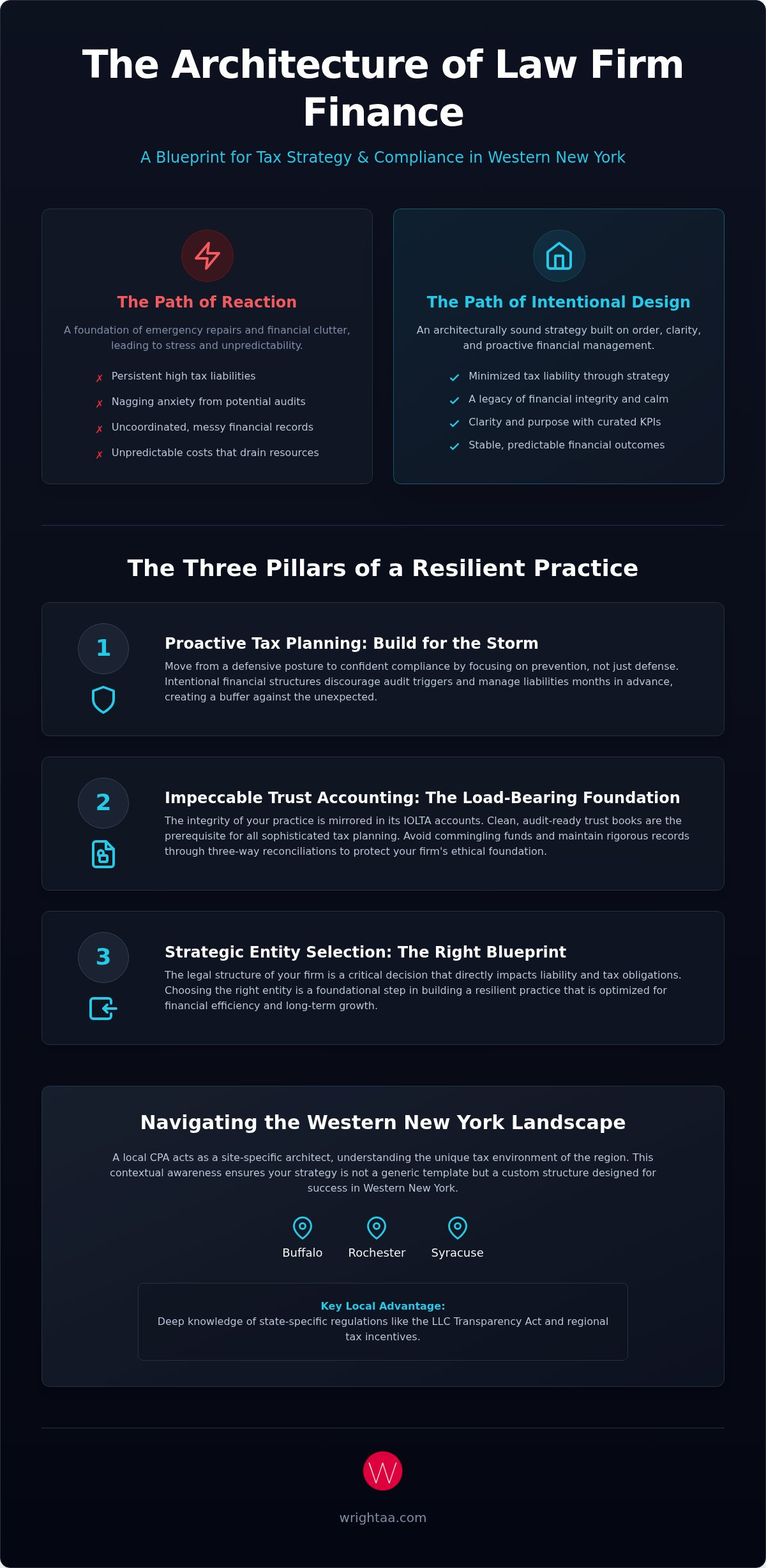
The cost of an audit often far exceeds the financial penalty involved. It drains the firm’s most precious resource: time. While litigation focuses on defense, strategic business tax planning in Buffalo, NY focuses on prevention. It is the difference between repairing a collapsed roof and building one that withstands the storm. Intentional financial structures, such as proper entity selection and clean ledger maintenance, naturally discourage the triggers that alert the IRS or New York State authorities.
There is a profound serenity in knowing your liabilities are managed months in advance. You don't have to guess. You don't have to scramble. By establishing a rhythm of monthly oversight, you create a buffer against the unexpected. This discipline transforms your relationship with the state, moving from a defensive posture to one of confident compliance.
The Local Landscape: Buffalo, Rochester, and Syracuse
Western New York presents a specific set of environmental conditions for legal practices. Navigating the regional nuances of the New York tax environment requires a deep contextual awareness. Local incentives and state-specific regulations like the LLC Transparency Act demand a level of precision that national firms often overlook. In the legal profession, understanding Tax Avoidance Explained as a legitimate, strategic exercise is fundamental to ethical wealth preservation.
A local CPA acts as a site-specific architect. We understand how the light hits the Buffalo market and how the state's decoupling from federal provisions affects your specific practice area. This proximity allows for deeper listening and more accurate interventions. It ensures that your tax strategy is not a generic template, but a custom structure designed for the unique geographic and cultural context of your firm.
The Three Pillars of Trust Accounting and Structural Integrity
The integrity of a legal practice is mirrored in the precision of its trust accounts. If your financial ecosystem is a building, the IOLTA (Interest on Lawyer Account) is the load-bearing foundation. When this foundation is compromised, the entire structure is at risk. For those focused on law firm tax planning Buffalo NY, trust accounting is not merely a box to check for the state bar. It is the primary ethical filter through which all other financial decisions must pass. A firm that maintains impeccable trust records is a firm built for longevity.
Fiduciary duty and partner wealth are inextricably linked. Messy books create friction that slows growth and invites unwanted scrutiny. By treating your trust accounts as a strategic asset, you ensure that the firm’s capital remains distinct and protected. This level of discipline requires the steady hand of a specialized CPA for law firms in Buffalo, NY who can translate complex regulations into a serene, manageable workflow.
IOLTA Compliance as a Strategic Asset
Clean trust books are the prerequisite for sophisticated tax planning. You cannot build a visionary tax strategy on a foundation of uncoordinated data. Commingling funds is a common structural flaw that complicates tax filings and creates ethical vulnerabilities. In 2026, the New York State Bar continues to demand rigorous record-keeping and frequent reconciliations to ensure client funds remain untainted. Understanding the boundary between legal strategy and risk is essential, as detailed in the IRS on Tax Avoidance vs. Evasion guidelines.
When your trust books are audit-ready, you operate with a sense of quiet confidence. You are no longer reacting to potential threats; you are moving with purpose. This clarity allows you to focus on high-level strategy rather than administrative repair. Partnering with a team that prioritizes this level of detail can help you refine your firm's financial architecture and secure your professional legacy.
The Three-Way Reconciliation Method
The three-way reconciliation is the ultimate structural inspection for your books. It requires a precise alignment between three distinct data points: the bank statement, the trust ledger, and the individual client balances. If these three numbers do not match exactly, the structure has a leak. This methodical process does more than satisfy regulators; it reveals hidden profit leaks and administrative errors that might otherwise go unnoticed.
Specialized accounting turns this rigorous requirement into a tool for growth. By identifying and resolving discrepancies every month, you prevent small cracks from becoming structural failures. This rhythmic oversight is what separates a reactive practice from a resilient one. It provides the peace of mind necessary to lead your firm with clarity and intent.
Controversy vs. Strategy: Navigating the New York Tax Landscape
In the legal world, many view tax matters through the lens of controversy. This model is reactive. It positions the professional as a defender who enters the scene after a structural failure has occurred. While representation in complex tax matters is necessary when disputes arise, it is fundamentally a process of repair. In contrast, the strategy model is rooted in the philosophy of design. Law firm tax planning Buffalo NY serves as a proactive intervention. It ensures the firm’s financial framework is built to withstand scrutiny before any conflict can take root.
By prioritizing law firm tax planning Buffalo NY, you shift the focus from defending past actions to curating future growth. Wright CPAs, LLC approaches this by designing strategies that mirror your operational goals. We don't just record history; we help you write it. This shift in perspective allows you to view your tax obligations not as a looming threat, but as a manageable element of your firm’s architecture.
Entity Structuring for Modern Law Practices
The choice between an S-Corp and an LLC is more than a legal formality; it's a foundational decision that dictates how capital flows through your practice. In New York, the tax efficiency of your business formation can vary significantly based on the number of partners and the nature of your revenue. Multi-partner firms often face unique pressures from state-specific tax laws that require a more nuanced approach than a standard template. Intentional selection of your entity acts as a core design element. It aligns your tax outcomes with your operational reality and ensures your structure is optimized for your specific goals in Buffalo and beyond.
Maximizing Deductions with Precision
Expenses are the natural elements that move through your financial environment. When managed with precision, these flows don't have to be viewed as losses. Instead, they can be repurposed to strengthen the firm’s interior. Many legal practices overlook firm-specific deductions that are essential for growth. These include investments in specialized legal technology, continuing legal education for associates, and context-specific overhead costs unique to the Western New York business climate. A strategic deduction is a structural tool used to maintain the architectural balance of a firm’s financial environment. By identifying these opportunities early, we help you curate a balance sheet that reflects both your professional values and your financial objectives.
A Methodical Framework for Monthly Compliance and Growth
Transitioning from fragmented spreadsheets to a curated financial system is akin to moving from a chaotic construction site into a finished, light-filled gallery. For many firms, law firm tax planning Buffalo NY is often hindered by the friction of uncoordinated data. When your records are scattered, clarity is impossible. By establishing a methodical framework, you create the spatial openness necessary to observe the true health of your practice. This transition requires more than just new tools; it requires a commitment to a rhythmic oversight that transforms compliance from a burden into a foundational strength.
Central to this framework is the identification of financial KPIs for small business tailored specifically for the legal environment. These metrics act as the sensory inputs of your firm’s architecture. They tell you where the structure is under tension and where there is room for expansion. Without these indicators, growth is a matter of guesswork. With them, it becomes a calculated, intentional intervention. You begin to see the relationship between your overhead and your outcomes with newfound precision.
The Monthly Reconciliation Ritual
A month-end close is not a bureaucratic necessity; it's a ritual of restoration. It ensures that every dollar is in its rightful place before the next cycle begins. This process should follow a precise sequence to maintain the integrity of your books:
- Step 1: Reconcile trust bank accounts against the general ledger to ensure absolute alignment.
- Step 2: Verify individual client ledgers against the trust total to confirm fiduciary accuracy and prevent commingling.
- Step 3: Review the Profit and Loss statement and Balance Sheet to identify immediate tax planning opportunities.
- Step 4: Consult with your CPA to adjust quarterly estimated payments based on real-time performance.
Leveraging Technology for Spatial Openness
In 2026, the choice of legal billing and accounting software is a choice of infrastructure. Modern cloud-based systems allow for deep listening, providing real-time financial awareness that traditional methods cannot match. These tools automate the flow of data, reducing the risk of human error and eliminating the billable leaks that often occur in uncoordinated environments. By integrating modern technology with traditional accounting principles, you create a system that's both efficient and enduring. If you're ready to refine your firm’s internal mechanics, you can partner with Wright CPAs, LLC for specialized law firm accounting.
Designing a Resilient Practice with Wright CPAs, LLC’ Advisory
Wright CPAs, LLC serves as the architect of your firm’s financial future. We don't merely observe your numbers; we help you arrange them into a structure that supports your highest ambitions. Effective law firm tax planning Buffalo NY requires more than a seasonal check-in. It demands a visionary approach that aligns your daily operations with your long-term legacy. By focusing on the intersection of ethical trust accounting and strategic wealth preservation, we provide the clarity needed to lead with intent. This is not a technical exercise; it's a commitment to the permanence and health of your practice.
This visionary guidance is best realized through outsourced CFO services in Buffalo, NY. Unlike traditional accounting which looks backward at what has already transpired, CFO-level advisory looks forward at what is possible. It evaluates the financial landscape and anticipates the shifts in the New York tax environment before they impact your practice. This partnership allows you to move away from the chaos of reactive compliance and into a state of architectural soundness. You gain a partner who understands the specific geographic and cultural context of your firm, providing site-specific solutions for growth.
The Fixed-Fee Advantage
Hourly billing for accounting is as outdated as paper ledgers. It creates a barrier to communication and introduces unnecessary uncertainty into your firm's overhead. We believe that professional advisory should be a stable, predictable element of your practice. Our fixed-fee monthly retainers provide the peace of mind found in recurring advisory costs, allowing you to budget with absolute confidence. This model ensures year-round oversight rather than a once-a-year tax scramble. It fosters a relationship built on deep listening and continuous improvement. When the friction of hourly billing is removed, the focus shifts entirely to the quality and substance of the strategy.
Your Walkthrough Toward Financial Serenity
The process of onboarding with us is a methodical guide to financial clarity. We begin with a thorough inspection of your current financial structures, identifying areas of tension and opportunities for reinforcement. We look at how expenses flow through your firm and where the foundation of your trust accounting can be strengthened. Success is defined as a practice that's both highly profitable and ethically unassailable. We guide you through each step of the transition, ensuring that your books become a curated source of calm rather than a source of anxiety. Wright CPAs, LLC' law firm advisory is a partnership in excellence.
Building a Legacy of Financial Clarity
Law firm tax planning Buffalo NY is the process of aligning your firm's internal mechanics with its highest ambitions. We have explored how a foundation of IOLTA compliance and intentional entity selection creates a practice that is both ethically sound and tax-efficient. By adopting a rhythmic, monthly framework, you replace the anxiety of a potential audit with the serenity of a predictable, well-ordered ledger. This transition allows you to focus on the practice of law while your financial structure remains resilient and secure.
At Wright CPAs, LLC, we provide specialized Buffalo Law Firm Accounting designed to move you beyond simple record-keeping. Our model utilizes fixed-fee monthly advisory retainers to ensure your overhead remains predictable while you gain CFO-level financial clarity. This partnership is not just about the numbers; it is about the purposeful design of your firm's future. You can move away from the chaos of reactive filing and toward a curated financial environment that reflects your professional excellence. Design a more intentional financial future for your law practice with Wright CPAs, LLC. Your firm deserves a structure as disciplined and enduring as the legal work you perform every day.
Frequently Asked Questions
Is three-way reconciliation required for all law firms in New York?
Yes, New York rules require law firms to maintain precise records for their attorney trust accounts. This includes performing regular reconciliations to ensure that bank balances, client ledgers, and the internal general ledger align perfectly. Neglecting this structural requirement can lead to significant ethical vulnerabilities during a state bar inspection.
How often should a law firm review its tax planning strategy?
A law firm should review its strategy at least quarterly to maintain financial health. This rhythmic oversight allows for adjustments as revenue flows change or new state regulations emerge. Waiting until the end of the year to address law firm tax planning Buffalo NY often results in missed opportunities for structural optimization and wealth preservation.
What is the most tax-efficient entity for a law firm in Buffalo?
The most efficient entity depends entirely on the firm’s specific revenue and partner count. Many small to mid-sized practices find that an S-Corp provides significant savings on self-employment taxes. However, an LLC may offer better flexibility for firms with complex partner distributions or specific growth goals in Western New York.
Can a CPA help with IOLTA compliance during a state bar audit?
A specialized CPA provides the essential documentation and historical reconciliations needed to satisfy state bar auditors. While we don't offer audit and attestation services, our law firm accounting ensures your books are audit-ready from the moment of entry. This proactive stance transforms a stressful event into a routine verification of your firm’s integrity.
What are the common tax deductions for law firms in Western New York?
Common deductions include continuing legal education, specialized practice management software, and professional liability insurance. Firms in Buffalo also frequently deduct context-specific overhead such as local bar association dues and regional marketing efforts. Every expense should be viewed as a material used to strengthen the firm’s interior financial health.
How do fixed-fee accounting services benefit law firm partners?
Fixed-fee services eliminate the uncertainty of hourly billing, allowing partners to budget with precision. This model encourages open communication and deep listening, as you never have to worry about a ticking clock when seeking guidance. It fosters a collaborative partnership focused on long-term strategy rather than transactional compliance.
What is the difference between tax preparation and tax planning for lawyers?
Tax preparation is a backward-looking exercise in compliance, while tax planning is a forward-looking design process. Preparation records what has already happened; planning anticipates what is to come. For those focused on law firm tax planning Buffalo NY, the goal is to arrange capital intentionally to minimize future liabilities.
Do I need a local Buffalo CPA if my firm also has a Rochester office?
Contextual awareness of the New York tax environment is critical regardless of whether your office is in Buffalo or Rochester. A local CPA understands the regional nuances and state-specific decoupling from federal provisions. This proximity ensures your financial architecture is built to withstand the specific pressures of the Western New York business landscape.


