

A bank balance alone can’t show whether every client’s trust funds are accounted for. Three-way reconciliation compares the bank statement, the trust account balance in the books, and the total of individual client ledgers on the same date. Law firms commonly complete this process monthly, including firms looking for IOLTA reconciliation services in Rochester.
It’s understandable to focus first on whether the account statement balances. The deeper check is whether the firm’s books and each client’s ledger agree, with every difference traced and resolved.
This article explains what the three balances represent and how to reconcile them step by step. It also covers the monthly review routine, supporting records, and when bookkeeping support may help a law firm. The goal is a clear, repeatable process that keeps client funds distinct and makes discrepancies easier to investigate.
Key Takeaways
- Understand why trust funds require careful, client-by-client records, and how New York’s rules shape that responsibility.
- Learn how to compare the bank balance, the book balance, and the combined client-ledger balances.
- Build a consistent review rhythm and know why monthly reconciliation can make discrepancies easier to investigate.
- Recognize when bookkeeping support may help your firm maintain clear records and a repeatable reconciliation process.
Why is trust account bookkeeping different?
Trust account bookkeeping tracks money the firm holds for clients, not firm revenue. Separate records make each balance traceable and help prevent commingling.
-
Review IOLTA and Attorney Trust Account Basics
Identify each iolta account and the client funds it holds. IOLTA means Interest on Lawyer Trust Accounts; in New York, the program is called IOLA. Unearned retainers remain client funds until earned, while interest goes to the state program. ABA Model Rule 1.15 provides a framework for safeguarding client property, keeping complete records, and separating client funds from firm funds.
-
Compare Bank Statements With Accounting Books
Match the statement period and account name to the books, then trace deposits, checks, transfers, fees, and interest. The New York State Senate says banks must send IOLA account holders statements showing the account name, service charges or fees deducted, and interest remitted. If your firm uses LawPay for trust payments, compare its transaction history with posted book entries and bank activity. Investigate differences instead of forcing the records to balance.
- Apply New York’s recordkeeping requirements to each transaction. New York Judiciary Law Section 497 and Rule 1.15 require contemporaneous records of trust deposits and disbursements, with each transaction assigned to a specific client. Record the matter, date, amount, and transaction purpose so the entry can be traced from source document to ledger.
- Keep the trust account ledger separate from operating records. Assign each receipt and payment to the correct client matter, and avoid using one client’s balance to cover another’s disbursement. Clear, client-by-client records can reveal a shortage that an account-level total might conceal.
- Retain trust account records for seven years after a matter closes. Keep statements, transaction support, and client ledgers together so the account’s history remains clear. A consistent filing method makes it easier to locate entries and explain how client funds moved through the account.
How do you reconcile an IOLTA account step by step?
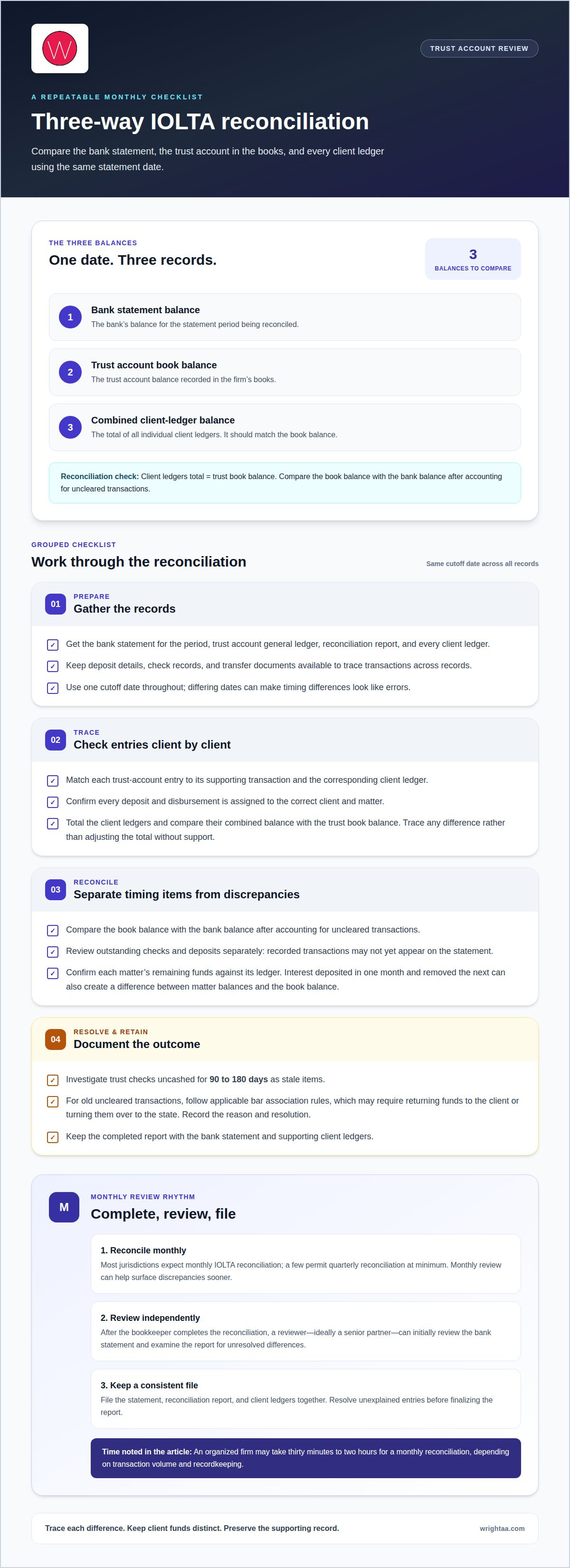
Use records from the same statement date and compare three balances: the bank statement, the trust balance in the books, and the combined total of all individual client ledgers. The bank statement, reconciliation report, and client ledgers are core records for the review.
-
Gather Reconciliation Documents and Bank Statements
Start with the statement for the period being reconciled, the trust account’s general ledger, the reconciliation report, and every client ledger. Add deposit details, check records, and transfer documents to trace transactions that appear in one record but not another. Use the same cutoff date across all records; otherwise, timing differences can look like errors.
-
Review Trust and Client Ledgers
Compare each trust-account entry with its supporting transaction and the corresponding client ledger. Confirm that deposits and disbursements are assigned to the correct client and matter. Then total the client ledgers. Their combined balance should match the trust account’s book balance. If it doesn’t, trace the entries instead of adjusting the total without support.
-
Confirm Client and Matter Trust Balances
Check that the trust account’s book balance matches the bank balance after accounting for uncleared transactions. Review outstanding checks and deposits separately, because a recorded transaction may not yet appear on the statement. Confirm each matter’s remaining funds against its ledger. Interest deposited in one month and removed the next can also create a difference between matter balances and the book balance.
-
Manage Client Trust Ledgers
Investigate trust checks uncashed for 90 to 180 days as stale items. For old uncleared transactions, follow the applicable bar association’s rules, which may require returning funds to the client or turning them over to the state. Keep the reason and resolution in the records. Clear separation between operating cash and trust funds also supports cash flow management.
Monthly or quarterly reconciliation frequency
Set a recurring monthly review. Most jurisdictions expect monthly IOLTA reconciliation; a few permit quarterly reconciliation at minimum, while monthly reviews can help surface discrepancies sooner.
-
Complete the Monthly Three-Way Reconciliation
Reconcile each trust account monthly and prepare a report for that statement period. Compare the bank statement, trust balance in the books, and combined client-ledger balances using the same cutoff date. Record outstanding checks and deposits as timing items, then investigate any remaining difference. Keep the report with the bank statement and supporting client ledgers.
-
Follow the Monthly Reconciliation Workflow
Begin when the monthly bank statement is available. Match posted transactions to the books, then identify checks and deposits that haven’t cleared. Resolve unexplained entries before finalizing the reconciliation report. An organized firm may take thirty minutes to two hours to complete a monthly reconciliation, depending on transaction volume and recordkeeping.
- Assign a reviewer after the bookkeeper completes the reconciliation. Ideally, a senior partner should open and initially review the IOLTA bank statement, then examine the completed report for unresolved differences. This second review can help catch errors early, particularly when an entry appears in the books but not on the statement.
- Keep the completed monthly report and its supporting records together. Use a consistent filing sequence, such as statement, reconciliation report, then client ledgers. Review the report monthly rather than waiting for a quarterly cycle; a shorter interval makes it easier to trace transactions while source records are readily available.
Law firm IOLTA reconciliation services
Outsourcing provides professional support for reconciliation work, while accounting software helps record and compare transactions. Rochester firms considering IOLTA reconciliation services can weigh workflow fit, attorney oversight, records access, and their capacity to review exceptions.
-
Review IOLTA Reconciliation Service Options
Map the work your law firm needs before considering outside support. A service may handle bookkeeping tasks, while attorneys retain responsibility for client funds and ledger oversight. Ask how deposits, earned fees, and unearned retainers appear in the workflow, and how errors are flagged for review. Firms with more than 10 active client matters holding trust balances may consider outsourcing.
-
Verify Provider Experience and Security
Review a sample reconciliation report and ask how transactions are traced from bank activity to client matters. Assess how access to statements and client records is granted, limited, and removed, and how files are transferred and retained. Define who reviews exceptions and approves corrections. When considering IOLTA reconciliation services in Rochester, these process details help firms assess practical experience and information handling.
- Compare the proposed workflow with your current accounting software. Software can organize entries and display balances, but it can’t independently investigate an unexplained difference or resolve a ledger discrepancy. An outsourced professional can perform agreed bookkeeping tasks, but the firm still needs clear review and approval steps. Choose an arrangement suited to transaction volume, staff capacity, and oversight needs.
- Set written boundaries before sharing trust records. Specify which accounts and matters are included, what supporting documents the provider receives, and how unresolved items reach the responsible attorney. Keep client-by-client balances visible, and track firm funds placed in trust within a firm matter. A defined process reduces ambiguity without transferring the lawyer’s responsibility for client ledgers.
- Use a review conversation to test whether the process fits. Ask the provider to walk through an example involving an uncleared check, a client deposit, and a ledger entry, then explain how each would be documented. If your firm needs broader financial oversight alongside routine bookkeeping, discuss your law firm’s accounting needs and reconciliation workflow.
Wright CPAs: Tax Planning and Preparation
Wright CPAs supports law firms with bookkeeping and broader financial guidance alongside their trust-account procedures. Its Law Firm Accounting and Bookkeeping services help organize financial records, while CFO Services provide a wider view of cash flow and business decisions. Tax Planning and Preparation can also connect accounting records with the firm’s tax needs.
Consider this support when bookkeeping demands are taking attention away from practice operations or financial records need a more consistent structure. The firm’s attorneys remain responsible for overseeing client funds and trust ledgers. To discuss aligning your firm’s accounting with its financial needs, contact Wright CPAs.
Build a steadier financial workflow
A reliable trust-account process takes more than a completed reconciliation. It also requires clear ownership, consistent records, and a routine that fits the firm’s broader financial operations. If your firm is considering IOLTA reconciliation services in Rochester, identify where bookkeeping support could make that routine more manageable without replacing attorney oversight.
Wright CPAs offers Bookkeeping, Law Firm Accounting, Tax Planning and Preparation, and Payroll Services. These services support a firm’s financial recordkeeping and related business needs. A conversation can help clarify which areas deserve attention and how accounting support can fit alongside existing trust-account procedures.
Contact Wright CPAs to discuss your firm’s bookkeeping needs. A more deliberate financial workflow can give your team a clearer foundation for its next decision.
Frequently Asked Questions
What is three-way reconciliation?
Three-way reconciliation checks whether the bank record, trust account books, and combined client matter balances agree on the same date. For example, a check recorded in a client ledger but not yet cleared by the bank may explain a timing difference. The reconciliation separates that temporary gap from an unexplained discrepancy that needs investigation.
What happens if the three balances don't match?
Pause before treating the account as reconciled. Trace differences through deposits, checks, transfers, interest entries, and individual client ledgers. Look for duplicate postings, omitted transactions, or timing differences, and document the cause and correction with supporting records. If client funds appear short or incorrectly assigned, bring the issue promptly to the responsible attorney for review and resolution.
What are the most common IOLTA compliance mistakes?
Common errors include commingling firm and client funds, failing to assign transactions to the correct client, and allowing incomplete records to accumulate. Other risks include overlooking bank charges, failing to review outstanding checks, or reconciling the account without checking individual matter balances. A consistent transaction trail and documented review help a firm spot these problems before they become harder to trace.
What does IOLTA stand for?
IOLTA stands for “Interest on Lawyer Trust Accounts.” The term describes trust accounts that hold qualifying client funds, with interest directed through the applicable state program rather than treated as firm income. In New York, the program is called IOLA. Knowing the local name helps Rochester firms recognize relevant account and program references in banking and accounting records.
Which Rochester firms specialize in law firm trust account and IOLTA reconciliation?
Wright CPAs provides Law Firm Accounting and Bookkeeping for firms seeking accounting support in Rochester and across Buffalo and Syracuse. These services relate to a law firm’s financial recordkeeping, but a firm should distinguish broader accounting support from a specifically defined reconciliation engagement. Attorneys remain responsible for oversight of client funds and the accuracy of client matter records.
What does a typical IOLTA reconciliation service include?
A typical process brings together the bank statement, trust account books, and client matter ledgers, then compares their balances for the same date. It may also identify outstanding checks or deposits, trace unexplained entries, and prepare a reconciliation report with supporting records. The firm should maintain a clear review process so responsible attorneys can understand unresolved items and approve corrections.


