

If your financial statements were a blueprint for a physical structure, would you trust the foundation to support your growth through 2026? For many leaders in Buffalo and Rochester, the process of small business financial reporting feels more like data clutter than a clear path forward. It's common to feel the weight of unpredictable cash flow or the quiet anxiety of not knowing if your profit matches the reality of your bank account. You deserve a sense of order that transcends simple compliance.
We believe that financial reporting should be an intentional act of design. In this guide, you'll discover how to transform raw numbers into a sophisticated strategy for long-term health and mental serenity. We will examine the impact of the One Big Beautiful Bill Act, including the permanent 20 percent QBI deduction and the restored 100 percent bonus depreciation. You'll learn to move past data overload toward a reporting framework that offers high-level guidance and the confidence to make major investments with ease. This is how you build a business that is both resilient and restorative.
Key Takeaways
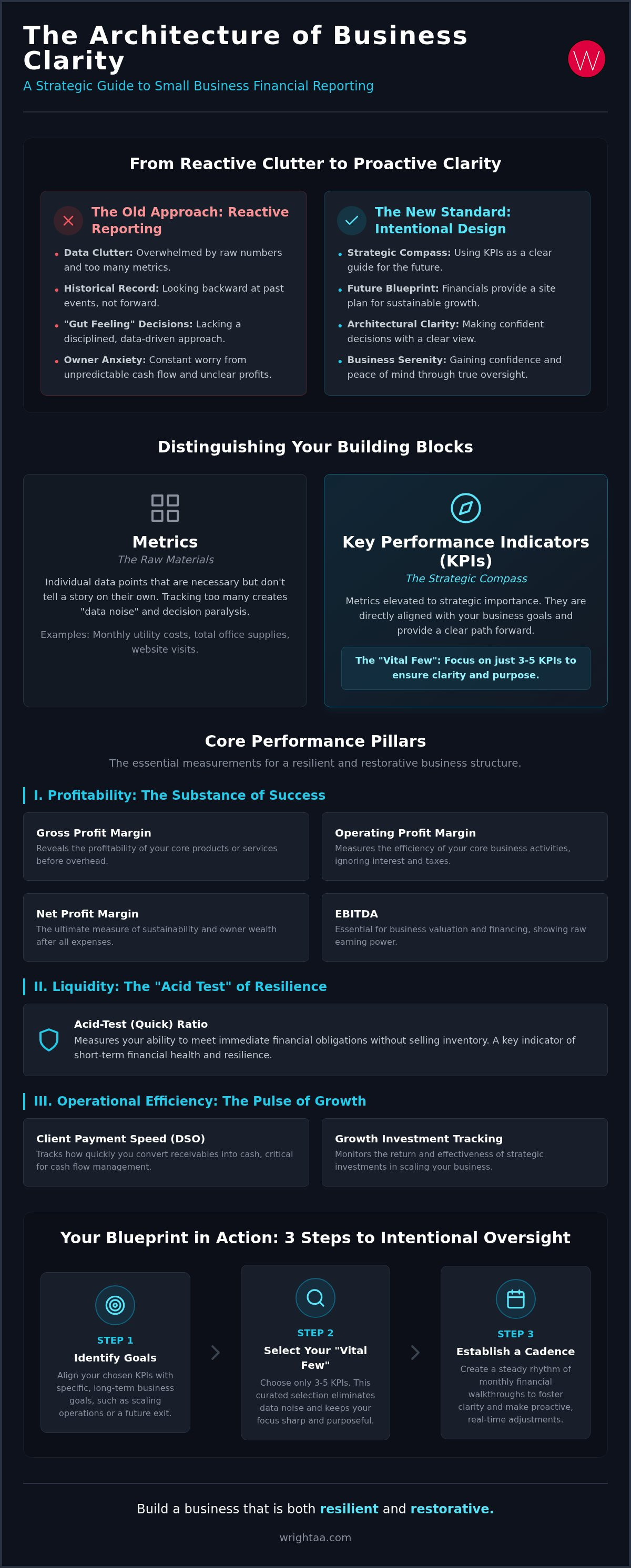
- Learn to distinguish between basic bookkeeping metrics and intentional KPIs that serve as a strategic compass for your firm.
- Understand how gross and net profit margins measure the true substance of your success and long-term sustainability.
- Master the "acid test" of liquidity to ensure your business maintains immediate financial resilience in the Syracuse and Rochester markets.
- Discover how small business financial reporting can be structured to track operational efficiency, from client payment speed to growth investments.
- Identify your "Vital Few" metrics to create a steady cadence of monthly financial walkthroughs that foster clarity and purpose.
Understanding Financial Reporting: The Architecture of Business Clarity
Financial reporting is often viewed as a historical record. It is a collection of past events. However, for the discerning owner, small business financial reporting functions more like a site plan for a future structure. It provides the necessary boundaries and elevations required to build something that lasts. In the Western New York market of 2026, relying on a "gut feeling" is no longer a sustainable method for growth. The economy requires a more disciplined approach to data. When you move beyond the static nature of basic compliance, you begin to see your business through the lens of architectural clarity. This shift reduces the silent weight of owner anxiety. It replaces confusion with a sense of purpose. It allows the owner to step back and observe the business as a whole rather than getting lost in the debris of daily operations.
Metrics vs. KPIs: A Design Perspective
There is a fundamental difference between a raw metric and a Key Performance Indicator. A metric is a measurement of a single element, such as your monthly utility cost or total office supplies. These are the raw materials of your financial statements. They are necessary, but they do not tell a story on their own. A KPI is different. It is a measurement that has been elevated to a position of strategic importance. It acts as a compass rather than a simple yardstick.
If your bookkeeping provides the foundation, your KPIs provide the structural integrity. Tracking too many metrics creates data noise. It leads to a specific type of decision paralysis where the abundance of information obscures the path forward. To maintain clarity, you must select 3-5 indicators that align with your specific 2026 goals. Whether you are focused on a future exit or scaling your operations in Buffalo, your reporting must reflect that intent. This curated selection ensures that every piece of data serves a specific function. It removes the clutter that often accompanies digital accounting tools and restores focus to what truly matters.
The Role of Intentionality in Financial Oversight
Proactive financial design requires a shift in perspective. Most businesses operate in a reactive state. They look at their numbers only when a problem arises or when tax season nears. This is defensive. True oversight is offensive. It uses data as an early warning system. For a startup in the Syracuse or Rochester area, these indicators act as sensors within a building. They detect shifts in the environment before the damage becomes structural. They allow for adjustments in real time rather than after a fiscal quarter has ended.
This level of intentionality creates a profound psychological benefit. When you understand the relationship between your profit and your cash, the unpredictability of the market feels less threatening. You aren't just surviving the fluctuations of the 2026 economy. You are navigating them with a steady hand. This is the essence of small business financial reporting. It is the transition from raw bookkeeping to a state of long-term business serenity. It allows you to focus on your craft while the numbers provide the quiet assurance of health. You move from a place of constant reaction to one of deliberate creation.
Profitability Metrics: Measuring the Substance of Your Success
Profit is the silent measure of a business's health. In the context of small business financial reporting, profitability metrics reveal the internal efficiency of your operations. They show whether your growth is built on a solid foundation or if you're merely scaling a fragile structure. By examining these numbers with intentionality, you move beyond the surface level of revenue to understand the true substance of your success.
Operating Profit Margin isolates the efficiency of your core business activities. It ignores the complexities of interest and taxes to focus on the daily pulse of your work. For those looking toward the future, EBITDA becomes a primary focus. This metric is essential for business valuation and securing financing within the Buffalo market. By stripping away non-cash expenses and capital structure, you gain a clear view of the business's raw earning power. It's a vital tool for owners who plan to eventually transition their legacy to a new steward.
Analyzing the Bottom Line
Net Profit Margin is the ultimate measure of business sustainability and owner wealth. For service-based firms in Rochester, calculating this involves a rigorous audit of overhead and fixed costs. You must identify "profit leaks" that quietly erode your foundation, such as underutilized software or inefficient administrative processes. It's necessary to analyze and report your financial results with precision to ensure your margins align with New York professional standards. This level of clarity allows you to make adjustments before they impact your long-term security. If you find your margins are drifting from your goals, our CFO services can help restore balance to your financial design.
The Nuance of Gross Margin in Service Industries
In service industries, the "materials" of your business are time and expertise. Law firms and consultants must track direct labor costs against revenue to maintain structural integrity. Gross Profit Margin is the relationship between revenue and the direct cost of delivery. When margin fluctuations occur in the WNY market, they often signal a need for pricing adjustments or a change in how you deploy your team. Monitoring these shifts through consistent small business financial reporting ensures that your pricing remains grounded in the reality of your direct costs. This intentionality prevents the common mistake of scaling a business model that is fundamentally flawed at its core.
Liquidity and Cash Flow: The Vitality of the Small Business
Liquidity is the physical manifestation of business health. While profit is often an abstract concept of success, cash is the material reality of survival. In the discipline of small business financial reporting, we use specific ratios to measure this vitality. These indicators function like sensors in a building, monitoring the flow of resources to ensure the structure remains habitable and functional. Without a clear understanding of liquidity, even the most profitable firm in Western New York can find itself in a state of sudden, avoidable crisis.
Operating Cash Flow tracks the actual movement of money rather than paper profit. It reveals the truth of your daily operations. For Buffalo startups and rapidly growing firms, the Burn Rate is an essential metric. It measures the velocity of cash consumption. This number tells you exactly how much time remains to refine your business design before the structure requires a new infusion of capital. Adhering to a standardized Financial Reporting Framework for Small- and Medium-Sized Entities helps ensure these measurements remain accurate and consistent over time.
Liquidity Ratios Compared
The Current Ratio offers a broad view of your ability to meet short-term obligations. A ratio of 2.0 suggests a robust, serene safety net. It means you have twice the assets needed to cover your immediate debts. A ratio of 1.0 indicates a structure under tension, where there is no room for error. The Quick Ratio, often called the "acid test," provides a more rigorous evaluation by excluding inventory or other less liquid assets. It tests your immediate resilience in the Syracuse market, where seasonal shifts or economic fluctuations can impact client behavior without warning.
Mastering the Cash Flow Cycle
There is a quiet danger in the confusion between being "profitable" and having "cash in the bank." A business can show substantial profit on an income statement while its bank account remains empty due to uncollected invoices. This gap between service delivery and client payment is the primary source of owner anxiety. Effective small business accounting Buffalo NY ensures operational continuity by bridging this gap. By tracking the timing of your inflows and outflows, you create a steady rhythm of financial health. This intentional oversight allows you to focus on the craft of your business while the small business financial reporting provides the quiet assurance that your obligations are met.
Operational Efficiency: Tracking the Pulse of Growth
Efficiency is the rhythm of a well-designed practice. It is the measure of how effectively your resources are converted into value. In small business financial reporting, operational efficiency metrics act as a diagnostic tool for your internal systems. They reveal whether your growth is fueled by true productivity or simply by an increase in volume that masks underlying waste. By tracking these indicators, you ensure that every expansion is a deliberate improvement rather than an accidental burden.
Accounts Receivable (AR) Turnover measures the velocity of your expertise. It asks how quickly your clients honor the value you've delivered. A slow turnover suggests a friction in your billing architecture. Designing systems that encourage prompt payment is not merely a clerical task. It's an intentional intervention that protects the health of your firm. Similarly, Revenue per Employee provides a sophisticated look at team capacity. It helps you understand if your current team is performing at an optimal level or if the structure is beginning to strain under its own weight. This data point is essential for maintaining the quiet authority of a firm that values quality over sheer quantity.
Specialized KPIs for Law Firms and Professional Services
For firms in the legal sector, efficiency requires a more granular focus. Utilization Rate tracks the balance between billable and non-billable hours for partners and associates. This ratio defines the actual productivity of your primary asset: time. However, utilization alone is insufficient. You must also monitor the Realization Rate, which is the difference between what is recorded as billable and what is actually collected from the client. Engaging a specialized CPA for law firms Buffalo NY helps optimize these metrics by aligning your internal workflows with your financial goals. This alignment ensures that your practice remains both profitable and purposeful.
Measuring Growth Efficiency
Growth must be sustainable to be meaningful. Customer Acquisition Cost (CAC) measures the investment required to secure new business in the Buffalo and Rochester markets. When compared to the Lifetime Value (LTV) of a client, this creates the LTV to CAC ratio. This relationship determines if your marketing efforts are building a permanent asset or if they're a temporary expense that lacks long-term return. Using these efficiency KPIs allows you to justify hiring your next team member with total confidence. You're no longer guessing when to scale. You're following the blueprint provided by your data. To begin designing your firm's growth strategy with precision, consider our CFO services for expert guidance.
Implementing a KPI Strategy: From Data to Intentional Action
Implementation is the final phase of financial design. It is the moment where philosophical concepts are translated into physical action. To begin this journey, you must select your "Vital Few." Tracking every available metric creates a cluttered landscape that obscures the path forward. By focusing on 3-5 specific indicators, you ensure that your small business financial reporting remains a tool for clarity. This curated selection acts as a strategic compass, guiding your decisions with quiet authority.
The cadence of your review defines the rhythm of your oversight. While quarterly walkthroughs offer a broad perspective, a monthly review provides the steady pulse needed for a healthy practice. It allows you to detect subtle shifts in your financial foundation before they require structural intervention. In the 2026 economy, this frequency is essential for maintaining a sense of order and purpose. It transforms raw data into a living narrative of your business's health.
Building Your Financial Dashboard
Modern technology serves as the construction technique for your financial visibility. Automation tools allow for the seamless extraction of data, removing the friction of manual bookkeeping. The goal is to create a "serenity dashboard." This is a visual space that emphasizes substance over noise. It provides a clear window into your liquidity and profitability without the distraction of irrelevant data points. Transitioning to outsourced CFO services Buffalo NY provides the consistent oversight required to keep this dashboard accurate and meaningful.
The Wright Approach: CFO-Level Guidance in Buffalo
At Wright CPAs, LLC, we view the financial health of your business as a permanent, thoughtful intervention. We don't just provide data. We design custom KPI frameworks that respect the specific geographic and cultural context of Western New York businesses. Our approach moves beyond simple number crunching. We offer strategic tax and business consulting that serves as a philosophical guide for your daily life. This level of intentionality ensures that your business supports your humanity rather than consuming it.
A Fractional CFO brings a refined perspective to your raw data. They interpret the relationships between your metrics to help you build a more resilient structure. This partnership allows you to focus on your professional craft while we maintain the integrity of your financial systems. It's about more than just growth. It's about achieving a state of long-term business serenity. Elevate your financial strategy with Wright CPAs, LLC today.
Designing Your Financial Future
Financial clarity is not a static destination. It's a continuous process of stewardship and intentional design. By moving beyond the clutter of raw data, you create a reporting framework that supports both your growth and your mental serenity. We've explored how the right KPIs serve as a strategic compass for your firm. You now understand the essential relationship between liquidity, profitability, and operational efficiency. Effective small business financial reporting ensures that your business remains a resilient structure in the 2026 economy.
At Wright CPAs, LLC, we provide specialized CFO-level financial guidance tailored for law firms and business owners. Our fixed-fee monthly accounting retainers ensure predictable costs and consistent oversight throughout the year. We prioritize substance over spectacle; we help you build a foundation that lasts. Discover how Wright CPAs, LLC brings financial clarity to your business. With the right blueprint in place, your business can flourish with confidence and purpose.
Frequently Asked Questions
What are the most important financial KPIs for a small business in 2026?
The most critical KPIs focus on net profit margin, the quick ratio, and accounts receivable turnover. These three indicators provide a comprehensive view of your firm's sustainability and immediate resilience. In the context of small business financial reporting, they act as the primary sensors for your business's health. They allow you to monitor the balance between your long-term growth and your daily operational vitality.
How often should a business owner review their financial reporting?
You should review your financial reports on a monthly basis. This cadence ensures that you remain connected to the pulse of your operations without becoming overwhelmed by daily fluctuations. A monthly walkthrough allows for intentional adjustments to your strategy before small variances become structural issues. It creates a steady rhythm of oversight that fosters a sense of order and professional calm.
What is the difference between a financial metric and a KPI?
A financial metric is a raw measurement of any business activity, while a KPI is a curated indicator of strategic success. Metrics provide the vast data pool from which you extract your "Vital Few" KPIs. Think of metrics as individual building materials and KPIs as the architectural plan that gives them purpose. KPIs are the specific numbers that directly influence your ability to achieve your 2026 goals.
How do I calculate my business’s burn rate?
To calculate your burn rate, divide your total cash reserves by your monthly net cash outflow. This number reveals how many months of operation your current capital can support. It's a vital measurement for Buffalo startups that are investing heavily in growth before reaching full sustainability. Knowing this number provides the clarity needed to make major decisions about hiring or expansion without unnecessary anxiety.
Why is my business profitable but I have no cash in the bank?
This discrepancy usually occurs because of the gap between service delivery and actual cash collection. Profit is recorded when a service is provided, but cash only enters the bank when an invoice is settled. High accounts receivable or heavy upfront investments can leave a profitable business with a temporary lack of liquidity. Monitoring your cash flow cycle helps you bridge this gap and maintain operational continuity.
What is a good net profit margin for a service-based business?
A healthy net profit margin for a professional service firm typically ranges between 10 and 20 percent. While some lean practices may achieve higher margins, this range suggests a stable balance between reinvestment and owner wealth. Your specific target should reflect your long-term goals for growth and the specific economic context of the Rochester and Buffalo markets. It's the ultimate measure of your business's enduring substance.
Can my bookkeeper help me track these KPIs, or do I need a CFO?
While a bookkeeper is essential for recording accurate data, a CFO is required to translate that data into a sophisticated strategy. Bookkeepers focus on the historical accuracy of your records. A CFO provides the high-level guidance needed to design a proactive path forward based on your small business financial reporting. This partnership ensures that your numbers aren't just recorded but are used to build a better future.
How does a law firm’s KPI tracking differ from other small businesses?
Law firms must prioritize utilization and realization rates to track the efficiency of their primary asset: billable time. These metrics measure how much time is spent on client work and how much of that work is successfully converted into collected revenue. This specialized focus ensures the legal practice remains productive and sustainable. It's a more granular approach to efficiency that reflects the unique structural requirements of the legal profession.


