

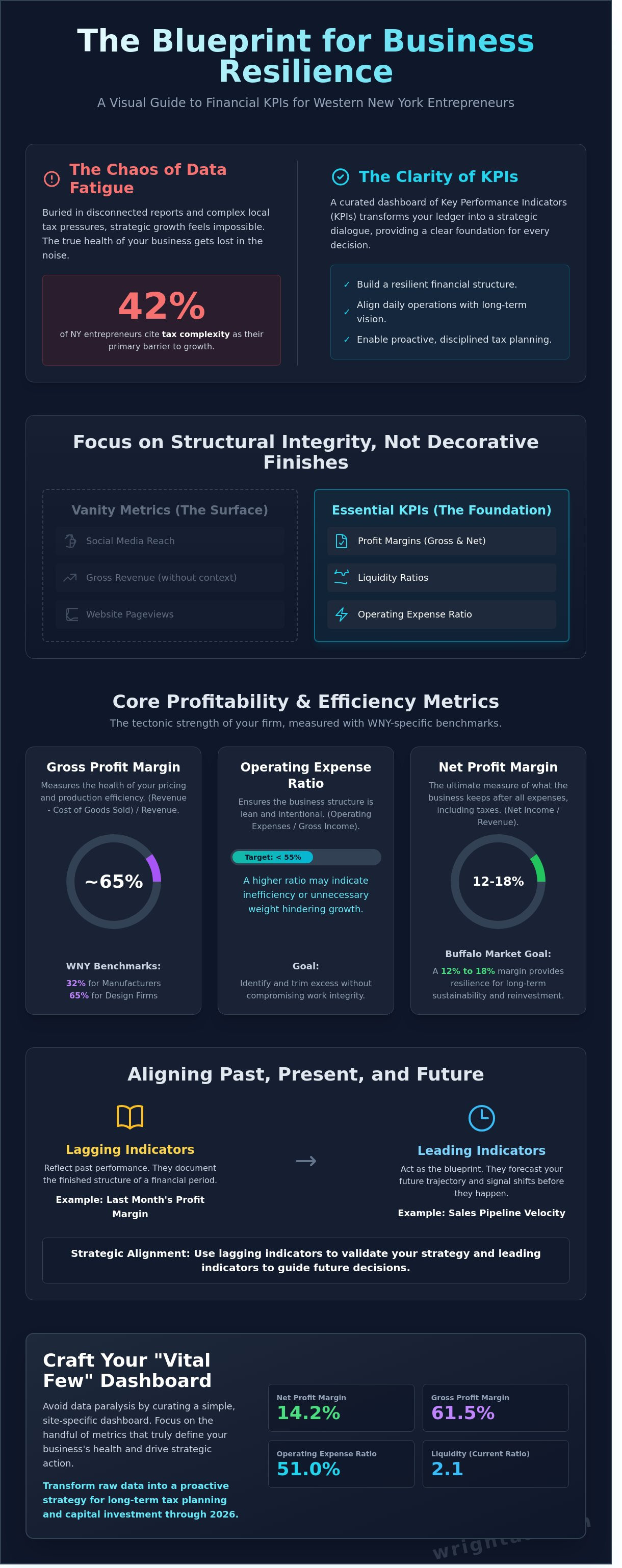
What if the most resilient structure you build this year isn't a physical office in Buffalo, but a transparent framework for your capital? In a state where 42% of entrepreneurs cite tax complexity as their primary barrier to growth, the difference between a thriving enterprise and a stagnant one often comes down to the clarity of your data. Establishing specific financial kpis for small business acts as the site-specific foundation for every decision you make. It transforms a chaotic ledger into a curated dialogue between your daily craft and your long-term vision.
You likely feel the weight of data fatigue, especially when trying to reconcile the unique local tax pressures of Western New York with your actual bank balance. It's difficult to find the spatial breathing room required for strategy when you're buried in disconnected reports. This guide will clarify the essential metrics that define true business health, allowing you to align your daily operations with disciplined tax planning. We'll explore a vital signs dashboard designed to ensure your solvency remains as permanent as the architecture of our historic Western New York cities.
Key Takeaways
- Define the structural integrity of your organization by distinguishing between surface-level vanity metrics and the essential indicators of enduring business health.
- Master the foundation of financial kpis for small business by analyzing gross profit margins and maintaining a lean, intentional operating structure.
- Navigate the tectonic shifts of the Western New York seasonal economy by assessing liquidity and your ability to meet short-term obligations in Buffalo, Rochester, and Syracuse.
- Curate a dashboard of the "Vital Few" metrics to gain clarity and avoid data paralysis, ensuring your financial reporting is site-specific to your industry’s unique vernacular.
- Transform raw data into a proactive strategy by aligning your financial performance with long-term tax planning and capital investment timing through 2026.
The Philosophy of Financial Clarity: Why KPIs Matter for Buffalo Businesses
A business is a structure. Just as a building relies on the silent strength of its foundation, a company finds its stability in the clarity of its data. For Western New York entrepreneurs, financial kpis for small business are the vital signs of structural integrity. They're the metrics that distinguish a lasting institution from a fleeting venture. In 2026, the sheer volume of digital noise often obscures the truth; however, intentional tracking restores focus to what truly matters.
Many owners focus on vanity metrics like social media reach or gross revenue; these are often just decorative finishes. True indicators represent the load-bearing elements of your operation. By filtering out the superficial, you create spatial breathing room for intentional growth. This disciplined approach reduces the friction of daily management. It allows you to focus on the craft of your trade rather than the chaos of unorganized spreadsheets.
Defining the KPI: Beyond Simple Accounting
A financial performance indicator is a quantifiable measure of strategic success that anchors your vision in reality. While lagging indicators like last month's profit margin document the past, leading indicators such as sales pipeline velocity forecast your future trajectory. These metrics facilitate a constant dialogue between your bank account and your long-term goals. They ensure every dollar serves a purpose within the larger design of your enterprise.
- Lagging Indicators: These reflect the finished structure of your financial period.
- Leading Indicators: These act as the blueprint, signaling shifts before they manifest in the ledger.
- Strategic Alignment: Every tracked number should relate directly to a specific business objective.
The Local Context: Buffalo’s Economic Materiality
Generic national benchmarks rarely translate to the specific materiality of the Buffalo market. Our region faces unique economic conditions, including New York State’s 2025 labor law updates and local property tax structures that differ significantly from national averages. A 15% net margin might be the standard in a generic report, but in WNY, success requires a more nuanced, site-specific baseline. Establishing these local markers ensures your business remains resilient against the shifting winds of the Great Lakes economy.
The Foundation: Core Profitability and Efficiency Metrics
Profitability is the tectonic strength of a firm. It isn't just about the volume of capital moving through your accounts, but the precision with which that capital is managed. Tracking financial kpis for small business provides the necessary site map for sustainable growth in a fluctuating market. Without these markers, a leader is building on shifting sand.
Gross Profit Margin represents the first layer of health. It measures the relationship between your revenue and the direct costs of your craft. For a WNY manufacturer, a 32% margin might be the local gold standard, while a Buffalo design firm often seeks 65% to sustain its specialized labor. This metric reveals whether your pricing reflects the true value of your materials and expertise.
The Operating Expense Ratio ensures the business structure remains lean and intentional. If this ratio exceeds 55% of your gross income, the organization may be carrying unnecessary weight that hinders its movement. By analyzing these essential financial KPIs, you identify exactly where efficiency leaks occur. It allows you to trim the excess without compromising the integrity of the work.
Net Profit Margin is the ultimate measure of what the business keeps. It's the quiet residue left after every obligation is met. In the Buffalo market, maintaining a 12% to 18% net margin provides the resilience needed for long-term sustainability. It creates the spatial breathing room required for future innovation and reinvestment.
Gross vs. Net: Understanding the Layers of Profit
The distinction between gross and net profit clarifies where a business loses its momentum. Service firms in Western New York often overlook the "leakage" found in unbillable hours or administrative bloat. A 7% shift in operating efficiency can be the difference between a firm that merely survives and one that thrives. You can refine your trajectory through intentional financial structural design that respects both your craft and your bottom line.
Revenue per Employee: Measuring the Human Element
This metric quantifies efficiency without losing sight of the human experience. To calculate it, divide your annual revenue by your full-time equivalent count. For Buffalo law firms, a benchmark of $215,000 per employee suggests a balanced, productive workload. If the number climbs too high, the quality of the craft may suffer from employee exhaustion. If it stays below $140,000, it's a signal to evaluate your internal systems before adding more seats to the table.
Navigating the Flow: Liquidity KPIs for Western New York’s Seasonal Economy
Cash flow management is the tectonic shift that either supports or compromises the integrity of a small business. In the context of Western New York, liquidity isn't just a balance sheet entry; it's the lifeblood that allows a firm to weather the transition between seasons. Tracking these financial kpis for small business creates a dialogue between current performance and future stability. It ensures that the structural foundation of the company remains sound even when the external environment becomes volatile.
The Current Ratio serves as a site-specific assessment of your ability to meet short-term obligations. In markets like Rochester and Syracuse, maintaining a ratio of 2:1 is a recognized benchmark for stability. However, the Quick Ratio, often called the acid test, offers a more rigorous look at immediate survival. By excluding inventory, it reveals the raw materiality of your liquid assets. For Buffalo firms facing a 25% revenue contraction during peak winter months, monitoring the burn rate is essential. It measures the speed at which capital is consumed, providing a clear timeline for how long the business can sustain operations without new inflows.
The Vital Role of Cash Flow Forecasts
Proactive management requires moving beyond reactive bookkeeping. By tracking the Cash Conversion Cycle, owners identify exactly where capital becomes trapped in the process. Effective strategies for managing seasonal cash flow allow a business to maintain its craft during periods of low activity. Establishing a 90 day liquidity buffer ensures that the firm's vision isn't compromised by temporary market dips.
Accounts Receivable Turnover: The Speed of Trust
This metric measures how quickly Buffalo clients settle their invoices, reflecting the health of your professional relationships. It highlights the delicate balance between payment terms and business liquidity. High turnover suggests a successful integration of sales and collections. To improve this without damaging client trust, consider these steps:
- Aligning billing cycles with project milestones to ensure steady inflows.
- Utilizing digital payment platforms to reduce the friction of physical checks.
- Offering a 2% discount for payments received within 10 days to incentivize promptness.
Consistent monitoring of these financial kpis for small business ensures that the firm remains grounded. It allows the owner to focus on the quality of their work rather than the uncertainty of their bank balance.
Crafting Your Dashboard: How to Select and Monitor KPIs
A dashboard is the structural framework of your financial clarity. Just as a building requires a foundation to support its weight, your business needs a curated selection of financial kpis for small business to support its growth. Data paralysis occurs when owners track everything and understand nothing. Research shows that 72% of business owners feel overwhelmed by the volume of data available to them. To avoid this, focus on the "Vital Few." Select five to seven metrics that speak directly to your current phase of operation.
Monitoring these metrics requires a rhythmic review process. Monthly reviews allow you to adjust for immediate fluctuations in the Buffalo market; quarterly reviews offer the spatial perspective needed for long-term strategy. Integration of modern accounting software automates the materiality of your reporting. It transforms raw numbers into a legible dialogue between your past performance and future potential. This automation ensures your data remains site-specific and relevant to the unique economic climate of Western New York.
Industry-Specific Metrics for WNY Professionals
Precision in measurement depends on your specific craft. For law firms in New York, the focus rests on utilization and realization rates. A 2023 industry report indicates that the average utilization rate for law firms sits near 32%. Improving this by even 4% significantly alters your firm's tectonic strength. Retailers and restaurants in the Elmwood Village or Canalside must prioritize inventory turnover and prime cost. Successful Buffalo restaurateurs often target a prime cost of 55% to maintain resilience against fluctuating seasonal costs. Construction firms require deep integration of job costing and over/under billing metrics to ensure cash flow remains steady throughout the harsh winter months.
Setting Intentional Targets
Establishing goals is an exercise in honesty. Your targets must be site-specific to your Buffalo business, reflecting your local overhead and labor market. It's a common error to compare a Year 1 startup's 5% margin to a Year 10 firm's 22% margin. This comparison ignores the evolution of a business's internal structure. As your firm transitions from a nascent startup to an established presence, your financial kpis for small business must evolve. A startup may focus on burn rate and customer acquisition cost, while a mature firm prioritizes EBITDA and net profit margins. This evolution ensures your financial reporting remains a true reflection of your firm's maturity and craft.
Build a more resilient financial foundation for your firm. Explore our strategic business advisory services
Beyond the Numbers: Integrating KPI Insights into Your Strategic Tax Planning
Financial data serves as the tectonic foundation of a healthy enterprise. It's more than a collection of figures; it's the raw material used to build a lasting legacy. When you track financial kpis for small business, you aren't just looking at the past. You're mapping the future. Strategic tax planning requires an appreciation for the dialogue between current cash flow and long-term permanence. By treating your balance sheet as a site-specific map, you can navigate the complexities of the tax code with the same precision an architect uses to site a building for optimal light.
KPIs as a Tax Planning Tool
Your margins dictate your ability to innovate. If your gross profit margin exceeds your three-year average by 15%, it's often the ideal time to explore Section 41 R&D tax credits or accelerate equipment depreciation. The sunset of several Tax Cuts and Jobs Act provisions on December 31, 2025, creates a narrow window for Buffalo owners. Timing capital investments before the 2026 rate hikes requires a deep understanding of your current liquidity and debt-to-equity ratios. We help you balance these elements to ensure your growth is sustainable and tax-efficient.
- Self-Employment Tax Optimization: We analyze the ratio between owner draws and W-2 payroll to ensure you're meeting IRS "reasonable compensation" standards while minimizing unnecessary tax exposure.
- Wealth Preservation: Connecting current-year performance to 10-year exit strategies ensures that the craft you put into your business translates into a protected legacy.
- Asset Materiality: Identifying underperforming assets allows for strategic disposals that can offset capital gains in high-revenue years.
The Wright Way: CFO Guidance for WNY Business Owners
Wright CPAs provides a CFO-level lens to your local business data. We don't just record history; we help you design it. Our approach treats financial advisory as a disciplined craft, focusing on the spatial relationship between your overhead, your revenue, and your personal goals. By utilizing financial kpis for small business through our fixed-fee monthly advisory, you gain the clarity needed to make decisions without the fear of hidden costs or unexpected tax bills. We act as the thoughtful makers of your financial structure, ensuring every line on your ledger serves a greater purpose.
The gap between where your business stands today and where your legacy begins is bridged by intentional data. It's time to move beyond reactive accounting and embrace a proactive, site-specific strategy. Elevate your financial clarity with a proactive tax strategy session and discover how a refined intellectual approach to your numbers can transform your business trajectory before the 2026 tax landscape shifts.
Cultivating Financial Clarity for the Path Ahead
The architecture of a resilient business depends on the integrity of its foundation. Clarity emerges when you move beyond raw data to understand the rhythmic nature of your 12-month fiscal cycle. By selecting specific financial kpis for small business, you create a meaningful dialogue between your daily operations and your long-term vision. This spatial awareness of your numbers is vital for Western New York law firms navigating the 4 distinct seasonal shifts of the 716 area code. True financial health requires more than looking back at past performance; it demands a proactive stance on tax planning and liquidity management.
Wright CPAs brings CFO-level financial guidance to Buffalo business owners, ensuring every metric serves a specific purpose. We provide specialized accounting for WNY law firms that focuses on the precision required for professional services. Our team delivers proactive tax strategies that go beyond simple preparation to foster permanent stability for your enterprise under 2024 tax regulations. It's time to transform your ledger into a visionary map for growth. Schedule a proactive tax and KPI strategy session with Wright CPAs. You possess the capability to shape a more intentional and prosperous future for your organization.
Frequently Asked Questions
What are the 3 most important financial KPIs for a brand new small business in Buffalo?
For a new Buffalo venture, the three essential financial kpis for small business are operating cash flow, gross margin, and the break-even point. These metrics provide the structural foundation for your growth. Maintaining a cash reserve equal to 90 days of fixed costs ensures your business survives the initial 24 months. It's about creating a sustainable rhythm that respects the local economic site and allows for future expansion.
How often should I review my financial KPIs to stay proactive?
You should review your financial KPIs every 30 days to ensure your business's trajectory remains true to your original intent. Monthly reviews allow you to identify a 5 percent variance in expenses before it becomes a structural failure. This unhurried, deliberate cadence creates a sense of calm and purpose. It transforms raw data into a continuous dialogue about your firm's health and future site.
Can my bookkeeper help me track these KPIs, or do I need a CFO?
Your bookkeeper manages the daily materiality of your ledgers, but a CFO provides the visionary architecture for your long-term wealth. While a bookkeeper ensures 100 percent accuracy in your data, a CFO interprets that data to build a strategic roadmap. 65 percent of businesses that scale successfully utilize a CFO to navigate complex tax codes. They bring a refined intellectual perspective to your balance sheet.
What is a 'good' net profit margin for a small business in New York State?
A healthy net profit margin for a New York small business typically falls between 7 and 10 percent according to 2023 industry benchmarks. Achieving this balance requires a disciplined approach to overhead and a deep understanding of your service's value. In high-cost regions like Buffalo, maintaining a 12 percent margin provides the necessary spatial breathing room for reinvestment. It's a reflection of your firm's operational craft.
How do I calculate my business's burn rate, and why does it matter?
Calculate your burn rate by subtracting your monthly revenue from your total operating expenses. This number reveals how much cash you're consuming each month to keep the doors open. For a typical Buffalo startup, a burn rate that exceeds $5,000 monthly without a 12-month cash runway poses a significant risk. It's the tectonic shift that determines if your business remains grounded or collapses under pressure.
What is the difference between a financial metric and a Key Performance Indicator (KPI)?
A financial metric is a simple data point, but a KPI is a curated signal that guides your design for the future. While a metric might track total sales, effective financial kpis for small business focus on the relationship between revenue and specific growth targets. This distinction allows you to ignore the noise and focus on the 3 core objectives that define your success. It's an intentional choice.
How do I know if my accounts receivable turnover is too slow for the Buffalo market?
You'll know your accounts receivable turnover is too slow if your average collection period exceeds 42 days. In the Buffalo market, a turnover ratio below 8.0 suggests your capital is trapped in unpaid invoices rather than fueling new craft. This delay disrupts the dialogue between your work and your cash flow. Efficient businesses aim for a ratio of 10.0 to maintain steady momentum and ensure liquidity.
Why is the Current Ratio specifically important for businesses in Rochester or Syracuse?
The Current Ratio is vital for businesses in Rochester or Syracuse because it measures the liquidity needed to navigate 4 months of high winter utility costs. A ratio of 2.0 indicates your assets double your liabilities. This provides a safety net when heating expenses or snow removal costs increase by 22 percent during the January freeze. It's an intentional guard against the environmental variables of the Upstate region.


