

What if the financial structure of your enterprise was as site-specific and intentional as the foundation of a Buffalo landmark? For many owners, the reality is far less serene. According to a 2023 study by the National Federation of Independent Business, 62% of small business owners feel they pay more than their fair share in taxes simply because of reactive strategies. You've likely felt the sting of a surprise April bill or the silence of a CPA who only speaks in deadlines. The complexity of New York State regulations often feels like a structural weight rather than a framework for growth.
We believe that business tax planning Buffalo NY is not a seasonal obligation; it's a craft of integration. By treating your tax strategy as a blueprint for growth, you can transform reactive compliance into a deliberate movement toward predictable cash flow and a minimized liability. This article examines how proactive planning creates a sense of financial calm, allowing you to focus on the human experience of running your business with a clear, disciplined path for the future.
Key Takeaways
- Transition from the friction of reactive compliance to a philosophy of intentional tax architecture that fosters a proactive dialogue with the tax code.
- Evaluate how your entity selection forms a tectonic foundation, aligning your business structure with your vision for long-term financial integrity.
- Uncover site-specific credits and regional incentives unique to the Western New York landscape through strategic business tax planning Buffalo NY.
- Design a rhythmic annual lifecycle that uses quarterly reviews to transform your financial perspective from simple compliance to enduring clarity.
The Philosophy of Proactive Business Tax Planning in Buffalo
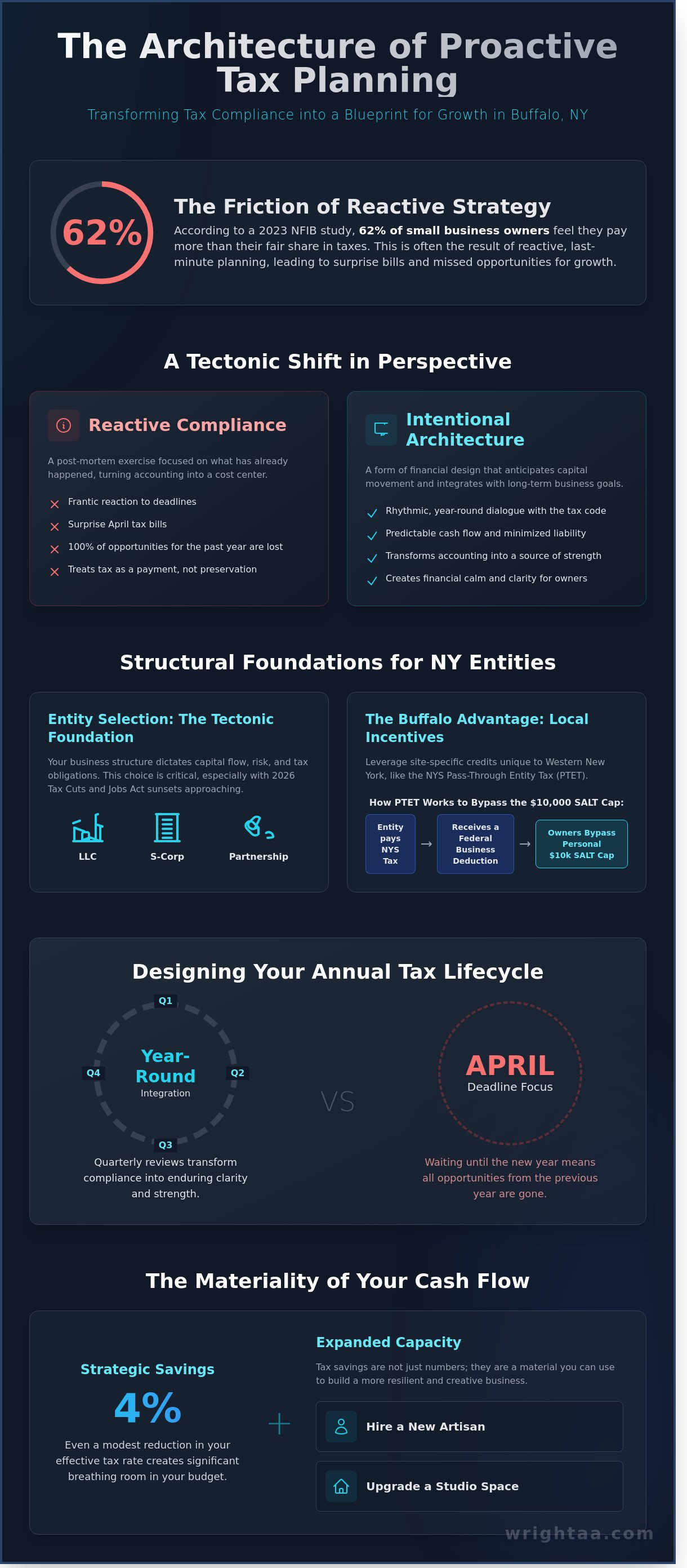
Tax planning is a quiet, rhythmic dialogue between your long-term goals and the structural realities of the tax code. It isn't a frantic reaction to a deadline. Instead, it's a form of financial architecture where we treat your balance sheet as a site-specific landscape. When we engage in business tax planning Buffalo NY, we don't just look at numbers; we look at the materiality of your craft and how it interacts with the broader U.S. tax system. This approach requires a tectonic shift in perspective. We move away from the noise of "tax prep" and toward the serenity of intentional design.
The contrast is clear. Reactive tax preparation is a post-mortem exercise; it records what has already vanished. Intentional tax architecture, however, creates a framework that anticipates the movement of capital before it settles. Buffalo’s economic landscape, shaped by a 12% increase in new business starts since 2021, demands this level of precision. A strategy that works in a different climate won't suit the unique vernacular of the Queen City. We must listen to the specific needs of the local market, from the resurgence of the West Side to the technical growth in the North Hill district.
Our approach elevates the human experience through financial clarity. We believe that a well-structured tax plan provides the same sense of calm as a perfectly balanced room. It allows a business owner to breathe, knowing that every dollar is placed with purpose. By integrating financial strategy into the daily life of the firm, we transform a technical obligation into a poetic exercise in wealth preservation.
Beyond the April Deadline
Waiting until January to consider your tax position is a structural failure. By the time the new year arrives, 100% of your opportunities for the previous fiscal year have already solidified. This delay turns your accounting into a cost center rather than a source of strength. We advocate for year-round integration where bookkeeping isn't just a record of the past, but a tool for the future. This shift in mindset from "payment" to "preservation" ensures that your firm remains resilient against shifting federal rates, such as the 21% corporate tax established in 2017. Consistency creates a stable foundation for growth.
The Materiality of Your Cash Flow
Intentional tax design creates spatial breathing room in your budget. When you lower your effective tax rate by even 4% through strategic reinvestment or local credits, you're not just saving money; you're expanding your firm’s capacity. There is a tactile relationship between tax savings and the ability to hire a new artisan or upgrade a studio space. In Buffalo, where the 6.5% state franchise tax can weigh heavily on small enterprises, every deduction acts as a structural support. Proactive tax planning is a permanent, thoughtful intervention. It ensures that your cash flow isn't a source of stress, but a material you can use to build something lasting.
Structural Strategies for New York Entities
Entity selection serves as the tectonic foundation of your enterprise. It's the primary structure that dictates how capital flows, how risk is contained, and how the business interacts with the landscape of New York law. For many entrepreneurs, the choice between an S-Corp, LLC, or Partnership isn't a static decision; it's a dialogue that evolves with the business's growth. As we approach 2026, the sunset of several Tax Cuts and Jobs Act provisions makes this structural choice even more critical. Materiality matters here. A structure that suits a solo consultant might fail to support the weight of a firm with 25 employees. Choosing the right framework requires a deep understanding of the regulatory vernacular unique to Albany's legislative environment.
Effective business tax planning Buffalo NY requires looking beyond simple registration. It involves analyzing how your entity's materiality impacts your bottom line. Every business must address its federal business tax obligations while simultaneously navigating the specific nuances of the New York State Department of Taxation and Finance. This dual responsibility demands a structure that is both resilient and flexible.
Leveraging the NYS Pass-Through Entity Tax (PTET)
In 2021, New York introduced the Pass-Through Entity Tax as a site-specific solution to the federal $10,000 limit on state and local tax (SALT) deductions. For Buffalo-based law firms and closely held businesses, PTET allows the entity to pay tax at the state level, effectively shifting the deduction to the federal return where it isn't capped. This structural workaround can result in substantial savings. Consider these factors when calculating the impact:
- The election must be made annually by March 15th to remain valid for the current tax year.
- Partners and shareholders receive a corresponding credit on their personal NYS returns, eliminating double taxation.
- For a business with $500,000 in taxable income, the federal tax savings can exceed $15,000 depending on the individual's bracket.
S-Corp Elections: A Design for Self-Employment Tax
Transitioning an LLC to an S-Corp is an exercise in precision. This maneuver is often most effective when a business's net income consistently exceeds a reasonable salary for its owners. By bifurcating income into a W-2 salary and shareholder distributions, you can significantly reduce the 15.3% self-employment tax burden. The integrity of this structure relies on the concept of "reasonable compensation." If a Buffalo architect earns $200,000 in profit but only takes a $30,000 salary, the IRS may view the structure as unstable.
- Integrate automated payroll solutions to ensure consistent withholding and reporting.
- Review your salary benchmarks annually against Bureau of Labor Statistics data for the Buffalo-Niagara region.
- Maintain clear separation between personal assets and entity accounts to preserve the corporate veil.
The relationship between your business structure and your long-term vision should be one of harmony and purpose. If you're ready to refine the spatial flow of your company's finances, it's time to consult with a professional designer of tax strategies who understands the local landscape. Proper alignment today prevents structural fractures in the years to come.
The Buffalo Advantage: Local Credits and Regional Incentives
Buffalo’s industrial legacy and its current resurgence create a unique fiscal environment for the observant owner. Tax strategy here is not a detached administrative task; it is an act of integration. Effective business tax planning Buffalo NY relies on identifying how the specific geography of Western New York offers credits that are unavailable in other regions. These incentives act as the tectonic foundation for your firm’s financial structure, allowing for a more intentional allocation of capital toward your core mission.
The NYS Department of Taxation and Finance manages several programs specifically designed to stimulate the Erie County economy. Understanding the 2024 thresholds for these incentives allows a business to move from a reactive posture to a visionary one. We view these credits as raw materials. When used correctly, they reduce the friction of expansion and allow for a deeper investment in the quality of your workspace and your people. A site-specific approach ensures that your tax liability reflects the reality of your physical footprint in the city.
Excelsior Jobs Program and Regional Growth
Growth in Buffalo is supported by the Excelsior Jobs Program, which offers five distinct tax credits over a 10-year benefit period. The most potent is the Excelsior Jobs Tax Credit, providing a 6.85% credit on gross wages for every net new job created in the region. For a firm expanding its headcount by 15 employees, this represents a substantial shift in annual cash flow. Additionally, the 2% investment tax credit applies to the materiality of your expansion, covering the costs of new equipment and facility upgrades. Integrating these into a master plan ensures that your physical growth is mirrored by fiscal resilience. It's about more than just numbers; it's about the long-term value of anchoring your operations in the local soil.
Historic Tax Credits for Buffalo’s Architecture
Preserving a city's vernacular is both a cultural duty and a sophisticated tax strategy. Buffalo’s abundance of 19th-century masonry and early 20th-century steel structures provides a specific opportunity through the NYS Historic Rehabilitation Tax Credit. This program offers a 20% state tax credit for qualified rehabilitation expenditures on income-producing properties. When coupled with the 20% federal credit, a business can offset 40% of its total renovation costs. This synergy between historic craft and modern tax liability transforms a derelict site into a high-performing asset. Claiming these credits requires precise documentation of the building’s spatial and structural changes, ensuring the dialogue between the past and the future remains intact. It's a method of elevating the human experience by honoring the structures that define our streets.
Success in this region requires a disciplined approach to documentation and a willingness to engage with the NYS Department of Taxation and Finance early in the design process. The 2019 legislation that made many of these state credits permanent has provided a predictable horizon for long-term planning. By aligning your business tax planning Buffalo NY with the city’s architectural and economic revitalization, you do more than save money. You participate in the ongoing story of the city while securing the longevity of your own enterprise. This thoughtful intervention in your financial life creates the breathing room necessary for true innovation.
Designing Your Annual Tax Lifecycle
Effective business tax planning Buffalo NY requires a rhythmic approach. It's not a frantic year-end sprint. Instead, it's a deliberate cycle that respects the natural cadence of the fiscal year. Just as a building must withstand the shifting weight of four distinct seasons, your financial strategy needs a structure that adapts to the environment. We view this lifecycle as an ongoing dialogue between your current cash flow and your future liabilities.
The four seasons of tax planning provide a steady framework for the Buffalo business owner. Winter is for reflection and compliance; it's when we document the materiality of the previous year. Spring shifts toward structural adjustments, where we refine entity selections or retirement contributions. Summer serves as the integration phase, allowing us to test the tectonic stability of your strategy against mid-year performance. Fall is the final refinement, where we optimize deductions before the calendar closes on December 31.
Financial KPIs act as the compass in this process. We monitor the 20% Qualified Business Income (QBI) deduction threshold with precision. If your net income approaches the phase-out limits established by the IRS, we adjust. A 5% shift in gross margin isn't just a metric; it's a signal to recalibrate your estimated payments. This prevents the erosion of liquidity and ensures your capital remains available for reinvestment.
We're also preparing for a significant shift in the legislative vernacular. On December 31, 2025, many provisions of the Tax Cuts and Jobs Act (TCJA) are scheduled to sunset. This will fundamentally alter individual tax brackets and estate tax exemptions. By mapping these changes now, you're not reacting to a crisis in 2026; you're executing a pre-designed plan that accounts for a higher-rate environment.
The Quarterly Dialogue
Steady communication is the foundation of structural financial health. A fixed-fee monthly retainer, often starting at $1,250 for established firms, removes the friction of hourly billing and encourages proactive inquiry. This rhythm allows us to track cash flow in real-time, preventing the 15% to 20% variances that often lead to year-end surprises. Outsourced CFO services further integrate this data, ensuring your tax strategy and operational goals exist in a singular, cohesive dialogue. You can refine your financial architecture by establishing this disciplined quarterly cadence today.
Mastering Deductions for Buffalo Professionals
For law firms and consultants in Western New York, deductions should be as site-specific as a well-designed office. We focus on overlooked opportunities that reflect the modern professional landscape. These include:
- Professional Development: Full deduction of CLE credits and dues for the Erie County Bar Association or local industry chapters.
- Hybrid Work Materiality: Precise calculation of home office expenses for partners who maintain dedicated, exclusive-use studios.
- Regional Travel: Documentation of mileage and expenses for client site visits across the Niagara Frontier, adhering to the 67 cents per mile 2024 IRS rate.
- The 2026 Pivot: Starting January 1, 2026, the phase-down of bonus depreciation to 0% will necessitate a strategic shift toward Section 179 expensing to maintain the immediate tax benefits of equipment purchases.
By treating deductions as a craft rather than a checklist, you ensure that every dollar spent contributes to the long-term integrity of your enterprise. This intentionality is what separates a standard tax return from a comprehensive financial legacy.
The Wright Partnership: From Compliance to Clarity
Traditional accounting often functions as a post-mortem; it's a look back at the past rather than a vision for the future. Wright CPAs, LLC operates as a thoughtful maker of financial frameworks. We treat your balance sheet with the same intentionality an architect brings to a site-specific build. By moving away from transaction-based accounting, we create a dialogue rooted in clarity and purpose. Our fixed-fee model, established in 2021, removes the friction of the billable hour. It allows us to focus on the craft of the work rather than the ticking of a clock. You won't hesitate to call with a question because the cost of that conversation is already integrated into our structural partnership.
This shift from compliance to advisory is a transition toward a more elevated human experience in business. We don't just record history; we help you design it. Within the framework of business tax planning Buffalo NY, this means identifying tax-efficient pathways before the fiscal year concludes. It's about the materiality of your cash flow and the tectonic strength of your entity structure. When you work with us, you're engaging in a process that values substance over spectacle. We prioritize the quiet, confident authority that comes from knowing your financial foundation is secure.
A Tailored Approach for Law Firms and Closely Held Businesses
Law firms face unique structural requirements that demand a refined intellectual approach. We specialize in the intricate details of IOLTA compliance and law firm profitability. In 2023, we worked with a Buffalo practice that struggled with fragmented data across three different software platforms. By integrating their bookkeeping, payroll, and tax strategy into a single, cohesive vision, we reduced their administrative overhead by 19% within twelve months. This wasn't a simple fix; it was a structural renovation of their internal processes.
Closely held businesses require a similar level of context-aware attention. We look at how the business interacts with the owner's personal financial landscape. Our process involves:
- Rigorous analysis of practice-specific profitability metrics.
- Integration of real-time bookkeeping to inform quarterly strategy sessions.
- Proactive structural changes that anticipate shifting tax codes in 2025 and 2026.
- Crafting a narrative for your business that lenders and stakeholders respect.
Your Next Line on the Paper
The first step in any design process is placing the first line on the paper. For your 2026 tax strategy, that line starts with a conversation. During our initial financial structure walkthrough, we examine the current state of your business with a disciplined eye. We look for where the light hits your revenue and where the shadows of unnecessary liability linger. We'll discuss how business tax planning Buffalo NY can be a tool for growth rather than a seasonal burden. It's an opportunity to ensure your business remains inextricably linked to its specific geographic and cultural context here in Western New York.
We invite you to experience a more serene approach to your firm's finances. Our method is unhurried but precise. We listen deeply to your goals before we propose a single intervention. If you value quality and seek a partner who understands that your business is a permanent reflection of your craft, we're ready to begin. Schedule a consultation to design your business tax strategy and start building a more intentional financial future.
Designing a Foundation for Permanent Growth
Strategic tax management isn't a seasonal chore; it's the foundation of your business's enduring structure. By integrating site-specific Buffalo incentives and choosing a robust New York entity framework, you transform tax obligations into a tool for growth. Since 2012, Wright CPAs has refined this craft specifically for Buffalo-based firms. We focus on the materiality of your numbers to ensure every deduction serves a greater purpose. For legal professionals, our specialized IOLTA compliance and law firm accounting ensure every detail aligns with New York State regulatory standards. Our predictable fixed-fee monthly advisory model provides the spatial breathing room you need to focus on your core mission without the stress of hourly billing. Effective business tax planning Buffalo NY requires more than just filing forms. It demands a visionary approach to your firm's annual financial lifecycle. Your financial architecture deserves the same intentional design as your physical space. When your fiscal house is built with precision, you can scale with confidence and clarity.
Begin your financial walkthrough with Wright CPAs
Frequently Asked Questions
What is the difference between tax preparation and tax planning for a Buffalo business?
Tax preparation is a historical recording of what has already occurred, while business tax planning Buffalo NY is the intentional design of your financial future. Preparation focuses on filing the 1040 or 1120 forms after the year ends; planning uses the tax code as a structural tool to reduce liabilities by 15% to 25% before December 31 arrives. It's the difference between looking at a finished building and drafting the blueprints that ensure its long-term stability.
How does the New York PTET benefit small business owners in 2026?
The Pass-Through Entity Tax allows Buffalo owners to bypass the federal $10,000 limit on state and local tax deductions. By electing into this regime, your business pays the tax at the entity level, which creates a federal deduction that reduces your taxable income dollar for dollar. This strategy remains a vital intervention for S-Corps and partnerships, often yielding a 5% to 7% increase in net cash flow for the 2026 fiscal year.
Can Wright CPAs help with multi-state tax planning if my Buffalo business expands?
We facilitate the expansion of your business footprint across all 50 state jurisdictions by managing the complexities of nexus and apportionment. Our approach ensures your growth is grounded in a site-specific understanding of each state’s tax vernacular. We analyze the three-factor formula of property, payroll, and sales to prevent double taxation. This creates a steady dialogue between your Buffalo headquarters and your satellite operations, ensuring the financial structure remains cohesive.
What are the most common tax mistakes Buffalo startups make?
Startups often fail to select the correct legal entity, leading to 40% higher tax burdens in their first three years. Many founders also overlook the Section 1202 Qualified Small Business Stock exclusion, which can eliminate 100% of capital gains tax on the first $10 million of a sale. These tectonic shifts in structure are difficult to correct later. We help you place the right foundation from the first day to ensure the materiality of your venture remains protected.
How do fixed-fee accounting retainers work for tax planning?
Fixed-fee retainers replace the erratic rhythm of hourly billing with a predictable monthly investment. Instead of receiving a $6,000 bill every April, you contribute a set amount each month for ongoing advisory and business tax planning Buffalo NY. This model encourages a continuous dialogue between you and your CPA. It ensures that every financial decision is made with intentionality rather than being a rushed reaction to a filing deadline.
What local Buffalo tax credits should I be aware of for my business?
The Excelsior Jobs Program provides a 6.85% tax credit on wages for businesses within the Buffalo Niagara region. If you're revitalizing local property, the Brownfield Cleanup Program offers credits ranging from 10% to 24% of eligible cleanup costs. These incentives are deeply linked to our specific geographic context. They reward businesses that invest in the craft of local industry and the physical restoration of our city’s historic sites.
Is it too late to start tax planning for the current fiscal year?
It's never too late to refine your strategy until the clock strikes midnight on December 31. Even in the final quarter, we can implement 401k profit-sharing contributions or Section 179 equipment deductions to alter your tax landscape. A single year-end intervention can save $3,000 for every $10,000 in accelerated expenses. We focus on these precise adjustments to elevate your financial experience before the reporting period closes.


