

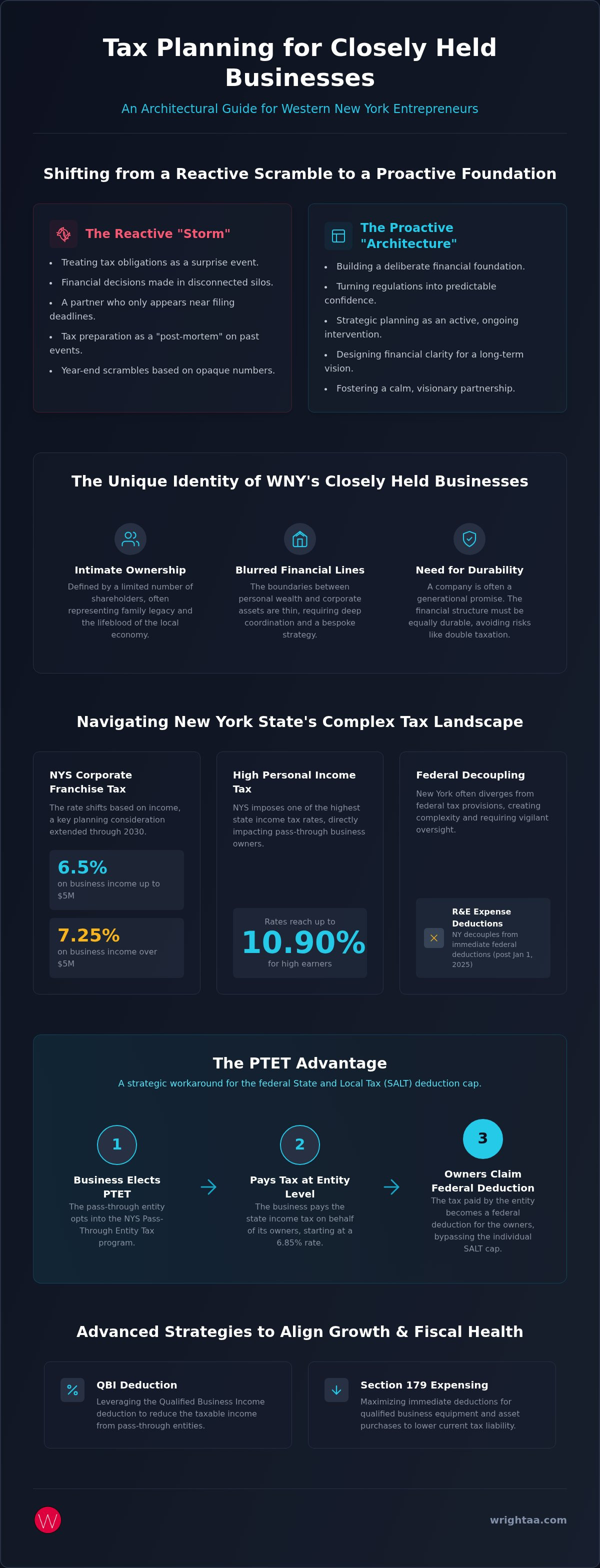
The most resilient structures are those designed with their environment in mind, yet many entrepreneurs treat their financial obligations as a recurring storm rather than a deliberate foundation. For many, tax planning for closely held businesses Buffalo NY feels like a reactive scramble against opaque year-end numbers and the weight of New York’s 7.25% corporate franchise tax rate. It’s difficult to find peace when your tax bill arrives as a surprise, especially as the state continues to decouple from federal provisions like domestic research and experimental expense deductions.
You likely value clarity and precision, yet you’re often met with silence from a partner who only appears when a filing deadline looms. It’s a common frustration to feel that your business and personal wealth are being managed in separate, disconnected silos. This article shifts that narrative. You’ll discover how proactive tax strategies and intentional financial design can protect your family-owned or private business in Western New York. We’ll preview the architectural framework needed to master the Pass-Through Entity Tax (PTET) and turn confusing regulations into a predictable, quiet confidence for your firm’s future.
Key Takeaways
- Understand why the intersection of personal legacy and corporate structure requires a uniquely curated financial design.
- Navigate the complexities of New York State regulations, including the strategic use of the Pass-Through Entity Tax (PTET).
- Discover how tax planning for closely held businesses Buffalo NY moves beyond seasonal filing to become a permanent, thoughtful intervention.
- Unlock advanced deductions like QBI and Section 179 to align your business growth with its fiscal health.
- Learn the value of a fixed-fee monthly retainer with Wright CPAs, LLC in fostering a calm, visionary partnership that eliminates year-end surprises.
Understanding the Closely Held Business Landscape in Western New York
The architecture of finance begins with a single, foundational truth: your business is an extension of your intent. A closely held business is defined by its intimacy, characterized as a privately owned entity with a limited number of shareholders. In Buffalo, Rochester, and Syracuse, these structures aren't merely legal designations. They represent the lifeblood of our local economy and the primary vehicle for family legacy. When the boundaries between personal wealth and corporate assets are this thin, a standard approach to accounting is no longer sufficient. It requires a deeper level of coordination.
Most business owners experience an emotional and financial intersection that traditional firms often overlook. Your business decisions dictate your family's security; your personal goals shape the company's trajectory. Effective tax planning for closely held businesses Buffalo NY acknowledges this duality. It moves beyond the mechanical act of filing forms to ensure that every dollar retained within the business serves a specific purpose for the owners. Standard tax preparation is a post-mortem, a static record of what has already happened. Strategic planning, however, is an active intervention.
The Unique Identity of WNY Private Businesses
Western New York is home to a robust collection of niche manufacturing firms, specialized law practices, and professional service groups that fit the closely held model. These businesses are deeply rooted in their geographic context. In Buffalo, a company is often a generational promise, a legacy intended to outlast its founders. This sense of permanence demands a financial structure that is equally durable. Local economic factors, from property tax shifts to regional labor trends, must be woven into the fiscal design. We don't view your business in a vacuum; we see it as a permanent structure within the WNY landscape.
Why Closely Held Entities Require Bespoke Strategies
Generic, "off-the-shelf" tax software is built for the average, not the exceptional. It fails to account for the nuanced interplay between New York's complex tax codes and the specific needs of private entities. Without professional, intentional planning, owners face the persistent risk of double taxation or the loss of significant pass-through benefits. The goal is to avoid the friction caused by reactive decision-making. By designing financial clarity, we create a framework where tax outcomes are predictable and aligned with your long-term vision. This bespoke strategy ensures that the intersection of your business and personal life remains a source of strength, not a point of stress.
Navigating New York State Tax Regulations for Private Entities
New York’s fiscal environment is a complex site. It requires precise engineering to ensure your business structure remains efficient under the weight of high state income tax rates, which reach up to 10.90% for high earners. For those engaged in tax planning for closely held businesses Buffalo NY, the challenge lies in the state's tendency to decouple from federal provisions. Specifically, New York has decoupled from the immediate deduction for domestic research and experimental expenses, a move effective for tax years beginning after January 1, 2025. This creates a divergence between your federal and state tax identities, requiring a more rigorous level of oversight.
The New York State corporate franchise tax adds another layer of specificity. For corporations with a business income base of $5 million or less, the rate is 6.5%. However, once income exceeds that $5 million threshold, the rate climbs to 7.25%, a figure recently extended through 2030. Advanced tax strategies are necessary to manage the interplay between these state-level mandates and your federal liabilities. A thoughtful tax strategy ensures these state-level choices don't conflict with your broader financial objectives.
The Significance of the NYS PTET Election
The Pass-Through Entity Tax (PTET) serves as a vital workaround for the federal SALT deduction cap, which for 2026 is $40,400 before phasing down. By electing into PTET, a business pays state tax at the entity level, allowing the owners to claim a federal deduction that would otherwise be capped. The rates are graduated, starting at 6.85% for income up to $2 million and reaching 10.90% for income over $25 million. The architecture of finance requires the election to be made by March 15, with estimated payments due quarterly. Missing this window can leave significant capital exposed to unnecessary taxation.
Entity Selection: S-Corp vs. LLC in New York
The process of starting a business in Buffalo begins with choosing the right entity. An LLC offers simplicity, but it often subjects all business income to self-employment tax. In contrast, an S-Corp allows owners to split income between a "reasonable salary" and distributions, which aren't subject to self-employment tax. New York authorities scrutinize these salary levels closely. We ensure your compensation is defensible while maximizing the efficiency of your distributions, creating a balance between compliance and cash flow preservation.
The Architecture of Finance: Proactive vs. Reactive Tax Planning
The "April 15th surprise" is a symptom of a reactive framework. When a business owner waits until the following spring to review their fiscal performance, they're looking at a site plan after the building has already settled into its foundation. Reactive accounting is inherently flawed because it offers no room for adjustment. Effective tax planning for closely held businesses Buffalo NY requires a year-round commitment to strategic oversight. It’s the difference between bracing for a storm and building a shelter that anticipates it. By shifting toward this proactive stance, owners eliminate the volatility that often plagues family-run firms. This transition fosters financial serenity, allowing for the implementation of outsourced CFO services that treat tax optimization as a continuous process rather than a seasonal chore.
The Problem with Traditional Yearly Tax Preparation
Traditional tax preparation carries a significant lost opportunity cost. When decisions are made in December without the context of the previous eleven months, strategies are rushed and often incomplete. This reactive posture leads to cash flow anxiety and missed deductions. Proactive tax planning for closely held businesses Buffalo NY serves as a permanent, thoughtful intervention. It ensures that every transaction is weighed against its tax outcome before the money leaves the business. While the New York State business tax resources provide the rules, a proactive partner provides the blueprint for navigating them. We believe that a tax bill should never be a mystery; it should be a known variable in a curated plan.
Designing a Monthly Cadence for Financial Clarity
The approach at Wright CPAs, LLC centers on a monthly advisory retainer that prioritizes clarity over complexity. This rhythmic cadence involves tracking financial KPIs that act as early warning systems for tax forecasting. This structure offers several distinct advantages for the Buffalo entrepreneur:
- Predictability: Fixed monthly costs eliminate the friction of hourly billing and allow for better budgeting.
- Precision: Real-time adjustments to estimated payments prevent year-end tax liability spikes.
- Partnership: Regular communication builds a deep understanding of your business's specific cultural and geographic context.
Deep listening is the cornerstone of this process. We don't just look at the ledger; we seek to understand the owner’s intent for their personal and business wealth. This disciplined awareness allows us to adjust the financial design in real-time. It ensures that the intersection of internal and external environments remains balanced, regardless of how New York's tax landscape shifts.
Advanced Strategies for Closely Held Business Owners
If monthly oversight provides the rhythm of your financial life, advanced strategies are the materials used to reinforce the structure. Moving beyond basic compliance allows for a deeper level of optimization, particularly through the use of federal provisions designed for pass-through entities. For those engaged in tax planning for closely held businesses Buffalo NY, these tools represent the difference between a standard filing and a sophisticated financial design. By integrating retirement contributions and specialized niche accounting, we ensure that your business growth doesn't create an unmanageable tax burden. This is particularly vital for professional services like law firms, where the intersection of high earnings and specific regulatory requirements demands a precise touch.
Maximizing the Section 199A Deduction
The Qualified Business Income (QBI) deduction, or Section 199A, offers a potential 20% deduction on qualified business income for pass-through owners. However, this benefit isn't a simple entitlement. For "Specified Service Trades or Businesses" (SSTB), such as law or accounting practices, the deduction begins to phase out once certain income thresholds are met. Intentional business structure is the only way to protect this benefit. We look at payroll management and W-2 wage optimization to ensure your entity remains eligible for the maximum possible deduction. It’s a delicate balance of internal variables that requires constant, unhurried adjustment to remain effective.
Strategic Reinvestment and Depreciation
Buffalo’s capital-heavy industries often find significant relief through Section 179 and bonus depreciation. These provisions allow for the immediate expensing of equipment purchases rather than depreciating them over several years. In a high-revenue year, a strategic equipment purchase can function as a powerful offset. We distinguish between simple repairs and capital improvements, ensuring that every dollar spent on your facility or fleet is categorized with tax efficiency in mind. This dual focus balances current tax savings with the long-term value of your business assets. A curated tax planning strategy ensures your business reinvestment is both purposeful and protected.
Beyond physical assets, retirement plan contributions serve as a primary tool for lowering taxable business income. Whether through a traditional 401(k) or a more complex Cash Balance plan, these contributions act as a tax-deductible expense for the business while simultaneously building personal wealth. It is a poetic duality: by securing your future self, you improve the present health of your firm. This level of intentionality turns a standard business expense into a cornerstone of your financial architecture.
Cultivating Financial Serenity with Wright CPAs, LLC
Financial serenity is not a destination. It’s a state of being achieved through rigorous discipline and thoughtful design. For many entrepreneurs, the tax season is a period of high friction and opaque liabilities. We believe your fiscal life should mirror a well-constructed building: stable, predictable, and resilient. The approach to tax planning for closely held businesses Buffalo NY at Wright CPAs, LLC centers on removing the anxiety of the unknown. By utilizing a modern technology stack and CFO-level oversight, we provide the clarity needed to make decisions with confidence. This is more than accounting. It’s a permanent, intentional intervention in your business’s lifecycle.
We invite you to experience strategic business tax planning as a curated service. Wright CPAs, LLC functions as a visionary partner for Western New York entrepreneurs, moving beyond the mechanical act of filing to offer year-round financial guidance. When your personal and business wealth are managed as a single, cohesive structure, the result is a profound sense of purpose and calm.
The Value of a Fixed-Fee Advisory Relationship
The traditional billable hour is a barrier to intimacy. It discourages proactive questions and creates a transactional rhythm that favors speed over substance. We’ve replaced this model with a fixed-fee monthly retainer. This structure fosters a collaborative, unhurried partnership where you can seek advice without fear of an unexpected invoice. Predictable costs lead to predictable outcomes. A monthly cadence ensures that your tax planning for closely held businesses Buffalo NY isn't a year-end scramble, but a continuous process of refinement and optimization. You gain the relief of year-round financial oversight and the peace of mind that comes from transparent, upfront pricing.
Next Steps Toward Financial Intentionality
Transitioning from a traditional tax preparer to a strategic partner is a shift in mindset. It requires moving from a reactive posture to one of deep listening and contextual awareness. Our engagement at Wright CPAs, LLC begins with a dedicated design phase. We analyze your current financial environment, identifying the intersections between your business operations and your family legacy. This initial walkthrough allows us to build a blueprint that aligns with your specific goals.
The path toward financial serenity begins with a single conversation. We encourage you to reach out for a discovery session centered on your long-term vision. We’ll discuss your business’s unique geographic and cultural context, ensuring that every strategic choice we make serves to improve your daily life and secure your firm’s future. Let’s build a foundation that supports your highest intentions.
Strengthening the Foundation of Your Firm
True financial intentionality is found in the space between a business's daily operations and its long-term legacy. You've seen how proactive tax planning for closely held businesses Buffalo NY serves as a permanent intervention, transforming seasonal anxiety into year-round clarity. By mastering the nuances of the NYS Pass-Through Entity Tax and aligning your entity structure with your personal wealth goals, you ensure that your firm remains a resilient structure in the Western New York landscape.
Since 2012, Wright CPAs has specialized in the unique needs of law firms and closely held entities across Buffalo, Rochester, and Syracuse. Our fixed-fee monthly advisory model is designed to eliminate the friction of the billable hour, fostering a partnership rooted in deep listening and disciplined strategy. It's time to move beyond the post-mortem of traditional accounting and toward a visionary framework that prioritizes your daily life and business health.
Please schedule a discovery session with Wright CPAs to begin designing a tax strategy that reflects your highest intentions. We look forward to helping you build a financial future defined by purpose and quiet confidence.
Frequently Asked Questions
What is the definition of a closely held business for tax purposes?
A closely held business is generally defined as a privately owned entity where more than 50% of the stock value is held by five or fewer individuals. These businesses are not publicly traded and often involve family members or a small group of partners. For tax planning for closely held businesses Buffalo NY, this structure creates a unique opportunity to align corporate tax outcomes with the personal financial goals of the owners.
How does the NYS Pass-Through Entity Tax (PTET) help Buffalo business owners?
The New York State Pass-Through Entity Tax (PTET) allows business owners to bypass the federal SALT deduction cap, which is limited to $10,000. By paying state taxes at the entity level, the business receives a full federal deduction for those taxes. This is a vital tool for Buffalo firms, as it effectively lowers the owners' federal taxable income by the amount of state tax paid on business earnings.
What is the difference between tax planning and tax preparation?
Tax preparation is the mechanical act of reporting historical data to satisfy compliance requirements after the year has ended. In contrast, tax planning is the proactive design of financial outcomes before they occur. It involves analyzing your business architecture throughout the year to minimize liabilities. While preparation looks at the past, planning builds the foundation for your firm’s future financial health and overall stability.
Can an LLC choose to be taxed as an S-Corp in New York?
Yes, a New York LLC can elect to be taxed as an S-Corporation by filing Form 2553 with the IRS and the corresponding state election. This choice often reduces self-employment taxes by allowing owners to take a portion of their income as distributions. It’s a strategic move that requires careful adherence to reasonable compensation rules to ensure the structure remains resilient under state and federal scrutiny.
Why should a closely held business consider a fixed-fee CPA model?
A fixed-fee model provides the transparency and predictability needed for a truly collaborative partnership. Traditional hourly billing often discourages business owners from seeking advice because they fear the cost of a phone call. By removing this friction, the fixed-fee model ensures year-round oversight. It allows us to focus on the quality of our guidance and the long-term success of your business rather than tracking billable minutes.
How often should I meet with my CPA for tax planning?
We believe a monthly cadence is essential for maintaining financial clarity and intentionality. Meeting once a year is insufficient for high-growth or complex entities. Monthly reviews allow us to monitor your financial KPIs and adjust your strategy in real-time. This unhurried rhythm ensures that your tax planning for closely held businesses Buffalo NY remains accurate and that there are no surprises when filing deadlines arrive in the spring.
What are the most common tax mistakes made by family-owned businesses in WNY?
Many family-owned firms in WNY struggle with commingling personal and business expenses, which complicates the financial design. Another common error is missing the March 15 deadline for the PTET election, which leads to lost deductions. Finally, many businesses fail to properly document "reasonable compensation" for S-Corp owners. These reactive mistakes often stem from a lack of proactive communication and a failure to treat finance as a permanent intervention.
Does Wright CPAs provide CFO-level financial guidance for small businesses?
Wright CPAs provides comprehensive CFO services and business consulting that go far beyond basic bookkeeping. We offer strategic guidance on cash flow management, new business formation, and specialized law firm accounting. Our role is to act as a visionary partner, helping you navigate complex financial environments with a disciplined and artistic approach. We prioritize substance over spectacle, ensuring your business structure supports your daily life and legacy.


