

What if a partnership’s most consequential tax decisions happen months before anyone prepares a return? A deliberate tax strategy for partnerships Rochester owners can use takes shape throughout the year, as income, expenses, and business plans evolve.
It’s understandable to focus on filing deadlines. But partnership income and deductions can affect each partner differently, and changes in business income may affect what partners need to plan for. Federal and New York filing responsibilities add another layer. These decisions are connected, so treating them as separate tasks can leave important questions until year-end.
This guide explains how partnership tax planning brings allocations, partner payments, deductions, and filings into a coordinated approach. You’ll learn which decisions to revisit during the year, how business-level choices can shape each partner’s tax picture, and what records and conversations make planning more deliberate. Accurate bookkeeping and timely financial reporting provide a clearer view of what’s changing, helping Rochester partnerships plan for tax obligations with fewer surprises.
Key Takeaways
- A thoughtful tax strategy for partnerships Rochester owners can use connects business reporting, partner allocations, and individual tax considerations.
- Keep the partnership agreement, business operations, and tax reporting aligned when reviewing allocations and partner basis.
- Compare distributions, reinvestment, compensation, and retirement-plan options by purpose, partner impact, timing, and recordkeeping needs.
- Use a year-round checklist to reconcile books, update projections, track ownership changes, and prepare tax records.
- Coordinate bookkeeping and financial reporting with tax planning to make partnership decisions with a clearer view of their effects.
What Partnership Tax Strategy Means for Rochester Business Owners
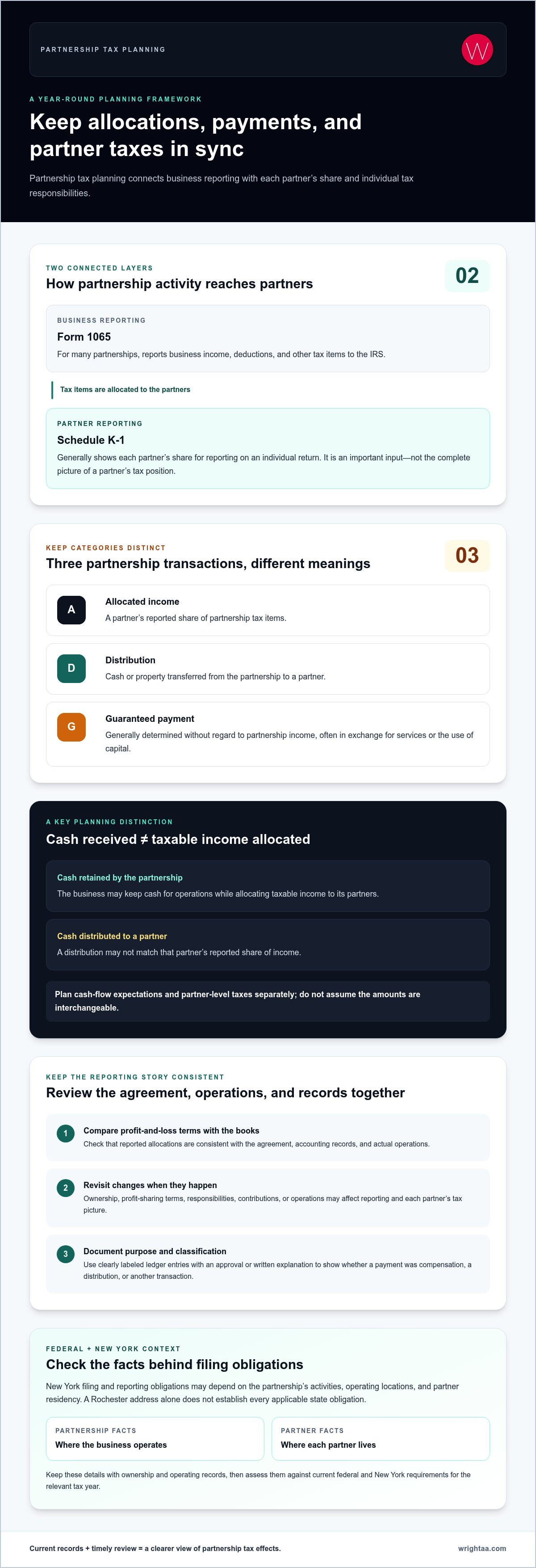
Partnership tax strategy is the year-round coordination of business reporting, partner allocations, and each partner’s individual tax responsibilities. It involves two connected layers: the partnership reports its financial activity and allocates tax items, while partners account for their respective shares on their own returns. The details depend on the entity’s structure, agreement, operations, and the federal and New York rules that apply to its circumstances.
That coordination begins before tax forms are prepared. Annual return preparation organizes and reports completed activity. Planning gives owners time to assess how expected income, spending, ownership changes, and business decisions may affect reporting and partner-level taxes. For a tax strategy for partnerships Rochester owners can apply with confidence, the underlying records and decisions need to tell a consistent story.
Owners can make that story easier to follow by keeping books current, recording the purpose of significant transactions, and discussing business changes before they are finalized. A new partner, a change in how profits are shared, or a shift in operations may affect reporting and each partner’s tax picture. Review these events when they happen, not only when the return is assembled.
How partnership income reaches individual partners
For many partnerships, Form 1065 reports business income, deductions, and other tax items to the IRS. Schedule K-1 generally provides each partner with their share for reporting on an individual return. Filing requirements and forms can depend on the partnership’s facts and current rules, so use the applicable IRS instructions for the tax year. The U.S. Partnership Taxation Overview offers background on federal pass-through taxation and distributive shares.
A partner’s allocated share isn’t necessarily the same as the cash they receive. A partnership may allocate taxable income while retaining cash for operations, or make a distribution that doesn’t match the partner’s reported share of income. Each partner’s broader tax circumstances also affect the final outcome. The K-1 is an important input, not a complete picture of an individual’s tax position.
Why Rochester and New York context matters
Federal rules are only one part of the planning picture. New York filing and reporting obligations may also matter, depending on the partnership’s activities, operating locations, and partner residency. A Rochester address alone doesn’t establish every applicable state obligation, and no special Rochester tax rule should be assumed without current authority.
As a practical starting point, document where the partnership conducts business and where each partner lives. Keep those facts alongside ownership and operating records, then assess them against current federal and New York requirements for the relevant tax year. This context helps identify filing responsibilities and partner-level effects before the return is prepared.
Build a Partnership Tax Plan Around Allocations, Payments, and Basis
A partnership’s tax reporting should reflect both its governing agreement and the way the business actually operates. The agreement may describe how partners share profits and losses, but tax allocations aren’t simply a matter of choosing a preferred outcome at year-end. Their treatment depends on the agreement, the facts, and applicable federal and New York rules. Review changes in ownership, responsibilities, or financial arrangements before they appear in the books or a tax return.
Three terms are easy to conflate. Allocated income is a partner’s reported share of partnership tax items. A distribution is cash or property transferred from the partnership to a partner. A guaranteed payment is generally a payment to a partner determined without regard to partnership income, often in exchange for services or the use of capital. These categories have different reporting implications. Verify their current-year treatment rather than assuming they are interchangeable. The IRS Guidance on Partnership Taxation is a useful starting point for federal partnership filing and reporting information.
A cash distribution and a partner’s taxable income aren’t necessarily the same amount. A partnership might retain cash for working capital while allocating income to its partners, or distribute cash that doesn’t match a partner’s share of reported income. That difference can affect cash-flow expectations and individual tax planning.
Review allocations and partner compensation
Read the profit-and-loss provisions alongside the accounting records. If the agreement sets different sharing terms for particular items or periods, review the books and reporting for consistency with those terms and actual operations. Document changes, including when they took effect and how partner responsibilities or contributions shifted. Reconcile compensation and distributions to the agreement and ledger, then evaluate their tax treatment under the rules that apply to the current year.
Clear records help answer practical questions: Was a payment compensation, a distribution, or another type of transaction? Was it recorded consistently with the agreement? A clearly labeled ledger entry, supported by an approval or written explanation, gives the preparer a more reliable basis for classifying the activity.
Track basis and partner-level tax details
Outside basis is a partner’s tax basis in their partnership interest. It’s tracked separately for each partner because contributions, allocated tax items, distributions, and a partner’s share of partnership liabilities may affect it under applicable rules. The effect depends on the facts and tax rules, so a single partnership-level balance can’t replace partner-specific records.
Maintain a schedule for each partner and update it as transactions occur. Tie contributions and distributions to dated records, preserve the supporting allocation details, and note changes in a partner’s share of liabilities for review. This gives year-end reporting a stronger foundation and helps identify questions while there’s still time to clarify the underlying transaction. For a broader view of how business decisions connect with tax planning, explore strategic business tax planning.
Wright CPAs helps closely held businesses coordinate tax planning with bookkeeping and financial reporting, bringing partnership activity and partner-level considerations into the same review. This coordination helps keep the agreement, records, and tax reporting aligned as the business changes.
Compare Partnership Tax Planning Choices Without Chasing One-Size-Fits-All Rules
A useful tax strategy for partnerships Rochester owners can rely on starts with the business purpose, not an assumed tax saving. A decision that supports cash reserves may affect when partners receive funds, while a compensation arrangement may create different reporting and recordkeeping needs. The partnership agreement, operating reality, available cash, and applicable rules all shape which choices make sense. Compare alternatives by their effects on the business and its partners before settling on an approach.
| Planning choice | Business purpose to assess | Partner impact and records | Timing question |
|---|---|---|---|
| Distributions | Provide partners with available cash while preserving operating needs. | Track amounts and dates by partner; distributions don’t necessarily match allocated taxable income. | How much cash can be released without weakening planned operations? |
| Reinvestment | Retain funds for working capital, equipment, or other business priorities. | Document the use of retained cash and communicate expectations to partners. | When will the business need funds, and how might that affect future distributions? |
| Compensation | Pay partners for services or other agreed contributions, as appropriate. | Distinguish payments from distributions in agreements, payroll or accounting records, and tax reporting. | Does the arrangement reflect actual duties and the governing agreement? |
| Retirement-plan review | Consider whether a plan fits business and partner objectives. | Review workforce composition, partner participation, eligibility, and administration records. | Would plan design and current rules support the intended arrangement? |
The table is a comparison framework, not a menu of freely interchangeable tax treatments. An agreement may limit how profits, losses, and payments are handled, while the partnership’s financial position may make an otherwise attractive distribution impractical. Before changing an arrangement, map the business reason, affected partners, approval process, accounting entries, and tax-reporting implications. Confirm the current-year rules that apply to the partnership’s specific facts.
Distributions, reinvestment, and cash planning
Cash in the bank and taxable allocations are related, but they answer different questions. A partnership might retain cash for seasonal expenses or planned investment even as partners receive allocated income for tax reporting. Projections help owners compare expected receipts, operating commitments, and possible distribution timing. Review them alongside cash-flow reports, then update partner expectations as conditions change. Projections inform decisions; they don’t promise a particular tax result.
Partner benefits and retirement-plan questions
Retirement-plan choices require a closer look at eligibility, plan design, current rules, and who works in the business. Consider workforce composition, partner participation, and the records needed to administer an arrangement. Accurate, consistent books help preserve the information used in that review. For related practices that support dependable reporting, see this guide to small business accounting guidance.
Use a Year-Round Partnership Tax Checklist for Rochester and New York
Quarterly reviews surface tax questions while there’s still time to clarify records, update projections, and plan for cash needs. A steady rhythm turns partnership tax work from a year-end scramble into a sequence of manageable reviews. For a tax strategy for partnerships Rochester owners can maintain throughout the year, connect bookkeeping, partner updates, and payment planning rather than treating each as a separate task.
What to review each quarter
Begin with reconciled books, then compare year-to-date results with the partnership’s projections. Note material changes in revenue, expenses, cash needs, or planned investments, and record the reason for each revision. Review distributions against available cash and the partnership agreement. Since partners may have tax obligations even when the partnership retains cash, include estimated payments in cash-flow discussions. Verify whether federal or New York estimated-payment requirements apply to the partnership or individual partners, and confirm current-year dates and rules before acting.
- Reconcile the books: Resolve unexplained balances and confirm transactions are assigned to the right accounts and periods.
- Refresh projections: Compare actual results with expectations, then document assumptions behind updated forecasts.
- Review partner changes: Record ownership changes, contributions, distributions, contact details, and any change in a partner’s residency.
- Flag operational shifts: Note new activities, locations, or changes in how the business operates for federal and New York tax review.
- Discuss payment planning: Use updated income and cash-flow information to assess potential estimated-payment needs under current rules.
Keep brief notes from each review: what changed, which partners may be affected, what records support the decision, and who will follow up. A clear record of the discussion helps the partnership carry questions forward rather than rediscovering them later.
What to prepare before year-end and filing
As the year closes, reconcile bookkeeping accounts and gather support for income, expenses, contributions, distributions, and partner payments. Keep current partner names, addresses, ownership details, and contact information together. Compare the partnership agreement with actual operations, and collect amendments or written approvals relevant to the year. Organize source documents so unusual or material items can be explained without reconstructing them from memory.
Reporting measures can help owners interpret changes in performance and cash needs alongside tax records. This overview of financial KPIs for small business offers related context for building useful reporting habits. Confirm applicable federal and New York forms, requirements, and dates for the specific tax year, as they can depend on the partnership’s circumstances.
Wright CPAs coordinates partnership tax planning with bookkeeping and financial reporting, keeping records and decisions in view throughout the year. Explore partnership tax planning with Wright CPAs to bring business and partner considerations into one deliberate review.
Coordinate Your Rochester Partnership Tax Strategy with Wright CPAs
A partnership’s financial records and tax decisions are closely connected. Wright CPAs, LLC serves businesses in Rochester and can bring tax planning, bookkeeping, and financial reporting into a coordinated review. The aim is to give owners a clearer basis for decisions, with business activity and partner concerns considered together.
A planning discussion can begin with how the business is structured, what each partner does, and how the partnership currently records its activity. From there, the conversation can address upcoming decisions, such as a change in ownership, a planned investment, or a shift in operations. These details help identify which federal and New York questions call for current-year analysis.
What a planning conversation can address
Each partnership has its own arrangement and operating context. A focused review can consider whether financial reporting reflects current business activity, whether partner records are organized, and where owners have questions about the year ahead. Depending on the business’s needs, planning can connect with bookkeeping, payroll, cash-flow management, or CFO support. These services help keep financial information useful for both business decisions and tax planning.
For example, if owners are weighing a new investment while reviewing partner payments, a current view of the partnership’s financial position can help clarify the choices and records needed to support them. A change in a partner’s role or residency may raise different questions. The details matter, so identify the relevant facts before drawing conclusions about treatment.
Prepare for a focused first discussion
A little preparation makes the initial meeting more concrete. Gather materials that show how the partnership is structured, what its recent financial activity looks like, and which decisions are approaching. Partners can also prepare a shared list of concerns so individual questions are visible alongside the partnership’s broader priorities.
- Recent financial statements and bookkeeping reports.
- Prior partnership and partner tax returns, if available.
- The current partnership agreement and any relevant amendments.
- A summary of ownership changes, contributions, distributions, or changes in partner roles.
- Planned investments, anticipated operating changes, and unresolved federal or New York tax questions.
Wright CPAs provides proactive tax planning and preparation, supported by bookkeeping and financial reporting for closely held businesses. Bringing these records together establishes a practical starting point for a tax strategy for partnerships Rochester owners want to manage throughout the year. The discussion can identify what information is clear, what needs follow-up, and which decisions to revisit as circumstances change.
For a considered approach shaped around your partnership’s records, ownership, and plans, discuss a year-round partnership tax plan with Wright CPAs.
Give Your Partnership’s Next Decisions a Clearer Starting Point
A useful tax plan isn’t fixed in place. It gives partners a framework for revisiting decisions as ownership, operations, and financial priorities change. Turn open questions into a focused discussion: what’s changing, which records explain the current picture, and what needs a closer look under current federal and New York rules.
Wright CPAs provides tax planning and preparation for businesses and individuals, serving Rochester, Buffalo, and Syracuse. Bookkeeping, cash-flow management, and CFO services can add financial context to planning conversations, so business decisions and partner considerations are viewed together. For owners shaping a tax strategy for partnerships Rochester businesses can carry forward throughout the year, start with a list of upcoming decisions and the questions they raise.
Bring those questions into a deliberate planning conversation and establish a cadence for revisiting them as the business evolves. Discuss a year-round partnership tax strategy with Wright CPAs.
Frequently Asked Questions
What tax strategies can a partnership use to plan ahead?
A partnership can plan ahead by matching regular financial reviews with upcoming business decisions. Before taking on a large contract, for example, owners can update revenue and expense forecasts, consider whether cash needs may change, and identify tax questions to address. A tax strategy for partnerships Rochester owners can use should account for how a business decision may affect each partner, not just the partnership’s overall results.
How is partnership income taxed in New York?
Partnership income may affect both the partnership’s reporting obligations and the tax returns of individual partners, but the exact treatment depends on the entity, its activity, and each partner’s circumstances. A partner’s residency and where the business operates can matter. A partnership with activity in Rochester, Buffalo, or Syracuse should map its operations and partner residency facts, then review the applicable New York and federal requirements for the current tax year.
Do partnerships pay estimated taxes for their partners?
Partners may need to make individual estimated tax payments, depending on their income, withholding, and other tax circumstances. The partnership can support planning by sharing timely projections and reporting information, but business results alone don’t determine each person’s payment obligation. Partners should assess federal and New York requirements separately and verify current payment dates and thresholds before setting a payment schedule.
What is the difference between a Schedule K-1 and a distribution?
A Schedule K-1 reports tax items assigned to a partner, while a distribution records cash or property transferred to that partner. They serve different purposes, so a bank transfer shouldn’t automatically be treated as the partner’s taxable income. For a practical check, compare the K-1 with the partner’s capital and distribution records, and review any unexplained difference during tax preparation. The specific tax effect depends on the transaction and applicable rules.
Can partnership tax allocations be changed at year-end?
Allocations must be grounded in the partnership agreement and applicable tax rules, not changed simply to place income with a partner who prefers a different result. If partners are considering an amendment, distinguish a prospective business change from an attempt to revise completed activity after the fact. Document the business reason, approval, and effective date, then review the tax implications before putting the change into operation.
What records should a Rochester partnership keep for tax planning?
Keep organized source records that show how transactions occurred and how they were recorded. Useful examples include bank statements, invoices, expense support, payroll records where relevant, and schedules of partner contributions and distributions. Preserve signed agreement amendments and current partner details as well. A clear record trail helps explain unusual entries without relying on memory and gives owners better information for reviewing decisions during the year.
When should a partnership begin tax planning for the year?
Begin before a major business or ownership decision, then revisit the plan as actual results develop. A new loan, planned purchase, or partner departure can change cash needs and raise questions that are easier to address before records are finalized. Set review dates that fit the business’s activity, and leave time to check current filing and payment requirements. Planning early gives partners more room to understand their options before acting.


