

What if your partnership return could do more than meet an annual filing obligation? For Syracuse business owners, tax preparation for partnerships Syracuse firms provide should connect the business’s financial records with each partner’s reporting needs. That takes more than a general tax-preparation process. It requires organized information and a clear understanding of how the partnership’s activity flows through to partner-level filings.
It’s understandable to be unsure what to gather, how the return connects to each partner’s taxes, or whether the numbers are complete and consistent. A clear process makes those responsibilities easier to manage. Wright CPAs, LLC provides tax planning and preparation in Syracuse, with support that can connect annual filing to bookkeeping, cash-flow visibility, and proactive tax planning.
This guide explains what partnership tax preparation involves, what to look for in a Syracuse-area CPA, and how to organize records and partner information for an orderly filing. It also covers how working with a tax professional can support accurate partner reporting and more informed decisions throughout the year.
Key Takeaways
- Partnership tax preparation connects the business return with each partner’s tax information, so both sides need to be coordinated.
- A defined process from record intake through return preparation and delivery can help identify missing or inconsistent details early.
- When comparing tax preparation for partnerships Syracuse businesses can use, consider partnership experience, access to financial-record context, partner communication, and ongoing support.
- Prepare bookkeeping records, prior returns, supporting documents, and notes about ownership changes, contributions, and distributions before filing begins.
- Project-based tax preparation and consulting can address an annual filing need, with the option to consider broader planning and financial support.
What partnership tax preparation in Syracuse covers, and why it differs from an individual return
For Syracuse partnership owners, the central concern is coordination: the business return must reflect the partnership’s records, and each partner needs accurate information for their own tax filing. Tax preparation for partnerships Syracuse businesses rely on addresses both parts of the process. It is a business-focused engagement, not simply several individual returns prepared at once.
A partnership generally reports its income, deductions, gains, losses, and other tax items on an entity return. Those items are allocated among partners and communicated through partner statements. The entity filing and each partner’s individual return are connected, but they are separate responsibilities. U.S. partnership taxation rules provide useful background on this flow-through structure.
What does a partnership return report?
For federal reporting, a partnership generally files Form 1065, the U.S. Return of Partnership Income. Each partner’s Schedule K-1 reports that partner’s share of relevant income, deductions, credits, and other tax items. A K-1 helps a partner prepare an individual return; it doesn’t complete or replace that return. Partners remain responsible for reporting applicable information on their own filings.
Preparation involves more than transferring totals from bookkeeping software. The return needs to reflect the partnership’s financial activity and how items are allocated among its partners. Inconsistencies between the books, ownership records, and partner information can lead to questions and delays while the details are resolved.
Which Syracuse businesses may need partnership tax preparation?
Common examples include general partnerships and multi-member LLCs taxed as partnerships. Reporting needs depend on the entity’s tax classification and activity, so the business structure alone doesn’t tell the whole story.
Changes during the year can affect the preparation work. These may include a new partner, a departing owner, changes in contributions or distributions, or updates to how income is allocated. A partnership operating in Syracuse or elsewhere in Central New York benefits from bringing those details together with its year-end financial records.
An individual-focused free tax program and a partnership CPA engagement serve different purposes. Programs designed for eligible individuals help with personal returns; they don’t replace preparation of a business entity return and coordination of partner statements. A partnership return calls for business records, ownership details, and partner-level reporting to be handled as one connected process.
How a partnership tax return moves from records to partner statements
A well-organized filing begins before the forms are prepared. For tax preparation for partnerships Syracuse businesses need, complete bookkeeping and current partner records provide a stronger starting point and help reveal gaps before they become filing questions.
Which records help a preparer begin?
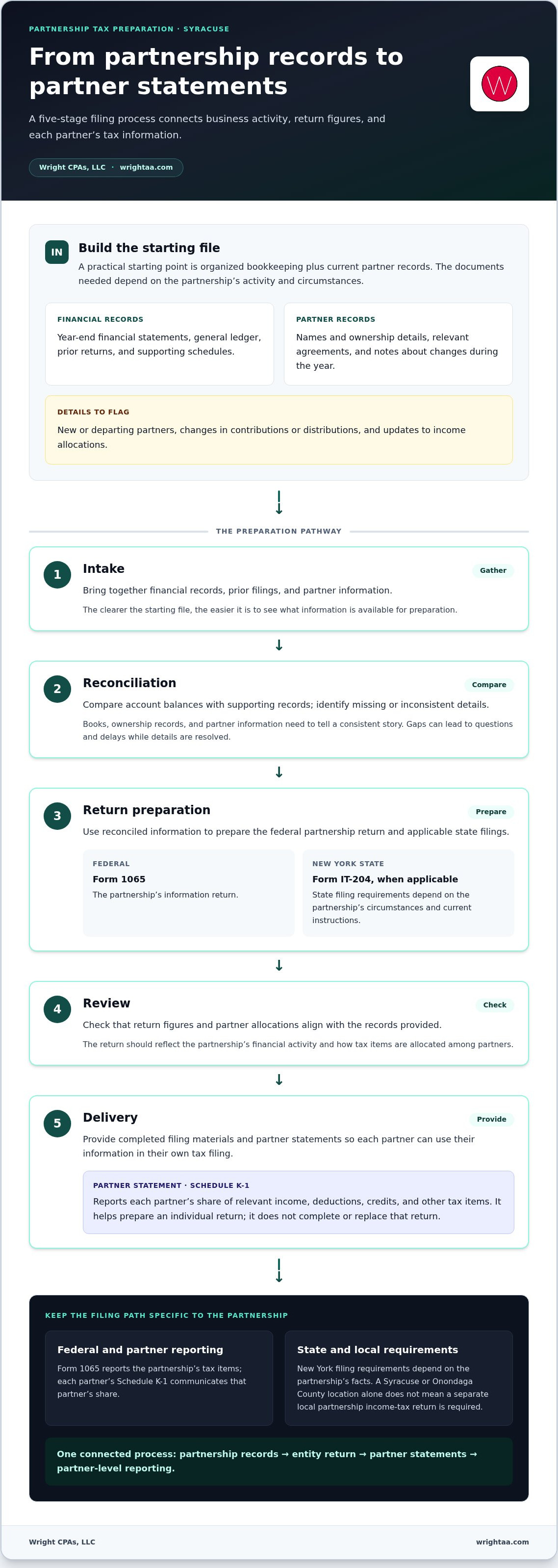
A practical starting file may include year-end financial statements, the general ledger, prior returns, and supporting schedules. Partner records can include names and ownership details, changes during the year, contributions, distributions, and relevant agreements. This is a working checklist, not a universal list of legal requirements. The documents needed depend on the partnership’s activity and circumstances.
From there, the process typically moves through five stages:
- Intake: Gather financial records, prior filings, and partner information.
- Reconciliation: Compare account balances with supporting records and identify missing or inconsistent details.
- Return preparation: Use the reconciled information to prepare the federal partnership return and applicable state filings.
- Review: Check that return figures and partner allocations align with the records provided.
- Delivery: Provide the completed filing materials and partner statements so each partner can use their information in their own tax filing.
At the federal level, Form 1065 is the partnership’s information return, and Schedule K-1 reports each partner’s share of relevant tax items. The IRS Publication 541 explains federal partnership reporting. Partners use their K-1 information when preparing individual returns; receiving a K-1 doesn’t, by itself, complete an individual filing.
How do federal and New York filings connect?
New York State partnership filing requirements depend on the partnership’s circumstances. The New York State Department of Taxation and Finance administers state tax filings, including Form IT-204, the New York partnership return, when applicable under current instructions. Preparation should account for the partnership’s facts and relevant state requirements rather than assume every entity follows the same filing path.
A Syracuse or Onondaga County location alone doesn’t mean a separate local partnership income-tax return is required. State and local obligations depend on the applicable rules and the business’s situation.
Bringing bookkeeping and partner records into one organized preparation process can also provide a clearer view of business finances. Wright CPAs, LLC provides tax planning and preparation for business owners, connecting preparation with bookkeeping and ongoing tax planning.
How to compare partnership tax preparation options in Syracuse
Choosing tax preparation for partnerships Syracuse owners can rely on starts with fit, not firm size. A partnership with few transactions may still need careful handling if ownership changed, allocations require attention, or partners need clear reporting. Simple-looking books don’t automatically make a partnership return simple.
The IRS explains partnership filing and partner reporting in its guidelines on partnership taxation. As you compare preparation options, look at how well each service connects business records, partnership reporting, and communication with the partners who use the resulting tax information.
| Option | Partnership familiarity | Records and partner communication | Review and ongoing support |
|---|---|---|---|
| Individual tax program | Generally designed for eligible individuals’ personal returns, rather than entity-return preparation. | Focuses on an individual’s documents; partnership books and partner allocations may be outside its scope. | May help with personal filing needs, but doesn’t necessarily include partnership-return review or year-round business support. |
| Retail tax-preparation office | Services and experience can vary by office and preparer. | May handle individual and business tax needs; clarify how partnership records and partner statements fit into the process. | Ask how the return is reviewed, how questions are handled, and what support is available beyond filing. |
| Business-focused CPA relationship | Can be structured around entity returns and partner-level reporting. | May consider bookkeeping context and explain how business information flows to partner statements. | Can connect annual preparation with tax planning or ongoing accounting, depending on the engagement. |
What should a partnership evaluate in a tax preparer?
Look for a clear explanation of the preparer’s partnership-filing experience and approach to partner information. The process should make responsibilities easy to understand: which records are needed, how questions are resolved, what review takes place, and how completed filings and partner statements are delivered. If the partnership also needs bookkeeping or tax planning, consider whether those services fit into the same working relationship.
When may ongoing accounting support add value?
Consistent bookkeeping gives annual preparation a clearer financial foundation by keeping records current and making changes easier to trace. Ongoing support can also connect tax planning with cash-flow visibility, helping owners consider tax decisions alongside the timing of business income and expenses. It may be useful to explore strategic business tax planning in Buffalo, NY as part of that broader view, while recognizing that planning doesn’t guarantee a particular tax result.
The right arrangement depends on the partnership’s complexity and the level of support it wants, not on whether the provider is large or small. A defined annual filing engagement may suit one business; another may benefit from a continuing relationship that includes accounting and planning.
How to prepare your Syracuse partnership for tax preparation
A complete, well-organized file gives tax preparation for partnerships Syracuse businesses rely on a clearer starting point. It also helps surface gaps while there’s time to investigate them, rather than during final review. Gather records for the full tax year, and note anything unusual or unresolved so you can discuss it with the preparer.
A practical partnership tax-preparation checklist
Use this as a preparation guide, not a universal list of legal requirements. The documents needed depend on the partnership’s activity and circumstances.
- Financial records: Year-end financial statements, bookkeeping reports, the general ledger, and bank and credit-card statements.
- Business activity: Payroll records, asset information, and supporting documents for significant or unusual transactions, as applicable.
- Prior filings: Previous federal and New York returns, along with notes or records of changes since those filings.
- Partner information: Current partner names and details, ownership changes, contributions, distributions, and relevant agreements.
- Allocation records: Information showing how partnership items are allocated among partners, based on current business records and agreements.
Before sending the file, compare bookkeeping balances with statements and supporting records. Flag missing documents, uncategorized transactions, or entries that don’t match your understanding of the year. Don’t assume partner percentages, allocations, or ownership stayed the same as the prior year. A short note explaining an unusual transaction can help the preparer focus follow-up questions.
Set expectations at the outset, too. Clarify how information will be gathered, when the partnership will review the draft or respond to questions, how partner statements will be delivered, and where follow-up questions should go. Clear communication helps keep the return and partner reporting connected and gives owners a better sense of next steps.
How proactive planning supports the annual filing
Tax planning is most useful when it reflects current financial records and actual business decisions. Consistent bookkeeping gives owners and their tax professional a clearer view of income, expenses, cash flow, and changes that may affect year-end preparation. For a broader accounting perspective, explore small business accounting in Buffalo, NY.
Preparation can also be a useful opportunity to consider how the partnership’s financial practices support decisions throughout the year. Wright CPAs, LLC connects tax preparation with planning and business financial support. Explore tax preparation and planning support to consider an approach suited to your partnership’s needs.
Partnership tax preparation with Wright CPAs: a clear next step for Syracuse businesses
A partnership return is one part of a larger financial picture. Wright CPAs, LLC serves business owners in Syracuse, Buffalo, Rochester, and beyond with tax planning and preparation shaped around the needs of the business. The goal is a clear connection between the partnership’s records, its filing, and the information partners need for their own tax reporting.
What a business-focused relationship can bring to partnership filing
Tax preparation can be considered alongside the financial work that informs it. Bookkeeping provides the underlying records; payroll and cash-flow management add context to business activity; and CFO-level guidance helps owners understand financial information as they make decisions. These services support a more complete view of the business without promising a particular refund or tax result.
That context can make financial reporting more useful beyond filing season. Owners may track financial KPIs for small business to understand measures that matter to their operations, then consider how those figures relate to cash flow and tax planning. The appropriate measures depend on the business and its goals.
Wright CPAs offers project-based tax preparation and consulting for defined annual needs, as well as fixed-fee monthly accounting and advisory retainers for businesses seeking ongoing support. One model focuses on a specific filing or project; the other provides continuing financial oversight throughout the year. The right fit depends on the partnership’s needs and the level of support it wants.
Taking the next step with Wright CPAs
Before discussing partnership tax preparation, outline how the business is structured, which filing questions or concerns have come up, and whether you need annual preparation alone or broader accounting and planning support. Useful context includes recent changes, current bookkeeping practices, and partners’ questions about reporting.
For Syracuse business owners, tax preparation for partnerships Syracuse should connect the business return with clear partner information and a practical understanding of the partnership’s finances. Wright CPAs serves Syracuse, Buffalo, and Rochester, bringing tax preparation into a broader conversation about the business’s records and planning needs.
To discuss partnership tax preparation with Wright CPAs, bring your questions about the return, partner reporting, and the records you’ve assembled. A clear conversation can help define the preparation work and whether ongoing accounting or advisory support would be useful.
Make partnership filing part of a clearer financial plan
A well-prepared partnership return depends on more than completing the entity filing. Organized books, accurate partner information, and a clear handoff of tax statements connect the business return with each partner’s individual reporting. Choosing support that fits the partnership’s needs can also make annual preparation part of a more informed, year-round approach.
For tax preparation for partnerships Syracuse business owners can work with Wright CPAs, LLC, which serves Syracuse, Buffalo, and Rochester, as well as clients throughout the United States. Partnerships with a defined annual filing need can choose project-based tax preparation and consulting. Those seeking continuing oversight can consider ongoing monthly accounting and advisory support.
Bring your questions, an overview of the partnership’s structure, and the records you’ve gathered. Discuss partnership tax preparation with Wright CPAs and take a practical next step toward a clear filing process and more connected financial planning.
Frequently Asked Questions
Does a partnership file its own tax return?
Generally, a partnership files an annual federal information return, Form 1065, to report its income, deductions, and other tax items. The partnership typically passes these items through to its partners rather than paying federal income tax as an entity. Each partner uses their Schedule K-1 information when preparing their own individual return. State filing requirements may also apply, depending on the partnership’s circumstances.
What is a Schedule K-1 for a partnership?
Schedule K-1 reports each partner’s share of the partnership’s tax items, such as income, deductions, and credits. The partnership prepares and provides a K-1 to each partner as part of its reporting process. Partners use the information on their individual tax returns. A K-1 is not a complete individual tax return, and it doesn’t by itself settle a partner’s full tax obligation.
What documents should I bring for partnership tax preparation?
Bring year-end financial statements, bookkeeping reports, the general ledger, prior federal and New York returns, and supporting schedules. Bank and credit-card statements, payroll records, and asset information may also help, depending on the business. Include partner details, ownership changes, contributions, distributions, and relevant agreements. This is a practical starting list, not a universal requirement. Note missing records or unusual transactions for discussion with your preparer.
Can a Syracuse CPA prepare a partnership return for a business based elsewhere?
Yes. A business’s location doesn’t necessarily prevent it from working with a CPA who serves clients remotely. Wright CPAs supports clients throughout the United States, in addition to serving Syracuse, Buffalo, and Rochester. The partnership’s location and activity can affect which state returns or other filings apply, so share where the business operates and where its partners are located as part of the preparation process.
When is a partnership tax return due?
For a calendar-year partnership, the federal Form 1065 deadline is generally the 15th day of the third month after the tax year ends. For the 2025 tax year, the federal deadline was March 16, 2026. Fiscal-year partnerships generally follow the same third-month rule based on their year-end. An extension may provide additional time to file, but state deadlines and requirements can differ.
Should a partnership use a CPA or a retail tax-preparation service?
It depends on the partnership’s filing needs and desired support. A retail tax-preparation service may fit some straightforward situations, while a business-focused CPA relationship can connect the entity return with bookkeeping, partner reporting, and tax planning. Compare how each approach handles partnership filings, document questions, review, and delivery. For owners searching “tax preparation for partnerships Syracuse,” the partnership’s complexity and need for year-round guidance are useful factors.
Does partnership tax preparation include partners’ individual tax returns?
Not automatically. Partnership preparation generally focuses on the entity’s return and related partner statements, including Schedule K-1s. Each partner uses their K-1 and other personal tax information to prepare an individual return, which is a separate filing. The partnership and its partners should coordinate timing and information so each person has the details needed for their own tax reporting.


