

What if the tax strategies designed to protect your wealth are the silent barriers preventing your next phase of growth? For many entrepreneurs in the Buffalo-Rochester-Syracuse corridor, the tension between minimizing tax liability and appearing bankable to local lenders feels like an impossible choice. You've built a solid foundation; however, the requirements from regional institutions often feel opaque and disconnected from your daily operations. Learning how to prepare financials for a business loan western new york is not merely a clerical exercise. It's a deliberate act of translation, turning raw data into a narrative of stability that resonates with local loan officers.
We recognize the complexity of the 2026 regulatory environment, from the New York LLC Transparency Act to the FAIR Business Practices Act. This guide provides a sophisticated framework to bridge the gap between your current bookkeeping and a successful loan application. You'll learn how to align your tax strategy with loan readiness, ensuring your business looks as strong on paper as it does in the field. We'll walk through the specific documentation and strategic storytelling required to secure capital in the Western New York market.
Key Takeaways
- Navigate the Buffalo-Rochester-Syracuse lending corridor by aligning your financial narrative with the specific expectations of local community banks and regional powerhouses.
- Discover how to translate your balance sheet into a story of stability. It's essential to identify tax-driven depreciation that should be added back to reflect true cash flow.
- Ensure your entity remains in good standing by addressing NYS-specific filing requirements and 2026 transparency mandates that regional loan officers scrutinize.
- Master how to prepare financials for a business loan western new york by shifting from reactive tax filing to a proactive strategy that demonstrates sustainable profitability.
- Adopt a fixed-fee advisory model to maintain a state of perpetual loan readiness, ensuring your financial architecture is always prepared for capital opportunities.
The Lending Landscape for Western New York Businesses
Loan readiness is a state of quiet equilibrium. It's the moment when your financial statement stops being a mere record of historical transactions and becomes a credible blueprint for future repayment capacity. In the Buffalo-Rochester-Syracuse corridor, this preparation requires a specific cultural lens that values intentionality. Unlike the high-velocity, transaction-heavy markets of the coast, Western New York operates on a foundation of deep-seated trust. Local loan committees often look for the "City of Good Neighbors" effect, where your reputation and community roots are viewed as intangible collateral. Understanding how to prepare financials for a business loan western new york means acknowledging that your data must tell a story of regional stability. Lenders here, such as M&T Bank or Five Star Bank, favor conservative growth and long-term viability over aggressive, high-risk speculation.
Regional Hubs: Buffalo, Rochester, and Syracuse
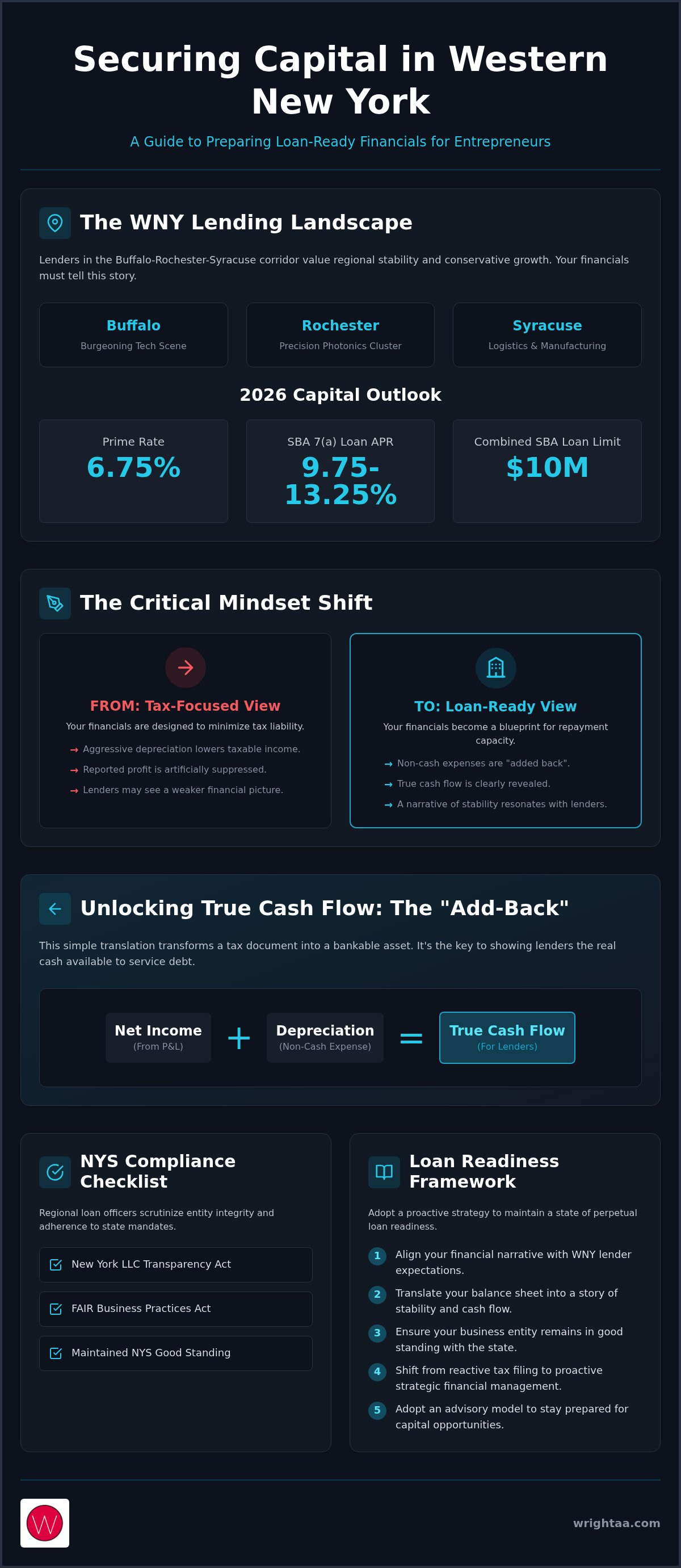
The I-90 corridor functions as a series of distinct economic ecosystems, each with its own rhythm. Buffalo's burgeoning tech scene, Rochester's precision photonics cluster, and Syracuse's logistics and manufacturing hubs require tailored financial narratives. When you approach a lender in these cities, your financials shouldn't just demonstrate profit. They should reflect your understanding of the local industry's behavior. Regional powerhouses and local community banks often have different thresholds for risk. Organizations like the Buffalo State SBDC serve as vital architects in the initial preparation phase. They help entrepreneurs translate their operational success into the structured formats that regional bank committees demand before they'll commit capital to a project.
The 2026 Capital Outlook for WNY Entrepreneurs
As of August 2026, the capital outlook for entrepreneurs remains disciplined yet accessible. With the prime rate holding at 6.75%, variable-rate SBA 7(a) loans are ranging from 9.75% to 13.25% APR. The recent expansion of the combined SBA loan limit to $10 million offers a broader horizon for established firms looking to scale their operations. However, there's a noticeable shift toward character-based lending in smaller Western New York communities. Lenders are looking for the person behind the ledger. In this context, Community Development Financial Institutions (CDFIs) act as essential catalysts for Buffalo's revitalization. They provide capital for visionary projects that might not fit the rigid boxes of traditional institutions. Learning how to prepare financials for a business loan western new york allows you to speak the language of both traditional banks and these specialized local lenders.
Tangible Infrastructure: Assets, Collateral, and Cash Flow
Assets are the physical weight of your business. In the Buffalo-Rochester corridor, valuing these assets requires a CFO perspective that transcends basic bookkeeping. Many owners prioritize tax-minimization, utilizing aggressive depreciation to lower taxable income. However, for a lender, this creates a paradox. While depreciation lowers your tax bill, it also artificially suppresses your reported profit. Understanding how to prepare financials for a business loan western new york involves identifying these non-cash "add-backs" early. By adding depreciation back into your net income, you reveal the true cash flow available to service debt. This intentional translation transforms a tax document into a bankable asset.
While a comprehensive guide to small business loans provides a broad national perspective, the WNY landscape requires a more localized lens. Lenders in our region are increasingly focused on the Debt-Service Coverage Ratio (DSCR). This metric measures your ability to cover loan payments with existing cash flow. In New York, this ratio is under constant pressure from rising operational costs. A sophisticated capital strategy accounts for these pressures before the first meeting with a regional loan officer. It's about demonstrating that your business is not just surviving, but thriving within its specific environment.
Valuing WNY Commercial Real Estate and Equipment
The choice between owning and leasing space in Western New York is a foundational financial decision. Owned real estate provides stable collateral, yet it ties up capital that might be better deployed in operations. If you lease, lenders will scrutinize Triple Net (NNN) leases. These agreements, common in Rochester's industrial zones and Buffalo's revitalized districts, require the tenant to pay taxes, insurance, and maintenance. These are recurring obligations that must be factored into your long-term cash flow projections. In Syracuse, where logistics and manufacturing dominate, equipment costs and their subsequent maintenance schedules become a primary focal point for capital expenditure planning.
The Burdened Cost of Payroll in New York
Mastering how to prepare financials for a business loan western new york means accounting for every hidden expense, especially labor. The true cost of an employee in New York is significantly higher than the gross wage. It includes mandated disability insurance, paid family leave, and workers' compensation premiums. These "burdened" costs directly impact your monthly liquidity and overall DSCR. Utilizing professional payroll services in Buffalo ensures you have the clean audit trail lenders require to verify these expenses. A clear record of these mandated costs demonstrates to a bank that you understand the regulatory environment of the state. It builds confidence in your projections. If you're looking to refine your fiscal architecture, engaging with CFO services can help align your internal records with external expectations.
The Regulatory Price Tag: Compliance and Entity Integrity
Compliance functions as the invisible scaffolding of your financial house. Before a regional bank in Syracuse or Buffalo reviews your cash flow, they first verify your legal existence and adherence to state mandates. A primary hurdle for many is the NYS LLC publication requirement. This unique regulation mandates that new LLCs publish a notice in two newspapers for six consecutive weeks. Lenders often view a lack of compliance here as a red flag for operational discipline. When considering how to prepare financials for a business loan western new york, ensuring you possess a current Certificate of Good Standing from the NYS Department of State is a non-negotiable first step. It signals that your business is not just a concept, but a recognized entity with integrity.
Integrating starting a business in Buffalo with the correct legal structure is essential for long-term bankability. If the foundation is cracked, the capital structure will eventually lean. Lenders look for a clear alignment between your corporate filings and your financial reporting.
Entity Selection and Loan 'Bankability'
Lenders analyze LLCs and S-Corps through different lenses of risk and liability. While an LLC offers simplicity, an S-Corp election can influence how a loan officer views your personal financial statement. The flow-through of income and the specific way you draw a salary affect your debt-to-income ratio. Choosing the right S-Corp vs. LLC election is a strategic choice that impacts your ability to secure personal guarantees. Beyond the initial setup, you must account for ongoing maintenance fees and the 2026 mandates of the New York LLC Transparency Act. These regulatory costs, though small, must be reflected in your projections to show a complete picture of your operational "burn rate" when determining how to prepare financials for a business loan western new york.
Local Permits and Industry-Specific Documentation
Professional practices require a deeper layer of documentation. For example, law firm accounting must demonstrate strict adherence to IOLA account management and professional liability coverage. Lenders in Erie County also look for specific local licensing compliance, which can influence the speed of your application. Delays in NYS regulatory approvals often extend the timeline for loan closing, requiring a cash reserve to cover expenses during the waiting period. A disciplined approach to these requirements ensures that when you meet with a loan officer, the conversation remains focused on your growth rather than missing permits.
Hidden Financial Architecture: Curating Proactive Financials
Reactive tax filing is the primary deal-killer for Western New York business loans. It is the difference between looking back at what happened and looking forward at what is possible. When you understand how to prepare financials for a business loan western new york, you move beyond mere compliance. You begin to curate a narrative of sustainable profit. Professional bookkeeping reduces friction with lenders by providing an impeccable audit trail. It is the ROI of clarity. By presenting organized records, you signal to the bank that your internal systems are as robust as your external operations.
Lenders prioritize the "normalization" of financials. This process involves adjusting your records to remove one-time expenses or anomalies that don't reflect your true earning power. Perhaps you had a significant legal settlement or a unique equipment repair. By isolating these events, you present a clearer picture of your business's core strength. This transparency builds trust with regional loan committees who value consistency and predictability over sudden, unexplained fluctuations in profit.
Tax Strategy vs. Loan Readiness: The CPA's Balancing Act
There is a natural tension between the desire for low taxable income and a lender's need for high net income. Resolving this duality requires proactive business tax planning. One strategic tool is the New York State Pass-Through Entity Tax (PTET). It allows for a meaningful federal deduction while maintaining the bottom line that lenders scrutinize. Fixed-fee monthly accounting ensures your financials are always ready, rather than scrambled together during a high-stakes loan application window. This steady rhythm of reporting creates a foundation of "always-ready" financials that can be deployed at a moment's notice.
The CFO Narrative: Beyond the Numbers
Numbers alone are silent. They require a narrative to give them meaning and context. Utilizing outsourced CFO services provides the Management Discussion and Analysis that local lenders crave. This narrative explains the "why" behind the "what," bridging the gap between raw data and business vision. Tracking specific financial KPIs proves to a bank that you possess the operational discipline to manage their capital effectively. The Debt Service Coverage Ratio (DSCR) is the single most important metric for WNY lenders, functioning as the mathematical proof of your ability to honor your debt commitments. To ensure your business's narrative is bankable, consider engaging with a firm that specializes in tax strategy to align your records with your growth goals.
Designing Your Capital Strategy with Wright CPAs, LLC
Wright CPAs, LLC functions as the architect of your business's financial narrative. We understand that a loan application is more than a stack of papers; it's a structural representation of your company's health and potential. By positioning ourselves as partners in your growth, we ensure that every ledger entry and tax election serves a dual purpose: immediate compliance and long-term bankability. Our firm brings a quiet, confident authority to the Western New York financial scene, helping you navigate the expectations of local institutions with precision and poise. We don't just compile figures. We structure them to withstand the scrutiny of regional lenders.
The onboarding process for our loan preparation and financial cleanup is deliberate and unhurried. We begin by examining the existing scaffolding of your books, identifying areas where reactive filing may have obscured your true earning power. This methodical approach ensures that when you finally sit across from a regional loan officer, your documentation is beyond reproach. Mastery of how to prepare financials for a business loan western new york is built into our monthly rhythm, removing the friction and anxiety often associated with seeking capital. Our fixed-fee advisory model provides the predictable cost management you need to remain loan-ready year-round.
A Partnership in Financial Intentionality
Our focus remains on your long-term success rather than simple, transactional compliance. We integrate modern technology to provide seamless support for clients across the Buffalo, Rochester, and Syracuse corridor. This digital infrastructure allows for real-time clarity, ensuring that your financial position is always visible and verifiable. We believe that architecture is a poetic exercise, and your finances should reflect that same sense of purpose. We invite entrepreneurs who value substance over spectacle to join us for a consultation regarding strategic business planning. It's an opportunity to align your internal operations with the high standards of the WNY lending community.
The Wright Approach to Capital and Growth
Success in the 2026 lending market requires more than just showing a profit. It demands a sophisticated understanding of financial KPIs from the very beginning. We integrate bookkeeping and tax strategy into a unified loan-readiness package, ensuring that your debt service coverage ratio and cash flow management are optimized for growth. For visionary WNY founders ready to scale, the path forward requires a disciplined approach to how to prepare financials for a business loan western new york. Wright CPAs, LLC provides the stability and insight necessary to turn your architectural vision into a permanent reality. Let's begin the process of refining your fiscal narrative today.
Building a Bankable Legacy in Western New York
Securing growth in the Buffalo-Rochester-Syracuse corridor requires a shift from viewing accounting as a historical record to seeing it as an architectural blueprint. We've explored how the intersection of regional trust and rigorous documentation creates a clear path to capital. By aligning your entity structure with state mandates and normalizing your cash flow, you transform raw data into a compelling story of stability. This process isn't merely about compliance; it's about building a structure that can support the weight of your future ambitions.
Understanding how to prepare financials for a business loan western new york is the first step toward scaling your vision with intentionality. It's about finding the quiet equilibrium between tax strategy and bankable profit. At Wright CPAs, LLC, we provide the steady, disciplined guidance needed to bridge this gap. Whether you require specialized law firm accounting or a proactive tax strategy, our fixed-fee predictability ensures your financial foundation remains solid year-round. Your business is a permanent, thoughtful intervention in the regional landscape. Wright CPAs, LLC is here to ensure it has the capital and clarity to flourish.
Design your financial foundation with Wright CPAs, LLC
Frequently Asked Questions
How many years of tax returns do WNY lenders usually require?
Lenders in the Buffalo-Rochester corridor typically require three years of federal and state tax returns for both the business and its owners. This timeline allows the loan committee to assess the stability of your earnings across different economic cycles. If your business has existed for less than three years, lenders may request interim financial statements to bridge the gap. Consistency between these returns and your internal records is essential for building trust during the review process.
Can I get a business loan if my tax returns show a loss due to deductions?
You can often secure a loan despite a reported tax loss if that loss is driven by non-cash expenses like depreciation or one-time capital investments. Bankers use a process called normalization to add these expenses back into your net income. This reveals the true cash flow available for debt service. Understanding how to prepare financials for a business loan western new york involves identifying these specific add-backs to present a narrative of actual profitability.
What is the difference between a compiled, reviewed, and audited financial statement for a loan?
These terms represent varying levels of CPA scrutiny. A compilation is the most basic, where a CPA organizes your data into a financial format without verifying the numbers. A review provides limited assurance that no material modifications are needed. An audit is the most rigorous, involving extensive testing and verification. Most regional lenders in Syracuse and Rochester accept compiled or reviewed statements for small to mid-sized loans, while larger facilities may require a full audit.
How does the NYS LLC publication requirement affect my loan application?
The NYS LLC publication requirement is a mandatory compliance step that lenders check to ensure your entity is in good standing. Failure to publish a notice in two newspapers for six weeks can lead to an inactive status with the Department of State. A lender won't close a loan on an entity that isn't legally compliant. Proving you've completed this process demonstrates operational discipline and protects the bank's interest in a valid and recognized legal entity.
What are the most common 'deal killers' for small business loans in Buffalo?
The most frequent deal killers include inconsistent data between tax returns and internal bookkeeping, undisclosed liabilities, and inadequate debt-service coverage. In the Buffalo market, a lack of transparency regarding owner draws or personal expenses paid through the business can also erode lender confidence. When you learn how to prepare financials for a business loan western new york, you eliminate these friction points by presenting a clean, reconciled, and professionally curated financial package from the start.
Do I need a formal business plan to get a loan in Rochester or Syracuse?
Most lenders require a formal business plan, particularly when you're seeking capital for expansion or a new venture. This document should go beyond simple projections to include a market analysis of the Rochester or Syracuse regions. It serves as the architectural narrative that explains your financial data. A well-structured plan demonstrates that you've considered the risks and opportunities within the local economy, providing the vital context that raw numbers often lack.
How does the New York PTET affect my debt-to-income ratio?
The New York State Pass-Through Entity Tax (PTET) functions as an optional tax that allows your business to pay state income tax at the entity level. While this reduces your federal taxable income, it can complicate how a lender views your personal debt-to-income ratio. It's important to show the loan officer that this is a strategic tax choice rather than a decrease in actual earnings. Your CPA can help bridge this gap in the narrative during the application process.
What is a Debt Service Coverage Ratio (DSCR) and why does my CPA care about it?
The Debt Service Coverage Ratio (DSCR) measures your business's ability to cover its annual debt payments with its net operating income. Lenders typically look for a ratio of 1.25 or higher, meaning you have $1.25 in profit for every $1.00 of debt. Your CPA focuses on this metric because it's the primary mathematical lens through which a bank views your bankability. Maintaining a healthy DSCR is the cornerstone of a sustainable and intentional capital strategy.


