

What if payroll’s greatest risk lies not in a single pay run, but in the gap between wages paid, taxes deposited, and records kept? For Buffalo business owners, payroll tax help Buffalo means understanding federal and New York requirements while keeping deadlines and employee records in order. Buffalo has no separate city-level payroll tax, but state and federal obligations still call for careful attention.
It’s understandable to want payroll handled accurately without letting it take time from daily operations. A late deposit, a filing that doesn’t match payroll records, or a payment that isn’t recorded in the books can create avoidable follow-up work. Reliable support should make responsibilities clear and keep these moving parts connected.
This guide explains what payroll tax support can cover, how to compare service scope, and what to consider when choosing an approach for your business. You’ll also see how payroll records can work alongside bookkeeping and tax planning. Wright CPAs, LLC is a Buffalo-based firm offering payroll services as part of broader business accounting support, bringing local context to the financial picture.
Key Takeaways
- Understand which payroll tasks relate to employer responsibilities, and how they differ from preparing an employee’s personal income tax return.
- Payroll tax help Buffalo businesses use should connect payroll data, accurate records, and applicable federal and New York filings.
- Compare support by scope, responsibility boundaries, communication, record access, and coordination with bookkeeping, while keeping clear review practices in place.
- Prepare for a payroll support discussion by gathering existing payroll records, prior filings, employee details, and payroll calendars.
- See how Wright CPAs’ payroll services can fit alongside bookkeeping and tax planning, with support tailored to your business’s circumstances.
What Payroll Tax Help in Buffalo Should Cover for a Small Business
Payroll tax help brings several connected tasks into view: calculating payroll-related amounts, keeping supporting records, making required deposits, and completing applicable reports. For a Buffalo business, payroll tax help Buffalo should account for federal obligations and New York State requirements, while clearly defining which tasks the business handles and which are included in its support arrangement.
Employer payroll responsibilities aren’t the same as preparing an employee’s personal income tax return. Employers generally withhold and remit applicable taxes and report payroll information. Employees use their wage and withholding records when filing their own returns. For a general overview of what payroll taxes are, see Wikipedia’s summary.
The exact service scope can vary. Before choosing support, identify who supplies employee and wage information, who reviews calculations, who handles deposits and filings, and how the business can access records. These details are especially important when an owner or employee remains responsible for approving payroll or providing information. Clear handoffs let a business delegate work without losing visibility.
Which payroll taxes and records may a business need to manage?
At the federal level, employers may need to account for income tax withholding, Social Security and Medicare taxes, and federal unemployment tax. IRS Form 941 is used for quarterly reporting of employment taxes, while Form 940 reports federal unemployment tax. Employee wage statements and related year-end reporting should also align with payroll records.
New York adds state-specific obligations. Form NYS-45 combines withholding, wage reporting, and unemployment insurance reporting. Depending on the business and its workforce, state requirements may also involve programs such as Paid Family Leave and disability benefits. Filing and deposit schedules should be checked against current IRS and New York State guidance.
Consistent records are the foundation. Keep employee details, wage and withholding information, payment confirmations, and copies of filings organized together. When a figure needs review, a clear trail from source information to the amount reported makes it easier to understand what happened. For example, keep the payroll report and related payment confirmation alongside the corresponding filing.
Why local context matters for Buffalo employers
Buffalo is the local setting, but payroll obligations aren’t all city-specific. There are no separate city-level payroll taxes for Buffalo; employers must still address federal and New York State requirements. Businesses with employees or operations in other New York locations should consider the rules that apply to each work location and employment situation.
Federal payroll tax rules set one layer of employer responsibility; New York requirements add state-specific withholding and reporting obligations. Keeping both layers visible helps owners understand what support needs to cover and how payroll records can connect with bookkeeping and business tax planning.
How Buffalo Payroll Tax Support Works Across Filings and Records
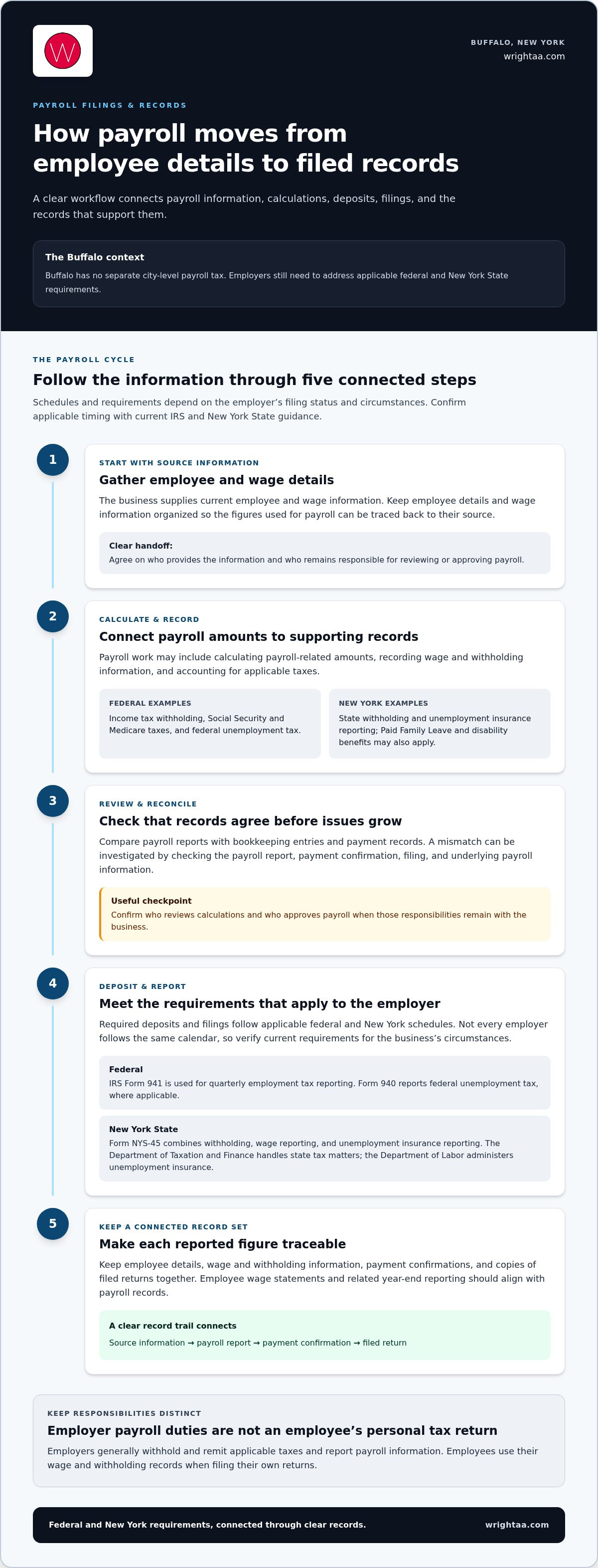
Payroll tax work follows a connected cycle. The business gathers current employee and wage information, payroll amounts are calculated and recorded, and required deposits and filings follow according to the employer’s circumstances and applicable federal and New York schedules. A missed handoff at any stage can leave records that don’t match the amounts reported or paid.
For employers seeking payroll tax help Buffalo, the practical goal is a clear path from source information to filed return. That path should show what information was used, who reviewed it, and where the final records are kept. It also gives the owner a way to review key details rather than treating payroll as a set of isolated transactions.
Federal and New York payroll tax touchpoints
At the federal level, IRS employment tax reporting may include Form 941 for quarterly reporting and Form 940 for federal unemployment tax, where applicable. The IRS explains deposit and reporting responsibilities in its guidance on employment taxes. New York State requirements involve agencies with distinct roles: the Department of Taxation and Finance handles state tax matters, while the Department of Labor administers unemployment insurance. State reporting may include Form NYS-45.
Forms, deposit timing, and deadlines depend on factors such as the employer’s filing status and circumstances. Use current IRS and New York State agency guidance to confirm the schedules that apply. Don’t assume every employer follows the same calendar.
What organized payroll records make easier
Keep wage details, withholding amounts, payment confirmations, and copies of filed returns in an organized record set. This helps an owner trace a reported figure back to payroll activity, review a question, and assemble information for year-end reporting. It also gives an accounting professional clearer context when reviewing how payroll activity appears in the books.
Reconciliation provides a useful checkpoint. Comparing payroll reports with bookkeeping entries and payment records can surface a mismatch while it’s still easier to investigate. For example, if a recorded payroll tax payment differs from the amount shown in payroll records, compare the payment confirmation and filing with the underlying payroll report before relying on the figures in later reporting.
This is general educational information, not advice about a particular employer’s tax obligations. Wright CPAs connects payroll services with bookkeeping and tax planning, helping businesses place payroll activity within a broader accounting picture. Explore Wright CPAs’ business accounting and tax support.
How to Compare Payroll Tax Help in Buffalo Without Losing Oversight
Good payroll support should make responsibilities clearer, not place them out of view. As you compare approaches, look beyond processing convenience. Consider what work is covered, who retains each responsibility, and how payroll information connects with the rest of your business records. For a wider view of financial organization, see this guide to small business accounting in Buffalo.
Service scope: Identify which payroll calculations, records, deposits, and filings the arrangement covers. Make a simple list of tasks that remain with the business, such as supplying employee changes or approving payroll details.
Responsibility boundaries: Establish who prepares, reviews, submits, and retains payroll-related information. Clear ownership matters when an owner or staff member still supplies or approves details.
Communication: Set out how routine updates are shared and how questions or discrepancies are escalated. A written understanding helps prevent important details from being lost between pay periods.
Record access: Confirm that the business can access payroll reports, payment records, and filing copies needed for review and accounting. Records should be easy to retrieve when a figure needs to be traced or reconciled.
Accounting coordination: Consider whether payroll remains a standalone task or is considered alongside bookkeeping and tax planning. Neither model is right for every business; the fit depends on how much context and coordination the business needs.
Questions that reveal service scope and accountability
A useful comparison traces each step from source information to completed reporting. Who provides employee and wage details? Who checks the resulting calculations? Who handles submissions and keeps copies? If the owner or internal staff remains involved, define those handoffs and review points. Document communication channels and escalation steps so responsibility stays clear when information needs correction.
Delegating work doesn’t mean giving up oversight. An owner can retain visibility through agreed reviews of payroll summaries, payment records, and filings. A practical review is to compare key totals with the business’s records, then follow up on differences before they carry into later reporting. A steady review practice helps the business understand what was processed and spot questions while the related details are still available.
When payroll support should connect with tax planning
Payroll choices shape more than each pay period. They affect business expenses, liability records, and the information used in tax planning conversations. The New York State payroll tax information published by the Department of Taxation and Finance can help orient employers to state-specific topics. For broader planning context, explore strategic business tax planning in Buffalo.
Payroll records are most useful when they reconcile with accounting records. That connection can make review more coherent and give business owners a clearer view of how payroll fits into the company’s financial picture.
How to Prepare Your Buffalo Business for Payroll Tax Support
A little preparation can make a discussion about payroll tax help Buffalo more focused. You don’t need to resolve every discrepancy first. Bring a clear picture of how payroll currently works, where records live, and which questions need attention. That context helps distinguish a records issue from a question about ongoing responsibilities or coordination with bookkeeping.
Records and questions to bring to an initial discussion
Gather useful records through a secure method, and avoid sending sensitive employee or financial information through unsecured channels. A concise preparation sequence can help:
- 1. Collect recent records. Assemble available payroll summaries, relevant federal and New York filings, payment records, and current employee details. Use the records you have, even if something is missing.
- 2. Map your payroll routine. Note how often employees are paid, the business locations involved, who supplies payroll information, and who currently reviews it.
- 3. Mark open items. List notices, discrepancies, missed deadlines, or questions about past filings. Include upcoming changes, such as a new hire, departure, or change in pay, if relevant.
- 4. Bring the calendar. Share the payroll calendar and any filing or deposit dates your business tracks. This helps frame the timing and responsibilities that need attention.
These details help make the conversation practical. They also distinguish immediate record questions from changes that may need to be considered in an ongoing support arrangement. If records are incomplete, note what’s missing rather than delaying the discussion until every document is located.
How to establish a workable review rhythm
Before support begins, agree on how the business will access payroll records, when information will be reviewed, and who remains responsible for each handoff. If an owner or employee approves payroll details, make that review step explicit. A simple written outline can prevent assumptions about who provides, checks, or retains information.
Reconciliation is most useful as a recurring practice, not only a year-end task. For example, comparing payroll records with bookkeeping entries and payment records at an agreed interval can help surface a mismatch while the related details are still easy to locate. The right rhythm depends on the business’s payroll frequency, staffing, and internal review capacity. Set it to fit those circumstances rather than adopting a schedule simply because another business uses it.
Wright CPAs, LLC offers payroll services alongside bookkeeping and tax planning, so payroll information can be considered within a broader accounting relationship. Explore payroll and accounting support for your business.
Choose Wright CPAs for Payroll Tax Help in Buffalo
Payroll affects more than the pay run. Its records shape bookkeeping, inform tax planning, and help owners understand the financial commitments attached to their workforce. For businesses seeking payroll tax help Buffalo, a local accounting relationship can bring those connected details into a broader view.
Wright CPAs, LLC is a Buffalo-based tax and accounting firm offering payroll services alongside bookkeeping and tax planning. The firm serves businesses in Buffalo, Rochester, and Syracuse. Support is tailored to each business’s circumstances, with local context and an understanding that requirements can differ across locations.
A connected view of payroll, bookkeeping, and tax planning
Payroll information is easier to use when it fits coherently into the business’s financial records. Wage and tax activity can inform bookkeeping, while organized records give owners and their accounting team a clearer foundation for tax planning conversations. That connection helps business owners see payroll not as an isolated administrative task, but as part of the company’s wider financial picture.
The right support should reflect the business’s circumstances, including its existing records and the questions it needs to resolve. Clear financial information can help owners make decisions with more context, whether they’re reviewing operating costs or preparing for a planning discussion. The value lies in a considered relationship between payroll, accounting, and business goals, not in a one-size-fits-all process.
A practical next step for Buffalo business owners
Bring the questions that matter most to your business. You might want to clarify payroll responsibilities, understand how records connect with bookkeeping, or discuss how payroll fits into tax planning. Sharing your business context helps frame a useful conversation about the support that suits your needs.
Wright CPAs offers a grounded place to discuss those needs, with payroll services connected to broader tax and accounting support. Talk with Wright CPAs about payroll tax support.
Dependable payroll records create a clearer view of business activity and stronger day-to-day oversight.
Bring Payroll and Business Records Into Clearer Alignment
Choosing payroll support is about more than handing off calculations. A useful arrangement makes responsibilities visible, keeps records accessible, and helps payroll activity connect with bookkeeping and tax planning. That clarity can give you a steadier view of deadlines, reporting, and the financial decisions attached to your workforce.
For payroll tax help Buffalo businesses can place within a broader accounting relationship, Wright CPAs, LLC offers payroll services alongside bookkeeping and tax planning. The Buffalo-based firm serves businesses in Buffalo, Rochester, and Syracuse, tailoring support to each business’s circumstances.
You can begin by identifying the payroll questions you need answered, the records you want organized, and the level of review that fits your role as an owner. A conversation can help clarify an approach that works with your business and its accounting needs.
Discuss payroll tax support for your business with Wright CPAs. Organized records and clearly assigned responsibilities can support better visibility and day-to-day oversight.
Frequently Asked Questions
What does payroll tax help for a Buffalo business typically include?
Payroll tax help typically covers payroll-related calculations, recordkeeping, deposits, and applicable reporting. For a Buffalo business, that can mean coordinating federal responsibilities with New York State requirements and keeping wage, withholding, payment, and filing records organized. The exact scope varies by arrangement, so clarify who prepares, reviews, submits, and retains each item. Payroll tax help Buffalo businesses use is separate from preparing employees’ personal income tax returns.
Does a small business need payroll tax support if it has only a few employees?
A small headcount doesn’t remove the need to manage applicable employer payroll responsibilities. Even with only a few employees, a business may need to track wages and withholding, make required deposits, and complete reporting. Paid support isn’t the only way to manage those tasks, but it can help owners who have limited time or want payroll records coordinated with their accounting. The right approach depends on the business’s circumstances and capacity.
Which federal payroll tax filings may an employer need to manage?
Depending on its circumstances, an employer may need to file IRS Form 941 for employment tax reporting and Form 940 for federal unemployment tax. Employers may also need to prepare and file year-end wage statements, including Forms W-2 and W-3. Applicable forms, deposit schedules, and deadlines can vary. Check current IRS guidance for the business’s filing requirements, and keep copies of returns and payment records together for review.
What New York payroll tax responsibilities should Buffalo employers understand?
Buffalo employers should consider New York State withholding and unemployment insurance reporting, along with applicable state programs such as Paid Family Leave and disability benefits. Form NYS-45 combines withholding, wage reporting, and unemployment insurance reporting. Buffalo has no separate city-level payroll tax, but federal and state obligations still apply. Businesses operating at multiple New York locations should assess the requirements relevant to their employees and work arrangements.
Can payroll tax support work alongside bookkeeping and tax planning?
Yes. Payroll support can sit alongside bookkeeping and tax planning, helping the business consider payroll activity in the context of its broader financial records. For example, comparing payroll reports with recorded wages and tax payments can help identify discrepancies and support more informed planning conversations. Wright CPAs, LLC offers payroll services alongside bookkeeping and tax planning to businesses in Buffalo, Rochester, and Syracuse.
How can a business prepare to move payroll tax support to an accounting firm?
Gather recent payroll summaries, prior filings, payment records, current employee details, and the payroll calendar. Note the business’s locations, pay frequency, existing review responsibilities, and any unresolved notices, discrepancies, or missed deadlines. Also list upcoming changes, such as staffing or pay adjustments, that could affect payroll. Handle employee and financial information securely, and agree on record access and responsibility boundaries during the transition discussion.
Can payroll tax help reduce filing errors or missed deadlines?
Structured support and clear review practices can help reduce the risk of errors or overlooked deadlines, but no arrangement can guarantee that they won’t occur. A defined process for checking payroll information, tracking applicable filing dates, retaining payment confirmations, and reconciling records gives owners more visibility. Responsibility boundaries matter too: business owners should understand which tasks are delegated and which information or approvals they still need to provide.


