

What if the federal tax status you secured for your business remains invisible to the state of New York? Many entrepreneurs believe that a federal S election automatically flows through to the state level, yet New York operates on its own distinct logic. Without a separate, intentional filing, your business may remain tethered to a C Corp structure at the state level, inviting the very double taxation you sought to avoid. Electing s corp status in New York requires a specific understanding of Form CT-6 and the rigid 75-day deadline that defines it.
It's natural to feel a sense of hesitation when navigating these dual requirements. You want the quiet confidence that your financial foundation is solid and that your tax structure is optimized for growth. This guide provides a clear map for navigating the state's specific mandates, from the fixed-dollar minimum tax to the complexities of mandatory elections for investment-heavy firms. We will walk through the essential steps to align your federal and state filings, ensuring your business operates with the clarity and purpose it deserves.
Key Takeaways
- Recognize that New York State requires a separate, intentional election to mirror your federal pass-through status and avoid state-level corporate taxes.
- Navigate the rigid 75-day window for electing s corp status in new york to ensure your Form CT-6 filing aligns with the state’s specific timeline.
- Eliminate the risk of the "Silent C-Corp" by securing state-level recognition, preventing your business from being taxed as a corporation by New York.
- Identify the threshold where investment income triggers a mandatory election, a critical nuance for businesses with significant passive earnings.
- Transform your tax structure from a static filing into a proactive strategy that enhances your firm’s long-term financial health and compliance.
The Architecture of the S Corporation in New York State
The architecture of a business is more than its legal shell. It's the intentional arrangement of fiscal responsibilities. An S corporation serves as a foundational element within this framework, providing a structural harmony between legal protection and tax efficiency. By choosing this path, business owners create a conduit where profits flow directly to shareholders, bypassing the traditional layer of corporate-level taxation. This design is particularly vital for those considering electing s corp status in new york, where the intersection of state franchise taxes and personal income reporting requires a steady hand. The relationship between the internal financial environment and the external regulatory site must be balanced with precision.
Strategic benefits extend beyond mere simplicity. This structure allows owners to categorize a portion of their income as distributions, which aren't subject to self-employment taxes. It’s a refined method of preserving capital while maintaining the robust shield of a corporation. In the architecture of finance, this is the equivalent of selecting materials that are both durable and light; it provides the strength of a corporate entity without the heavy burden of double taxation. This balance ensures that the business remains both resilient and agile.
The Pass-Through Concept in a New York Context
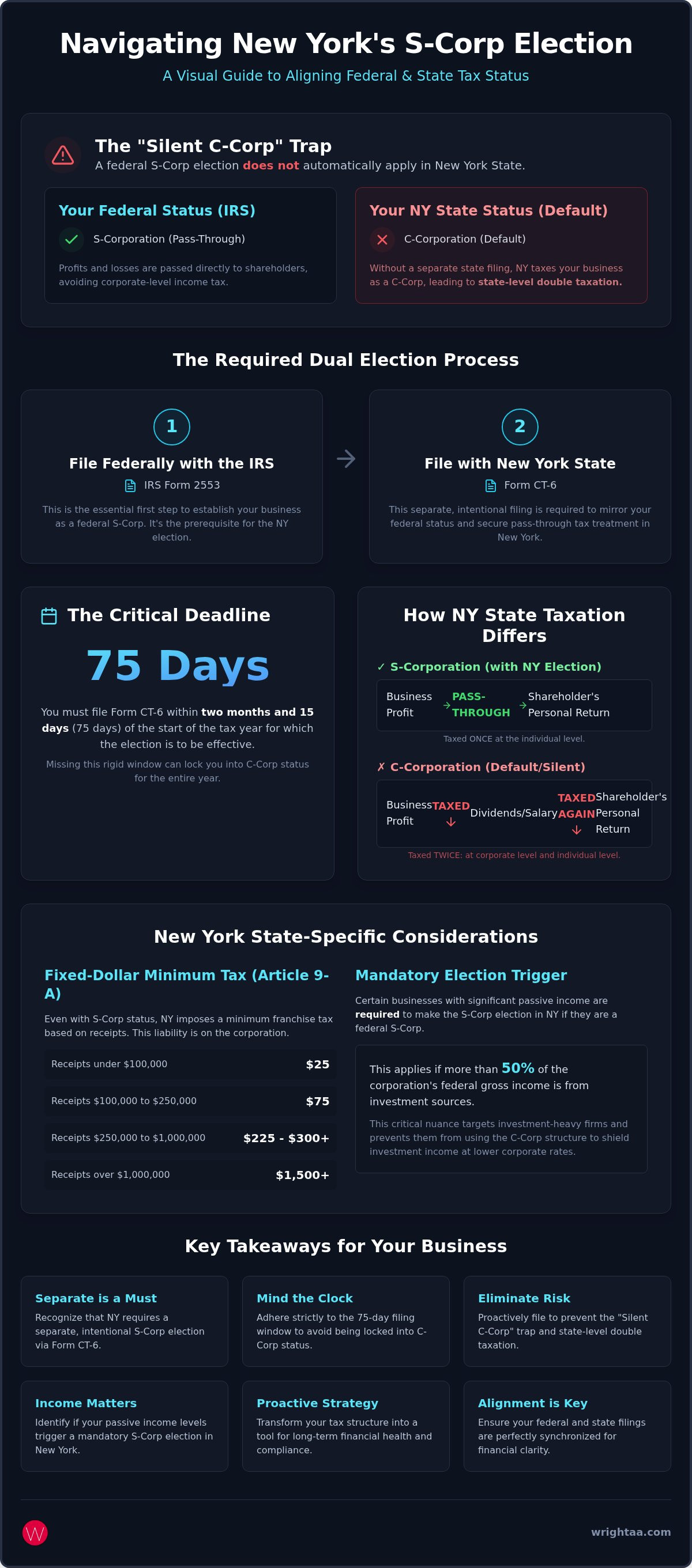
In New York, the tax landscape is governed by Article 9-A. For most entities, this involves a franchise tax based on business income or a fixed-dollar minimum. For example, a business with receipts under $100,000 faces a modest $25 minimum tax, while larger firms with receipts exceeding $1,000,000 see this scale to $1,500. When a business successfully navigates the process of electing s corp status in new york, the primary tax liability shifts from the corporate entity to the individual shareholders. This transition is not merely a clerical change. It’s a fundamental shift in how the state views your business’s economic footprint. For closely held businesses in Buffalo and the surrounding region, this reporting method provides a clearer view of personal wealth and business health as a single, unified landscape.
S Corp vs. LLC: Strategic Tax Implications
Choosing between an S Corp and an LLC is often a study in "site" versus "structure." An LLC represents the site; it's the legal ground upon which the business stands. An S-election is a tax status, not a legal entity type. While both can offer pass-through benefits, the S Corp structure provides more granular control over payroll and distributions. This distinction is critical for those looking to design a tax-efficient future. For a deeper analysis of these choices, you can explore our guide on S-Corp vs. LLC: Tax Implications in New York State. This clarity allows for a more intentional approach to long-term financial planning and asset protection.
The Dual Election: Why Federal Approval Isn’t Enough in NY
A common misconception among Western New York entrepreneurs is that federal tax status dictates state-level treatment. It doesn't. If you secure IRS approval but neglect the state filing, you enter the "Silent C-Corp" trap. Your business remains a pass-through for federal purposes, yet New York continues to tax you as a traditional corporation. This oversight creates structural cracks in your financial plan. It leads to unexpected double taxation at the state level, where corporate income is taxed once at the entity level and again on your personal return. Avoiding this requires an intentional, dual-level approach to electing s corp status in new york.
For businesses in Buffalo, Rochester, and Syracuse, financial clarity depends on the alignment between these two distinct jurisdictions. When the federal and state structures don't match, the resulting friction can erode your capital. Maintaining structural integrity means ensuring that every document filed with the IRS is mirrored by its counterpart in Albany. This level of coordination is a foundational requirement for any tax-efficient strategy. If you are currently evaluating your business structure, our team can help you design a tax strategy that ensures both layers are perfectly synchronized.
The Federal IRS Form 2553 Requirement
Before New York recognizes your status, you must establish a federal foundation. IRS Form 2553 is the prerequisite instrument. The timeline is rigid; you must file within two months and 15 days of the beginning of the tax year. Common pitfalls often include missing shareholder signatures or failing to prove the timely mailing of the form. These errors at the federal level can delay or even invalidate your eligibility for state-level benefits. It’s essential to treat this first step as the cornerstone of your entire tax architecture.
The New York State Form CT-6
Once the federal foundation is set, you must turn your attention to New York State Form CT-6. This is the specific document that signals your intent to the state. Understanding Form CT-6 and Strategic Timelines is vital, as New York does not offer the same leniency as the IRS for late filings. A defining feature of this form is the requirement for unanimous shareholder consent. Every individual with an interest in the company must provide a written signature to authorize the election. This process demands a high level of precision and oversight. Coordinating these filings requires CFO-level guidance to ensure that every signature is captured and every deadline is met, preserving the fiscal health of your organization.
Navigating NY Eligibility and the Mandatory S Election Trap
Eligibility is the site survey of business taxation; it determines whether the ground is suitable for the structure you intend to build. For most Article 9-A corporations, the path to electing s corp status in new york is straightforward, provided they meet the federal criteria. However, New York introduces a unique regulatory feature known as the mandatory S election. Under Tax Law § 660(i), the state may force your hand if your revenue mix leans too heavily toward passive sources. This isn't a choice you make; it’s a condition the state imposes when your investment income exceeds 50% of your federal gross income for the year.
Investment income, as defined by the state, is often broader than many realize. It encompasses more than just basic interest. It includes royalties from intellectual property and certain types of rental income that might otherwise seem like active revenue. When these elements comprise more than half of your gross income, New York effectively removes the "C Corp" option from your toolkit. This mandatory shift can disrupt a financial plan that hasn't accounted for pass-through reporting at the state level. It requires a deep understanding of your revenue's composition to avoid being caught in this structural trap.
The 50% Threshold for Mandatory Elections
Monitoring the texture of your revenue is essential to avoid an unintended election. Investment income includes interest, dividends, and royalties, along with certain capital gains. If you cross that 50% threshold without having filed Form CT-6, the state treats you as an S Corp regardless, which can lead to reporting friction. Utilizing financial KPIs for small business allows you to track these ratios in real time. This proactive awareness ensures that your tax status remains a deliberate choice rather than a surprise triggered by your portfolio's performance.
Special Considerations for Law Firms and Professional Corps
Professional entities, such as PCs and PLLCs, face their own specific nuances within this framework. For legal practices, the transition involves more than just a tax form; it requires an alignment of shareholder distributions and professional regulations. Our work as a CPA for law firms Buffalo NY focuses on creating this intentionality. We ensure that the process of electing s corp status in new york respects the professional boundaries of your practice while optimizing the tax benefits available to your partners. This disciplined approach balances the firm's growth with the rigorous compliance standards of New York State.
The Logistics of Election: Form CT-6 and Strategic Timelines
The process of electing s corp status in new york is a sequence of precise actions, much like the assembly of a complex structural frame. It requires a methodical approach where each step supports the next. Precision in documentation is not just a requirement; it is the safeguard of your business’s financial integrity. To successfully transition your entity, follow this established sequence:
- Step 1: Confirm federal S Corp status. You must have an approved IRS Form 2553 on file, as New York’s recognition is contingent upon this federal foundation.
- Step 2: Obtain unanimous shareholder consent. Every individual with an equity interest must provide a written signature for the New York election to be valid.
- Step 3: Complete Form CT-6. This document must contain precise entity information, including your employer identification number and the exact date of incorporation.
- Step 4: Submit to the NYS Department of Taxation and Finance. This must occur within the specific 75-day window defined by the state.
- Step 5: Verify receipt. Confirm the "Effective Date" for your tax year to ensure your pass-through status is active for the intended period.
The 75-Day Clock: Timing Your Entry
Time is a rigid material in tax compliance. The 15th day of the 3rd month is the most critical juncture on your tax calendar. For a calendar-year business in 2026, the deadline to file Form CT-6 is March 15, 2026. If you're establishing a new entity, the clock begins the moment you incorporate; you have exactly 75 days to secure your status. Missing this window can leave your business in a state of tax limbo, often resulting in corporate-level taxation for the duration of the year. This timing is non-negotiable and requires proactive oversight.
Filing Methods and Documentation
Choosing between online submission and paper filing is a matter of administrative preference, yet each has its own weight. Online services offer immediate confirmation, while paper filing via certified mail provides a physical "proof of mailing." This proof is your primary defense in any potential tax controversy. Integrating these filing tasks into your business tax planning Buffalo NY ensures that these deadlines are anticipated rather than reactive. If you are just beginning your journey, our team provides the intentional guidance needed for New Business Formation to ensure your structure is sound from day one.
Structural Integrity: Integrating S-Corp Status into a Proactive Strategy
Transitioning to an S-Corp is more than an administrative task; it’s a shift in your business’s operational DNA. Many owners view the filing of Form CT-6 as a final destination. In reality, it’s the commencement of a more disciplined financial era. Once you’ve completed the process of electing s corp status in new york, your monthly bookkeeping must evolve to reflect this new reality. You’re no longer just managing cash flow; you’re managing a pass-through entity that requires precise payroll records and clear distinctions between earned income and profit sharing. This structural change demands a move away from the "one-and-done" mindset toward a model of continuous, intentional oversight.
The Reasonable Salary Requirement
The IRS and the New York State Department of Taxation and Finance pay close attention to officer compensation. If your salary is set too low solely to avoid payroll taxes, you invite unwanted scrutiny and potential reclassification of your distributions. Setting a "reasonable" salary is an exercise in both data and discipline. We use CFO-level data to analyze industry benchmarks and your firm’s specific performance to find the right balance. This ensures you satisfy regulatory requirements while still maximizing the tax-advantaged distributions that fund your long-term wealth. It’s about finding the equilibrium between your immediate W-2 needs and your future financial goals, ensuring your compensation reflects the true value of your contribution to the firm.
Ongoing Advisory and Monthly Clarity
A static tax plan is a fragile one. For S-Corps, a fixed-fee monthly retainer provides the steady, unhurried guidance needed to maintain compliance year-round. This model allows for continuous adjustments to your strategy as your revenue fluctuates, rather than waiting until the end of the year to discover a filing error. Ensuring your small business accounting Buffalo NY is configured correctly from the start prevents the structural cracks that lead to state-level penalties. It creates a space where financial data becomes a tool for decision-making rather than a source of anxiety.
If you are in the early stages of starting a business in Buffalo NY, the choices you make today will define your fiscal landscape for years to come. Electing s corp status in new york is a powerful tool, but its true value is realized through ongoing, proactive management. Booking a consultation allows us to walk through your specific context and build a financial architecture that is both resilient and tax-efficient. Building a relationship with an advisor who understands the intersection of state mandates and your personal growth is the final piece of a sound business foundation.
Designing a Resilient Financial Foundation
The structural choices you make today define the resilience of your business tomorrow. Successfully navigating the requirements for electing s corp status in new york ensures that your entity remains a true pass-through, protecting your capital from the friction of double taxation at the state level. It is a process that demands both technical precision and a visionary approach to long-term growth. By aligning your federal and state filings within the rigid 75-day window, you create a stable environment for your firm to thrive.
Integrating this status into a proactive strategy requires more than a single filing; it requires a commitment to ongoing financial clarity. We offer Buffalo-based expertise tailored specifically for law firms and closely held businesses, providing a fixed-fee monthly advisory model that removes the ambiguity of traditional accounting. This disciplined approach allows you to focus on the purpose of your work while we maintain the integrity of your tax structure. Design a more intentional tax structure with Wright CPAs and secure the future of your practice with confidence.
Frequently Asked Questions
Is a New York S-election mandatory for all federal S Corporations?
An election is not automatic or mandatory for every federal S Corporation. Most businesses must intentionally file Form CT-6 to align their state status with their federal one. However, if your investment income exceeds 50% of your federal gross income, New York deems the election mandatory under Tax Law § 660(i). Without a proactive election, your business remains a C Corporation at the state level, potentially leading to double taxation.
What is the deadline for filing Form CT-6 in New York?
The deadline for electing s corp status in new york is the 15th day of the third month of the tax year. For a calendar-year business, this date is March 15. New businesses must file within 75 days of their date of incorporation. These timelines are rigid and leave little room for error. Missing this window often requires waiting until the following tax year to secure the desired pass-through treatment.
Can an LLC elect S Corp status for New York State taxes?
Yes, an LLC can function as an S Corporation for state tax purposes if it has first secured that status with the IRS. This dual-layered approach allows you to retain the legal flexibility of an LLC while utilizing the tax advantages of an S Corp. You must ensure that both the federal Form 2553 and the state Form CT-6 are filed and approved to maintain structural consistency across both jurisdictions.
What happens if I miss the New York S-election deadline?
If you miss the filing window for electing s corp status in new york, your business will be taxed as a C Corporation by the state for that year. This occurs even if the IRS has already approved your federal S-election. New York is notably strict regarding these deadlines and rarely grants late-filing relief. You will likely have to wait until the next tax year to secure the desired pass-through treatment.
Do all shareholders have to sign the NY S-Corp election form?
Yes, New York requires unanimous written consent from all shareholders for the election to be valid. Every individual with an equity interest must sign Form CT-6. This requirement ensures that all owners agree to the shift in tax liability from the corporate level to their personal returns. Collecting these signatures early is a critical step in maintaining the integrity of your filing and avoiding last-minute administrative friction.
How does New York tax S Corporation shareholders who live out of state?
Non-resident shareholders are subject to New York personal income tax on their share of the S Corporation’s New York-sourced income. The corporation may also be required to make estimated tax payments on behalf of these non-resident owners. These payments are generally due in four installments throughout the year. It's a layer of complexity that requires careful coordination between the business entity and its individual shareholders to ensure compliance.
Can I revoke my New York S-election later if my business strategy changes?
You can revoke your New York S-election if your business strategy evolves. This typically involves filing a written statement of revocation with the Department of Taxation and Finance. The timing of this filing determines when the revocation becomes effective. It's a significant structural change that should be integrated into a broader tax strategy, as returning to C Corporation status alters your long-term reporting and liability requirements.
Does Buffalo have specific city-level S-Corp taxes I should know about?
Unlike New York City, Buffalo does not impose a separate city-level general corporation tax on S Corporations. Your primary state-level obligation remains the New York State franchise tax, which often results in a fixed-dollar minimum based on your New York receipts. This simplifies the tax landscape for businesses in Western New York. It allows you to focus on state and federal alignment without the additional burden of a localized corporate income tax.


