

The accounting firm with the longest service list isn’t necessarily the right one for your business. When comparing accounting firms in Buffalo NY, focus on whether the firm’s services and working style fit the decisions you need to make, not just the tax return you need to file.
Tax preparation, bookkeeping, and advisory work serve different purposes, and a service list that looks comprehensive may not match your day-to-day needs. Local context matters, too. A Buffalo-area business may need support that accounts for New York requirements and the company’s industry, structure, and stage of growth.
This guide provides a practical way to compare firms by service scope, communication, planning, and ongoing support. You’ll learn how to clarify what’s included, assess whether a firm can help beyond tax season, and consider how your needs may change as your business grows. The aim is to find accounting support that fits your current operations and the decisions ahead.
Key Takeaways
- When comparing accounting firms in Buffalo NY, focus on how each firm’s service scope and working style fit your business, not just its tax preparation offering.
- Compare communication, reporting cadence, technology, and billing structure to understand what an ongoing relationship would involve.
- Use a consistent framework: list your needs, rank priorities, and separate essential services from optional support.
- Plan a firm transition around records, deadlines, continuity, and the reporting process your business relies on.
- Year-round bookkeeping, financial reporting, and proactive tax planning can connect routine accounting with clearer business decisions.
Why comparing accounting firms in Buffalo takes more than comparing tax-return services
A directory can show which firms are nearby, but it can’t tell you whether their services suit your business. Comparing accounting firms in Buffalo NY means considering three things together: your financial needs, the work included in the relationship, and how you want to communicate and make decisions. A firm focused on annual tax filing may fit a business with straightforward, occasional needs. A business with regular payroll, frequent transactions, or changing plans may need support throughout the year.
Tax preparation organizes financial information to complete tax returns. Ongoing accounting support maintains and interprets financial records over time to inform business decisions.
The right fit depends on how your business operates. Entity structure can affect the records and reporting a company needs to maintain. A high volume of transactions can make regular bookkeeping and reconciliations more useful, while plans to hire, expand, or change operations may call for cash-flow guidance and forward-looking tax planning. Industry needs matter as well. A law firm, for example, may have accounting considerations that differ from those of another closely held business. Look beyond whether a firm offers accounting services and assess whether its actual scope reflects your circumstances.
What does an accounting firm do beyond preparing tax returns?
An accounting firm may provide tax preparation, bookkeeping, payroll, cash-flow support, or advisory work, but firms combine these services in different ways. Bookkeeping organizes day-to-day transactions. Payroll supports employee pay processes. Cash-flow guidance helps owners understand expected inflows and outflows, while advisory work can help interpret financial information and inform decisions. Wright CPAs brings tax, accounting, and consulting together, with CFO-level guidance for businesses that need help understanding their financial picture.
When does a Buffalo business need year-round accounting support?
Look for recurring patterns rather than one unusually busy week. Reports that arrive too late to guide decisions, cash balances that are difficult to explain, or choices made without current financials may indicate that occasional tax-season help isn’t enough. Regular bookkeeping and review can give owners a steadier view of business activity. Advisory support can add context when a decision requires more than historical numbers. For a closer look at the foundations of regular financial oversight, explore small business accounting in Buffalo.
Not every business needs the same service rhythm. A one-time tax engagement may suit a defined filing need, while monthly accounting can establish a recurring process for maintaining records, reviewing reports, and planning ahead. Start by identifying the decisions your financial information should support, then decide what level of service would make that information useful. This is more practical than choosing by location or service labels alone.
Compare Buffalo accounting firms by service scope, planning, and communication
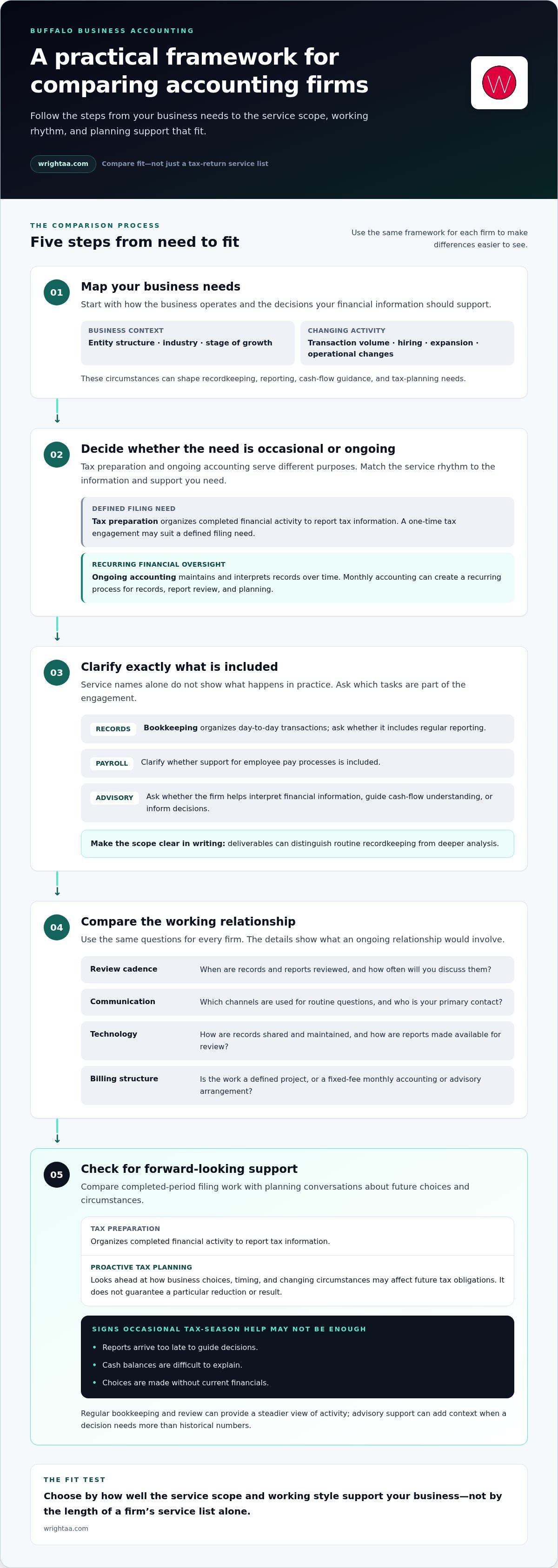
A useful comparison looks past service names and asks what happens in practice. Does bookkeeping include regular reporting? Is tax planning part of an ongoing relationship or a separate engagement? How often will you review financial information together? When comparing accounting firms in Buffalo NY, use the same criteria for each firm so you can see the differences clearly.
| Comparison area | What to clarify |
|---|---|
| Service scope | Which tasks are included, such as bookkeeping, payroll, tax preparation, or advisory support? |
| Review cadence | When are records and reports reviewed, and how often will you discuss them? |
| Communication | Which channels are used for routine questions, and who is your primary contact? |
| Technology | How are records shared, maintained, and made available for review? |
| Billing structure | Is the work a defined project or a fixed-fee monthly accounting or advisory arrangement? |
Before an engagement begins, understand the service scope and the expected contact cadence. A written description of deliverables can distinguish routine recordkeeping from deeper analysis. An agreed review schedule clarifies when you’ll receive information and discuss it. Technology matters because the process for sharing records and accessing reports affects how easily your team can work with the firm. NetSuite’s small business accounting tips also highlight the value of consistent practices for maintaining useful financial information.
How to compare tax preparation with proactive tax planning
Tax preparation organizes completed financial activity to report tax information. Planning looks ahead by considering how business choices, timing, and changing circumstances may affect future tax obligations. It doesn’t guarantee a particular reduction or result. The analysis depends on each business’s situation and decisions. A firm that provides both can connect filing work with forward-looking conversations. Wright CPAs provides strategic business tax planning in Buffalo as part of its tax work.
What to understand about fees, deliverables, and communication
A project-based engagement is built around a defined task, such as tax preparation or a consulting project. A fixed-fee monthly retainer is structured around recurring accounting or advisory support. Neither format is automatically better. The fit depends on whether you need a discrete result or continuing attention. Wright CPAs offers fixed-fee monthly accounting and advisory retainers, as well as project-based tax preparation and consulting engagements.
Compare the written scope, reporting deliverables, review frequency, and expected communication channels. These details help you assess the service model against your day-to-day needs. To learn how Wright CPAs brings tax, accounting, and consulting together, explore Wright CPAs’ accounting and advisory support.
A practical framework for choosing an accounting firm in Buffalo, NY
A repeatable process makes comparing accounting firms in Buffalo NY less dependent on polished descriptions or a long service list. Start with the decisions your business needs to make, then assess each firm’s scope against those needs. Separate essential requirements from optional support so an appealing extra doesn’t distract from a missing foundation.
- List the work that needs support. Note recurring tasks such as bookkeeping, payroll, and tax preparation, along with specific pressure points like late reports or uncertain cash flow. Include upcoming changes, too. This list should reflect your operating needs, not every accounting service you can think of.
- Rank priorities by consequence. Mark what must be covered for the relationship to work and what could be useful later. Timely monthly records may be essential for one business. For another, CFO-level guidance may matter because the owner needs help interpreting financial information before making decisions.
- Compare the actual scope. Map each firm’s stated services to your priorities. Distinguish work performed routinely from support available only as a separate project. A service label alone doesn’t tell you which records, reports, or guidance you’ll receive.
- Assess communication and local context. Consider whether the working rhythm and communication channels suit your team. For a Buffalo-area business, relevant experience with New York tax matters and local business conditions can help put decisions in context. Don’t assume every company has identical needs.
- Review the fit against real decisions. Picture using the firm’s reports to plan hiring, manage cash flow, or evaluate a change in operations. If the proposed scope gives you the information and guidance needed for those decisions, it may be a better fit than a broader package you won’t use.
Match accounting support to business size and complexity
Revenue alone doesn’t determine the right service level. Consider transaction volume, payroll needs, entity structure, and the decisions you handle as an owner. Routine bookkeeping and tax preparation may cover the core needs of one business; another may also need cash-flow management or CFO guidance. Closely held businesses and law firms can have specialized reporting considerations, so relevant industry experience can help when matching the scope of service to your needs.
Assess technology, access, and working relationship
Technology should make the accounting process easier to follow. Compare how financial documents are exchanged, how reports are accessed, and whether the review schedule is predictable. Modern tools can support collaboration between a Buffalo-based firm and clients across the United States, while clear communication keeps the relationship grounded. Choose reports that help you track the decisions and indicators that matter to your business. Information on financial KPIs for small business can help frame which indicators may be useful.
Keep your comparison notes concise: essential needs, optional support, and the reasons each firm’s approach fits. This gives you a consistent basis for deciding and a reference point as your business changes.
What switching accounting firms involves for Buffalo-area businesses
Changing accounting firms can raise practical concerns: Will records stay accessible? Who is tracking upcoming deadlines? How will reports look under a new process? These are useful questions to address, but a transition doesn’t have to follow one fixed timeline or sequence. The work depends on your current records, the services involved, and what’s coming up for the business. Switching isn’t necessary for every company. If the current arrangement still fits, reviewing expectations may be enough.
For businesses comparing accounting firms in Buffalo NY, treat a handover as an organized transfer of context, not just files. The new relationship needs enough background to understand prior filings, current bookkeeping, unresolved items, and how you use financial reports. Clarifying these details early helps identify gaps and set sensible priorities.
Prepare financial records and clarify the handover
Gather the records that explain your financial position and how it has been managed. Assembling a complete set may take time, and some records may not move automatically between systems. Make an inventory, note where information is stored, and identify who currently has access.
- Prior tax returns and available supporting records
- Recent financial statements and bookkeeping files
- Payroll information and records relevant to payroll processing
- Accounting software and other systems used to manage financial data
- Open questions, unfinished tasks, and upcoming filing or payment dates
Keep the notes factual. For example, distinguish a completed reconciliation from one still awaiting review, and flag any transaction or balance that needs explanation. This gives the incoming firm a useful starting point without assuming that every file is complete or every system can transfer data seamlessly.
Set expectations for the first reporting and planning cycle
At the start of the relationship, align on who provides records, how they’ll be shared, when reporting is reviewed, and which communication channels suit your team. Set initial priorities based on the condition of the current books and the decisions ahead. A business preparing for a major purchase may need a different first discussion than one focused on completing routine bookkeeping.
- Agree on the first reporting period and the records needed for it.
- Identify responsibilities for bookkeeping, payroll, and tax-related work.
- Mark relevant New York and federal dates on the business calendar, using current, verified information for the company’s circumstances.
- Set a process for documenting questions and following up on unresolved items.
Review the first cycle together. Use it to clarify report formats, resolve misunderstandings, and shape the next planning conversation. A deliberate handover supports continuity while leaving room to adapt the process to the business. For support with a transition or ongoing accounting needs, explore accounting support from Wright CPAs.
How Wright CPAs supports Buffalo businesses beyond tax season
Wright CPAs, LLC is a Buffalo-based tax, accounting, and consulting firm founded in 2012. The firm supports businesses locally and across the United States, using modern technology to connect financial information with ongoing guidance. For owners comparing accounting firms in Buffalo NY, consider how tax work relates to the broader financial picture. A return records tax information for a filing period; regular accounting and planning can keep business decisions connected to current financial activity.
A service model shaped around financial clarity
Monthly bookkeeping creates an organized record of business activity. Financial reporting gives owners a view of that activity, while proactive tax planning helps them consider how future decisions may affect their tax position. Together, these services can provide a clearer foundation for conversations about operations and plans. The value is in arranging financial information around the questions an owner needs to answer, not simply producing more reports.
The right combination depends on the work at hand. A business that needs recurring records and reporting may benefit from a monthly accounting relationship. Payroll services fit when managing employee pay is part of the accounting workload. Cash-flow management is relevant when owners need a clearer view of expected inflows and outflows, while CFO guidance can help interpret financial information for broader decisions. Each service has a distinct purpose, so the scope should follow the business’s priorities.
Recurring support differs from a defined project. Wright CPAs offers fixed-fee monthly accounting and advisory retainers for ongoing work, as well as project-based tax preparation and consulting engagements. A project can address a specific need; a monthly relationship provides a continuing structure for bookkeeping, reporting, and advisory work. Tax preparation can also be part of a broader year-round relationship, connecting filing work with planning conversations rather than treating the return as the only point of contact.
That approach can be useful for closely held businesses and law firms, where the questions owners need answered may reflect the structure and activity of their specific business. The goal isn’t to add services without purpose. It’s to align accounting work with the information and guidance an owner needs, whether that means maintaining clear books, planning for tax obligations, or interpreting financial results.
Explore accounting support with Wright CPAs
A useful first conversation can begin with what feels unclear: tax planning, bookkeeping, payroll, reporting, cash flow, or the need for CFO-level perspective. Describing the decisions ahead helps clarify which type of support may be relevant and whether a project-based or recurring structure is a better starting point.
Buffalo-area business owners can Explore accounting and tax support with Wright CPAs and consider how an ongoing financial relationship could fit their business.
Choose support that can grow with your business
The best accounting relationship should make the next decision easier to approach. As your business changes, revisit whether the support you rely on still matches its needs. A new hire, a shift in operations, or a more complex financial picture may call for a different level of attention. You don’t need to anticipate every future requirement today. A clear understanding of what matters now gives you a sound place to begin.
Use this framework to make comparing accounting firms in Buffalo NY a deliberate process: identify the decisions you want help with, then consider which working relationship can support them. The aim isn’t to select the longest list of services. It’s to connect your financial information to the way you run your business.
Ready to discuss your priorities? Talk with Wright CPAs about accounting and tax support and identify a practical next step for your business.
Frequently Asked Questions
How should I compare accounting firms in Buffalo, NY?
Compare firms against a short list of business needs, then consider how their proposed work would support a real decision. If you’re planning to hire, for example, assess whether the service model gives you a useful view of payroll costs and cash flow, not only completed tax filings. When comparing accounting firms in Buffalo NY, note what each firm will deliver, who handles the work, and how the arrangement could adapt as your needs change.
Is a CPA firm different from an accounting firm?
The terms can overlap, but a CPA is a professional designation requiring licensure in the United States, while an accounting firm may include CPAs and other accounting professionals. The distinction matters if a specific credential is relevant to the work. Review the engagement details to understand who is responsible for your account, what qualifications they hold, and which services are covered. This separates the firm’s general description from the people and work assigned to your engagement.
Do small businesses in Buffalo need year-round accounting support?
Not always. A business with few transactions and limited reporting needs may prefer a narrower arrangement, while one adding employees or making regular operating decisions may benefit from ongoing records and financial review. Consider whether current information would affect a decision, such as the timing of a purchase or a hiring plan. The same reasoning applies to owners in Buffalo, Rochester, and Syracuse: match the support to business activity, not to a one-size-fits-all idea of company size.
What should an accounting firm engagement include?
An engagement should define the work, responsibilities, and boundaries clearly enough that both sides understand what happens next. Along with deliverables and review frequency, clarify how additional tasks are handled, what information your team must provide, and how unresolved items are documented. If the engagement includes bookkeeping and tax preparation, for instance, define how those workstreams connect. Clear terms help prevent assumptions about services that aren’t part of the agreed scope.
Can an accounting firm help with tax planning as well as tax preparation?
Yes, some firms provide both, but planning is most useful when it connects to a specific upcoming decision. Before changing compensation, making a substantial purchase, or restructuring operations, organize the relevant financial information and discuss how the choice may affect your tax position. Recommendations depend on the business’s circumstances, so don’t assume a particular strategy or result in advance. Clarify whether planning is included in ongoing support or arranged as separate work.
How do I change accounting firms without disrupting my business?
Build a transition plan around active work rather than choosing a handover date in isolation. Record who is handling each open filing or bookkeeping item, identify upcoming deadlines, and preserve access to the systems and records your business relies on. Assign an internal point person to coordinate documents and track outstanding requests. The sequence will depend on your records and current workload, so align responsibilities before changing access or ending existing arrangements.


