

What if the most useful business decisions begin with a clearer reading of the numbers already in front of you? Financial literacy for entrepreneurs isn’t about becoming an accountant. It’s about understanding what your financial information can tell you, and where it can’t.
If reports feel technical or disconnected from daily choices, it can be hard to tell whether rising revenue means stronger profits or whether there’s enough cash available to meet upcoming obligations. These figures describe different parts of the business. Reading them together can bring more clarity to decisions about spending, growth, and timing.
This guide explains what core financial information can show and offers a practical routine for reviewing and questioning your business numbers. You’ll learn how revenue, profit, and cash flow differ, which warning signs deserve attention, and how accurate, timely bookkeeping creates a clearer foundation. We’ll also look at how tax planning fits into financial awareness, and when bookkeeping, tax support, or CFO-level guidance can help connect the numbers to your next decision.
Key Takeaways
- Financial literacy for entrepreneurs helps you interpret business records and use them to make more deliberate decisions.
- Learn what the income statement, balance sheet, and cash flow statement each reveal, and where each report has limits.
- Use a repeatable decision process to examine relevant figures, test assumptions, and weigh trade-offs before acting.
- Build a financial review routine that fits your business, from organizing records to documenting questions and decisions.
- See how bookkeeping, tax planning, and CFO guidance can support clearer understanding and more informed choices.
What Financial Literacy for Entrepreneurs Means in Everyday Business
Business financial information is useful when it helps guide a choice. Financial literacy for entrepreneurs means understanding and using that information to assess how the business is performing, what it can support, and where uncertainty remains. It connects records to the conditions they describe: sales earned, bills owed, cash available, and resources the business owns.
Business financial literacy is the ability to interpret financial information and use it to make informed decisions; it doesn’t require accounting expertise. Bookkeeping organizes and records transactions. Financial literacy helps an owner ask what those records mean. The broader concept of Financial Literacy also centers on understanding information well enough to use it. For a business owner, that understanding can make everyday choices more deliberate and support resilience as the business changes.
Which financial concepts should an entrepreneur learn first?
Start with a small set of connected terms. Each answers a different question about performance or financial position, so one figure rarely tells the whole story.
- Revenue: What did the business earn from sales during a period?
- Expenses: What costs did it incur to operate?
- Profit: After expenses, what remained from the activity measured?
- Cash: What money is available in accounts now?
- Assets: What resources does the business own or control?
- Liabilities: What does it owe?
- Owner equity: What remains for the owner after liabilities are subtracted from assets?
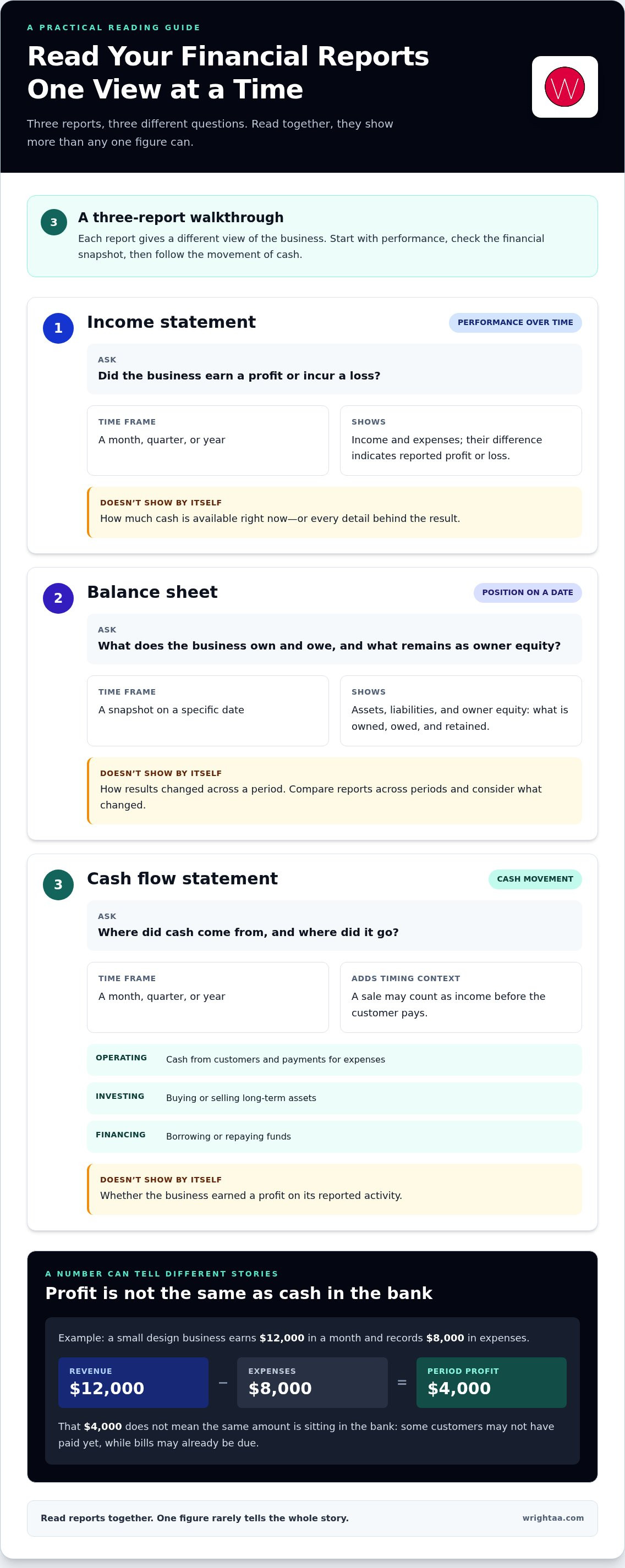
Imagine a small design business that earns $12,000 in a month and records $8,000 in expenses. Its profit for that period is $4,000, but that doesn’t mean $4,000 is sitting in its bank account. Some customers may not have paid yet, while bills may already be due. Cash, profit, and revenue describe different conditions, not interchangeable versions of the same number.
How financial literacy changes an owner’s decisions
Understanding these terms gives owners a steadier basis for choices about spending, hiring, pricing, and growth. Before committing to a new expense, ask what costs it adds, when payments are due, and what assumptions support the expected return. These questions don’t predict every outcome. They make uncertainty visible before it becomes part of the commitment.
The same habit can sharpen a pricing discussion. Reviewing the costs of delivering a service alongside the revenue it brings in can help an owner assess margin without relying on a universal target. Before hiring, compare expected payroll costs with the work the role is meant to support. Financial understanding doesn’t eliminate judgment; it gives judgment clearer material to work with.
Owners don’t need to become accountants to build this skill. Learn the meaning of key figures, notice when a number needs context, and ask focused questions when the picture is unclear. That foundation helps turn financial records into useful signals for daily operations, resilience, and intentional growth.
How to Read the Core Financial Reports Without an Accounting Background
Financial reports are easier to use when you begin with the question each one answers. The income statement describes performance over time. The balance sheet captures financial position on a particular date. The cash flow statement tracks cash moving in and out during a period. Read together, they offer different views of the same business, not competing versions of one answer. Entrepreneur.com on Financial Statements also explains how these reports help owners assess financial health and inform decisions.
| Report | Question it answers | Typical time frame | What it doesn't show alone |
|---|---|---|---|
| Income statement | Did the business earn a profit or incur a loss? | A month, quarter, or year | How much cash is available right now |
| Balance sheet | What does the business own and owe, and what is the owners’ residual interest? | A specific date | How results changed across a period |
| Cash flow statement | Where did cash come from, and where did it go? | A month, quarter, or year | Whether the business earned a profit on its reported activity |
What the income statement and balance sheet reveal
An income statement gathers income and expenses across a reporting period. The difference indicates reported profit or loss for that period. It helps an owner examine performance, but it doesn’t show every detail behind a result or how much money is currently available to pay obligations.
A balance sheet shows what a business owns, owes, and retains as owner equity at a specific point in time. Assets, liabilities, and equity form a snapshot, not a running account of the year. Compare reports across periods and consider what changed. A single figure may prompt a question, but its trend and business context help shape a useful interpretation.
Why the cash flow statement adds a different view
The cash flow statement follows cash through operating activity, such as receipts from customers and payments for expenses; investing activity, such as buying or selling long-term assets; and financing activity, such as borrowing or repaying funds. It brings timing into view. A sale may count toward reported income before a customer pays, while an upcoming bill may require cash before the related expense is fully reflected in the period’s results.
That distinction is why reported profit and available cash are related but not interchangeable. Consider a business that has completed work and recorded the income, but is still waiting for payment. Its income statement may show profit while its bank balance remains tight. Comparing all three reports helps owners ask more precise questions about performance, obligations, and timing. For a deeper look at managing those movements, explore A Small Business Guide to Cash Flow Management.
Accurate, timely bookkeeping gives these reports a more dependable foundation. If you want help making financial information more useful for business decisions, Wright CPAs’ accounting and advisory support can include bookkeeping and CFO guidance.
How Entrepreneurs Use Financial Understanding to Evaluate Business Choices
A financial decision is rarely about one number. Changing a price, adding a role, or borrowing funds can affect revenue, costs, cash timing, and future obligations in different ways. Financial literacy for entrepreneurs helps bring those effects into the same frame, so a choice is based on more than its most appealing outcome.
A repeatable process can make decisions clearer without making them mechanical:
- Define the choice. State what you’re considering and what the business needs the decision to accomplish.
- Identify relevant figures. Gather the costs, expected revenue, payment timing, and obligations directly connected to the choice.
- Test assumptions. Ask what must be true for the expected result to happen. Consider what changes if demand, costs, or timing differ from your estimate.
- Review trade-offs. Weigh the potential benefit against the resources committed and the flexibility the business gives up.
This sequence creates room to notice uncertainty before it becomes a commitment. It doesn’t replace judgment; it gives judgment a more grounded starting point.
What to understand before changing prices or taking on debt
For a pricing decision, separate sales revenue from the costs of delivering the product or service. Consider materials, labor, and other operating costs, then ask how a proposed price might affect demand and the amount left to support the business. Margin awareness helps frame the discussion, but the right price depends on the business and its customers, not a universal target.
Debt calls for a related but distinct review. Look beyond the amount borrowed to understand repayment terms, payment timing, and the effect of those obligations on the business’s capacity to meet other commitments. A forecast can help compare possible outcomes, but it remains an informed estimate, not a guaranteed result. Testing a less favorable scenario can show which assumptions carry the most weight.
How taxes fit into an entrepreneur’s financial picture
Tax obligations belong in the planning conversation alongside operating expenses, hiring, and growth. A decision may affect the business’s tax position as well as its day-to-day resources, so consider those effects before finalizing plans. Tax planning supports financial understanding; it doesn’t replace it. Owners still need to understand the business activity, costs, and commitments behind a decision.
For example, before expanding operations, an owner might examine expected sales, added operating costs, payment schedules, and tax considerations together. The purpose isn’t to predict every outcome. It’s to see how the parts interact and identify questions that need a better-informed answer. Focused guidance on strategic business tax planning in Buffalo, NY can help owners include tax considerations in a broader decision-making process.
Build a Manageable Financial Review Routine for Your Business
A useful financial review doesn’t need to be elaborate. It needs to happen at a pace that fits the business and produce clear questions or next steps. A solo business with steady activity may need a different rhythm from a growing company managing payroll, several revenue streams, or changing costs. Choose a cadence you can sustain, then adjust it when complexity or decisions increase.
Timely, organized records make a financial review more useful because they give decisions a clearer and more current foundation. Consistent bookkeeping helps reports reflect business activity accurately, so owners can compare results with their plans and prior periods rather than relying on memory or partial information.
Create a reliable foundation for reviewing the numbers
Before opening reports, bring the underlying records into order. Keep business transactions, receipts, invoices, payroll records, and account reconciliations organized and up to date. If a record is missing or a transaction is unclear, note it instead of drawing a firm conclusion from incomplete information. A consistent process makes changes easier to interpret from one review to the next.
For example, an owner reviewing a period might notice that expenses appear higher than planned. Rather than assume the cause, they can ask: Were there one-time purchases? Are all invoices recorded? Did payroll or supplier costs change? The review then becomes a way to investigate and understand, not a reason to jump to an unsupported conclusion.
Turn each review into clear next steps
Once the records are ready, use a short sequence to keep the review focused:
- Organize records. Gather transactions and supporting documents, and flag missing or unclear items.
- Review reports. Compare actual results with the business’s plans and a relevant prior period.
- Note questions. Record changes that need context, along with assumptions that remain uncertain.
- Document decisions. Capture the action, who will follow up, and what information could change the decision.
Separate immediate operational questions from longer-term planning. A supplier invoice that needs clarification may call for prompt follow-up. A possible expansion, new role, or pricing change may require analysis across several periods. Writing both down prevents an urgent detail from crowding out a more consequential decision.
Compare like with like where possible. If a current period differs from the plan, ask what changed in sales, costs, timing, or business activity before deciding what it means. Prior periods provide another reference point, but they don’t explain the cause on their own. Financial KPIs for small business can help owners choose and interpret measures that fit their goals, rather than tracking numbers without a clear purpose.
Use each review to build financial literacy for entrepreneurs as a working habit: observe, question, and record what you learn. If reliable records or thoughtful interpretation would strengthen your review process, explore bookkeeping and CFO support from Wright CPAs.
How Wright CPAs Helps Entrepreneurs Put Financial Information to Work
Financial literacy is an owner skill. It grows through practice, accurate records, and the right questions. Professional guidance can strengthen that process by helping clarify what the information shows, where uncertainty remains, and which decisions may need closer attention. The goal isn’t to hand over judgment. It’s to give owners a more dependable foundation for using it.
Wright CPAs supports business owners through bookkeeping, tax planning, and CFO services. Each can contribute a different perspective: organized records make activity easier to understand, tax planning brings obligations into view, and CFO-level guidance can connect financial information with broader business priorities.
When bookkeeping or accounting guidance can help
Bookkeeping can help when transactions, invoices, payroll records, or reconciliations are difficult to keep organized. Accurate, timely records create a clearer basis for reviewing business activity and asking informed questions. If reported results are surprising, reliable bookkeeping can help owners examine what contributed to them before deciding what they mean.
Tax planning adds a proactive perspective. Considering tax obligations alongside operating and growth decisions can help owners understand how a planned change may affect the wider financial picture. It’s one part of financial understanding, not a substitute for reading business information or weighing choices. Wright CPAs provides tax planning and preparation as part of its accounting and advisory work.
When an owner may benefit from CFO-level perspective
CFO services can help connect reports and forecasts with the priorities behind a decision. An owner considering expansion, a new hire, or a change in operations may need to weigh expected activity against available resources and competing commitments. CFO-level guidance can help frame that analysis and clarify assumptions, while the owner remains responsible for choosing the path forward.
The right kind of support can also change as a business becomes more complex. An owner may start by needing steadier bookkeeping, then seek broader financial perspective as decisions begin to affect more parts of the business. The purpose is not to replace financial literacy for entrepreneurs, but to strengthen it with records and context that make questions easier to work through.
Wright CPAs is based in Buffalo and serves businesses in Rochester, Syracuse, and throughout the United States. Its accounting and advisory support can help owners connect reliable financial information with practical decisions. To explore how that support could fit your business, learn about Wright CPAs’ accounting and advisory services.
Make Your Next Financial Review a Starting Point
Financial literacy for entrepreneurs develops through steady attention, not a single perfect review. Carry one question into your next decision: What assumption am I relying on? Which detail is still unclear? What information would help me move forward with care? Asking consistently can make financial information feel less like a set of technical reports and more like a practical guide.
You don’t need to resolve every uncertainty alone. Guidance can help clarify what the numbers reveal, what they leave open, and how those details relate to your priorities. That perspective can help you approach the next decision with greater intention while keeping ownership of the choice.
Wright CPAs, LLC has supported businesses from its Buffalo home since 2012. If you’re ready to strengthen the way you understand and use your business finances, explore support for greater financial clarity.
Start with one question, then build from there. A clearer view can take shape one deliberate decision at a time.
Frequently Asked Questions
Is financial literacy the same as accounting?
No. Accounting creates and organizes the records an owner relies on, while financial literacy helps the owner interpret what those records mean for a decision. You don’t need to handle every accounting task yourself. For example, if a report shows an unexpected cost increase, ask what changed, whether it’s ongoing, and how it affects your plans. Those questions help turn information into useful context.
Can a business be profitable but still run short of cash?
Yes. A business can report a profit while cash is temporarily committed elsewhere or due to arrive later. For example, a company might complete a large project near the end of a month, but not receive the customer’s payment before payroll and supplier bills come due. Looking at payment timing alongside reported results helps an owner plan for the gap rather than assuming profit means every obligation can be met immediately.
What financial information should a new entrepreneur learn first?
Start with revenue, expenses, profit, and cash, then learn what the income statement, balance sheet, and cash flow statement can each tell you. Financial literacy for entrepreneurs grows faster when concepts connect to real activity: take one customer sale and trace when it is earned, what it costs to deliver, and when payment arrives. That exercise can make later conversations about pricing, financing, or tax planning easier to follow.
How often should entrepreneurs review their business finances?
There’s no single review schedule that suits every business. Transaction volume, complexity, and decisions on the horizon all affect the right rhythm. A new contract, planned hire, seasonal shift, or large purchase may call for a closer look outside the usual review. Keep records current and capture questions as they arise; this helps you use the next review to examine changes rather than reconstruct past activity.
Can financial literacy help an entrepreneur make better pricing decisions?
Yes, it can give an owner a clearer basis for evaluating a proposed price, though it can’t set the right price on its own. Test a few price scenarios against the business’s delivery costs and expected demand. Then weigh factors such as customer expectations and the role the offering plays in the broader business. This approach helps reveal trade-offs without treating any single margin or figure as a universal target.
When should an entrepreneur seek help understanding business finances?
Consider guidance if reports are difficult to interpret, records are inconsistent, or a decision depends on an assumption you can’t confidently assess. Support may also be useful as tax planning, forecasting, or growth introduces new questions. Wright CPAs provides bookkeeping, tax planning and preparation, cash flow management, and CFO services for business owners, including those in Buffalo, Rochester, and Syracuse. Professional perspective can add context while you remain the decision-maker.


