

Your balance sheet shouldn't be a collection of past events. It's the foundation of a structure yet to be built. Many entrepreneurs feel like passengers in their own business finances, staring at bank balances with a sense of quiet unease. You might wonder, what does a fractional cfo do for a small business that a standard bookkeeper doesn't? The answer lies in the transition from recording history to designing the future. It's the difference between a stack of bricks and a finished home.
It's common to feel anxiety over cash flow even when your profit margins look healthy. You shouldn't have to guess how to fund your next stage of growth. We'll show you how a strategic partner creates a clear roadmap for financial expansion and predictable cash flow through rigorous modeling. This guide explores the 2026 landscape of fractional leadership, where demand for this specialized guidance has more than doubled. We'll detail how to move beyond basic compliance toward a life of intentional, disciplined growth that honors the work you've already put in.
Key Takeaways
- View your financial data as a foundation for design rather than a record of the past, allowing for more intentional business decisions.
- Understand exactly what does a fractional cfo do for a small business by exploring how they translate complex data into a clear, three-year strategic roadmap.
- Distinguish between the roles of accountant, controller, and CFO to ensure your financial team matches the current scale and complexity of your organization.
- Recognize the "complexity ceiling" that often arrives at the $1M revenue mark, requiring a move from simple survival to sophisticated cash flow management.
- Integrate proactive tax planning with high-level financial oversight to protect your profit margins and create a more predictable business life.
Defining the Fractional CFO: An Architect for Your Financial Future
A business is a living structure. It requires more than just maintenance; it requires a design that accounts for the weight of growth and the elements of the market. Many entrepreneurs reach a point where their financial foundation feels sturdy, yet they lack the blueprints for what comes next. This is where the role of a fractional executive becomes essential. A fractional CFO provides executive-level financial leadership on a part-time or contract basis, offering the same caliber of insight found in major corporations but tailored for the scale of a growing firm.
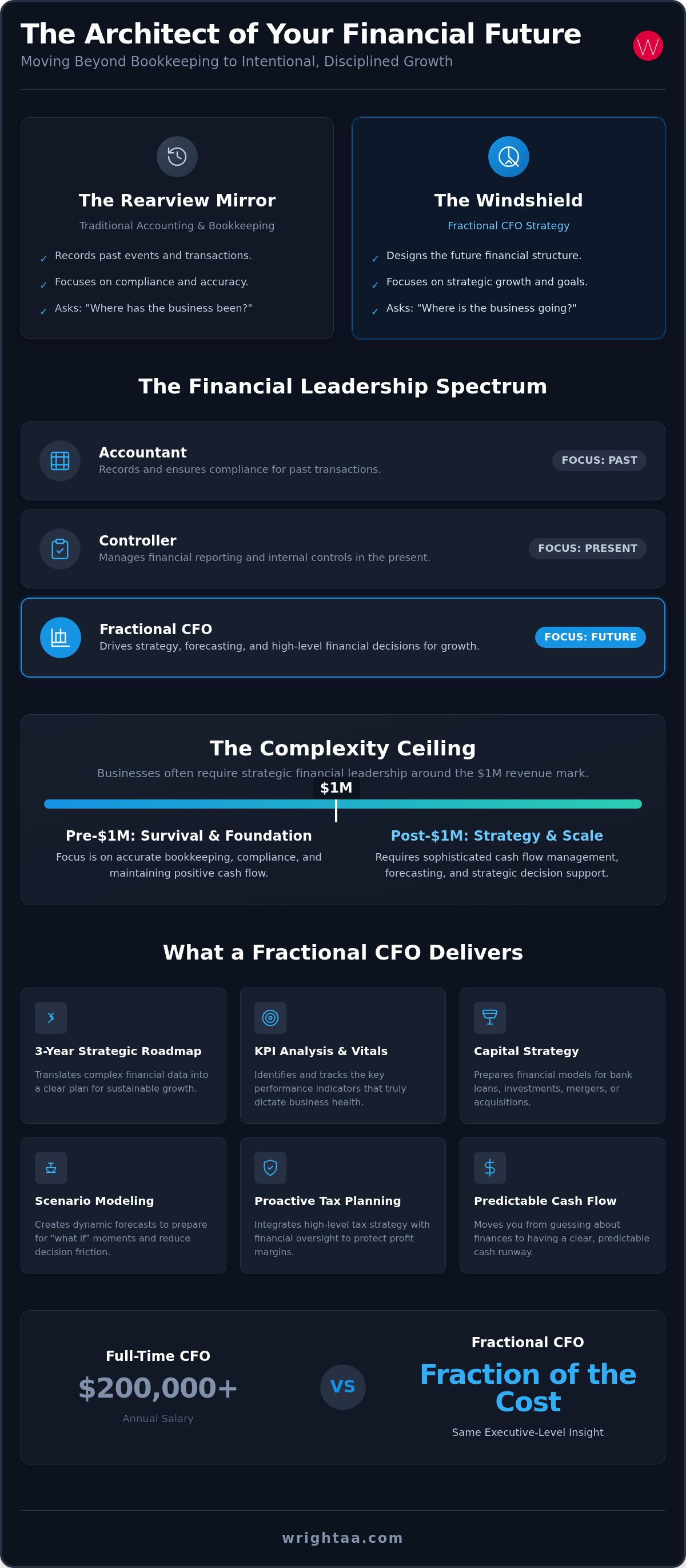
The distinction between a fractional CFO and a traditional accountant is best understood through the lens of perspective. An accountant looks through the rearview mirror, meticulously documenting where the business has been to ensure compliance and accuracy. A CFO looks through the windshield. They prioritize the road ahead, identifying potential obstacles and clear paths for acceleration. A fractional CFO serves as the bridge between raw financial data and visionary business strategy. By utilizing this model, small businesses can access expertise that typically commands a $200,000 annual salary for a fraction of the investment.
Beyond Bookkeeping: The Intentionality of CFO Leadership
Bookkeeping is the act of recording history. It ensures that every transaction is placed correctly within the ledger, much like ensuring every brick is level. While this is necessary, history alone cannot build a future. A fractional CFO shifts the focus from compliance-based thinking to strategic-based thinking. They don't just tell you that you spent money; they tell you if that spending aligns with your three-year goals. This partnership brings a sense of spatial openness to a business owner's mental load. When you trust that the financial architecture is being handled with discipline, you gain the freedom to focus on your craft and your clients.
The 2026 Landscape: CFOs as Strategic Navigators
In 2026, the intersection of technology and finance has become more precise. Artificial intelligence now handles the heavy lifting of data categorization, but it cannot replace the nuanced judgment of a seasoned professional. For businesses in Buffalo and Rochester, modern technology acts as a tool for deeper intentionality. It allows for real-time financial walkthroughs where you can simulate the impact of a new hire or a capital investment before committing resources. So, what does a fractional cfo do for a small business in this high-tech environment? They transform raw, automated data into a curated narrative that guides your next move. They ensure that your growth isn't just a byproduct of effort, but a result of deliberate design.
The Core Functions: How a Fractional CFO Transforms Small Business Operations
Financial clarity isn't a static state. It's a continuous process of refinement and discipline. When considering what does a fractional cfo do for a small business, it's helpful to view them as the master builder of your company's internal structure. They move beyond the simple reconciliation of accounts to perform deep structural analysis. This involves creating the blueprints for three-year and five-year growth cycles, ensuring that every expansion is supported by a stable foundation of capital. By identifying the specific Key Performance Indicators (KPIs) for your industry, they determine the "vitals" that dictate the health of your firm.
Capital strategy serves as another pillar of this role. Whether you're preparing for a bank loan or navigating a merger, a fractional CFO provides the professional modeling required to speak the language of lenders and investors. They transform a messy internal narrative into a clear, disciplined presentation of value. This level of CFO-level guidance ensures that your growth is never accidental, but always intentional. It provides a sense of calm in the face of complex financial decisions.
Forecasting and Budgeting: Designing the Path Ahead
A static budget is a snapshot; it lacks movement. A dynamic financial forecast, however, behaves like light within a space, shifting as the environment changes. Fractional CFOs utilize scenario modeling to prepare for "what if" moments in the Western New York economy. They might model the impact of a sudden shift in local demand or the rising costs of raw materials. This proactive approach reduces the emotional friction often associated with big decisions. You don't have to guess. You can see the path before you walk it.
Optimizing Profitability and Margins
Profitability has its own internal architecture. A CFO analyzes your service lines to find where value is being built and where it's being eroded. They look for hidden costs, those small leaks in the structure that often go unnoticed by those too close to the daily operations. This data-driven perspective provides the evidence needed to justify a price increase or a necessary pivot in your service offerings.
- Intentional Allocation: Moving from surviving month-to-month to allocating capital for long-term endurance.
- Margin Protection: Identifying which clients or products are truly contributing to the structural integrity of the firm.
- Tax Integration: Ensuring every strategic move accounts for the 2026 adjustments to the Qualified Business Income deduction and other tax implications.
By treating the business as a curated environment, the CFO ensures that every dollar has a purpose. They help you move from being a passenger in your finances to being the architect of your own success. This transition is essential for any business aiming to survive the complexity ceiling of the modern market.
CFO vs. Controller vs. Accountant: Understanding the Hierarchy
A business requires layers of oversight to remain resilient. When exploring what does a fractional cfo do for a small business, it's helpful to view the financial department as a tiered structure. Each role serves a specific purpose, much like the different stages of a construction project. Without a clear hierarchy, the financial integrity of the firm can become cluttered, leading to decisions based on incomplete or misunderstood data.
The accountant serves as the historian. Their focus is on the past, ensuring that every transaction is categorized with precision and that the business remains compliant with tax authorities. Above them, the controller acts as the manager. They oversee the accuracy of the accounting systems, ensuring that reports are produced on time and that internal controls are functioning. Finally, the CFO provides the vision. They interpret the reports generated by the accountant and controller to drive high-level strategy. This hierarchy ensures that the business is not just recording facts, but using them to build value.
The Hierarchy of Financial Needs
Financial health is built in stages. If the lower levels are neglected, the upper levels cannot stand. We view this through a three-level framework:
- Level 1: Compliance and Tax Preparation. This is the foundation. It involves meeting legal obligations and ensuring the site is secure.
- Level 2: Accurate Reporting and Bookkeeping. This is the structure. It provides the walls and roof, giving the owner a clear view of the current environment.
- Level 3: CFO Strategy and Tax Planning. This is the design. It's where the fractional CFO evaluates the relationship between the business and its long-term goals.
Why One Person Rarely Fills All Roles
The mindset required for record-keeping is fundamentally different from the mindset required for strategic planning. One is technical and tactile; the other is analytical and visionary. It's rare to find a single individual who can maintain the discipline of daily bookkeeping while also navigating complex financial modeling for a five-year expansion. This separation of duties is why Small Business Accounting in Buffalo, NY: Designing Financial Clarity requires a cohesive team approach.
At Wright CPAs, we provide this integrated team. We ensure that your foundation is compliant, your reporting is accurate, and your strategy is intentional. This collaborative model clarifies what does a fractional cfo do for a small business: they turn the accuracy of the past into the fuel for the future. By distributing these responsibilities across a specialized team, you gain a level of sophistication that was once reserved for the largest corporations.
Identifying the Turning Point: When Does Your Small Business Need a CFO?
Growth is rarely a linear path. It's an evolution of structural requirements that changes as your firm gains mass. For many businesses in Western New York, the $1M annual revenue mark acts as a complexity ceiling. At this level, the simple systems that served you during the startup phase begin to feel restrictive. You may have access to reports, but you lack the clarity to interpret them. This "blind spot" is a primary signal that the foundation needs a more sophisticated design.
Stagnant growth often points to a hidden bottleneck. If you've hit a plateau and cannot identify the cause, your financial architecture likely needs a professional redesign. Major transitions also require a higher level of oversight. Whether you're preparing for a sale, an acquisition, or a geographic expansion into Rochester or Syracuse, you need the professional modeling that a strategic partner provides. This ensures that your next move is supported by data, not just intuition.
Emotional and Operational Red Flags
There's a specific anxiety in being "profitable but broke." It's the sensation of watching revenue climb while your bank account remains stubbornly stagnant. This suggests a failure in cash flow management, which is a structural issue, not a sales problem. When you find yourself spending more hours in spreadsheets than in your core genius, the balance of your business life has shifted. A fractional CFO performs deep listening to your financial data, identifying the quiet signals that precede either a crisis or a breakthrough. They return your time to you, allowing you to focus on the work only you can do.
Industry-Specific Needs: Law Firms and Closely Held Businesses
Certain environments demand specialized oversight. Law firms must manage the delicate relationship between IOLTA accounts and firm profitability. This requires more than a generalist's touch. It requires a CPA for Law Firms in Buffalo, NY: Elevating Your Practice Through Financial Intentionality to ensure that compliance and growth are held in perfect balance. For closely held and family-owned businesses in our region, a CFO acts as a neutral arbiter of value. They help navigate the intersection of personal legacy and business performance, ensuring the firm remains a permanent and thoughtful intervention in the market.
Understanding what does a fractional cfo do for a small business involves recognizing that you shouldn't have to carry the weight of complex financial modeling alone. If you're ready to move from being a passenger to being an architect, it's time to explore how strategic CFO services can provide the clarity you need to scale with confidence.
The Wright Approach: Integrating CFO Insight with Strategic Tax Planning
A CFO strategy that ignores tax planning is a structure without a weather-tight seal. It may look impressive, but it cannot endure the seasons of the fiscal year. When asking what does a fractional cfo do for a small business, the answer must include the intentional integration of tax efficiency. At Wright CPAs, we act as the Architect of Finance for businesses across Buffalo and Rochester. We believe that financial leadership shouldn't be reactive. It should be a permanent, thoughtful intervention in the life of your business.
Our approach bridges traditional building methods with modern sensibilities. We value the technical precision of the classic CPA while embracing the visionary discipline of the modern CFO. This duality is best managed through a fixed-fee monthly retainer. It removes the friction of hourly billing, allowing for a steady, unhurried dialogue about your future. You gain predictable advisory costs and a partner who is deeply invested in the context of your specific geographic market.
Proactive Tax Strategy as a Growth Lever
A fractional CFO identifies tax-saving opportunities long before the year-end deadline arrives. This is a core part of what does a fractional cfo do for a small business; they ensure that growth does not create an unnecessary tax burden. This proactive stance allows you to treat tax planning as a growth lever rather than a compliance burden. Whether it's navigating the 2026 adjustments to Qualified Business Income deductions or determining the best business formation for a new venture, every decision is made with the long-term structure in mind. For a deeper look at this integration, explore The Architecture of Finance: Strategic Business Tax Planning in Buffalo, NY.
Next Steps: Designing Your Financial Clarity
The transition toward financial clarity begins with a consultation rooted in deep listening. We don't rush the creative process. Instead, we seek to understand the site and the structure of your business before proposing a path forward. During this initial walkthrough, we evaluate your current financial hierarchy and identify where the complexity ceiling is limiting your potential. We look at the relationships between your internal operations and the external market environment of Western New York.
We invite you to elevate your business strategy with Wright CPAs CFO services. Our goal is to provide a sense of calm and purpose, transforming your finances from a source of anxiety into a well-designed environment where your business can thrive. By focusing on quality over quantity and substance over spectacle, we help you build a financial future that is as durable as it is visionary.
Designing Your Financial Legacy
The transition from a passive observer of your finances to an active architect requires a fundamental shift in perspective. You've seen how the distinction between historical record-keeping and forward-looking design defines the health of a growing firm. When you ask what does a fractional cfo do for a small business, the answer is found in the creation of a curated environment where cash flow is predictable and tax strategy is integrated into every strategic move. This disciplined approach ensures that your business remains a permanent and thoughtful intervention in the market.
Since 2012, Wright CPAs has provided Buffalo businesses with this level of intentionality. Whether you're managing the specific requirements of a law firm or the legacy of a closely held family business, our fixed-fee monthly retainers provide the clarity you need to scale without the friction of unpredictable costs. It's time to move beyond the complexity ceiling and build with confidence.
Your future deserves a professional blueprint. Book a Strategic Consultation with Wright CPAs today and begin the process of refining your financial architecture. We look forward to listening to your story and helping you design a path toward lasting growth.
Frequently Asked Questions
Is a fractional CFO worth it for a business making less than $1 million?
Yes, it's worth it when complexity outpaces your current systems. While many firms wait until the $1M revenue mark, businesses with high transaction volumes or specialized needs, such as law firms in Buffalo, benefit earlier. A fractional CFO ensures your foundation is designed for the weight of future growth. They help you avoid the "profitable but broke" cycle by implementing disciplined cash flow management before a crisis occurs.
How does a fractional CFO differ from my current tax accountant?
A tax accountant focuses on compliance and recording history. In contrast, what does a fractional cfo do for a small business that goes beyond these basics? They prioritize the road ahead through strategic modeling and capital allocation. While your accountant ensures you meet legal obligations, the CFO uses those records to design a more profitable future. At Wright CPAs, we integrate these roles to provide a cohesive financial architecture.
Can a fractional CFO help my business secure a bank loan or investment?
Yes, a fractional CFO is instrumental in preparing your business for external capital. They create the professional financial models and three-year forecasts that lenders in Rochester and Syracuse require. By presenting a disciplined narrative of your firm's value and repayment capacity, they increase your credibility. They act as your advocate during negotiations, ensuring the terms of a loan or investment support your long-term structural integrity.
What are the typical hours per month for a fractional CFO engagement?
Engagements typically range from five to twenty hours per month. The exact rhythm depends on the complexity of your operations and the scale of your growth goals. For many Western New York businesses, a fixed-fee monthly retainer is the preferred model. This allows for a steady, unhurried partnership where the CFO is available for strategic dialogue without the friction of hourly billing, ensuring consistent oversight of your financial environment.
How do fractional CFO services integrate with my existing bookkeeper?
The CFO acts as the visionary manager for your bookkeeping function. They don't replace your bookkeeper; they elevate their work by interpreting the data they produce. This relationship ensures that the daily record-keeping is accurate and aligned with high-level strategy. The CFO provides the "deep listening" required to turn a stack of receipts into a clear roadmap, allowing the bookkeeper to focus on precision while the CFO focuses on purpose.
What specific KPIs should a fractional CFO track for a service-based business?
Service-based firms should track metrics that reveal the relationship between time and value. These vitals include:
- Project profitability and margins
- Employee utilization rates
- Customer Acquisition Cost (CAC)
- Lifetime Value (LTV) of a client
Tracking these metrics allows for more intentional pricing decisions and service pivots. It ensures that your growth is both sustainable and profitable.
How does a fractional CFO help with tax planning in New York State?
They integrate proactive tax strategy into your broader financial goals. In New York State, this involves navigating specific pass-through entity taxes and local credits. A fractional CFO identifies these opportunities before the year ends, rather than reacting during tax season. This integrated approach protects your margins and ensures that your business formation choice continues to serve your long-term vision as state regulations evolve.
What is the first project a fractional CFO usually tackles for a small business?
The first project is usually a comprehensive financial walkthrough. This involves a rigorous assessment of your current cash flow, balance sheet health, and existing reporting systems. The goal is to identify immediate bottlenecks or "leaks" in your profitability. By establishing this baseline, the CFO can design a strategic roadmap that addresses your most pressing anxieties while preparing the structure for intentional expansion in the coming years.


