

Confident financial decisions don’t require perfect numbers. They come from a steady rhythm of checking the numbers you have. If reports are hard to interpret, cash availability is uncertain, or bookkeeping has fallen behind, feeling confident about your business finances can seem out of reach. It’s difficult to plan spending or growth when the figures don’t feel current or connected to daily decisions.
A consistent review routine can change that. You’ll learn which financial information to check and when, how to spot questions before they become surprises, and how to use a clear view of performance and cash to guide decisions. The goal isn’t to know every accounting detail. It’s to understand what the numbers are telling you well enough to choose your next step with care.
This article outlines a practical schedule for reviewing your finances, the key reports and cash-flow details to keep in view, and ways bookkeeping, tax planning, and CFO-level guidance can support sound decisions. Confidence grows through regular attention, not guesswork.
Key Takeaways
- Separate revenue, profit, cash, and forecasts to understand what each number can and can’t tell you.
- Use current, organized records as the foundation for reports you can rely on when making decisions.
- A simple monthly review can make feeling confident about your business finances a repeatable practice.
- Compare actual results with expectations to identify questions and decide what needs attention next.
- Bookkeeping, cash flow management, tax planning, and CFO guidance can support different financial needs as your business changes.
Why Feeling Confident About Your Business Finances Starts With Clarity
An unclear report or a late bookkeeping update can make ordinary decisions feel heavier. Should you hire, replace equipment, or hold off on a planned expense? If the numbers are incomplete, even a familiar choice can feel like a guess. Feeling confident about your business finances doesn’t mean knowing exactly what will happen next. It means understanding the information available, recognizing what it can’t yet tell you, and knowing what to examine next.
That distinction matters. A forecast is an informed estimate, not a promise, and business conditions can change. Confidence doesn’t require perfect predictions or a business without challenges. It grows when you can explain what the figures indicate, identify open questions, and avoid treating an unknown as a certainty.
Regular financial visibility helps you make deliberate decisions by showing what’s known, what needs attention, and where to look before you act.
What financial confidence looks like in a small business
In practice, confidence might mean being able to describe recent performance in plain language: sales rose, but expenses also increased; or revenue held steady while a few customer payments are still outstanding. You can name questions you haven’t answered yet, such as whether a slower payment cycle is temporary or becoming a pattern. That’s thoughtful uncertainty. Without a dependable view, it’s harder to know which questions to ask.
Understanding financial information doesn’t require speaking in accounting jargon. It does require connecting figures to the business behind them. The overview of Financial Intelligence in Business describes the value of understanding financial statements and how their details relate to the larger picture. For an owner, that perspective helps turn a report from a set of figures into a basis for informed questions.
Why financial uncertainty can persist
When transactions are recorded inconsistently, reports may arrive late or leave out details that would change how you interpret them. Mixing personal and business activity can blur the picture, making it harder to see which costs belong to the business and how it is performing on its own. These habits don’t necessarily mean the business is struggling, but they can make its financial position harder to read.
A bank balance alone can also mislead. It shows cash in the account at a point in time, but not necessarily what has already been committed to payroll, supplier bills, taxes, or other upcoming expenses. A healthy-looking balance can coexist with tight cash flow; a temporarily low balance may not tell the whole story if customer payments are due. The number matters, but so does its context.
Consider an owner deciding whether to take on a new recurring expense. A single balance offers only one view. Recent performance, expected payments, upcoming obligations, and unresolved bookkeeping questions add context for weighing the commitment. The aim isn’t to eliminate uncertainty. It’s to distinguish what the records support from what still needs attention, so the next decision rests on more than instinct.
Build Confidence With Reliable Records, Cash Visibility, and Useful Reports
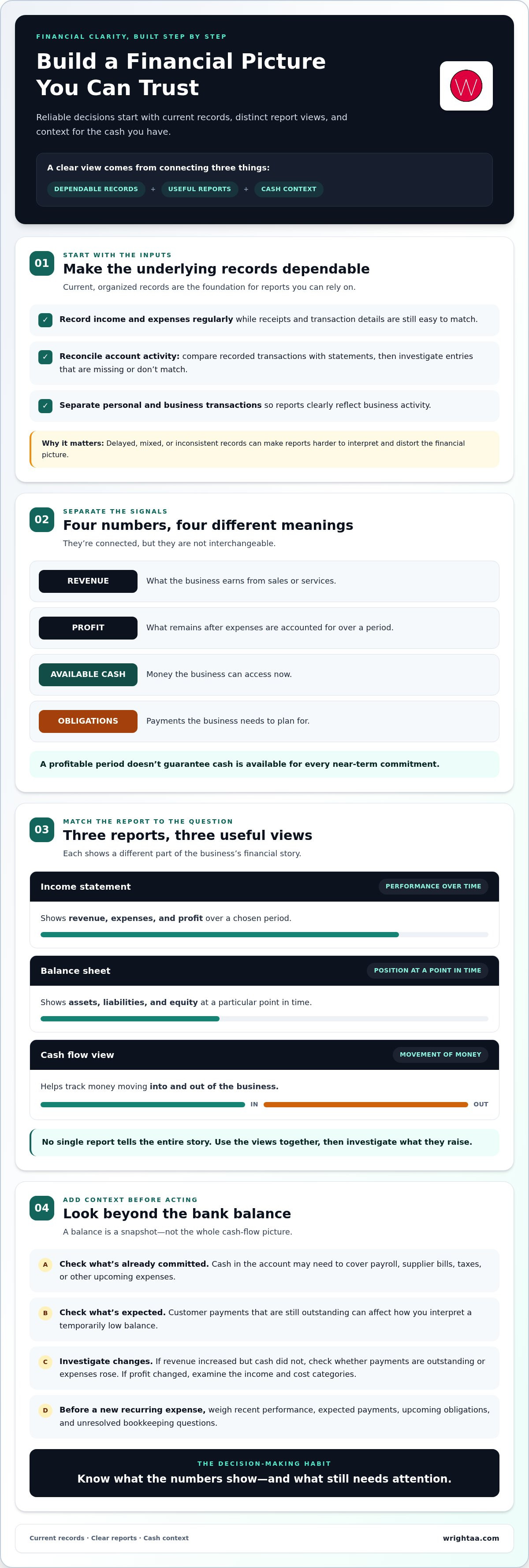
Clear decisions depend on more than a report that looks complete. The records behind it need to be current, organized, and connected to actual business activity. Recording income and expenses regularly, rather than reconstructing them months later, makes it easier to notice missing information and understand changes in performance. These records form the basis for reports. If inputs are delayed or mixed together, the financial picture can be distorted.
It also helps to separate four ideas that are easy to treat as interchangeable. Revenue is what the business earns from sales or services. Profit is what remains after expenses are accounted for over a period. Available cash is money the business can access now, while upcoming obligations are payments it needs to plan for. A profitable period doesn’t guarantee cash is available for every near-term commitment.
Which financial reports help answer different questions?
An income statement shows revenue, expenses, and profit over a chosen period. A balance sheet shows assets, liabilities, and equity at a particular point in time. Cash flow reporting helps track money moving into and out of the business. Each offers a different view; none tells the entire story on its own.
An income statement shows performance over time, a balance sheet shows financial position at a point in time, and a cash flow view shows how money moves.
Together, these reports help an owner frame useful questions. If revenue increased but cash did not, are customer payments still outstanding, or did expenses rise? If profit changed, which income or cost categories contributed? Reports can point to what to investigate, but they don’t always explain the cause on their own. Transaction details, timing, and business context matter too.
How to make the underlying numbers more dependable
A small set of repeatable recordkeeping habits can make reports easier to trust:
- Record business income and expenses regularly, while receipts and transaction details are still easy to match.
- Reconcile account activity by comparing recorded transactions with statements, then investigate entries that are missing or don’t match.
- Keep personal and business transactions separate so business reports clearly reflect business activity.
Reconciliation is more than a tidy-up. It can surface duplicate entries, omitted transactions, or amounts recorded differently from the account activity. Resolving discrepancies helps establish a sound basis for comparing reports from one period to another. If an item remains unclear, note it and follow up rather than quietly treating an assumption as settled.
These practices give the numbers a dependable structure without requiring every question to have an immediate answer. For owners who want consistent bookkeeping and financial reporting as part of their routine, ongoing accounting support can help keep the underlying records organized and useful.
Read Your Business Numbers Without Mistaking One Signal for the Whole Story
Each financial metric describes a different part of the business. Revenue can rise while profit falls; profit can look healthy while cash is temporarily tight. A forecast offers a view of what may come next, but it depends on assumptions that can change. Reading these signals together provides more useful context than treating any one figure as a verdict.
No single financial metric is a complete diagnosis because each measures a different part of the business, over a different period or point in time.
| Signal | What it can show | What it can’t show alone |
|---|---|---|
| Revenue | Sales earned during a period | Whether those sales were profitable or collected |
| Profit | Income remaining after recorded expenses | Whether cash is available now |
| Cash balance | Money held in accounts at a moment in time | What is committed to upcoming payments |
| Forecast | Possible future results based on assumptions | What will happen with certainty |
A strong sales period, for example, may include invoices customers haven’t paid yet. Meanwhile, payroll, supplier bills, or other obligations may be approaching. The sales are real, but the timing of incoming and outgoing money affects what’s available to spend. A forecast can help you look ahead, but read it as a planning tool, not a promise.
Questions that put financial reports in context
Start by comparing the current period with the previous one and with the expectations you set. Ask what changed and whether timing played a part: did a large invoice land earlier than usual, or did a planned expense shift into this period? Then classify the variance as one-time, recurring, or still unexplained. This turns a surprising result into a focused question rather than an automatic conclusion.
Keep the evidence distinct from your interpretation. “Payroll expense increased” may be a report finding; “we hired more staff” is a possible explanation that needs checking. Review the underlying transactions or operating changes before deciding what the variance means. When a cause remains unclear, record the question for follow-up instead of building a decision on an untested assumption.
When a financial signal deserves closer attention
Repeated cash shortfalls, overdue receivables, or unexplained shifts in expenses and margins deserve timely review. So do payroll obligations that appear out of step with expectations. Look for patterns across periods, then trace them to their source. A single change may reflect timing; a recurring one may call for a different response. Neither should be judged against a universal threshold, since business models and cash cycles differ.
Feeling confident about your business finances doesn’t mean reacting to every movement. It means noticing a signal, checking its context, and deciding what question or action follows. That measured approach makes reports more useful and helps keep a temporary fluctuation from being mistaken for a lasting trend.
Create a Simple Monthly Routine for Feeling Confident About Business Finances
A monthly check-in gives financial review a place on the calendar instead of leaving it until a decision feels urgent. Choose a consistent date, such as a set day after each month ends, and protect enough time to complete a short sequence. The aim isn’t to examine every transaction together. It’s to close the period, understand the main movements, and leave with clear next steps.
A practical monthly financial check-in
Keep the routine small enough to repeat, even during a busy month. Work through the same four stages in order, and capture questions as they arise rather than pausing to resolve every detail immediately. A shared document or task list can hold open questions, decisions, the person responsible for each follow-up, and a date to revisit it.
- Close the records. Organize transactions and supporting records for the period, and note any items that still need clarification.
- Review the reports. Look at the key financial reports and mark material changes, unusual movements, or unresolved entries.
- Compare expectations. Set actual results beside the budget, forecast, or other expectations you established. Identify where results differed without assuming the reason.
- Decide next actions. Choose a few specific follow-ups, assign an owner, and set a date to check progress.
For example, if expenses came in above expectations, the follow-up might be to identify which costs changed and whether the difference is likely to continue. A useful action is concrete and answerable. “Understand expenses” is broad; “review the largest unexpected expense categories before the next check-in” gives someone a clear task.
To make your review more focused, Wright CPAs’ guide to financial KPIs for small business can help you consider which measures are relevant to your business, rather than tracking numbers without a clear purpose.
Keep the routine useful as the business changes
Revisit the assumptions behind your review when the business changes. Hiring can affect payroll and cash needs; a new investment may alter expected costs; seasonal patterns or a shift in revenue can change what deserves attention. Add detail only when it helps you understand a decision. A simpler routine that you can sustain is more useful than an elaborate one that gets skipped.
If cash timing is a recurring concern, a focused cash flow management guide can help you think through planning for money coming in and going out. The monthly review can capture the relevant questions and follow-ups, keeping cash planning connected to the rest of your financial picture.
Wright CPAs provides accounting and advisory support that can bring bookkeeping, reporting, and financial guidance into a regular rhythm. Learn more through accounting and advisory support.
When Accounting and Advisory Support Can Make Financial Decisions Clearer
A manageable monthly review can give an owner a useful starting point. As the business grows, though, the financial work may become harder to keep current or interpret alone. The sign to look for isn’t a particular size or stage. It’s whether the information arrives in time to guide decisions, and whether you have a clear way to resolve the questions it raises.
Signs it may be time for additional financial support
If closing the books regularly slips, reports are difficult to understand, or you’re making decisions before the numbers are ready, support may help restore a reliable rhythm. Growing payroll responsibilities, tighter cash timing, or more involved tax planning can also create questions that benefit from added perspective. Getting guidance doesn’t mean giving up control. You remain responsible for business decisions; support can help make the information and trade-offs clearer.
The right kind of help depends on the need. Bookkeeping keeps business activity organized; financial reporting turns those records into useful views of performance. Cash flow management focuses on timing and expected money movement. Tax planning considers tax implications as decisions take shape, while CFO-level guidance can help owners assess financial options and plan ahead. These needs can overlap, but they serve distinct purposes.
How ongoing guidance can support a clearer view
Consistent bookkeeping and reporting create a steadier information base, making it easier to notice patterns and bring specific questions to a review. Cash flow management can help owners consider upcoming inflows and obligations, while tax planning can bring tax considerations into decisions before year-end. The aim is not to outsource every judgment. It’s to have more timely information and informed discussion when weighing a choice.
Wright CPAs offers fixed-fee monthly accounting and advisory retainers that include bookkeeping, financial reporting, and proactive tax strategy. For a related overview, explore small business accounting in Buffalo, NY. A continuing relationship can provide year-round financial oversight, helping owners review their finances consistently and address questions as they arise.
Feeling confident about your business finances can mean having a routine that fits your operation, clear answers where possible, and a sound process for open questions. If you’d like to discuss what accounting or advisory support could look like for your business, connect with Wright CPAs.
Make Your Next Financial Review a Steady Step Forward
Financial confidence grows through attention, not certainty. Each time you make space to understand the business’s position, you create a better foundation for the decisions ahead. Feeling confident about your business finances doesn’t mean having every answer at once. It means knowing what deserves your attention and taking the next step with care.
Wright CPAs provides accounting and advisory support for businesses in Buffalo, Rochester, and Syracuse, as well as across the United States. If a steadier financial perspective would help you plan with greater clarity, explore how Wright CPAs supports clearer business finances.
Start with one review, one useful question, and one decision you can approach with better information. A calm, consistent practice can make the path ahead feel more manageable.
Frequently Asked Questions
How can I feel more confident about my business finances?
Start by setting a recurring time to review complete, up-to-date records. Compare the period with an earlier one, and note decisions that depend on information you still need, such as whether a large customer payment has arrived. Feeling confident about your business finances develops as you follow through on those questions. You don’t need to predict every outcome; you need a reliable way to see what requires attention.
What financial reports should a small business owner review each month?
Many owners review an income statement, balance sheet, and cash flow view, along with relevant account activity. Check that each report covers the same period you intend to assess; mismatched date ranges can make comparisons confusing. Owners in Buffalo, Rochester, and Syracuse can use this same basic approach, adapting the details to their business. If a figure looks unusual, trace it to the underlying transactions before drawing a conclusion.
Can a profitable business still have cash flow problems?
Yes. A business can record a profitable sale before receiving the customer’s payment, while supplier bills or payroll are due sooner. For example, an owner may see a strong month on the income statement but need to delay a purchase until outstanding invoices are collected. Reviewing expected receipts alongside scheduled payments helps show whether the issue is timing, a repeated gap, or something that needs closer attention.
How often should I review my business finances?
A monthly review is a practical baseline for many small businesses, but it may not be enough during a period of rapid change. If cash is tight or a major commitment is approaching, check the relevant information more often until the decision is settled. Choose a cadence that fits the volume and complexity of your business, then keep a brief record of decisions so the next review can begin with what changed.
What should I do if I do not understand my financial reports?
Identify the exact line, date range, or change that is unclear, then check whether the transactions behind it are recorded and categorized as intended. Avoid making a decision based on a guess. You might ask, “Why did this expense rise compared with the prior period?” A bookkeeper or accountant can explain how the figure is presented and help identify what additional detail would clarify its meaning.
Do I need a CFO to feel confident about my business finances?
No. You can begin with organized records, a manageable review process, and support focused on the questions you’re facing. As payroll, cash planning, or reporting becomes more complex, CFO-level guidance may help you weigh options and plan ahead. The choice depends on the decisions your business needs to make, not a universal revenue cutoff. You remain in control; the purpose of guidance is to strengthen the information behind your judgment.


