

What if your firm's escrow account was not a source of persistent anxiety, but a masterwork of structural integrity? For many practitioners, trust accounting for law firms Buffalo NY feels like a fragile glass structure, susceptible to the slightest tremor of a clerical error or a missed reconciliation. You likely recognize the weight of these ethical obligations. The fear of IOLA commingling or the exhaustion of manual three-way reconciliations can easily pull your focus away from the core of your legal practice. It's a common tension between the rigorous need for precision and the daily reality of a busy firm.
This guide offers a sophisticated framework to transform your financial records into an audit-ready sanctuary. By viewing your ledger through the lens of intentional financial architecture, you can move beyond simple compliance toward true clarity. We will explore the nuances of IOLA compliance, the essential rhythm of automated three-way reconciliation, and the deep peace that comes from a firm built on a foundation of ethical excellence. You deserve a system that is as disciplined and refined as the legal counsel you provide to your clients.
Key Takeaways
- Define the ethical boundaries of IOLA compliance to ensure your Buffalo practice remains a sanctuary of professional integrity.
- Implement the three-way reconciliation method as a structural standard, aligning bank balances, book records, and individual client ledgers with precision.
- Guard against common escrow vulnerabilities by managing buffer funds and bank fees with the foresight of a master builder.
- Discover how intentional financial architecture and specialized trust accounting for law firms Buffalo NY provide the clarity generalist bookkeeping cannot match.
- Build a workflow centered on transparency and separation of duties to achieve audit-ready financial records and lasting peace of mind.
The Regulatory Landscape of IOLTA in New York State
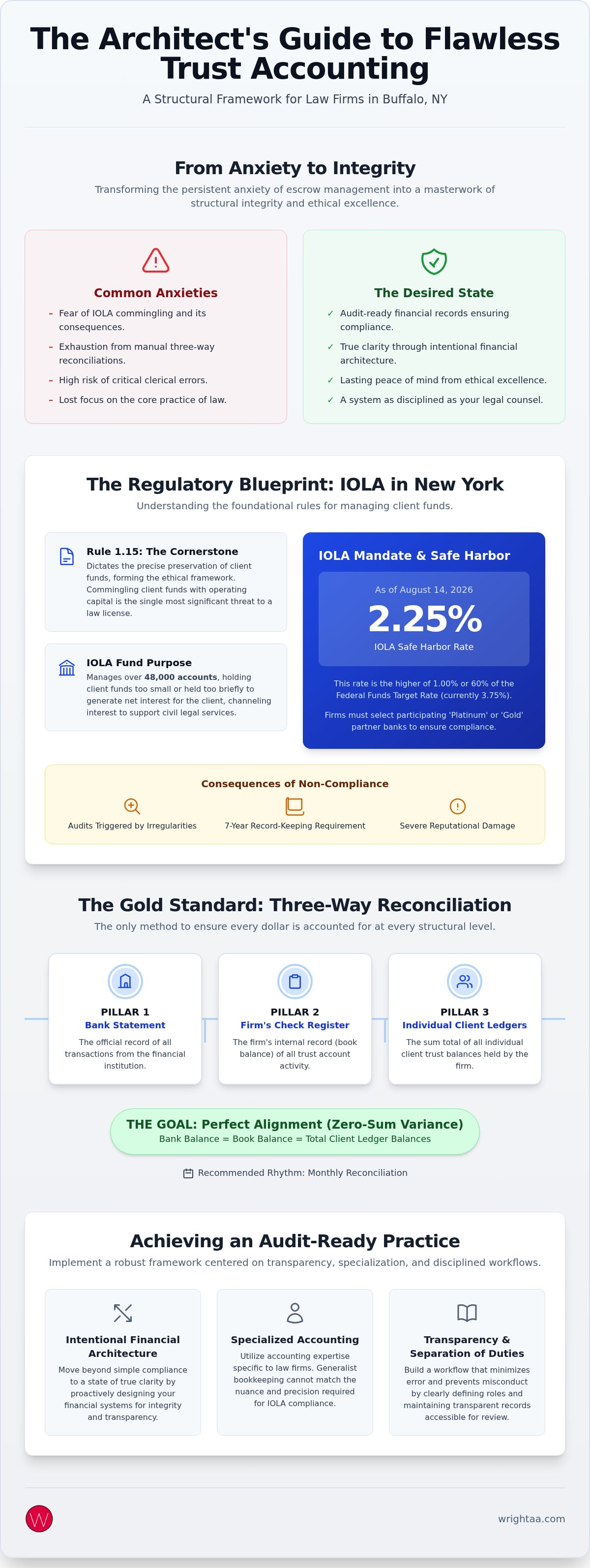
Integrity is the invisible architecture of a law practice. In New York, this structure is codified within Rule 1.15 of the Rules of Professional Conduct. This rule dictates the preservation of client funds with a precision that mirrors a master blueprint. For those managing trust accounting for law firms Buffalo NY, the distinction between operating capital and client property isn't just a ledger entry; it's a boundary that defines your professional existence. Commingling these funds is the most significant threat to a Buffalo law license, representing a collapse of the firm’s ethical framework. It’s the difference between a building that stands the test of time and one that falters under its own weight.
The concept of Interest on Lawyers' Trust Accounts (IOLTA), known in our state as the IOLA Fund, serves as the primary mechanism for holding client deposits that are too small or held for too short a time to generate net interest for the client. These accounts are fiduciary tools designed to manage small-client funds while supporting civil legal services across New York. The IOLA program currently manages over 48,000 accounts across the state, channeling resources toward the common good through a disciplined financial structure. It turns the fragmented pieces of client retainers into a cohesive resource for the public interest.
Understanding the IOLTA Mandate
The IOLA mandate requires WNY attorneys to select participating banking institutions that meet specific interest rate criteria. As of August 14, 2026, the IOLA safe harbor rate is 2.25%, which is the higher of 1.00% or 60% of the upper bound of the Federal Funds Target Rate, currently at 3.75%. Selecting a 'Platinum' or 'Gold' partner bank ensures your firm meets these standards while supporting the broader legal community. It's a deliberate choice that reflects your firm's commitment to the local ecosystem. Small-client fund management becomes a quiet act of civic participation when handled with this level of intentionality.
Consequences of Non-Compliance in Buffalo
The Attorney Grievance Committee for the Eighth Judicial District maintains a watchful eye on these accounts. Audits are often triggered by simple irregularities, such as a notice of insufficient funds or a report of inadequate record-keeping. Under Rule 1.15(d), Buffalo firms must maintain detailed records of all trust account transactions for seven years. The reputational cost of an investigation in our tight-knit local community often outweighs any immediate financial penalty. A single oversight can tarnish a legacy built over decades of practice, turning a firm of stature into a cautionary tale. Effective trust accounting for law firms Buffalo NY is, therefore, a matter of preserving your firm's very silhouette against the local horizon.
The Architecture of Three-Way Reconciliation
If compliance is the blueprint, three-way reconciliation is the structural inspection. It's the only method that ensures every dollar is accounted for at every level of the firm’s anatomy. While many firms manage basic bank reconciliations, trust accounting for law firms Buffalo NY requires a more rigorous triple-check system. This gold standard prevents the subtle erosion of financial integrity. It's not merely a suggestion; it's a vital safeguard for your practice's longevity and professional standing. Without it, the connection between your firm's records and the bank's reality can slowly drift apart.
The process rests on three distinct pillars: the bank statement, the firm's check register, and the individual client ledgers. Each must reflect the same reality from a different perspective. Alignment here isn't just about math; it's about transparency. Adhering to New York IOLA regulations ensures that client funds remain untainted by operational expenses. While some proposed rules suggest a 60-day window, monthly reconciliation remains the safest rhythm for a modern Buffalo practice. This steady cadence allows for the early detection of discrepancies before they become structural failures.
The Three Pillars of the Reconciliation Process
The first step involves reconciling the bank statement to your check register, accounting for all outstanding checks and deposits. Once the bank and book balances align, you must reconcile that total to the sum of all individual client ledgers. This second connection is where many firms stumble. Finally, you must investigate and document any variances immediately. A zero-sum variance is the only acceptable outcome. This disciplined approach is often best managed through CFO-level oversight, ensuring the internal and external views of your firm remain in perfect harmony.
Documenting the Paper Trail
New York law firms are bound by Rule 1.15(d) to maintain these records for seven years. This requirement includes checkbooks, bank statements, and all ledgers. In a modern Buffalo practice, the transition from physical to digital record-keeping must be handled with care. Digital records offer spatial openness and ease of retrieval, yet they require robust backup systems to ensure permanence. Whether you prefer the tactile nature of paper or the efficiency of the cloud, the goal remains the same for trust accounting for law firms Buffalo NY: a clear, unassailable history of every transaction. This documentation forms the permanent record of your firm’s commitment to its clients.
Common Pitfalls in Legal Escrow Management
Every structure has its vulnerabilities. In the context of trust accounting for law firms Buffalo NY, these weaknesses often manifest as small, overlooked details that eventually compromise the entire foundation. One such vulnerability is the "buffer" fund. While New York rules allow a nominal amount of firm capital to remain in a trust account to cover bank service charges, there is no specific dollar limit. However, maintaining excessive funds beyond what is strictly necessary for fees is a form of commingling. It creates a blurred line between the firm’s assets and the client’s property, inviting unnecessary regulatory scrutiny.
Inadequate tracking of bank fees is another common point of failure. If a bank inadvertently withdraws a service fee from client funds rather than the firm’s designated "buffer," a technical commingling violation occurs immediately. This is why a simple bank-to-book reconciliation is never enough. It only catches half the story. To achieve true financial integrity, practitioners must utilize a three-way reconciliation for law firms. This method ensures that the bank balance, the book balance, and the individual client ledgers all exist in a state of perfect alignment. Without this triple check, errors can remain hidden for months, quietly eroding the firm's compliance standing.
Handling unidentified funds requires a similarly disciplined approach. In New York, funds that remain unclaimed or unidentified must eventually follow the state's escheatment process. This is not a task for the unhurried. Leaving abandoned funds in a trust account indefinitely is a structural flaw that complicates every future reconciliation. It creates "noise" in your financial reporting that obscures the true state of your active client matters.
Addressing the Commingling Misconception
Commingling isn't always a deliberate act of misconduct; it's often the result of convenience overriding discipline. Some attorneys mistakenly pay firm expenses directly from an escrow account once a fee is earned. While the money may technically belong to the firm at that moment, the act of paying a third-party vendor from a trust account is a violation. Earned fees must first be transferred to an operating account. Our fixed-fee CPA for Law Firms Buffalo NY services help firms design workflows that make these transitions seamless and transparent, ensuring that personal and trust funds never inhabit the same space longer than necessary.
The Risk of Undocumented Withdrawals
The promise to "reconcile later" is a dangerous foundation for any practice. For those managing trust accounting for law firms Buffalo NY, contemporaneous recording is a necessity, not an option. Every withdrawal must be documented at the moment of the transaction. Delaying this record-keeping creates a gap where memory fails and errors take root. When an audit occurs, the lack of a clear, immediate paper trail is often viewed as a sign of deeper mismanagement. Discipline in the present is the only way to secure the future of your firm's reputation.
Implementing a Robust Trust Accounting Framework
A resilient financial framework functions much like a load-bearing wall; it must support the weight of the firm's growth without compromising its structural integrity. For those managing trust accounting for law firms Buffalo NY, this requires a blueprint that prioritizes transparency over convenience. In multi-attorney practices, the most critical control is the separation of duties. The person who records a retainer deposit shouldn't be the same individual who authorizes a withdrawal. This duality creates a natural system of checks and balances, ensuring that no single point of failure can jeopardize the firm's ethical standing. It's a disciplined approach that transforms a chaotic ledger into a curated financial environment.
Beyond daily operations, an annual trust account health check serves as a necessary inspection. This proactive strategy involves a deep dive into your records to identify stagnant funds or subtle reconciliation drifts before they become regulatory issues. It's about maintaining the clarity of your firm's financial silhouette. If your current system feels more like a patchwork than a professional structure, it's time to refine your approach. Establishing these high-level controls is essential for any practice that values substance over spectacle. To build this foundation, many firms look to our specialized law firm accounting and CFO services for guidance.
Standardizing the Deposit and Withdrawal Workflow
Precision begins at the moment of entry. Every client retainer must be accompanied by a standardized checklist to ensure it maps to a specific client matter from the start. When fees are earned, the transfer to the operating account should follow a rhythmic, documented process rather than an ad-hoc withdrawal. This mapping ensures that every dollar has a clear purpose and a defined path. It eliminates the "orphan" funds that often clutter trust ledgers, allowing for a cleaner, more minimalist aesthetic in your financial reporting. Consistency here is the hallmark of a refined intellectual practice.
Technology as a Foundation
Modern legal practice requires tools that mirror the precision of architectural software. Integrating platforms like Clio, MyCase, or LeanLaw with QuickBooks Online creates a seamless data flow that significantly reduces human error. This integration allows for real-time oversight, giving you a clear view of your trust liabilities at any moment. Automation doesn't replace the need for professional judgment; it simply creates a more stable ground for it to stand on. This technological synergy is a core component of modern small business accounting Buffalo NY, ensuring that your firm's financial architecture is both visionary and grounded.
Elevating Your Practice with Specialized Law Firm Accounting
A generalist bookkeeper often views a ledger as a static collection of entries. They see the surface, but they may miss the underlying stress points that define a legal practice. For those managing trust accounting for law firms Buffalo NY, a surface-level understanding is insufficient. The legal industry requires a specialized lens, one that recognizes the intricate relationship between fiduciary duty and firm profitability. At Wright CPAs, LLC, we approach your firm’s finances as an intentional architecture. We don't just record history; we design the framework that supports your future growth. This transition from basic bookkeeping to CFO-level oversight provides a profound sense of clarity and purpose. It's the difference between a temporary shelter and a permanent, well-conceived structure.
Moving beyond mere compliance allows a firm to focus on strategic cash flow management. When your trust accounts are perfectly aligned, you gain a transparent view of your earned revenue. This clarity is the prerequisite for meaningful business consulting and proactive financial planning. It’s about creating a serene environment where you can practice law without the quiet hum of financial anxiety in the background. We prioritize quality over quantity, ensuring that every financial intervention is thoughtful and contextual to your specific practice area. It's a disciplined way to ensure your firm remains both visionary and grounded. The result is a practice that feels intentional at every level.
The Value of Proactive Tax Strategy
The integrity of your trust accounting directly impacts your firm's overall tax planning. If your bookkeeping is fragmented, your tax strategy will be equally disjointed. Integrating your law firm accounting with annual tax preparation ensures that no deductions are overlooked and no liabilities are unexpected. This holistic view is the essence of Business Tax Planning Buffalo NY. It turns a seasonal obligation into a year-round architectural exercise, optimizing your firm's tax position while maintaining the highest ethical standards. A well-designed tax strategy is a permanent, thoughtful intervention in your firm’s lifecycle. It provides the financial stability needed to weather any economic season.
Partnering for Long-Term Success
We provide customized advisory retainers for Buffalo’s growing practices, offering a steady rhythm of oversight that evolves with your firm. This partnership allows you to dedicate your energy to your clients while we maintain the foundation. Our approach is artistic yet disciplined, grounded in deep listening and contextual awareness of the WNY legal landscape. By securing the technical details of your trust accounting for law firms Buffalo NY, we provide the spatial openness you need to excel in your craft. It’s time to design a more intentional financial future for your firm with Wright CPAs, LLC. Let us help you build a practice that is as enduring as the counsel you provide. Excellence in design is not a luxury; it is a necessity for a firm built to last.
Securing Your Firm’s Ethical Blueprint
Financial integrity is not a static state; it's a continuous, intentional practice. By mastering the rhythm of three-way reconciliation and establishing a robust framework for your escrow accounts, you protect the very silhouette of your practice. We've explored how a disciplined approach to trust accounting for law firms Buffalo NY transforms a complex regulatory burden into a source of quiet confidence. It's about ensuring that every client deposit is handled with the same precision and care you bring to your legal counsel. This structural clarity allows you to focus on the human elements of your practice while the technical foundation remains secure.
Wright CPAs, LLC stands as a dedicated partner in this architectural exercise. As a Buffalo-based firm with specialized experience in Law Firm Accounting, we provide the proactive tax and CFO advisory services necessary to elevate your practice beyond simple compliance. You don't have to navigate these technical requirements alone. Schedule a consultation for Law Firm Accounting in Buffalo, NY with Wright CPAs, LLC to bring clarity and structural integrity to your firm's financial future. Your commitment to excellence deserves a foundation that is equally refined and enduring.
Frequently Asked Questions
What is the difference between IOLTA and a regular trust account?
An IOLA account is a collective fiduciary tool for funds that are nominal in amount or held for short durations. The interest generated supports civil legal services across New York. Conversely, a regular trust account is designed for significant sums or long-term holdings. In these instances, the interest earned belongs strictly to the client. Both require the same rigorous standards of structural integrity and transparency to remain compliant.
How often must a Buffalo law firm perform three-way reconciliation?
Monthly reconciliation is the minimum standard for maintaining a healthy financial architecture. While New York Rule of Professional Conduct 1.15 doesn't explicitly mandate a frequency, a proposed amendment suggests a 60-day interval. For those managing trust accounting for law firms Buffalo NY, waiting that long is a structural risk. A 30-day cadence ensures that any variances are identified and corrected before they compromise the firm's foundation or lead to disciplinary oversight.
Can I use my trust account to pay for firm overhead if I'm short on cash?
Using trust funds for operating expenses is a fundamental breach of fiduciary duty. Client property must remain separate from firm capital at all times. Even if fees have been earned, they must be formally transferred to your operating account before being used for overhead. Borrowing from escrow, regardless of the intent to repay, is a collapse of ethical integrity. It’s an intervention that almost always results in severe professional consequences.
What happens if I discover a shortage in my IOLTA account?
Discovery of a shortage requires an immediate and disciplined investigation. You must document the cause with precision and rectify the balance using firm funds if a clerical error occurred. Promptly identifying the variance is the first step in restoration. Depending on the nature of the shortage, consulting with legal counsel regarding your reporting obligations to the Attorney Grievance Committee is a prudent measure to preserve your reputation and demonstrate your commitment to ethics.
Does New York law require a specific software for trust accounting?
New York law doesn't mandate the use of a specific software platform. However, the record-keeping requirements of Rule 1.15 are so rigorous that manual systems often lack the necessary structural integrity. Utilizing integrated tools like Clio or QuickBooks Online provides a reliable foundation for your ledger. These systems help automate the complex data flow, ensuring that your trust accounting for law firms Buffalo NY remains accurate, transparent, and ready for an unexpected audit.
How long should I keep my law firm's trust account records?
You must maintain all trust account records for a period of seven years. This requirement, codified in New York Rule of Professional Conduct 1.15(d), includes bank statements, checkbooks, and client ledgers. Think of these documents as the permanent blueprints of your firm’s history. Whether you store them in a digital sanctuary or a physical archive, they must be readily accessible. This longevity ensures that your firm's financial narrative remains clear and verifiable over time.
What are the common triggers for a NYSBA trust account audit?
Audits are often triggered by technical irregularities that suggest a deeper structural failure. A common catalyst is a notice of dishonored checks, which banks are required to report to the Lawyers’ Fund for Client Protection. Client grievances or inconsistencies discovered during unrelated investigations can also lead to a focused review of your escrow accounts. Maintaining a quiet, disciplined adherence to reconciliation best practices is the most effective way to avoid these stressful regulatory interventions.
Is it better to handle trust accounting in-house or outsource to a CPA?
Partnering with a specialized CPA offers a level of CFO-level oversight that is difficult to achieve in-house. A refined expert brings a visionary perspective to your financial architecture, moving beyond simple data entry to proactive advisory. This collaboration allows you to focus on the humanity of your legal work while we ensure the technical integrity of your books. It’s a strategic choice that prioritizes substance and long-term stability over temporary convenience.


