

A business is a living structure, and tax is the foundation upon which it stands. If the site is poorly surveyed, even the most visionary project can feel unstable. For many independent creators in Western New York, the 15.3% federal rate often arrives as an unforeseen weight on a new build. Managing self-employment tax Buffalo NY requires more than simple compliance; it demands a precise spatial awareness of your financial landscape. It's natural to feel a sense of friction when transitioning from employee to owner, where every earned dollar carries a new, complex set of responsibilities.
We recognize that the shift toward self-reliance can feel clouded by the technicalities of state and federal codes. This guide offers a professional framework designed to replace that uncertainty with financial clarity and strategic growth. You will understand your specific obligations and why Buffalo entrepreneurs are exempt from the MCTMT. We will also outline a steady strategy for reducing your tax burden and mastering quarterly payments with confidence. By treating your tax strategy as an intentional design choice, you create the room necessary for your business to breathe and expand.
Key Takeaways
- Understand the 15.3% federal rate and the dual responsibility of acting as both employer and employee within your business.
- Distinguish your regional obligations from those in other districts, specifically why Buffalo entrepreneurs are exempt from the MCTMT.
- Discover how intentional structural choices, like the S-Corp election, can refine your approach to self-employment tax Buffalo NY.
- Protect your resources by applying the "ordinary and necessary" rule to business deductions and home office expenses.
- Transition from reactive year-end filing to a proactive strategy that ensures lasting financial clarity and professional growth.
Defining the Foundation: What is Self-Employment Tax?
Building a business in Western New York requires a clear understanding of the site's regulatory constraints. While traditional employees see taxes withheld by a third party, the entrepreneur occupies a dual role. You are both the employer and the employee. This duality is the core of What is Self-Employment Tax? It's a separate obligation from standard federal income tax. While income tax funds general government operations, self-employment tax is a dedicated contribution to the Social Security and Medicare systems. It represents the social infrastructure you support as an independent creator.
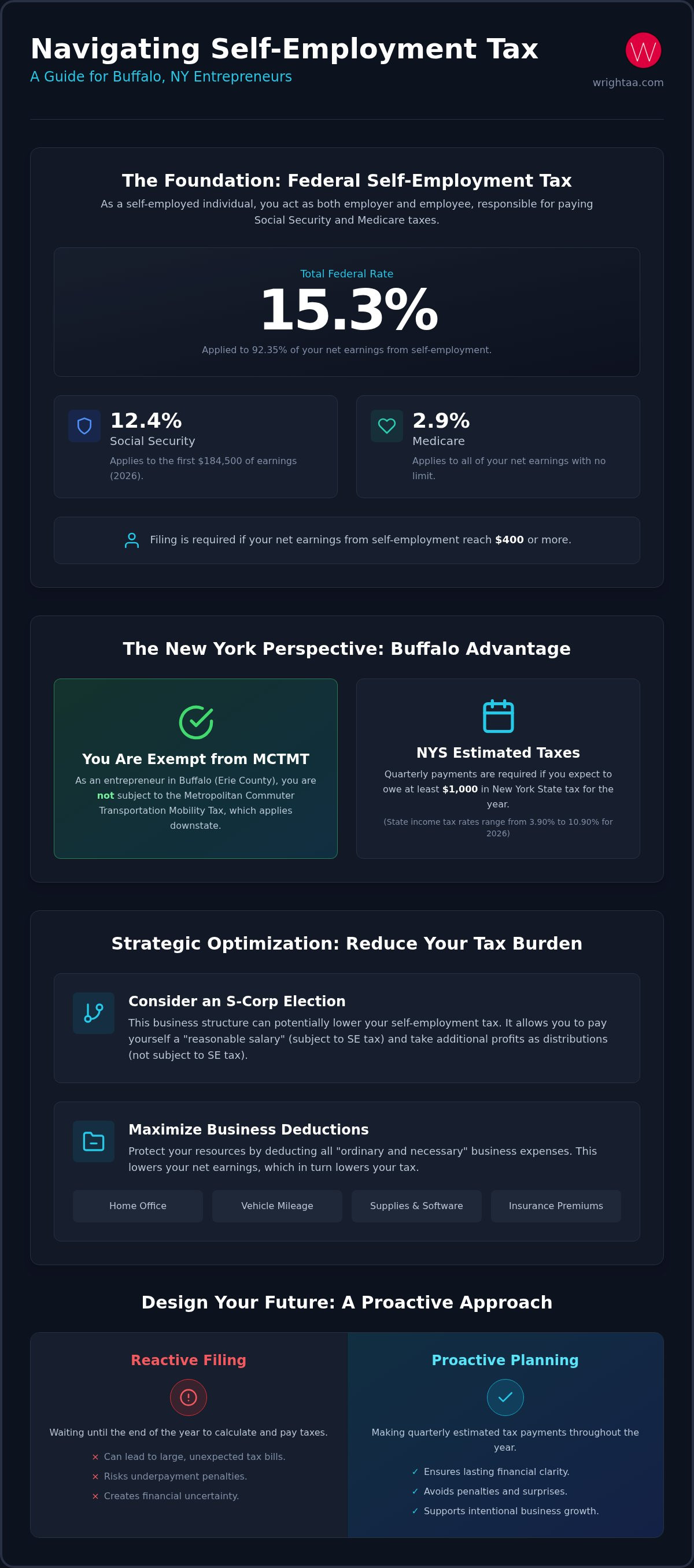
For 2026, the threshold for filing remains consistent. If your net earnings from self-employment reach $400, the requirement to contribute begins. This is not a penalty for success; it's the structural cost of building your own professional future. It's the first step toward financial clarity. Managing self-employment tax Buffalo NY starts with recognizing this foundational line in your ledger. Without this recognition, the 15.3% rate can feel like an unexpected intrusion rather than a planned, intentional expense.
The 15.3% Calculation
The calculation is precise. The 2026 self-employment tax rate is 15.3%, which is comprised of 12.4% for Social Security and 2.9% for Medicare. To account for the employer portion of the tax being deductible, the IRS applies this rate to only 92.35% of your net earnings. It's a subtle but significant reduction in the taxable base. For high earners, the Social Security portion only applies to the first $184,500 of net earnings in 2026. Beyond this limit, the 2.9% Medicare tax continues to apply to all earnings without a ceiling.
Who Qualifies as Self-Employed in Buffalo?
Identity is defined by intent and action. You are self-employed if you carry on a trade as a sole proprietor or an independent contractor. The IRS focuses on your "intent to profit" rather than your specific industry. Buffalo examples include independent consultants in the Elmwood Village or tradespeople renovating historic North Buffalo homes. If you control your own tools, schedule, and final output, you are the architect of your own tax structure. Whether you receive a 1099-NEC or manage a steady stream of gig work, you're responsible for this contribution.
Understanding self-employment tax Buffalo NY ensures that your financial foundation remains as sturdy as the masonry of the city's historic landmarks. This clarity allows you to focus on growth rather than reacting to quarterly surprises. By viewing these obligations as structural elements of your business, you can plan for them with the same precision you apply to your craft.
The New York Perspective: State-Specific Obligations
Geography dictates obligation. While federal rules provide a broad canopy, New York State law adds layers of local texture to your financial environment. Buffalo entrepreneurs must balance the 15.3% federal rate with state-level income taxes that range from 3.90% to 10.90% for the 2026 tax year. Unlike the flat nature of federal official IRS guidance, New York utilizes a progressive structure that scales with your success. This requires a nuanced understanding of how your business net income aligns with specific state brackets. It's not merely about the total owed; it's about how that total is distributed across the fiscal year.
MCTMT and the Buffalo Business Owner
The Metropolitan Commuter Transportation Mobility Tax (MCTMT) often causes confusion for those unfamiliar with the state's internal boundaries. Erie County is not part of the Metropolitan Commuter Transportation District. Consequently, most owners managing self-employment tax Buffalo NY are exempt from this specific tax, even if their net earnings exceed the $50,000 threshold that applies in the downstate region. However, spatial boundaries are fluid in a digital economy. If you perform services physically within the NYC metropolitan area, or if you have employees stationed there, this obligation may still emerge. Monitoring these geographic touchpoints is essential for maintaining financial clarity and avoiding unexpected state notices.
NYS Estimated Tax Requirements
New York operates on a pay-as-you-go philosophy. If you expect to owe at least $1,000 in tax for the year, you're generally required to make quarterly estimated payments. This prevents the accumulation of large, unmanageable liabilities at year-end. The rhythm is steady and predictable, mirroring the quarterly cycles of the federal system. Staying aligned with these dates is a matter of business discipline:
- Q1: April 15, 2026
- Q2: June 15, 2026
- Q3: September 15, 2026
- Q4: January 15, 2027
Missing these windows can result in underpayment penalties that erode your profit margins. Proactive planning ensures these dates are milestones of growth rather than sources of anxiety. Maintaining meticulous records is also vital for residency audits. New York remains rigorous in verifying where business activity actually occurs, especially for those with multiple offices or remote clients. For those seeking a more intentional approach to their fiscal structure, engaging in professional tax strategy can refine these processes into a cohesive system. This level of oversight transforms a reactive filing process into a visionary tool for long-term stability.
Structural Optimization: Reducing the Self-Employment Burden
Business structure is a choice between passive acceptance and intentional design. Many creators assume that forming an LLC provides an automatic shield against the 15.3% rate. In reality, a standard single-member LLC remains a pass-through entity where every dollar of profit is exposed to the burden. To refine your approach to self-employment tax Buffalo NY, you must look toward the S-Corporation election. This is not a change in your legal entity, but a specific tax status that allows you to bifurcate your income. By separating a reasonable salary from shareholder distributions, you protect a portion of your earnings from the heavy lift of Social Security and Medicare taxes. Form follows function.
Sole Proprietorship vs. S-Corp
The shift from a sole proprietorship to an S-Corp represents a transition from a reactive posture to a proactive strategy. While a sole proprietor pays self-employment tax on their entire net profit, an S-Corp owner only pays payroll taxes on their W-2 salary. The remaining profit, taken as a distribution, is generally exempt from the 15.3% tax. This distinction is a primary focus in our analysis of S-Corp vs. LLC: Tax Implications in New York State. The math of this structural change is often transformative for a growing firm.
| Entity Type ($100k Net Profit) | Income Subject to SE/Payroll Tax | Estimated Tax Obligation |
|---|---|---|
| Sole Proprietorship / LLC | $92,350 | $14,130 |
| S-Corp ($50k Salary) | $50,000 | $7,650 |
The Reasonable Compensation Framework
Efficiency requires balance. The IRS mandates that S-Corp owners pay themselves a "reasonable" salary based on the services they provide. Setting this figure too low invites scrutiny. Setting it too high diminishes the tax benefit. Wright CPAs, LLC utilizes data-driven benchmarks to justify compensation levels for Buffalo entrepreneurs, ensuring the structure survives an audit while maximizing savings. It is a delicate intersection of current cash flow and future Social Security benefits. For those navigating the early stages of growth, New York State business resources provide a starting point, but a tailored strategy is what ensures long-term financial clarity.
The tipping point for this transition usually occurs when net profits consistently exceed $60,000. At this level, the tax savings begin to outweigh the added costs of payroll services and corporate bookkeeping. It is the moment when a "gig" truly becomes an enterprise. This structural optimization is a cornerstone of proactive tax planning. It allows the entrepreneur to reinvest saved capital back into their own vision. Instead of a mandatory expense, tax becomes a variable you can manage through thoughtful business design.
Deduction Architecture: Maximizing Your Business Expenses
Deductions are the internal bracing of a financial structure. They provide the necessary support to lower your taxable income while reflecting the true cost of your professional craft. The IRS identifies deductible expenses through the "ordinary and necessary" rule. An expense must be common in your trade and appropriate for your business to qualify. When managing self-employment tax Buffalo NY, these deductions are your primary tool for reducing the 15.3% burden. Every dollar properly classified as a business expense is a dollar that escapes both income and self-employment taxes. It is a matter of precision and intentionality.
The home office deduction serves as a bridge between the domestic and the professional environments. You may choose the simplified method, which applies a flat rate per square foot, or the actual expense method. The latter requires a meticulous accounting of utilities, mortgage interest, and repairs, but it often yields a more robust result for those in historic Buffalo properties with higher maintenance costs. Additionally, health insurance premiums represent a 100% deduction for the self-employed. These premiums function as an adjustment to income, ensuring that your personal well-being is not a financial liability to your enterprise.
Local Travel and Buffalo-Specific Deductions
Movement is a prerequisite for growth. For many entrepreneurs, client meetings in Rochester or Syracuse are a standard part of the week. Deducting mileage for these trips requires a consistent log, but the cumulative impact on your tax liability is significant. Beyond travel, the tools of your trade offer further opportunities. Section 179 expensing allows you to recover the full cost of equipment and technology purchased in 2026 during the year of acquisition. This immediate recovery of capital is essential for maintaining a modern, competitive edge. You can explore a deeper list of these opportunities in our guide on Top 7 Tax Deductions for WNY Small Businesses.
The Importance of Financial Clarity
Clean bookkeeping is the foundation of every valid deduction. Without a clear separation between the personal and the professional, the structure becomes unstable. Commingling funds is a fractured practice that invites scrutiny and obscures your true profitability. True financial clarity comes from a disciplined approach to record-keeping, where every transaction is categorized with purpose. This level of detail ensures that no legitimate expense is overlooked when it is time to file. For those who value substance over spectacle, engaging in proactive tax planning ensures that your deduction architecture is both compliant and optimized for long-term growth.
Retirement planning also functions as a strategic anchor. Utilizing vehicles like a SEP-IRA or a Solo 401(k) allows you to invest in your future while simultaneously reducing your current taxable income. These are not merely savings accounts; they are structural elements that reinforce your financial independence. By integrating these deductions into your annual cycle, you move beyond reactive filing into a space of visionary business management.
Designing Your Future: Beyond Annual Tax Prep
Tax preparation is a look into the past. It's a reactive exercise, documenting what has already occurred without the power to change the outcome. In contrast, tax planning is an act of creation. It involves the intentional design of your financial future, ensuring that every decision aligns with your long-term vision. For those managing self-employment tax Buffalo NY, the shift from reactive filing to proactive strategy is the first step toward true financial clarity. It's the difference between merely surviving the tax season and utilizing your capital as a tool for growth.
Sustainable businesses aren't built on guesswork. They require a structural integrity that only deep, specialized guidance can provide. Transitioning from a solitary "gig" to a resilient enterprise often necessitates CFO-level oversight. This guidance transforms raw data into a narrative of possibility. By utilizing fixed-fee monthly retainers, you gain year-round access to professional strategy without the friction of surprise costs. This steady, predictable oversight allows you to focus on your craft while Wright CPAs, LLC focuses on the fiscal architecture that supports it.
Proactive Tax Strategy for Buffalo Businesses
Waiting until April to address your obligations is a fractured approach. True stability comes from year-round monitoring that anticipates changes before they become liabilities. We analyze your cash flow to ensure you can fund your tax obligations and business expansion simultaneously. This level of coordination is a hallmark of Outsourced CFO Services in Buffalo, NY. It ensures that your quarterly payments are accurate reflections of your current success, preventing the erosion of your reserves through underpayment penalties. It's about maintaining a steady rhythm in an ever-shifting environment.
Your Next Steps Toward Clarity
The journey from a DIY approach to a professionally managed structure is a significant milestone. It marks the moment you prioritize quality and substance over the stress of manual calculation. When you're ready to refine your business design, the first step is a focused conversation. Preparing for an initial tax strategy consultation involves gathering your recent records and clearly defining your growth objectives. This transparency allows Wright CPAs, LLC to listen deeply and understand your unique context before the creative process begins.
Building a legacy through intentional design is the Wright CPAs, LLC philosophy. Since our founding in 2012, we've remained committed to the idea that accounting is not just a technical exercise, but a poetic one that improves your daily life. By treating your tax obligations as structural elements rather than burdens, you create a space where your business can truly flourish. Book a consultation with Wright CPAs, LLC to begin your transition toward financial clarity.
Mastering the Fiscal Landscape
Building a sustainable enterprise is an act of persistent, intentional design. We have explored how structural optimization through an S-Corp election can refine your approach to self-employment tax Buffalo NY, providing the internal bracing your business needs to flourish. By mastering the architecture of deductions and maintaining a clear separation between personal and professional environments, you protect the capital necessary for your next project. True financial clarity isn't a seasonal event but a permanent state achieved through proactive strategy and disciplined bookkeeping.
Wright CPAs, LLC provides the CFO-level guidance required to transform complex obligations into a stable framework for growth. Our fixed-fee monthly accounting and advisory retainers ensure you have unhurried access to year-round planning without the friction of unexpected costs. We invite you to design a more intentional tax strategy with Wright CPAs, LLC. You have already laid the foundation for something meaningful. Now is the time to ensure the structure you build is as resilient as it is visionary. Your professional future deserves a design that's both grounded and inspired.
Frequently Asked Questions
Do I have to pay self-employment tax if my Buffalo business lost money this year?
You generally don't owe self-employment tax if your business experiences a net loss. This tax is calculated based on net earnings of $400 or more. If your expenses exceed your revenue, there's no taxable base for the Social Security and Medicare components. However, you should still file your return to document the loss. This record can sometimes be used to offset future income, maintaining the long-term integrity of your financial structure.
How much should I set aside for self-employment taxes in New York?
A prudent strategy involves setting aside 25% to 30% of your net income. This reserve covers the 15.3% federal rate and New York's progressive income tax brackets. By maintaining this liquidity, you ensure that quarterly payments don't disrupt your operational cash flow. It's a simple, intentional habit that prevents the friction of a large, unexpected year-end liability. This discipline is the first step toward true financial clarity.
Can I deduct half of my self-employment tax on my federal return?
Yes, the IRS allows you to deduct 50% of your federal self-employment tax as an adjustment to your gross income. This deduction is taken on your 1040 and reduces the amount of federal income tax you owe. It recognizes the dual role you play as both employer and employee. While it doesn't lower the self-employment tax itself, it provides a meaningful reduction in your overall tax burden during the annual filing process.
What happens if I miss a quarterly estimated tax payment deadline?
Missing a deadline typically results in underpayment penalties and interest charges. These costs accrue from the date the payment was due until the date it's received. If you miss a window, it's best to pay as soon as possible to minimize these additions. Consistent, timely contributions are the foundation of a stable financial structure. They help you avoid the weight of unnecessary penalties that can erode your business's profit margins.
Is the New York State MCTMT applicable to businesses in Buffalo?
Buffalo businesses are generally exempt from the Metropolitan Commuter Transportation Mobility Tax. Erie County sits outside the designated district, which is centered around the NYC metropolitan area. You only need to monitor this obligation if you conduct physical business or maintain employees within those specific downstate counties. For most local entrepreneurs, this tax isn't a factor in their structural planning, allowing for a more focused approach to regional obligations.
How does the S-Corp election specifically reduce my self-employment tax?
The S-Corp election allows you to split your income into a salary and shareholder distributions. Only the salary portion is subject to the 15.3% payroll tax. Distributions are exempt from this specific burden, though they remain subject to standard income tax. This structural choice can significantly lower your total self-employment tax Buffalo NY when your net profits reach a level where the savings outweigh the administrative costs. It's a matter of intentional business design.
Are there specific tax credits for self-employed individuals in Western New York?
Most credits available are broad federal or state incentives rather than local specific ones. You may qualify for the Earned Income Credit or specific New York State credits related to clean energy or child care expenses. The key is to review your business activities against the current state tax code during your planning sessions. Proactive oversight ensures you don't overlook these opportunities to reinforce your financial foundation and reduce your overall liability.
Does a Buffalo business owner need a separate bank account for taxes?
While not legally required, a separate tax account is a hallmark of financial clarity. It prevents the commingling of personal and business resources, making it easier to manage self-employment tax Buffalo NY. By siphoning tax reserves into a dedicated space, you ensure the funds are available when quarterly vouchers are due. This discipline creates a serene environment where you can focus on your professional craft without worrying about the source of your tax payments.


