

A project's true integrity isn't found in the depth of its concrete footings; it lives within the precision of its ledger. In the evolving landscape of Western New York, partnering with a construction industry accountant in Rochester is more than a back-office necessity. It's a deliberate choice to treat your financial framework with the same rigor as your physical builds. You've likely seen how easily profit fade can erode a successful season when job costing misses the mark. It's a common frustration that turns ambitious growth into a cycle of reactive survival.
This guide reveals how specialized financial oversight provides the structural stability required to scale your contracting business. You'll learn how to maintain predictable cash flow while managing New York's 5% retainage cap and the expansion of prevailing wage requirements to off-site fabrication. We'll look at the strategic shift toward high-tech retrofitting in the local market and how professional reporting satisfies the strictest lenders and sureties. By the end, you'll understand how to transform your accounting from a technical exercise into a poetic blueprint for growth.
Key Takeaways
- Learn how a construction industry accountant Rochester provides the specialized financial context required to bridge the gap between traditional craftsmanship and modern development.
- Identify the critical role of Work-in-Progress (WIP) reporting and job costing in maintaining the structural integrity of your project margins.
- Navigate the complexities of New York State tax regulations, including the Look-Back Rule, through proactive planning and precise strategy.
- Evolve from daily financial management to visionary scaling by implementing CFO-level cash flow strategies and business consulting.
- Discover how a fixed-fee advisory model fosters a partnership rooted in clarity, intentionality, and long-term stability for your firm.
The Role of Specialized Accounting in Rochesters Construction Landscape
Rochester's skyline tells a story of dualities. One side holds the weight of historic masonry; the other reflects the glass and steel of modern high-tech retrofitting. For a contractor, this landscape is both a canvas and a complex challenge. Managing the finances of a firm here requires more than just balancing a ledger. It demands a construction industry accountant Rochester who understands that every line item represents a physical intervention in the built environment. Financial integrity is the silent partner of architectural excellence.
Generalist accounting often treats construction as a standard retail or service model. This is a fundamental error. Construction is a high-risk, high-reward sector defined by long-term contracts and unique revenue recognition. By applying specialized Construction accounting principles, such as the percentage of completion method, a firm moves from reactive compliance to a state of intentionality. You gain the ability to see profit fade before it erodes your foundation. This foresight is what protects a business from the regional volatility inherent in Western New York's economy.
Beyond the General Ledger: Industry-Specific Nuance
The Rochester-Syracuse corridor has a specific rhythm. Seasons dictate the pace of work, while market shifts dictate the type of work. We've seen a distinct move from large industrial builds to the sophisticated retrofitting of older spaces for healthcare and education. This shift requires a financial strategy as adaptable as the structures themselves. While the core tenets of small business accounting Buffalo NY provide a baseline of clarity, construction firms need a deeper level of nuance. They need a system that tracks the pulse of every project in real-time, ensuring that capital is never trapped in stagnant pipelines.
The Wright Approach to Local Expertise
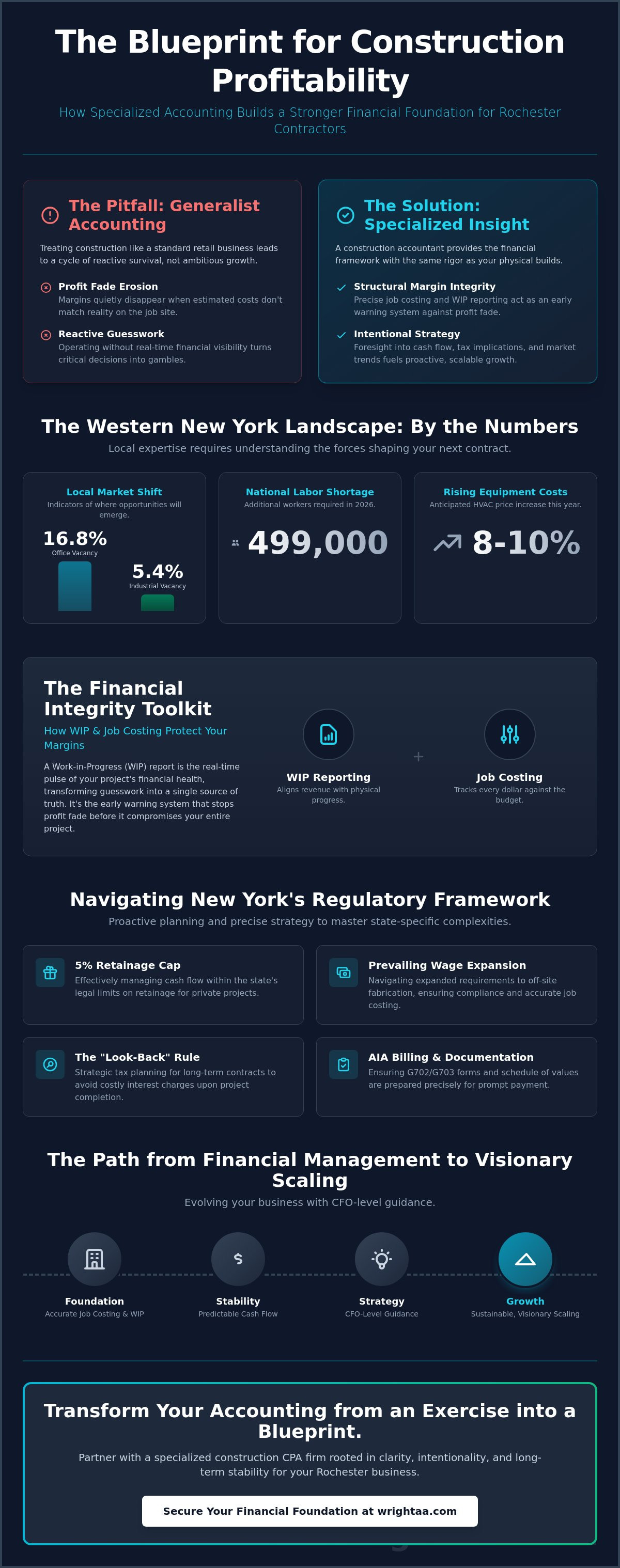
True expertise is grounded in the local soil. It's knowing that Rochester's office vacancy rate reached 16.8% at the close of 2025, while the industrial market remains tight with a 5.4% vacancy rate. These aren't just statistics; they're indicators of where the next contract will emerge. A partner with deep roots in Western New York understands the pressure of the national labor shortage, which requires 499,000 additional workers in 2026. They also anticipate that HVAC equipment prices will rise by 8-10% this year. This quiet, confident authority over your fiscal health allows you to focus on the craft of building, knowing your financial structural integrity is secure.
Work-in-Progress (WIP) and Job Costing: The Structural Integrity of Your Financials
A Work-in-Progress (WIP) report is more than a static document. It functions as the pulse of a construction project, offering a real-time view into the health of your site operations. Without this visibility, a firm operates in a state of financial guesswork. A specialized construction industry accountant Rochester ensures that your revenue recognition aligns with the actual physical progress of the build. This is typically achieved through the percentage-of-completion method, which provides a single source of truth by matching project costs with earned revenue in a given period.
Profit fade is the quiet erosion of margins that occurs when estimated costs don't mirror reality. It often begins as a small discrepancy in labor or materials; however, without rigorous job costing, it can compromise the entire project's viability. By the time many contractors realize their profit is slipping, the window for intervention has closed. Accurate job costing acts as an early warning system. It allows you to adjust your strategy before a minor variance becomes a structural failure in your financials. Ensuring your team follows NYS Tax Guidelines for Contractors when distinguishing between capital improvements and taxable repairs is a vital part of this cost accuracy.
AIA Billing and Schedule of Values
Prompt payment relies on the clarity of your documentation. The AIA G702 and G703 forms are the industry standard, yet they often become a source of friction when improperly prepared. Your schedule of values must be a precise reflection of the build. When billing accuracy is maintained, project cash flow remains steady. This allows you to meet your obligations to subcontractors and suppliers without the stress of delayed draws. If you're ready to bring this level of intentionality to your firm's reporting, our business consulting services can help design the framework you need.
Protecting Your Bonding Capacity
Sureties and lenders in the Rochester market look for stability. They analyze your balance sheet for signs of overbillings or underbillings, which can signal cash flow mismanagement or project delays. High underbillings suggest you are performing work you haven't yet billed, while excessive overbillings can indicate you are "borrowing" from future project phases to cover current costs. By tracking financial kpis for small business, you demonstrate a level of sophistication that builds trust with bonding agents. This transparency is the key to securing the bonding capacity needed for larger municipal or commercial projects.
Strategic Tax Planning for New York Contractors
Taxation, like any architectural element, requires a precise fit within the broader structure of your business. In the Western New York market, tax strategy isn't a seasonal chore; it's a continuous process of calibration. A construction industry accountant Rochester looks beyond the immediate tax return to understand how New York State's specific regulations impact your long-term liquidity. For firms handling multi-year projects, navigating the Look-Back Rule is essential. This rule requires contractors to re-evaluate taxes paid in prior years based on actual project outcomes, ensuring that the percentage-of-completion estimates were accurate. It's a complex intersection where project management and fiscal responsibility meet.
For closely held firms, the line between personal and business tax often blurs. Strategic planning ensures that your entity structure, whether an S-Corp, C-Corp, or LLC, is optimized for the current environment. While the federal corporate tax rate remains at 21% for 2026, the local nuances of New York's tax code can create significant variations in your effective rate. Identifying often-overlooked deductions, such as specific site preparation costs or specialized equipment maintenance, preserves the capital necessary for scaling your operations.
NYS Tax Credits and Incentives
New York offers specific pathways to mitigate tax liability that generalist firms might overlook. Evaluating the ongoing impact of the Employer Retention Credit (ERC) remains a priority for many contractors. Additionally, fuel tax credits and aggressive equipment depreciation strategies under Section 179 allow you to reinvest in your fleet and machinery. This proactive approach mirrors the principles of business tax planning Buffalo NY, where every financial decision is made with contextual awareness of the regional economy.
The Power of Year-Round Planning
Waiting until April to address your tax position is a strategic failure. Rochester contractors face unique cyclical shifts that require quarterly reviews to adjust for project-based income volatility. These reviews rely on the accuracy of your Work-in-Progress (WIP) schedules, which serve as the blueprints for your financial reporting. When your accountant understands the tactile reality of your jobsites, they can provide tax strategy that feels grounded and purposeful. This steady rhythm of oversight ensures that your capital matches your project pipeline, preventing the stress of unexpected liabilities during the height of the building season.
CFO-Level Guidance: Designing a Scalable Construction Business
Growth without a blueprint is merely an accumulation of risk. For many contractors, the transition from daily firefighting to a long-term financial vision marks the true beginning of a scalable enterprise. It's the difference between reacting to a bank balance and designing a financial architecture that supports unhurried, sustainable expansion. A construction industry accountant Rochester acts as a strategic architect, ensuring your capital reserves are always aligned with your project pipeline. This foresight is critical when making go/no-go decisions on major Rochester bids. If a project threatens to overextend your labor burden or dilute your equipment ROI, the data provides the clarity to walk away.
Designing for scale requires an intimate understanding of how money moves through a jobsite. It's a rhythmic process of balancing internal resources with external demands. When you align your financial data with your operational goals, you create a single source of truth. This clarity allows you to pursue projects that fit your firm's specific geographic and cultural context, rather than chasing every available contract. It's about quality over quantity and substance over spectacle.
Fractional CFO Services for Contractors
Accessing high-level expertise shouldn't require the overhead of a full-time executive. Our outsourced CFO services Buffalo NY offer a competitive edge by providing deep strategic analysis. We look at the tactile details of your business: the true cost of labor, the lifecycle of your machinery, and the weight of your indirect costs. This level of oversight transforms your financials from a technical requirement into a poetic guide for your firm’s future. If you're ready to move beyond transactional bookkeeping, our CFO services provide the intentional guidance your firm deserves.
Technology and Financial Clarity
Modernizing your tech stack creates a seamless bridge between the field and the office. Cloud-based systems allow for real-time visibility into project health, eliminating the manual errors that lead to financial friction. When your data is accurate and immediate, you reach a state of financial serenity. You can trust the numbers. This trust allows you to focus on the intersection of humanity and the built environment, secure in the knowledge that your financial foundation is as sound as the structures you build. By automating the mundane, you create the spatial openness needed for creative and strategic thinking.
Wright CPAs: Your Rochester Partner for Financial Intentionality
Financial clarity is not an accidental byproduct of doing business; it's a deliberate intervention. At Wright CPAs, LLC, we believe that the same precision you bring to a jobsite should be reflected in your financial statements. As a construction industry accountant Rochester, we provide a quiet, confident authority that allows you to focus on the craft of building. We eschew the loud spectacle of traditional marketing in favor of a sophisticated, grounded approach to your firm's fiscal health. Our goal is to ensure that your business remains as permanent and thoughtful as the structures you create.
Our firm is built on the principles of clarity and contextual awareness. We understand that the Western New York market requires more than just transactional bookkeeping. It requires a partner who prioritizes substance over spectacle. This is why we utilize a fixed-fee monthly advisory model. This structure removes the friction of hourly billing and creates the spatial openness needed for deep, intentional listening. It fosters a steady rhythm of communication where we can address project-specific challenges before they impact your bottom line. By providing predictable costs for our services, we mirror the stability we seek to build within your own organization.
Our Commitment to the Built Environment
We maintain a specialized focus on closely held businesses and trade contractors who value the intersection of traditional building methods and modern sensibilities. Our approach is methodical. We perform regular financial walkthroughs that go beyond the surface numbers to analyze the tactile reality of your projects. This allows us to integrate traditional accounting values with the technological needs of a modern firm. We don't just report on the past; we help you design a financial future that prioritizes quality over quantity. This disciplined focus ensures that every decision, from tax strategy to capital investment, is made with a rigorous commitment to excellence.
Begin the Walkthrough: Next Steps
The transition from financial confusion to a curated plan for growth begins with a single, intentional step. Our advisory retainers are designed to provide year-round peace of mind, allowing you to move through your project pipeline with confidence. We help you move beyond the stress of compliance and into a state of financial serenity. If you are ready to treat your financials with the same care you bring to the built environment, our business consulting and CFO services offer the structural integrity you need. Contact Wright CPAs, LLC today to begin the process of designing a resilient financial future for your firm.
Building a Legacy of Financial Clarity
A firm's longevity is built on more than the quality of its physical construction; it's sustained by the integrity of its financial reporting. By moving beyond basic compliance, you transform your ledger into a poetic blueprint for future expansion. We've explored how a dedicated construction industry accountant Rochester provides the essential oversight required to manage New York's specific tax environment and complex job costing requirements. This specialized perspective ensures that your cash flow remains as steady as a well-poured foundation.
Wright CPAs, LLC offers a partnership rooted in substance. Our proactive tax strategies for WNY businesses and specialized construction and law firm expertise provide the clarity needed to navigate regional market shifts. Through our fixed-fee monthly advisory for predictable costs, you gain the spatial openness to focus on your craft. It's time to align your financial architecture with your visionary goals. Your commitment to excellence on the jobsite deserves an equal commitment in the office.
Design your financial future with Wright CPAs, LLC and secure the structural stability your firm deserves. We look forward to helping you build a resilient and intentional business in the heart of Rochester.
Frequently Asked Questions
Why do construction companies in Rochester need a specialized accountant?
Specialized accountants understand the unique revenue recognition methods required for long-term projects and high-risk contracts. A generalist often misses the subtle shifts in the local market, such as the transition from large-scale industrial builds to high-tech retrofitting. A construction industry accountant Rochester provides the specific insight needed to ensure your financial reporting reflects the tactile reality of your jobsites rather than a generic business model.
What is the Work-in-Progress (WIP) report and why is it critical for contractors?
The Work-in-Progress (WIP) report is a dynamic financial tool that tracks the percentage of completion for every active project. It's critical because it identifies profit fade before it compromises your firm's liquidity. By aligning actual costs with estimated benchmarks, the WIP report provides the structural integrity needed to make informed operational decisions in real-time, preventing the slow erosion of your project margins.
How does the New York State tax environment affect construction profitability?
Profitability in New York is heavily influenced by specific regulatory details, such as the 5% cap on retainage for private contracts exceeding $150,000. Additionally, the recent expansion of prevailing wage laws to include off-site fabrication adds a layer of complexity to labor burden calculations. A construction industry accountant Rochester helps navigate these shifts, protecting your bottom line from unexpected state-level liabilities and compliance errors.
What are the benefits of a fixed-fee accounting model for construction firms?
A fixed-fee model eliminates the friction of hourly billing and creates a steady, unhurried rhythm of communication. It allows for intentional advisory sessions where the focus remains on your firm's long-term strategy rather than the clock. This predictability in your accounting overhead mirrors the stability you strive for in your own project estimates, fostering a partnership built on trust and substance.
Can a specialized CPA help my Rochester firm secure better bonding?
Yes, specialized reporting significantly enhances your credibility with sureties and lenders in the Western New York market. Accurate financial statements that clearly explain overbillings and underbillings demonstrate a high level of fiscal discipline and transparency. When a bonding agent sees that your internal controls are as rigorous as your building techniques, they are more likely to extend the capacity needed for larger projects.
What is the difference between job costing and general bookkeeping?
General bookkeeping records the firm's overall financial transactions, while job costing analyzes the specific heartbeat of an individual project. Job costing breaks down the tactile costs of labor, materials, and equipment for a single build. This micro-level analysis is essential for determining the true profitability of your work and refining your future bidding strategies to ensure every project contributes to your firm's growth.
How often should a construction business owner meet with their tax strategist?
You should meet with your tax strategist at least once per quarter to calibrate your position based on current project data and Work-in-Progress reports. Waiting until the end of the year is a strategic failure that leads to reactive decision-making. These rhythmic reviews allow for proactive adjustments to your tax planning, ensuring your capital reserves remain sufficient to cover your obligations without disrupting your project momentum.
What specific financial KPIs should Rochester contractors be tracking?
Contractors should monitor their gross margin per job, their ratio of overbillings to underbillings, and their days sales outstanding (DSO). Tracking these indicators provides a clear view of your firm's operational health and cash flow velocity. In the Rochester market, where office vacancy rates reached 16.8% at the close of 2025, these metrics help you identify which sectors offer the most resilient opportunities for sustainable growth.


