

If you view your business as a living structure, are your monthly reports the foundation or merely the debris left behind after construction? Many leaders feel a persistent disconnect between a healthy bank balance and the actual profit reflected on paper. You might find yourself hesitating before a major investment, stalled by the fear that you lack the structural data to support a bold move. Learning how to read your financial statements to make decisions is the first step toward replacing this uncertainty with a clear, intentional path forward.
We believe that financial literacy is the most vital skill for any intentional creator. This guide will show you how to transform raw data into a strategic blueprint for your business. We will explore the dualities of your balance sheet and income statement, moving from broad philosophical goals to the specific material details of your cash flow. By the end, you will have the clarity to hire with confidence and the foresight to manage your firm’s growth with a steady, unhurried hand.
Key Takeaways
- Shift from reactive record-keeping to a proactive structural blueprint, viewing your financial reports as the foundation of your business integrity.
- Learn how to read your financial statements to make decisions by analyzing revenue trends and gross margins to confirm if your growth is truly sustainable.
- Evaluate your firm's structural integrity through the balance sheet, ensuring you have the liquidity to navigate unexpected economic shifts with confidence.
- Understand the vital rhythm of capital flow to prevent the common paradox where a profitable business fails due to a lack of operating cash.
- Adopt a disciplined five-step review process to transform monthly data into a visionary framework for strategic hiring and long-term expansion.
The Philosophy of Financial Statements: More Than Compliance
Architecture is the art of creating space that serves a specific purpose. Financial statements are the blueprints of your business's internal environment. They are not merely static records of what has passed. Instead, they represent the structural integrity of your vision. Too often, bookkeeping is treated as a reactive chore. It's the debris left over after a month of work. True financial intentionality is different. It is a proactive design process. It requires a quiet, disciplined look at the materials you have gathered and the structures you have built.
Beyond the Tax Return
Compliance is the floor of business management, not the ceiling. When you view your statements only as a requirement for the IRS, you lose the ability to see trends as they form. Financial clarity is a tool for emotional regulation. It reduces the "anxiety of the unknown" that keeps many entrepreneurs awake at night. This is the true value of small business accounting Buffalo NY. It's about designing a foundation that is both resilient and flexible. You gain the confidence to say yes to a new hire or no to a distracting project because the data supports your intuition.
The Narrative of Three Documents
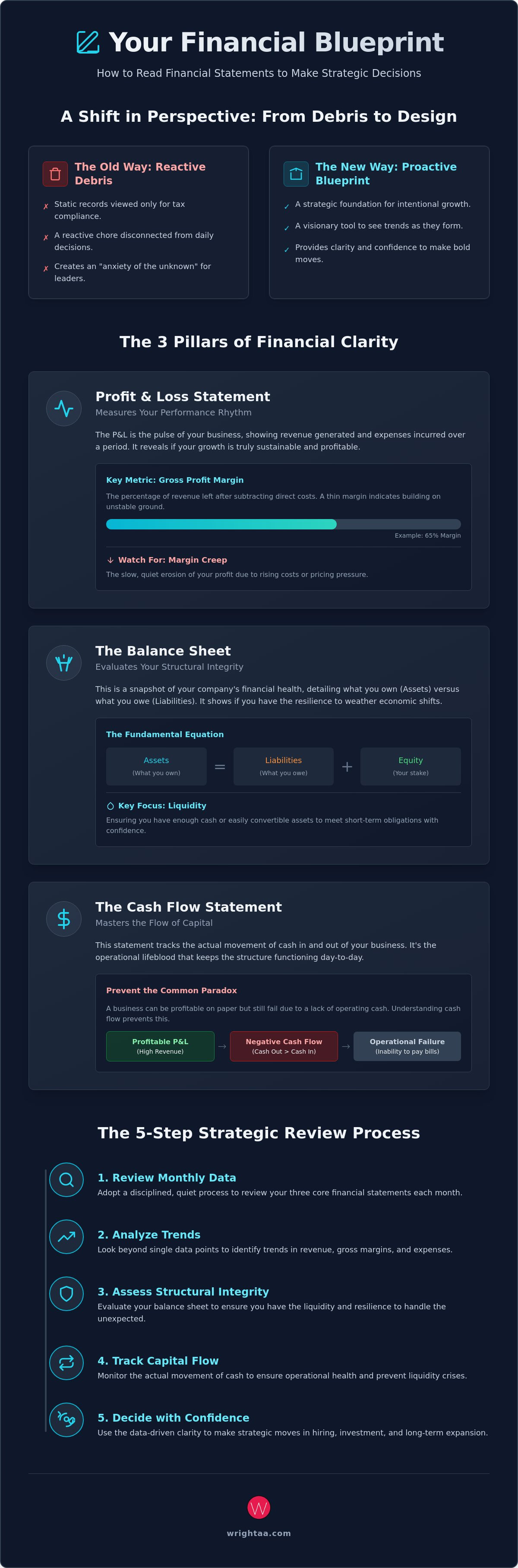
Your business speaks through three primary documents. Each serves a unique architectural function. The Profit and Loss statement captures your performance rhythm; it shows the cadence of your revenue and the weight of your expenses. The Balance Sheet measures your structural integrity, detailing what you own versus what you owe. Finally, the Cash Flow statement tracks your operational lifeblood. Through rigorous Financial statement analysis, these three streams converge. They provide a holistic view of your business’s health that a single bank balance can never offer. Mastery of this narrative ensures that your expansion is not accidental but deeply intentional.
Decoding the Profit & Loss Statement: Measuring Your Performance Rhythm
The Profit and Loss (P&L) statement is the pulse of your organization. It records the vibration of daily activity, capturing the energy spent to generate results over a specific period. While the balance sheet represents the physical structure, the P&L represents the movement within it. Learning how to read your financial statements to make decisions starts with understanding this cadence. You must distinguish between growth that is intentional and growth that is merely accidental. Accidental growth often feels like a crowded room; it's loud, chaotic, and leaves little space for profit to breathe.
True performance analysis requires looking beyond the "Bottom Line." Many business owners see a positive number at the end of the month and assume the structure is sound. However, this figure often fails to account for the "Real Line," which includes the uncompensated time and effort of the owner. If the business only shows a profit because you are working eighty hours a week for a modest draw, the design is flawed. Learning how to read financial statements allows you to see these structural cracks before they lead to operational fatigue.
Revenue and Margin Analysis
Not all revenue is created equal. Some clients or services drive significant profit, while others merely create noise and consume resources. Gross Profit Margin is the ratio of revenue remaining after direct costs. It's the first indicator of your pricing health. If this margin is thin, you're building on unstable ground. You must also watch for "margin creep," where the slow erosion of pricing power or the steady rise of material costs quietly eats away at your take-home pay. Identifying these trends early ensures that your growth remains both profitable and sustainable.
Identifying Operating Inefficiencies
Operating expenses are the climate control of your business. They should provide comfort and efficiency, not represent a drain on your energy. It's vital to distinguish between investments that strengthen the business and waste that adds unnecessary weight. Benchmarking your spending against Western New York industry standards helps you see where you might be over-extended. By measuring these against Financial KPIs for small business, you can cut the "fat" from your operations without bruising the "muscle" that drives your success. If the rhythm of your performance feels erratic, our CFO services can help you restore balance and design a more predictable future.
The Balance Sheet: Evaluating Your Structural Integrity
If the Profit and Loss statement represents the rhythm of your work, the balance sheet represents the physical structure of the firm itself. It is a quiet, steady reflection of what your business is at its core. This document is built upon a single, timeless equation: your assets must equal the sum of your liabilities and equity. This balance ensures that every material resource in your environment is accounted for. Understanding how to read your financial statements to make decisions allows you to see if you are building a fortress of capital or a fragile house of cards.
A balance sheet is a snapshot in time, unlike the P&L which records the flow of energy over a duration. This distinction is vital for long-term stewardship. For instance, many owners in Western New York face a unique seasonal cadence. Can your business survive a sudden Buffalo winter slowdown? The answer lies in your liquidity. If your wealth is tied up in heavy equipment or aging inventory, you may lack the fluid resources needed to sustain operations when the environment turns harsh. This beginner's guide to reading financial statements provides a helpful foundation for distinguishing between these different classes of value.
As you look toward 2026 planning, pay close attention to your Accounts Receivable. This line item tells a hidden story about your relationships and your boundaries. If this number is growing faster than your revenue, you're essentially acting as a bank for your clients. This can quietly undermine your structural integrity, leaving you vulnerable even during periods of high activity.
Liquidity and Leverage
The Current Ratio serves as a litmus test for your short-term health. It compares your current assets to your current liabilities. A healthy ratio suggests a serene level of working capital, providing the breathing room to navigate unexpected repairs or market shifts. For a growing Rochester or Syracuse firm, the question of debt is often a matter of design. Debt can be "good debt" when it's used as a tool to acquire assets that generate a return higher than the cost of the capital. It's about using leverage to extend your reach without compromising your foundation.
Asset Utilization
Every asset on your books should serve a specific purpose. If equipment is sitting idle or inventory is gathering dust, it's a drain on your structural energy. We also look at the strategic impact of depreciation. This technical detail is a key component of business tax planning Buffalo NY. It allows you to account for the natural wear and tear of your physical environment while optimizing your tax position. By mastering how to read your financial statements to make decisions, you ensure that every asset is working in harmony with your broader vision.
The Cash Flow Statement: Mastering the Flow of Capital
If the income statement is the rhythm and the balance sheet is the structure, the cash flow statement is the movement of water through the pipes. It is the most tactile of the three documents. It reveals the literal movement of capital into and out of your environment. Many leaders face a jarring paradox; a business can be profitable on paper while the bank account remains stubbornly empty. Mastery of how to read your financial statements to make decisions requires you to look beyond accrual accounting to see the actual liquidity available for today's needs.
Operating cash flow is the true measure of your business’s self-sufficiency. It tells you if your daily activities generate enough energy to sustain themselves. Investing and financing activities show where your capital goes to grow or how you are fueling that growth through external support. In the Western New York economy, this rhythm is often seasonal. Managing the peaks of a busy summer and the valleys of a quiet winter requires a disciplined approach to capital allocation. You must ensure that the flow remains steady, even when the external environment is still.
Profit vs. Cash
The disconnect between profit and cash usually stems from timing. You may have completed a project and recognized the revenue, but the invoice remains unpaid. For Buffalo law firms and service providers, this delay can create a significant strain. You are paying for payroll and overhead today with the hope of collecting tomorrow. This timing gap is a common trap that can lead to insolvency despite a healthy P&L. Understanding these nuances is essential for how to read your financial statements to make decisions that protect your firm's future.
Planning for Reinvestment
Before you commit to a new hire or an office expansion, you must determine if you have enough "dry powder." This term refers to the liquid cash available for strategic intervention. Reinvesting too early can overextend your structure; reinvesting too late can lead to stagnation. A fractional CFO Buffalo NY provides the foresight needed to navigate these transitions. They help you design a cash flow forecast that mirrors your strategic blueprint. If you are ready to master your capital flow, our cash flow management services offer the clarity and discipline your business deserves.
Turning Data into Strategy: The CFO’s Decision-Making Framework
Financial analysis is not a post-mortem. It is a living dialogue with your business's future. When you master how to read your financial statements to make decisions, you move from the anxiety of the unknown to the serenity of a planned path. This process is similar to an architectural review. You aren't just looking at what has been built; you're looking at the structural capacity for what comes next. By asking "What if?" you can model the impact of a new Syracuse office or a team expansion before you ever break ground.
Scenario planning allows you to visualize the stresses on your structure before they occur. It transforms your balance sheet and P&L from static reports into a dynamic architectural model. This foresight is what separates reactive owners from visionary leaders. It ensures that your growth is not just a matter of luck but a result of rigorous design and intentional stewardship.
A Framework for Intentional Growth
We recommend a disciplined monthly ritual. This four-step process ensures your growth remains grounded in reality:
- Step 1: Check Liquidity. Ensure you have the fluid capital to meet your obligations. Safety is the foundation of all creative risk.
- Step 2: Review Margins. Confirm your pricing remains healthy and your direct costs are contained. Efficiency is the measure of your operational rhythm.
- Step 3: Compare Actuals to Budget. Identify where you've strayed from your blueprint. Discipline allows for course correction before a small gap becomes a structural failure.
- Step 4: Forecast Tax Liability. Anticipate your obligations to the state and federal government. With the permanent QBI deduction from the 2025 One Big Beautiful Bill Act, your tax planning should be a proactive part of your monthly rhythm.
This framework is the final piece of learning how to read your financial statements to make decisions that align with your long-term legacy. It moves the conversation from "what happened" to "what is possible."
The Wright Approach
There comes a point in every firm's journey where DIY bookkeeping no longer provides sufficient clarity. The complexity of growth requires professional oversight. Our fixed-fee monthly advisory retainers provide the architectural guidance necessary for sophisticated stewardship. We offer more than just records; we provide a vision. By integrating tax strategy and CFO services into your monthly cadence, you ensure that every decision is backed by rigorous data.
For Western New York business owners, proactive planning is the difference between surviving the season and thriving within it. Designing your financial future requires deep listening and contextual awareness. If you're ready to transform your raw data into a strategic blueprint, we invite you to explore how our business consulting can provide the discipline and design excellence your business deserves. Designing your financial future with Wright CPAs, LLC ensures that your vision is supported by a foundation as enduring as the structures you build.
Designing Your Financial Legacy
The blueprint of your business is now in your hands. You've moved beyond the debris of reactive bookkeeping to a place of intentional stewardship. By mastering how to read your financial statements to make decisions, you've gained the ability to see the structural integrity of your firm and the rhythm of its performance. This clarity is the foundation for every hire, every expansion, and every season of growth.
True financial excellence requires a commitment to quality over spectacle. Whether you are managing a law firm or a closely held business, the intersection of proactive tax strategies and disciplined CFO-level guidance creates a permanent, thoughtful intervention in your daily operations. You don't have to navigate these complexities alone. Our approach ensures that your financial environment is both resilient and evocative.
Elevate your business strategy with our Outsourced CFO Services in Buffalo, NY. Our team provides the sophisticated oversight and deep listening necessary to design a resilient financial future. Step forward with the quiet confidence that your data is not just a record of the past, but a visionary guide for what you will build next.
Common Inquiries in Financial Design
What is the most important financial statement for a small business owner?
The three core statements are inseparable; however, the Cash Flow Statement is often the most critical for immediate survival. While the Profit and Loss reflects your performance rhythm, cash flow measures the literal liquidity available to pay your team and vendors. A business can be profitable on paper yet fail because it lacks the fluid capital to meet its obligations. Viewing these documents as a unified structure provides the most complete picture of your health.
How often should I be reading my financial statements to make decisions?
You should review your financial data at least once a month to maintain a proactive rhythm. This monthly cadence allows you to spot trends before they become structural failures. Learning how to read your financial statements to make decisions is a discipline that rewards consistency. By the time quarterly reports arrive, many opportunities for course correction have already passed; monthly oversight ensures your growth remains intentional and your foundation remains secure.
Can I use my tax return as a financial statement for decision-making?
A tax return is a historical record designed for compliance; it is not a strategic tool for daily leadership. Tax returns often include accounting adjustments or depreciation schedules that don't reflect your actual operational reality. To build a resilient future, you need real-time data that shows your current liquidity and performance. Relying on last year's return to make today's expansion decisions is like using an old photograph to navigate a changing landscape.
What is the difference between an income statement and a profit and loss statement?
The terms "Income Statement" and "Profit and Loss Statement" refer to the same document. Both capture your revenue and expenses over a specific duration of time. This report measures the cadence of your business activity; it shows whether your operations are generating a surplus. While the names differ, the purpose remains the same: to record the energy spent and the results achieved within your business environment during a set period.
How do I know if my business has a cash flow problem or a profitability problem?
A profitability problem usually appears in your Gross Margin; it suggests your pricing or direct costs are fundamentally out of balance. A cash flow problem is often a matter of timing; it appears when your invoices aren't collected quickly enough to cover your current liabilities. Distinguishing between these two issues is essential for knowing how to read your financial statements to make decisions that address the root cause of your stress rather than just the symptoms.
What financial ratios are most critical for Buffalo-based service businesses?
Buffalo service firms should prioritize the Current Ratio and Accounts Receivable (AR) Days. The Current Ratio measures your short-term health by comparing assets to liabilities; it ensures you can survive a quiet winter season or a sudden slowdown. AR Days reveal how long it takes for your clients to pay for your work. Monitoring these metrics helps you maintain a serene level of working capital even when the external Western New York economy shifts.
Is it possible for a business to be too small to need a balance sheet?
No business is too small to require a balance sheet. Even a solo practice has assets, liabilities, and equity that define its structural integrity. Without a balance sheet, you lack a snapshot of what your business actually owns and owes at any given moment. This document provides the essential foundation for all future growth; it's the anchor that keeps your vision grounded and your equity protected as you begin to scale.
How does proactive tax planning change the way I read my P&L?
Proactive tax planning shifts your focus from "top line" revenue to your net-after-tax profit. It encourages you to view expenses as strategic investments that can reduce your overall liability while strengthening your operations. Instead of seeing taxes as an annual surprise, you begin to treat them as a manageable component of your monthly performance rhythm. This intentionality allows for more predictable reinvestment in your firm's future and a clearer understanding of your true take-home pay.


