

What if the most enduring structure you build isn't the one housing your staff, but the financial architecture supporting your family’s legacy? For many owners, the daily operations of a company feel like a constant negotiation between growth and preservation. It's common to feel that you're paying more in avoidable taxes than necessary, or to feel a sense of unease regarding how to transition wealth from the entity to your personal life. Finding a specialized CPA for closely held business Buffalo NY provides the clarity needed to turn these frustrations into a deliberate, quiet confidence.
You deserve a financial strategy that feels as grounded and intentional as the business you've cultivated. We'll discuss how proactive tax planning and CFO-level insights can transform your liability into a tool for long-term profitability. We'll examine the impact of the One Big Beautiful Bill Act of 2025 on your QBI deduction and how New York’s PTET election can safeguard your earnings. This is your roadmap to a stable, visionary future for your business and your family.
Key Takeaways
- Understand why Buffalo’s economic landscape relies on family-owned enterprises and how ownership concentration shapes your financial architecture.
- Learn to balance the duality of the owner-operator by strategically distributing funds to optimize tax efficiency between business profits and personal wealth.
- Discover how a specialized CPA for closely held business Buffalo NY provides CFO-level clarity that transforms standard bookkeeping into a proactive engine for growth.
- Identify the essential role of buy-sell agreements in succession planning to ensure your business structure survives transitions and preserves your legacy.
- Gain a clear roadmap for the future by shifting from reactive compliance to an intentional design that bridges professional success with long-term stability.
Understanding the Closely Held Business Landscape in Buffalo, NY
The economy of Western New York is a tapestry woven from family legacy and private ownership. In Buffalo, the business landscape is defined not by faceless conglomerates, but by the quiet, steady work of tightly controlled firms. These entities form the bedrock of our local commerce. Understanding the specific needs of these organizations requires a specialized CPA for closely held business Buffalo NY who recognizes the weight of every financial decision. The architecture of a company is more than its legal filing; it's the physical manifestation of the owner's intent.
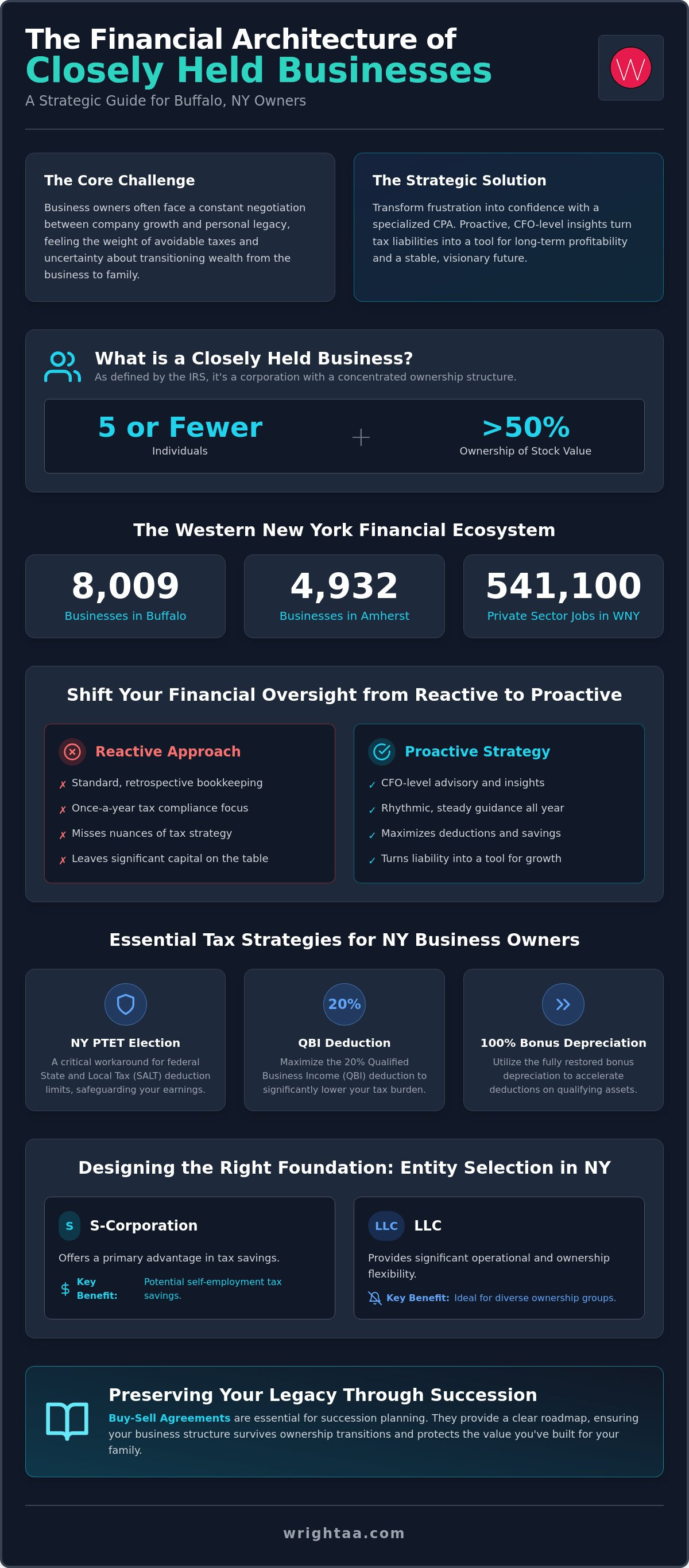
According to IRS standards, a closely held business is a corporation where more than 50% of the value of its outstanding stock is owned, directly or indirectly, by five or fewer individuals at any time during the last half of the tax year. This concentration of ownership creates a unique duality. The owner is often the operator, the visionary, and the lead shareholder. In a privately held company, the relationship between the business and the personal wealth of the owners is inseparable. This proximity brings challenges. Owners must constantly balance the need for business reinvestment against the financial requirements of the shareholders. It's a delicate, elemental equilibrium.
The Unique Financial Ecosystem of Western New York
Buffalo’s market dynamics are distinct. With 8,009 businesses in the city and 4,932 in the town of Amherst, the concentration of local ownership is high. These firms navigate New York State specific mandates, such as the Pass-Through Entity Tax (PTET), which offers a critical workaround for federal SALT deduction limits. A local expert ensures your valuation reflects the reality of the WNY labor market, where private sector jobs reached 541,100 in early 2026. Moving from survival to intentional growth requires this level of geographic and cultural context. It's about building something that lasts.
Why General Accounting Often Fails Closely Held Entities
Standard bookkeeping is a retrospective exercise. It looks at what has already passed. For a closely held firm, this once-a-year approach leaves significant capital on the table. General accounting often misses the nuances of proactive tax strategy, such as maximizing the 20% Qualified Business Income (QBI) deduction or utilizing 100% bonus depreciation restored by the One Big Beautiful Bill Act. Your financial oversight should be rhythmic and steady. It should guide you through the year, rather than surprising you at its end. When accounting is reactive, the design of the business suffers. Proactive guidance ensures the structure remains sound as the environment changes.
The Intersection of Personal and Business Tax Strategy
The boundary between a closely held business and its owner is often porous. It's a shared environment where personal financial health is tethered to the entity's performance. For an owner-operator in Western New York, business profits are not just numbers on a ledger; they are the source of personal wealth and legacy. Managing this intersection requires a business tax planning Buffalo NY strategy that views the two as a single, cohesive structure. When the business succeeds, the owner's personal architecture should strengthen in tandem.
Strategic fund distribution is the mechanism that balances these needs. Deciding between a traditional salary and dividend distributions significantly impacts your self-employment tax burden. According to IRS rules for closely held corporations, these distinctions are vital for maintaining compliance while minimizing liability. Modern technology now allows for real-time clarity on these tax liabilities. By utilizing advanced accounting systems and AI-enabled insights, owners can see the tax impact of every draw before the transaction occurs. This clarity removes the anxiety of the unknown, replacing it with a sense of calm and purpose.
Entity Selection: Designing the Right Foundation
Choosing between an S-Corp and an LLC is a fundamental design choice. In New York, this decision dictates how capital flows from the site of production to the owner’s pocket. The s corp vs llc new york tax comparison often reveals that an S-Corp may offer self-employment tax savings, while an LLC provides significant flexibility for diverse ownership groups. The right foundation prevents structural cracks in your financial plan as you scale. If you're unsure which path fits your vision, consulting with a specialist can provide the necessary structural analysis for your specific context.
Proactive Planning vs. Reactive Filing
We call this the "Architecture of Finance." It's the act of building a strategy long before the tax year concludes. For professional services in Buffalo, identifying industry-specific deductions is essential. We look for opportunities like domestic R&D expensing or the permanent 100% bonus depreciation restored in 2025. This proactive approach also helps avoid the "Double Taxation" trap common in C-Corp structures, where profits are taxed at the 21% federal corporate rate and then again when distributed. A skilled CPA for closely held business Buffalo NY ensures your tax strategy remains a thoughtful, permanent intervention rather than a rushed, year-end correction.
CFO-Level Advisory: Beyond the Balance Sheet
A bookkeeper records the past. They ensure the site is clear and the materials are accounted for. An outsourced CFO, however, designs the future. For the owner of a closely held entity, this distinction is the difference between maintenance and creation. By engaging a specialized CPA for closely held business Buffalo NY, you move beyond the static balance sheet into a realm of active financial leadership. It's about using data as a sensory tool to feel the rhythm of your operations and the health of your enterprise.
Designing financial clarity requires more than just looking at profit and loss statements. It involves identifying specific financial kpis for small business that act as structural load-bearing points. When these indicators are clear, cash flow management becomes a tool for visionary decision-making rather than a source of stress. You transition from wondering if you can afford a new hire to knowing exactly how that investment will behave within your financial ecosystem. This level of insight allows for a quiet, confident authority in every business move you make.
Predictable Costs for Predictable Growth
Traditional accounting often relies on unpredictable hourly billing. This creates a "fear of the clock" that stifles communication. If you're afraid to pick up the phone because of a pending invoice, the creative design process stops. We believe in a fixed-fee monthly retainer model. It fosters a deeper, more unhurried relationship. These outsourced CFO services Buffalo NY provide a higher ROI because they prioritize deep listening and contextual awareness over transactional tasks. It's a commitment to substance over spectacle.
Strategic Cash Flow for Closely Held Businesses
Buffalo and Syracuse markets have their own seasonal ebbs and flows. A quiet authority in finance understands these environmental factors and how they impact liquidity. Strategic cash flow isn't just about paying bills; it's about intentional capital allocation. You must decide when to reinvest in the firm's structure and when to distribute wealth to shareholders. This foresight is a key component of business succession planning, ensuring your enterprise remains future-ready and resilient. By forecasting growth for the next three to five years, you ensure the structure remains stable through every economic season.
Succession and Continuity: The Permanent Intervention
Building a business is an act of creation. Transitioning it is an act of preservation. For closely held firms, the weight of succession is both psychological and financial. It represents the intersection of a life's work with the needs of the next generation. A CPA for closely held business Buffalo NY acts as the steward of this transition, ensuring the financial architecture remains unyielding as leadership changes. Without a deliberate plan, the structure you've built risks fragmentation. It's about protecting the site and the vision from the elements of uncertainty.
Buy-sell agreements serve as the essential structural reinforcements in this process. They define how ownership interests are handled during life events, ensuring the entity remains intact. These agreements must be integrated with your broader estate planning to protect your family’s interest. A CPA serves as the primary architect of a business succession plan by aligning tax efficiency with the long-term structural integrity of the owner’s legacy. This level of intentionality prevents the erosion of wealth during the transfer of power.
Beyond the transition itself, managing your personal capital requires a strategy that is both transparent and effective. You can explore Wealth Management and Financial Advisory Fees to learn how Evergreen Wealth Management provides the financial clarity needed for pre and post-retirement success.
Valuation and Exit Strategies
Determining the true value of a closely held business requires deep listening. It's not just a multiple of earnings; it's a reflection of the firm's cultural and economic context within Western New York. Preparing the books for a generational hand-off or an internal transfer involves rigorous attention to detail. You must account for the tax implications of different exit paths, particularly under New York’s graduated income tax rates, which can reach 10.90%. For those with business income over $5 million, the top corporate franchise tax rate of 7.25% has been extended through 2030, making careful exit timing even more critical. A clean, transparent financial history is the best foundation for a successful transition. It provides the proof of quality that incoming owners require.
Maintaining Compliance Across Generations
Multi-generational ownership introduces new layers of complexity. New shareholders must be educated on the existing financial architecture to maintain the firm's stability and discipline. Ongoing consulting plays a vital role here, preserving both business culture and accumulated wealth. It ensures that the original vision remains the guiding principle even as the environment evolves. This process often highlights the intersection of traditional building methods with modern sensibilities, ensuring the business remains relevant and resilient. If you're ready to secure your firm's future, exploring our succession planning services can provide the clarity you need to move forward with purpose.
Wright CPAs, LLC: Your Partner for Intentional Financial Design
Wright CPAs, LLC operates on a philosophy of proactive guidance rather than reactive response. We are a Buffalo-based firm that views the financial life of a business as a structure requiring careful, constant attention. For those seeking a CPA for closely held business Buffalo NY, we offer a partnership rooted in substance and depth. Our specialized expertise in CPA for law firms Buffalo NY and other tightly controlled entities allows us to address the unique dualities of owner-operated firms. We prioritize quality over quantity, ensuring every client receives the rigorous commitment to design excellence they deserve.
Our fixed-fee monthly accounting retainers are designed to create financial serenity. By removing the transactional nature of hourly billing, we provide the breathing room necessary for true strategic thought. This model ensures that our oversight is a permanent, thoughtful intervention in your daily life, much like a well-designed building improves the experience of its inhabitants. It's a steady, unhurried approach to financial leadership that prioritizes the long-term health of your enterprise over short-term gains.
The Wright Approach to Buffalo Business
Our history is deeply intertwined with the Western New York community. We've seen the local economy evolve, from traditional manufacturing to the rise of professional services and management firms that now define our region. This context informs our work at Wright CPAs, LLC. We utilize modern technology, including AI-driven insights, to provide real-time clarity, yet we never abandon traditional professional values. Deep listening is the first step in our design process. We seek to understand the site and the culture of your business before we propose a strategy. This ensures every intervention is contextual and effective.
Begin Your Financial Walkthrough
An initial consultation with our Buffalo team is a narrative walkthrough of your current financial landscape. We identify the structural weaknesses and the opportunities for reinforcement. The transition process is deliberate and steady. We guide you away from the stress of reactive filing toward a proactive strategy that anticipates the future. It's time to build a financial foundation that matches the ambition of your business. You can schedule a consultation to design your business’s financial future.
Building an Enduring Financial Legacy
Financial intentionality isn't a single event; it's a continuous process of stewardship. We've explored how aligning your entity selection with personal tax goals and utilizing CFO-level insights creates a resilient foundation. By addressing succession today, you ensure the structure you've built remains a permanent intervention for your family and the Buffalo community. True stability comes from a design that anticipates change rather than merely reacting to it.
Since 2012, Wright CPAs, LLC has focused on proactive tax strategy to help owners navigate these complexities with quiet confidence. As a specialized CPA for closely held business Buffalo NY, we bring deep expertise to law firm accounting and tightly controlled entities across Western New York. Our predictable fixed-fee monthly advisory models are designed to provide clarity and serenity, allowing you to focus on the substance of your work rather than the cost of the clock.
Design a more intentional financial future for your business. Your vision deserves a financial architecture that is as thoughtful and enduring as the legacy you're building every day.
Frequently Asked Questions
What exactly defines a closely held business for tax purposes?
The IRS defines a closely held corporation as one where more than 50% of the value of its outstanding stock is owned by five or fewer individuals at any time during the last half of the tax year. This structure is the backbone of the Buffalo economy, covering a vast majority of family-owned firms. Because ownership is concentrated, the tax rules are distinct, requiring a strategy that accounts for the tight relationship between the entity and its shareholders.
How is a CPA different from a standard business accountant?
A standard accountant typically focuses on the retrospective recording of transactions and compliance. In contrast, a CPA for closely held business Buffalo NY acts as a strategic architect who designs the financial future of the firm. CPAs are licensed professionals held to rigorous ethical standards and possess the technical depth to navigate complex NYS tax mandates. It is the difference between simply documenting the past and intentionally building for the future.
Why should a Buffalo business choose a fixed-fee retainer over hourly billing?
Fixed-fee models remove the psychological barrier of the "billable hour," which often prevents owners from seeking timely advice. When you aren't worried about a ticking clock, you're more likely to engage in the deep, unhurried conversations that lead to better financial design. This model fosters a proactive partnership where the focus remains on quality and substance. It creates a predictable cost structure that aligns with your business’s need for steady, rhythmic growth.
Can Wright CPAs, LLC help with both my business and personal tax returns?
Yes, we prioritize an integrated approach because the financial health of a closely held business is inseparable from the owner’s personal wealth. By managing both returns, we can strategically coordinate fund distributions, salary levels, and tax credits to minimize your total liability. This holistic oversight ensures that the flow of capital from the business to the individual is efficient and intentional. It prevents the structural gaps that often occur when two different firms handle your filings.
What are the specific tax advantages of an S-Corp for closely held businesses in NY?
An S-Corp status allows business income to pass through to shareholders, avoiding the 21% federal corporate income tax rate. In New York, this structure is particularly advantageous when combined with the Pass-Through Entity Tax (PTET) election, which serves as a workaround for the federal SALT deduction limit. For 2026, the SALT cap is set at $40,000, and utilizing the PTET can significantly reduce your federal taxable income. It is a powerful tool for preserving capital within the family structure.
How often should I meet with my CPA for proactive tax planning?
We recommend a rhythmic cadence of monthly or quarterly meetings to ensure your strategy remains aligned with your operations. Waiting until the end of the year to discuss taxes is a reactive approach that often leaves money on the table. Regular touchpoints allow us to adjust for seasonal cash flow fluctuations and legislative changes, such as the restored 100% bonus depreciation. These steady interactions ensure that your financial architecture remains resilient throughout the year.
Do you provide specialized accounting for law firms in Western New York?
We offer specialized services tailored to the unique regulatory and financial requirements of legal practices. This includes managing IOLA accounts, partner equity distributions, and complex multi-state tax obligations. Our approach recognizes that a law firm’s financial design must support both professional excellence and partner legacy. We understand the specific cultural context of the Buffalo legal community and provide the disciplined oversight necessary to elevate your practice’s profitability.
What is the first step in moving my accounting to Wright CPAs, LLC?
The process begins with a deliberate financial walkthrough where we assess the current state of your business and personal tax landscape. This initial consultation is a quiet, focused exploration of your goals and any existing structural weaknesses. We then design a transition plan that moves you away from reactive filing toward a proactive, CFO-level strategy. This first step is about establishing a shared vision before we begin the work of reinforcing your business's financial future with Wright CPAs, LLC.


