

A building's integrity depends on the soil beneath it. A firm's creative legacy depends on the ledger behind it. For many design professionals, the challenge isn't the vision; it's the invisible friction of managing a business. You've likely felt the weight of unpredictable cash flow between project phases or the frustration of tracking overhead across a thousand design iterations. Specialized accounting for architects Rochester offers a way to ground your firm in financial clarity without compromising your artistic intent.
We understand that you'd rather focus on the silhouette of a new structure than the nuances of New York State tax compliance. It's common to feel a sense of unease regarding R&D tax credits or the complexity of the Section 179D deduction, especially with the June 30, 2026, deadline for new construction starts approaching. This guide reveals how disciplined project accounting and proactive tax planning empower you to balance visionary design with predictable profitability. You'll discover how to turn your financial reports into clear, actionable blueprints that mirror the precision of your most successful projects.
Key Takeaways
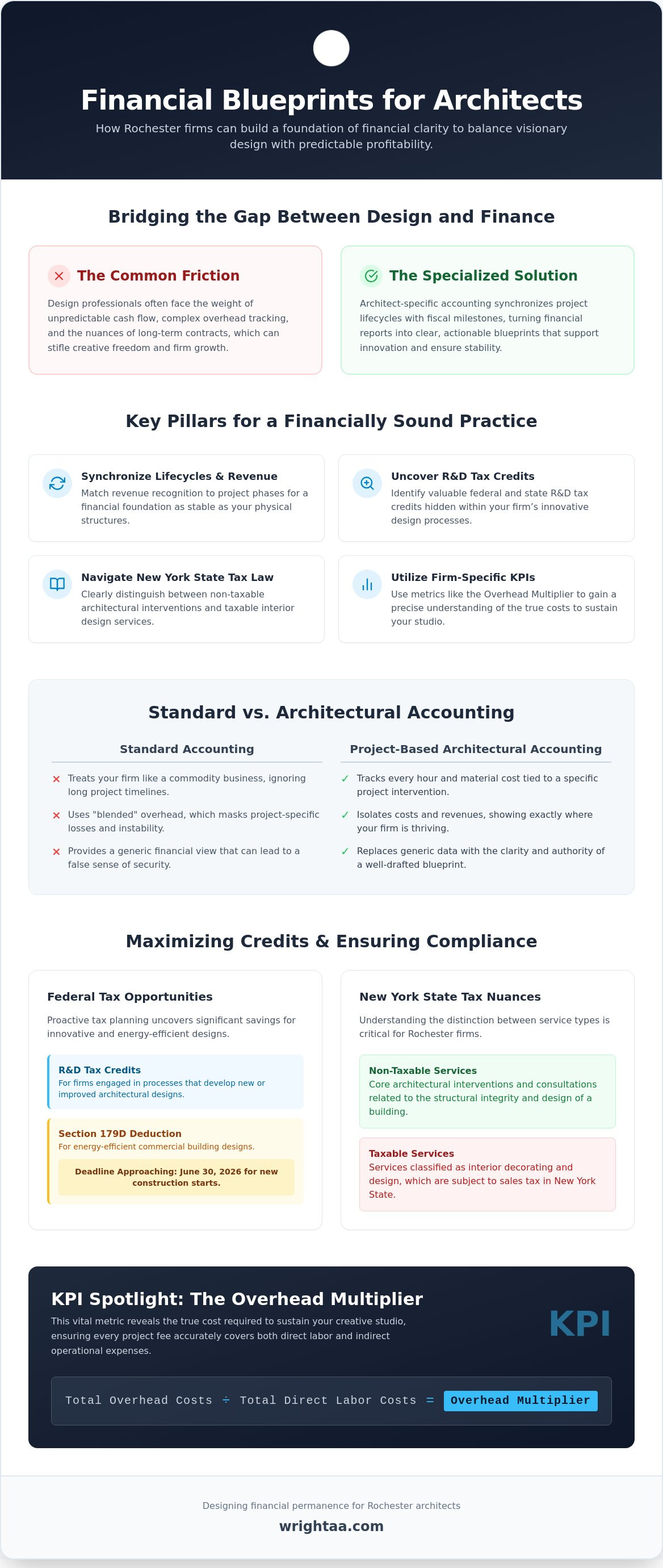
- Learn to synchronize project lifecycles with revenue recognition to create a financial foundation as stable as your physical structures.
- Uncover how specialized accounting for architects Rochester identifies federal and state R&D tax credits within your firm’s innovative design processes.
- Navigate the nuances of New York State tax law by distinguishing between non-taxable architectural interventions and taxable interior design services.
- Utilize firm-specific KPIs, such as the Overhead Multiplier, to gain a precise understanding of the true costs required to sustain your creative studio.
- Establish a sense of financial permanence through fixed-fee models and CFO-level consulting that align your firm’s fiscal health with its long-term vision.
The Architecture of Finance: Why Rochester Firms Require Specialized Oversight
Architectural accounting is the intentional synchronization of a project's lifecycle with its fiscal milestones. It's more than basic bookkeeping; it's the structural support for your creative vision. In our region, accounting for architects Rochester requires a deep understanding of both the site's history and its future potential. Financial intentionality is a prerequisite for creative freedom. Without a clear ledger, even the most inspired design remains a fragile concept. When you align your firm's finances with its philosophical goals, you create the spatial openness needed for true innovation.
Standard retail or service accounting models fail to capture the nuances of long-term design contracts. They treat your firm like a commodity business, ignoring the years of gestation some projects require. This mismatch creates friction. It leads to a lack of clarity that can stifle a studio's growth. By contrast, a specialized approach recognizes that every line on a balance sheet is connected to a physical intervention in the built environment. This clarity allows for the luxury of patience. When the foundation is secure, you can afford to wait for the right material or the perfect light.
The Unique Fiscal Rhythm of the Rochester Design Market
Rochester's economic landscape is undergoing a profound shift. We're moving away from the dominance of legacy industrial giants toward a vibrant era of modern redevelopment and urban renewal. This transition creates a unique fiscal rhythm for local firms. Urban renewal projects in the Flower City often involve complex funding structures and extended timelines that differ from traditional builds. You might find yourself managing a sensitive small-scale residential renovation in a historic district while simultaneously overseeing a large-scale commercial adaptive reuse project. To ensure the final aesthetic matches your vision, it is helpful to learn more about W&F Painting Solutions LLC and how they provide professional finishing for both residential and commercial spaces. Each project scale demands a different approach to cash flow and resource allocation. A CPA who understands Rochester's specific zoning requirements and development cycles can anticipate these shifts before they impact your studio's daily operations.
Standard Accounting vs. Architectural Project Accounting
Project-Based Accounting is the granular tracking of every hour and material cost tied to a specific site intervention. Generic financial statements often rely on "blended" overhead, which is a dangerous practice for design firms. It masks project-specific losses and provides a false sense of security that can lead to long-term instability. A project-based ledger offers quiet authority. It replaces the noise of generic data with the clarity of a well-drafted blueprint. By isolating the costs and revenues of individual projects, you can see exactly where your firm is thriving and where the structure needs reinforcement.
Project-Based Accounting: Building Your Firm’s Structural Integrity
A project-based ledger is the financial equivalent of a site plan. It maps the relationship between resources spent and value created. For firms engaged in accounting for architects Rochester, the most vital metric is Work in Progress (WIP). WIP represents the "inventory" of your firm; it is the accumulation of billable hours and expenses that haven't yet been invoiced. Tracking this accurately ensures that your financial reporting reflects the physical reality of the studio. Without a disciplined WIP process, your balance sheet becomes a blurred image rather than a sharp, technical drawing.
Revenue recognition is the principle that determines when your firm has truly "earned" its fee. For firm principals, this is the most critical concept to master. It's the difference between seeing a bank balance and understanding your actual profitability. Managing consultant pass-through costs, such as those for structural engineers or landscape architects, requires a similar level of precision. These costs must flow through your books without distorting your own firm's performance metrics. When you achieve this transparency, you build a foundation of trust with your clients that mirrors the permanence of your designs.
Revenue Recognition and the Accrual Method
The accrual method provides a more serene and accurate view of long-term project health than simple cash accounting. It records income when it's earned and expenses when they're incurred, regardless of when the currency changes hands. While we often discuss the nuances of small business accounting in Buffalo, NY, these principles are universal for any firm managing multi-year design contracts. Recognizing revenue based on the percentage-of-completion allows you to see the steady rhythm of a project's life. It prevents the artificial "peaks and valleys" that often cause unnecessary anxiety for firm owners.
Managing Direct vs. Indirect Costs
Direct labor and materials are the tactile costs of a project. They represent the physical energy poured into a specific site. However, the true test of a firm’s health is how it allocates indirect costs like rent, software subscriptions, and insurance. To maintain clarity, you must calculate an "Effective Multiplier" for every staff member. This number reveals the actual revenue generated for every dollar spent on direct labor. Proper allocation ensures that overhead doesn't mask project-specific losses. Understanding these costs is also a prerequisite for identifying New York State business tax credits that reward innovative design firms. If you feel your current reporting lacks this level of detail, our team can help you refine your financial framework to better support your creative goals.
Navigating New York State Tax Compliance and Credits for Architects
Tax strategy is often viewed as a burden. In reality, it's a creative tool. For those managing accounting for architects Rochester, navigating the specific mandates of New York law requires a blend of technical precision and foresight. Proactive planning isn't reserved for global firms with massive footprints. It's the silent partner of the boutique studio. It ensures that every dollar earned is protected with the same care as a structural joint. By understanding the intersection of local regulations and federal incentives, you can uncover "found money" that fuels your next innovation.
The New York State Pass-Through Entity Tax (PTET) is a prime example of this strategic dualism. For Rochester-based LLCs and S-Corps, the annual election is due on March 15, 2026. This election allows the firm to pay state taxes at the entity level, potentially providing a significant federal deduction for its partners. When combined with the NYS corporate tax rates, which sit at 6.5% for businesses with income at or below $5 million, the need for a disciplined approach becomes clear. These numbers aren't just figures; they're the boundaries of your firm's fiscal site.
The R&D Tax Credit: Incentivizing Design Innovation
The R&D tax credit is frequently misunderstood. Many believe it's for laboratories and white coats. This isn't the case. R&D credits are for any architect solving a unique structural problem or experimenting with new, tactile materials. If you're refining sustainable building techniques, achieving LEED certification, or developing custom facade systems, you're likely engaging in qualified research. To satisfy a NYS tax audit, you must maintain rigorous documentation of your process:
- Project notes detailing the technical uncertainty being addressed.
- Records of alternative design concepts evaluated during the schematic phase.
- Time-tracking data specifically linked to the experimentation process.
R&D credits are not just for scientists; they're for any designer who pushes the limits of the built environment to improve the user's daily life.
New York law draws a sharp line between architectural services and interior design. Architectural drawings are typically exempt from sales tax. Interior decorating and the sale of tangible goods are not. This duality creates a complex landscape for multi-disciplinary firms in the Flower City. If your firm provides both structural design and furniture procurement, you must be meticulous in your billing. Failing to separate these services can lead to unexpected liabilities during an audit. This risk is amplified for firms with a multi-state nexus, particularly those working on projects in Pennsylvania or Ontario. To protect your studio, consider a consult on strategic business tax planning. This proactive step ensures your compliance is as permanent and thoughtful as your interventions in the landscape.
Strategic KPIs: Measuring the Vitality of the Built Environment
The health of a studio isn't found in a single bank balance. It's found in the metrics that measure the vitality of the built environment. For those focused on accounting for architects Rochester, these Key Performance Indicators (KPIs) act as sensors. They provide real-time data on the firm's structural integrity. The Utilization Rate measures the rhythm of your team's billable hours. It's a simple ratio: billable time divided by total hours. A healthy rate suggests a team in harmony with its project load, while a low rate may indicate an imbalance in staffing or an excess of administrative noise.
The Overhead Multiplier reveals the true cost of keeping the lights on in a Rochester studio. It compares indirect expenses to direct labor. When this number rises without a corresponding increase in project value, the firm's foundation begins to shift. To evaluate how effectively your firm turns labor into revenue, you must track the Net Multiplier. This is the definitive metric for firm principals. It represents the net revenue divided by direct labor. Finally, managing Aged Accounts Receivable is vital. Cash flow is the financial oxygen of a studio. Without a steady flow, even the most visionary projects can stall before completion.
The Principal’s Dashboard: Beyond the P&L
A standard Profit and Loss statement is often insufficient for a visionary principal. It's a retrospective view; it shows where you've been, not where the site is going. You need to see the "future site" of your finances. This requires a customized dashboard that emphasizes forward-looking data. We often recommend reviewing our financial KPIs for small business guide to understand the broader context of Western New York. One vital metric is the "Backlog." By tracking contracted work that hasn't yet been started, you can predict staffing needs six months in advance. This foresight prevents the frantic hiring cycles that often disrupt a studio's culture.
Benchmarking Against the Rochester Market
Rochester firms often enjoy a lower overhead than their counterparts in NYC or larger national hubs. However, this geographic advantage requires careful management. Local market volatility can impact fee structures, forcing a choice between lump sum and hourly billing. A lump sum contract offers certainty but carries the risk of scope creep. Hourly billing provides flexibility but can lead to client friction if not managed with transparency. Professional CFO services provide the strategic guidance needed to interpret these benchmarks. They help you adjust your fees to reflect your firm's true value in the local landscape. Understanding these relationships allows you to design a firm that is as resilient as the structures you create.
Wright CPAs: Designing Financial Permanence for Rochester Architects
Wright CPAs acts as the structural engineer of your firm's financial health. We understand that a studio's creative output requires a stable, intentional base. Our approach to accounting for architects Rochester is built on the belief that financial clarity shouldn't be a reactive after-thought. It should be a permanent, thoughtful intervention within your business. We favor proactive tax strategies that look toward the horizon rather than just looking back at year-end filings. This ensures that your fiscal foundation is as resilient as the buildings you design. By combining modern technology with CFO-level strategic consulting, we guide you through the complexities of the built environment's economy with quiet, confident authority.
Our role is to translate complex fiscal data into a narrative that makes sense for a design professional. We don't just manage numbers; we manage the relationships between your vision and your firm's sustainability. This partnership is grounded in a commitment to design excellence. It's about creating a space where your firm can thrive without the noise of financial uncertainty. When your ledger mirrors the precision of your blueprints, you gain the freedom to pursue projects that truly matter. We help you build a firm that is as enduring as the structures you create for the Rochester community.
The Fixed-Fee Advantage: Clarity Over Complexity
Predictability is a form of architectural elegance. Our fixed-fee monthly retainer model is designed to provide this stability for Rochester firms. It eliminates the anxiety of the clock. You don't have to worry about an invoice for every question or conversation. This encourages open, unhurried communication. Our retainer includes ongoing bookkeeping and precise financial reporting that mirrors the clarity of a well-drafted blueprint. It allows you to see how your firm's internal environment interacts with the external market. You can explore how this model supports long-term growth and sustainable profitability through our outsourced CFO services. It's a method that prioritizes substance over spectacle, giving you the spatial openness to focus on your craft.
A Partnership Rooted in Context and Listening
We view ourselves as refined intellectual partners. Our process begins with a deep, contextual awareness of your firm's unique situation. We don't believe in generic solutions. Instead, we conduct a thorough financial site analysis for every new client. This involves listening to your goals and understanding the specific geographic and cultural context of your work in the Flower City. We look at your project lifecycles, team rhythm, and tax position. This methodical approach creates a sense of trust and suggests that the design process is equally patient and disciplined. It ensures that the financial systems we build for you are as intentional as your own design process. Quality and substance are the pillars of our collaboration. We invite you to schedule a consultation with Wright CPAs to design your firm’s financial future. Together, we can create a legacy of both artistic excellence and sustainable profitability.
Securing the Structural Integrity of Your Firm’s Future
A firm's creative legacy is built on more than just aesthetics. It requires a disciplined financial framework that mirrors the precision of a technical drawing. By mastering the nuances of project-based accounting and leveraging strategic New York State tax credits, you ensure that your studio remains as resilient as the structures you design. Specialized accounting for architects Rochester provides the clarity needed to navigate complex development cycles and unpredictable cash flows. It's about aligning your fiscal milestones with your artistic intent.
Predictability isn't a constraint; it's a foundation for innovation. When you move from reactive bookkeeping to proactive planning, you create the spatial openness required for deep creative work. Our fixed-fee models and CFO-level advisory services are designed to eliminate fiscal noise. This allows you to focus on the poetic intersection of humanity and the built environment. We provide the specialized expertise in New York State tax compliance that visionary principals need to protect their progress.
Elevate your firm’s financial strategy with Wright CPAs to transform your ledger into a visionary tool for growth. We're here to help you design a financial future that is as permanent and thoughtful as your most inspired design. Let's build something enduring together.
Frequently Asked Questions
Why is project accounting better than standard accounting for architects?
Project accounting tracks every hour and material cost at the level of the individual site or intervention. Standard accounting often blends overhead across the entire studio, which can mask specific project losses. By isolating each contract, you gain the clarity of a financial blueprint for every design phase. This granular oversight allows principals to make informed decisions about resource allocation and future bidding.
Can Rochester architecture firms claim the R&D tax credit for sustainable designs?
Yes, firms experimenting with net-zero energy systems or innovative facade materials often qualify for these credits. The R&D tax credit rewards the technical uncertainty involved in developing sustainable, resilient structures. It's an essential tool for firms engaged in specialized accounting for architects Rochester. This "found money" can be reinvested into the studio to fuel further design innovation and creative research.
How does New York State handle sales tax for architectural services vs. interior design?
Professional architectural drawings and structural consultations are generally exempt from New York sales tax. However, interior decorating services and the procurement of tangible goods like furniture are taxable. Multi-disciplinary firms must bill these services separately to maintain strict compliance. Failing to distinguish between these categories can lead to significant liabilities during a New York State tax audit.
What is a "good" utilization rate for an architecture firm in Upstate New York?
A healthy utilization rate for technical staff typically falls between 60% and 75%. This rhythm ensures that the majority of team hours are billable while leaving space for professional development and firm culture. Principals often maintain a lower rate, as their time is dedicated to business consulting and visionary leadership. Monitoring this metric helps maintain the equilibrium between creative output and sustainable profitability.
Should my architecture firm use the cash or accrual method of accounting?
The accrual method is superior for firms managing long-term design contracts because it recognizes revenue as work is performed. This provides a serene and accurate view of the firm's health regardless of when a client's check arrives. Cash accounting can create artificial peaks and valleys in your reporting. The accrual method aligns your financial statements with the physical progress of your projects.
How can a fractional CFO help a growing architecture practice in Rochester?
A fractional CFO provides high-level strategic consulting without the overhead of a full-time executive. They help interpret complex KPIs like the Net Multiplier and manage cash flow during Rochester's unique urban renewal cycles. This partnership ensures that your firm's growth is both intentional and grounded. They act as a refined intellectual partner, guiding your studio toward long-term financial permanence.
What are the most common tax deductions architects overlook in New York?
Many firms overlook the Section 179D deduction for energy-efficient designs in government-owned buildings. The PTET election is another vital strategy for Rochester-based LLCs and S-Corps to reduce federal tax liability. Additionally, the federal R&D credit and the 72.5 cents per mile business mileage rate for 2026 are frequently underutilized. These deductions represent significant opportunities to protect your firm's hard-earned capital.
How do I manage consultant fees so they don’t erode my firm’s profit margin?
Manage consultant fees by tracking them as pass-through costs that are separate from your direct labor. Your contracts should clearly define any administrative markups for managing engineers or landscape architects. This prevents these external expenses from distorting your internal profitability metrics. By isolating these costs, you maintain a clear view of your firm's own value and structural integrity.


