

What if the most resilient part of your Syracuse factory isn't the steel in its frame, but the logic in its ledger? You've likely felt the pressure of rising material costs and the friction of multi-state compliance. It's common to view tax as a seasonal surprise, a sudden weight that disrupts your operational rhythm. However, when you implement sophisticated tax strategies for manufacturing companies Syracuse, you transform a yearly obligation into a deliberate blueprint for growth.
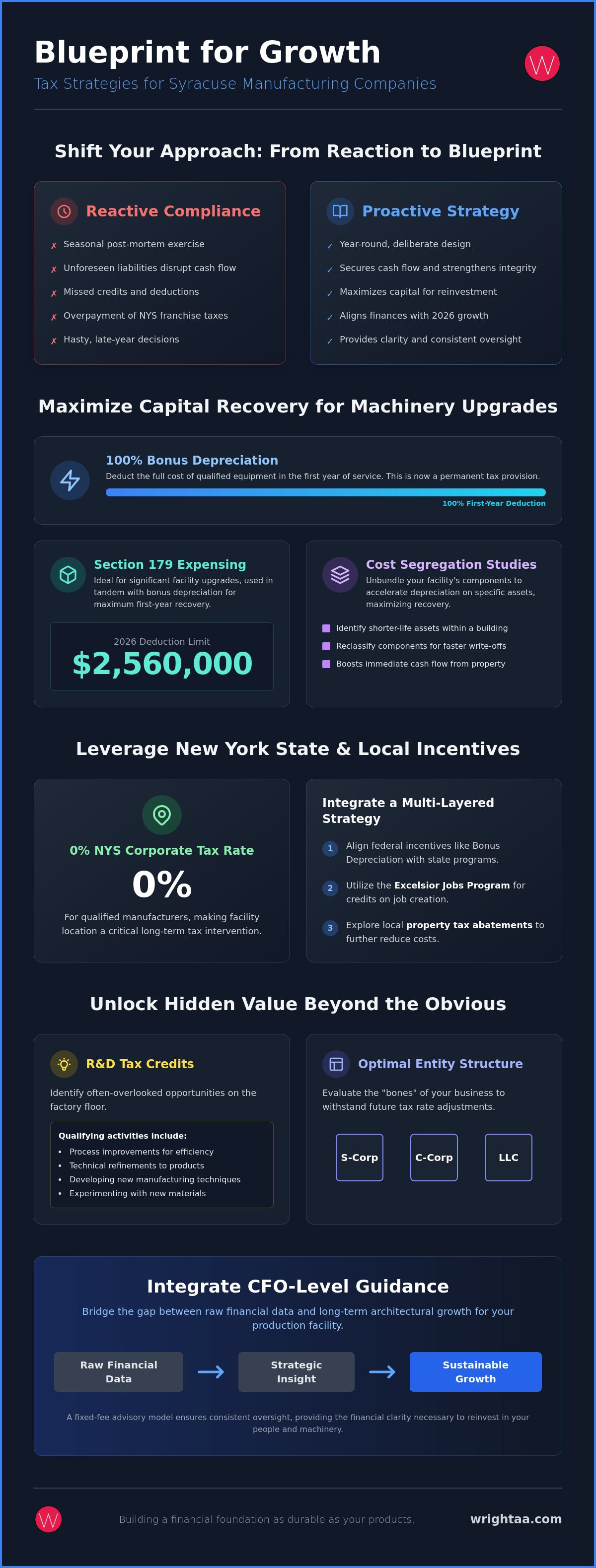
We believe that tax planning is the structural foundation of a healthy business. It shouldn't be an afterthought, but a proactive design that secures your cash flow and strengthens your firm's financial integrity. This article explores how the permanent 100% bonus depreciation and New York's 0% corporate tax rate for qualified manufacturers can fund your next capital reinvestment. We'll guide you through the 2026 landscape to ensure your plant's future is as solid as its output.
Key Takeaways
- Learn how to shift from reactive compliance to a proactive blueprint that aligns your financial structure with the 2026 economic resurgence in Central New York.
- Master the latest capital recovery methods, including Section 179 and bonus depreciation, to refine your tax strategies for manufacturing companies Syracuse and fund essential machinery upgrades.
- Identify often-overlooked opportunities for R&D tax credits by recognizing how process improvements and technical refinements on the factory floor qualify as innovation.
- Evaluate the "bones" of your business by choosing the optimal entity structure—S-Corp, C-Corp, or LLC—to withstand 2026 corporate tax rate adjustments.
- Discover how integrating CFO-level guidance bridges the gap between raw financial data and long-term architectural growth for your production facility.
Navigating the Syracuse Manufacturing Landscape: Why Proactive Planning is the Foundation
Architecture begins with a site visit. In Syracuse, the site is shifting rapidly. The 2026 economic landscape in Central New York is defined by a significant industrial resurgence, driven by large-scale investments in high-tech production. For local manufacturers, success requires more than operational efficiency; it demands a structural approach to financial management. Effective tax strategies for manufacturing companies Syracuse function as the blueprinting phase of this growth. Without a clear plan, even the most robust production line can struggle under the weight of unforeseen liabilities.
Understanding the broader U.S. corporate tax system is the first step in this process. However, the true advantage lies in how federal rules intersect with regional opportunities. We view tax strategy as a year-round discipline. It's an intentional dialogue between your current output and your future expansion. This is about building something that lasts, ensuring your financial foundation is as durable as the products you create.
The Central New York Manufacturing Context
Syracuse sits at the heart of a technological transformation. The massive investments in the semiconductor sector have created a ripple effect through local supply chains. Small and mid-sized plants now face new demands for capacity and precision. Navigating this requires a deep understanding of how local property tax abatements and New York State’s Excelsior Jobs Program interact with federal incentives. With the state offering a 0% corporate income tax rate for qualified manufacturers, geographic intentionality is paramount. Choosing where to expand or place a new facility isn't just a logistics decision. It's a permanent tax intervention that defines your long-term profitability.
The Cost of Reactive Accounting
Many firms treat tax season as a post-mortem exercise. Looking in the rearview mirror creates a structural risk for high-CAPEX companies. When you wait until April to address your financial position, you've already missed the opportunity to optimize your cash flow for the preceding twelve months. Reactive accounting leads to hidden leaks. These are the lost credits and missed deductions that occur when decisions are made in haste during a late-year scramble.
Syracuse firms often overpay on New York State corporate franchise taxes simply because they lack a proactive framework. We advocate for a shift toward a fixed-fee advisory model. This approach ensures consistent oversight and removes the stress of unexpected bills. It provides the financial clarity necessary to reinvest in the people and machinery that drive your business forward. In a high-stakes environment, clarity is your most valuable asset.
Maximizing Capital Recovery: Depreciation Strategies for Syracuse Production Lines
A production line is a tactile reality. It hums with the effort of creation, a complex assembly of steel, sensors, and logic. In the eyes of the fiscal architect, these physical assets are more than just tools; they are reservoirs of latent capital. Effective tax strategies for manufacturing companies Syracuse involve extracting this value through precise depreciation methods. By aligning your recovery schedule with the physical life of your machinery, you transform a sunk cost into a liquid resource for future expansion.
The 2026 tax landscape offers unprecedented clarity for capital intensive firms. Under the One Big Beautiful Bill Act (OBBBA), 100% bonus depreciation remains a permanent fixture for qualified property placed in service. This allows for the full deduction of equipment costs in the first year, providing an immediate infusion of cash flow. For many Syracuse plants, this is best used in tandem with Section 179 expensing, which carries a 2026 deduction limit of $2,560,000. If you're considering a significant facility upgrade, our team can help you design a tax strategy that sequences these incentives to maximize your first-year recovery.
Advanced Depreciation Techniques
Precision matters. Cost segregation studies allow you to unbundle the "built environment" of your facility. By identifying components like specialized electrical systems, reinforced flooring, or climate control units, you can reclassify them as personal property. This accelerates their depreciation from a 39-year life down to five or seven years. It acknowledges the sensory reality of the factory floor: while the shell of the building may stand for decades, the internal systems face constant wear and technological obsolescence. You can also explore Federal tax credits for manufacturers to see how energy-efficient upgrades further enhance these recovery schedules.
Planning for Equipment Dispositions
The lifecycle of an asset eventually reaches its conclusion. When retiring or selling older Syracuse plant machinery, you must account for the "tax trap" of depreciation recapture. If an asset is sold for more than its depreciated book value, the IRS taxes that gain at ordinary income rates. Strategic timing is essential here. By coordinating dispositions with new acquisitions, you can often offset these gains.
- Review your fixed asset ledger quarterly to identify idle machinery.
- Evaluate the trade-in value against the potential recapture liability before signing a purchase agreement.
- Document the physical condition of retired assets to support abandonment claims.
The Modified Accelerated Cost Recovery System (MACRS) provides a steady, rhythmic cadence of deductions that mirrors the gradual decline of an asset's physical utility over time. When managed with intention, these schedules ensure that your production line remains a source of financial strength throughout its entire operational life.
Incentivizing Innovation: Leveraging R&D and Energy Credits in Central New York
Innovation is often mischaracterized as a sudden, loud breakthrough. In the context of a Syracuse production facility, it is more often a quiet, methodical refinement. It's the adjustment of a machine’s tolerance to reduce waste or the development of a new alloy that withstands harsher conditions. These everyday improvements are the bedrock of modern manufacturing. When you look closer, these technical challenges satisfy the requirements for significant tax savings. Developing effective tax strategies for manufacturing companies Syracuse requires recognizing that your shop floor is, in many ways, a laboratory of trial and error.
The Research and Development (R&D) tax credit remains one of the most powerful tools for Central New York firms. While competitors often treat this as a separate, isolated line item, we view it as an integral part of your financial structure. For tax years beginning after December 31, 2024, domestic R&D expenses can be fully deducted in the year they are incurred. This change, solidified by the Federal Tax Incentives for Manufacturers, provides immediate relief for firms investing in technical uncertainty. It allows you to recoup 6% to 8% of qualifying expenses, which can be reinvested directly into your workforce or equipment.
Qualifying Your Syracuse Operations for R&D
A successful claim requires more than just high-level summaries. It demands a disciplined framework of documentation based on the IRS Four-Part Test. You must prove that your activities are technical in nature, intended to improve a product or process, and involve a process of experimentation to eliminate uncertainty. We help you capture the poetic process of design by documenting project notes, CAD drawings, and payroll allocations as they happen. This contemporaneous record-keeping serves as your audit defense, transforming a potential regulatory risk into a secure financial asset. Commonly overlooked expenses, such as the wages of supervisors and the cost of prototype supplies, often represent the largest portion of the credit.
The Architecture of Sustainability
The architecture of your facility also offers opportunities for capital recovery. Sustainability is no longer just an environmental gesture; it's a strategic financial decision. Through the Section 179D deduction, Syracuse manufacturers can claim significant write-offs for energy-efficient building systems, including lighting, HVAC, and the building envelope itself. In Central New York, where heating and cooling costs fluctuate with the seasons, these upgrades provide a dual benefit. They reduce operational overhead while creating a more comfortable, productive environment for your team. When you integrate Investment Tax Credits (ITC) for solar or geothermal installations, you're not just improving a building. You're designing a more resilient and self-sustaining business model.
Structural Integrity: Entity Selection and Multi-State Tax Nexus for Manufacturers
The skeletal frame of a business is its entity structure. In Syracuse, this choice is not merely a legal formality. It is a strategic decision that dictates how capital flows through the organization and how much of it remains available for reinvestment. Sophisticated tax strategies for manufacturing companies Syracuse begin with evaluating whether the "bones" of the firm can support its growth. A structure that served you well as a local shop may become a constraint as you scale into a regional power.
The 2026 tax landscape has shifted the weight of these decisions. With New York's general corporate tax rate at 6.5%, the 0% rate for qualified manufacturers creates a powerful incentive for specific entity types. Choosing between an S-Corp, C-Corp, or LLC requires a deep understanding of how these "bones" interact with both state and federal law. If you're unsure if your current structure is still the most efficient for your expansion, our team can help you with tax strategy and business consulting to ensure your foundation is secure.
Designing the Right Entity Structure
Flow-through entities, such as S-Corps and LLCs, avoid the double taxation inherent in C-Corporations by passing income directly to shareholders. This is often the preferred path for closely held Syracuse firms where personal and business goals are intertwined. However, a C-Corporation might offer superior benefits if you intend to retain significant earnings within the company for heavy machinery acquisitions. Your entity choice should reflect a ten-year vision. It's about the permanence of the structure, not just the immediate relief of this year's tax bill. We look at the intersection of your personal tax planning and the firm’s operational needs to find the most balanced approach.
Managing Multi-State Complexity
As Syracuse manufacturers reach beyond Central New York, they encounter the complexity of the "nexus." Shipping goods across state lines or employing remote technicians in the Northeast corridor can trigger tax obligations in jurisdictions where you have no physical plant. New York State uses specific apportionment rules based on sales, payroll, and property to calculate your tax burden. It's easy to fall into the trap of "accidental nexus" in a global-shipping economy.
- Review your sales heat maps annually to identify new filing requirements.
- Monitor the location of remote employees to avoid unexpected payroll tax liabilities.
- Track the physical presence of company-owned vehicles or equipment in other states.
Economic nexus occurs when a Syracuse manufacturer’s sales into another state exceed a specific dollar threshold or transaction count, regardless of physical presence. Managing this complexity requires a disciplined, rhythmic review of where your products land and what legal footprint they leave behind. By designing your tax strategy with these boundaries in mind, you protect the structural integrity of your entire operation.
Designing Financial Clarity: Integrating Tax Strategy into CFO-Level Guidance
A tax return is a static record of the past. It documents what has already occurred, offering little more than a retrospective view of your firm's performance. In contrast, a proactive tax strategy is a living blueprint. For Central New York manufacturers, the economic shifts of 2026 require more than just compliance; they require a synthesis of tax knowledge and operational insight. This is where outsourced CFO services become essential. They act as the bridge between the technical nuances of the tax code and the physical reality of the factory floor, ensuring that every financial decision strengthens the whole.
The most effective tax strategies for manufacturing companies Syracuse are those integrated into the daily rhythm of the business. When tax planning is isolated from operations, opportunities for growth are often lost in the gap. By utilizing strategic business tax planning, firms in Syracuse and Buffalo can move beyond reactive filing. We treat financial data as a raw material. It requires a disciplined hand to shape it into a structure that supports long-term expansion and protects against market volatility. This is the poetic execution of business strategy: turning raw numbers into a clear path forward.
The Role of the Modern CFO in Manufacturing
Cash flow management is the tool we use to create "spatial openness" in your budget. It provides the breathing room necessary to pivot when supply chains shift or new technology emerges. We utilize specific financial KPIs to monitor the health of your production line in real time. These metrics go beyond simple profit and loss; they measure the efficiency of your capital. Through predictive modeling, we stress-test your financial position against potential market shifts. This ensures that your foundation remains stable even when the external environment becomes unpredictable.
Partnering for Long-Term Success
True advisory begins with deep listening. We believe that understanding the specific geographic and cultural context of your Syracuse plant is just as important as knowing the tax code. Our approach prioritizes substance over spectacle. We don't offer loud promises or generic solutions. Instead, we provide a disciplined partnership rooted in design excellence. We're committed to the idea that a well-structured business improves the daily lives of its owners and employees alike. It's time to move beyond the surprise of tax season and toward a future of intentional growth. Design your financial future with Wright CPAs, LLC and build a legacy that lasts.
Designing a Permanent Foundation for Industrial Growth
The factory floor is a place of precision and permanence. Your financial structure should mirror that same rigor. We've explored how proactive planning, optimized depreciation, and intentional entity selection create the structural integrity necessary for a thriving plant. When you implement sophisticated tax strategies for manufacturing companies Syracuse, you aren't just filing a return; you're blueprinting a more resilient future for your operations.
Real growth requires a partner who understands the specific cultural and geographic landscape of Central New York. Our proactive, year-round advisory model at Wright CPAs, LLC provides the modern, technology-driven clarity you need to navigate complex New York State tax laws with confidence. We prioritize substance over spectacle, offering specialized expertise that turns financial data into a strategic asset for your firm.
Your production line is ready for the next decade. Ensure your tax strategy is prepared to support it. Request a Consultation for Strategic Manufacturing Tax Planning. We look forward to helping you build a financial framework that supports your vision and endures for generations.
Frequently Asked Questions
What is the most overlooked tax credit for Syracuse manufacturing companies?
The Research and Development (R&D) Tax Credit is the most frequently overlooked incentive because firms often believe it only applies to laboratory breakthroughs. In reality, it covers technical refinements on the factory floor, such as developing new casting methods or improving waste reduction protocols. By implementing these tax strategies for manufacturing companies Syracuse, firms can recover a percentage of wages and supplies used during experimentation. This credit provides a rhythmic infusion of capital for ongoing innovation.
How does the One Big Beautiful Bill Act (OBBBA) affect equipment depreciation in 2026?
The One Big Beautiful Bill Act (OBBBA) permanently reinstates 100% bonus depreciation for qualified property. This provides long-term certainty for capital investments, allowing firms to deduct the full cost of new machinery in the first year it's placed in service. It removes the previous uncertainty of expiring tax breaks. Manufacturers can now plan multi-year facility upgrades with the confidence that their immediate tax relief is a structural certainty within their budget.
Can my Syracuse manufacturing plant claim R&D credits for process improvements?
You can claim R&D credits for process improvements if the activity meets the IRS Four-Part Test for technical uncertainty and experimentation. Whether you're refining a chemical formula or optimizing a production line's speed, the technical nature of the work qualifies. Proper documentation of the trial and error process is the key to securing these tax strategies for manufacturing companies Syracuse. It transforms the poetic process of design into a tangible financial asset for the business.
What are the New York State tax benefits for manufacturers located in Central NY?
Qualified New York manufacturers are eligible for a 0% corporate income tax rate on their business income base. Additionally, the Excelsior Jobs Program offers refundable credits for job creation and research expenditures that scale with your investment. Manufacturers in Syracuse can also leverage the Manufacturer’s Real Property Tax Credit to offset franchise taxes. These state-level incentives are designed to foster a permanent industrial presence and encourage long-term facility expansion within the region.
How does multi-state nexus affect a manufacturer shipping from Syracuse?
Shipping goods from Syracuse triggers economic nexus when your sales into another state exceed that jurisdiction's specific transaction or dollar thresholds. Even without a physical office, you may be required to collect sales tax or file income tax returns in those states. This complexity requires a rhythmic review of your shipping logs and customer locations. Failure to monitor these boundaries can lead to unexpected liabilities and risks to your firm's structural financial integrity.
When should a Syracuse manufacturer consider moving to a fixed-fee accounting model?
A Syracuse manufacturer should consider a fixed-fee model when they require consistent, year-round advisory rather than a once-a-year tax surprise. This model aligns the accountant's goals with the business's health by encouraging continuous dialogue and proactive planning. It provides the financial clarity needed for capital reinvestment without the friction of hourly billing. It's an intentional shift from reactive bookkeeping to sophisticated business consulting and structural financial oversight.
Is an S-Corp or C-Corp better for a manufacturing firm with high capital expenditures?
C-Corporations are often better for firms with high capital expenditures because they allow for the retention of earnings at a lower corporate rate for future machinery purchases. However, S-Corporations avoid double taxation by passing income directly to shareholders, which may benefit closely held firms. The choice depends on your 10-year vision for growth and reinvestment. We analyze the intersection of these structures to ensure your firm’s "bones" remain strong and adaptable.
How can a fractional CFO help with my manufacturing company’s tax strategy?
A fractional CFO integrates your tax strategy into your broader business operations and cash flow management. They move beyond the tax return to provide architectural-level guidance, using financial KPIs to monitor the health of your production line. This partnership ensures that tax planning isn't an isolated event, but a continuous thread that guides your capital allocation. By working with a strategic partner like JKB Services, you can bring a sophisticated, disciplined perspective to your firm's daily financial life and long-term goals.


