

Most founders view tax season as a frantic repair of the past, yet the most resilient companies treat it as a blueprint for the future. True financial intentionality begins with a foundational approach to tax preparation for startups Rochester, where every deduction and credit acts as a structural support for growth. You likely understand the weight of complex equity structures or the quiet anxiety that a missed R&D credit is slowly draining your runway. It's frustrating when generic accounting fails to account for the specific rhythm of a scaling business in Monroe County.
We agree that your focus should remain on innovation, not on deciphering the nuances of New York State franchise tax deadlines. This article promises to demonstrate how strategic tax preparation and proactive planning can provide the financial clarity your Rochester startup needs to scale with confidence. We'll examine the methods for preserving cash flow, meeting local obligations, and maintaining the clean records that future investors require for their due diligence.
Key Takeaways
- Understand why specialized tax preparation for startups Rochester is essential to bridge the gap between traditional industrial models and high-growth technology ventures.
- Learn to leverage the R&D Tax Credit and Section 1202 exclusions as deliberate tools for capital preservation rather than mere afterthoughts.
- Recognize how moving beyond a transactional mindset allows you to build a transparent financial structure that invites sophisticated venture capital.
- Gain a clear roadmap of New York State and federal compliance requirements to ensure your startup remains grounded and secure.
- Explore the value of continuous financial advisory in creating a serene, curated environment that supports both your daily operations and long-term vision.
Navigating the Rochester Startup Ecosystem: Why Tax Intentionality Matters
Rochester is a city defined by its structural history. The brick facades of the High Falls district and the legacy of industrial giants provide a textured backdrop for a new generation of innovators. Today, the local economy is being rewritten in laboratories and co-working spaces. This shift requires a new kind of financial thinking. Effective tax preparation for startups Rochester requires an understanding of this evolution. It's about moving beyond the survival-mode of simply filing on time; it's about designing a financial environment that supports rapid, sustainable scaling. A startup isn't a finished building. It's a structure in a constant state of growth and refinement.
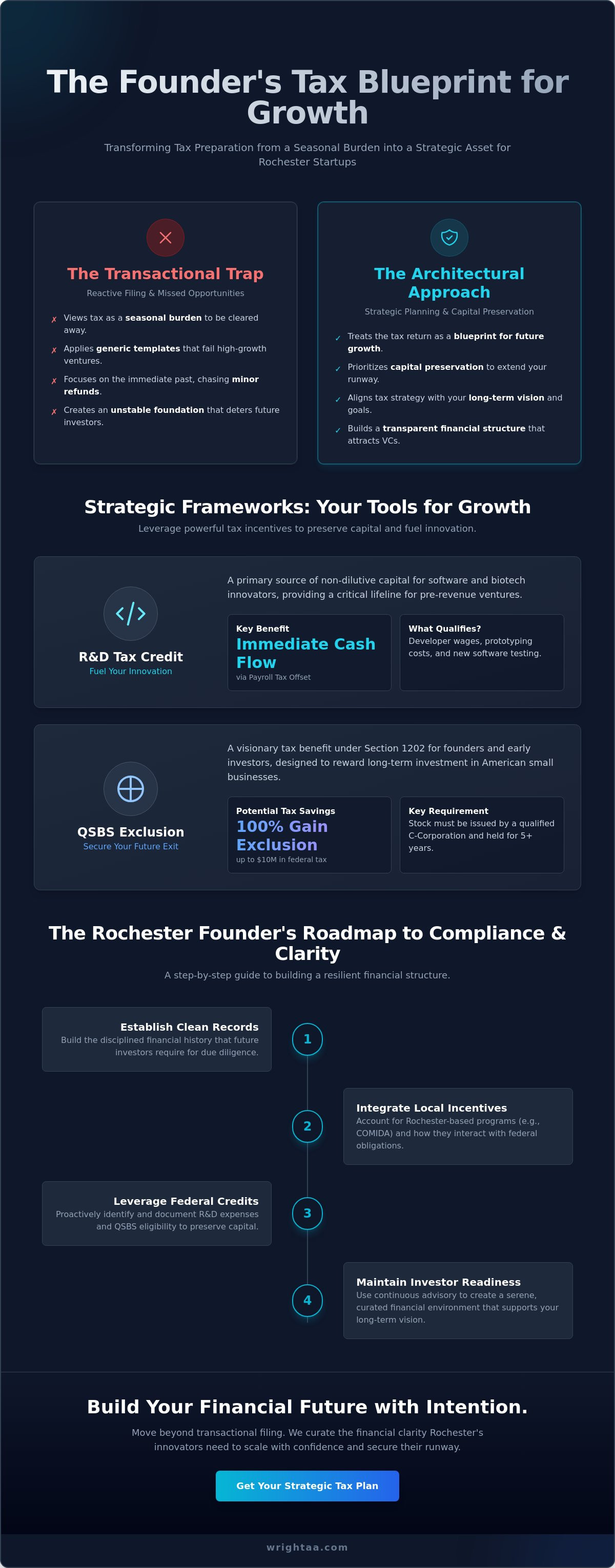
Standard tax services often treat every business like a static retail shop. This transactional approach fails high-growth ventures because it ignores the dynamic nature of equity, research expenditures, and multi-state expansion. When a firm applies a generic template to a scaling startup, they miss the subtle intersections where local incentives and federal law meet. True intentionality means seeing the tax return as a foundational element of your business architecture rather than a seasonal burden to be cleared away.
The Local Innovation Landscape
Being situated within hubs like NextCorps or the Carlson MetroCenter places your business at the heart of a specific economic climate. Local grants and Rochester-based incentives aren't isolated windfalls. They have a direct, material impact on how you navigate the broader U.S. corporate tax system. Geographic awareness is a vital component of business tax preparation. If your strategy doesn't account for how a Monroe County industrial development agency (COMIDA) exemption interacts with your federal obligations, you're building on an unstable foundation. Your financial environment should reflect the specific soil of the Finger Lakes region in which it's planted.
The Philosophy of Financial Architecture
We view a tax return as more than a compliance document. It's a blueprint for future investment. When venture capitalists or angel investors examine your books, they aren't just looking for mathematical accuracy. They're looking for evidence of discipline. The "retail trap" of seasonal filing focuses on the immediate past, often chasing a minor refund at the expense of long-term structural integrity. A proactive approach to tax preparation for startups Rochester ensures that every decision made today strengthens the site for tomorrow's expansion. It's the difference between a temporary shelter and a permanent, thoughtful intervention in the market. By aligning your tax strategy with your growth goals, you create a sense of calm and purpose that resonates throughout your entire organization.
Strategic Tax Frameworks: Credits and Deductions for High-Growth Ventures
Growth requires deliberate resource allocation. While many preparers focus on the immediate refund, a sophisticated approach to tax preparation for startups Rochester prioritizes capital preservation. This is where tax planning becomes a form of financial architecture. By identifying credits early, founders can reinvest saved capital into engineering talent or product development. It's a method of building runway from within your own existing financial structure. You aren't just filing forms; you're reinforcing the site of your future expansion.
Maximizing the Research & Development Credit
The Research & Development credit is a primary source of capital for Rochester’s software and biotech innovators. Qualified research expenses aren't limited to laboratory work. They often include the wages of developers and the costs of testing new software iterations. For pre-revenue ventures, the payroll tax offset is a critical lifeline. It allows startups to apply the credit against federal payroll tax liabilities, providing immediate cash flow when it's most needed. Maintaining a clear trail of documentation is essential. Precise records act as the structural supports that defend your claim during a state or federal audit.
Qualified Small Business Stock (QSBS)
Founders must look ahead. Section 1202 provides a 100% gain exclusion on the sale of Qualified Small Business Stock; this represents a visionary tax benefit for early creators. This exclusion can eliminate federal tax on up to $10 million in gains. However, the eligibility requirements are rigid. Stock must be issued by a C corporation, and the company’s gross assets cannot exceed $50 million. Because this benefit is tied to your origin, your initial structure is paramount. You can explore these nuances in our guide on business entity selection for NY startups.
Beyond these federal incentives, Rochester-based firms should leverage New York’s specific landscape. The Life Sciences Research & Development Tax Credit offers a refundable credit of 20% for companies with fewer than 10 employees. Proactive planning also addresses the burden of self-employment tax for LLCs, where thoughtful entity adjustments can preserve significant cash flow. Mastering these incentives through specialized tax preparation for startups Rochester requires a steady, methodical approach. Understanding your federal tax obligations is simply the first layer of a resilient business. A curated tax strategy ensures that these opportunities aren't merely missed but are instead integrated into your broader financial blueprint. This level of planning reduces the friction of growth and provides the quiet confidence required to scale.
The Limitation of Transactional Filing: Why Retail Preparers Fall Short
Retail tax preparation often focuses on a "maximum refund" mindset. This is a narrow lens. For a growing company, a refund is often irrelevant, especially in pre-revenue stages. What matters is the preservation of capital and the clarity of the financial site. Transactional preparers treat taxes as a seasonal chore. They enter data into templates designed for static businesses. This lacks the geographic and technical awareness required for tax preparation for startups Rochester. A cheap filing today often leads to expensive structural repairs tomorrow. When a preparer doesn't understand the nuances of a scaling venture, they inadvertently create audit risks that can stall future funding rounds or complicate investor due diligence.
The Complexity of Startup Equity
Equity is the material from which startups are built. It isn't just compensation; it's a transfer of ownership. Retail preparers often overlook the 83(b) election. This simple document must be filed within 30 days of a grant. If it's missed, the founder faces a massive tax bill as the company's valuation rises. Reporting Incentive Stock Options (ISOs) and Non-Qualified Stock Options (NSOs) requires specialized knowledge of the common business tax deductions available to the entity versus the individual. A complex cap table demands a disciplined eye, not a generic software prompt. Mistakes here don't just affect the current year. They create a legacy of errors that can complicate your exit strategy and frustrate early employees who rely on the integrity of their options.
Proactive Strategy vs. Reactive Filing
Filing is the final act of a long process. Proactive strategic business tax planning allows for a rhythmic flow of information. It prevents the anxiety of the April deadline. In Monroe County, predicting cash flow for quarterly estimated payments is essential for maintaining stability. We don't believe in seasonal bursts of activity. Instead, we advocate for a steady, unhurried communication flow. This ensures that your financial environment remains serene. Tax preparation for startups Rochester should be a year-round dialogue. It ensures that every material choice you make is supported by sound tax strategy. It moves the conversation from "what happened?" to "what are we building?" This rhythmic approach transforms the tax return into a living document that grows alongside your team.
A Roadmap to Compliance: The Rochester Founder’s Tax Preparation Checklist
Compliance is a deliberate act of stewardship. For those scaling within the NextCorps incubator or RIT Venture Creations, the complexity of tax preparation for startups Rochester demands a structured approach. It begins with the digital environment. A cluttered ledger is like a poorly designed workspace; it hinders movement and obscures vision. By establishing a clean bookkeeping system early, you create a sense of spatial openness in your financials. This clarity allows you to see the relationship between your current spending and your future runway.
Organizing the Financial Site
Effective tax prep relies on designing financial clarity through meticulous, rhythmic bookkeeping. You must categorize expenses with precision. Software subscriptions, travel, and Rochester-based office costs should be clearly delineated. If you operate a law or consulting firm, reconciling specialized accounts like IOLTAs is a requirement for professional integrity. This organization ensures that your balance sheet reflects the true value of your assets, including the proper treatment of startup costs and equipment depreciation. When your books are clean, the tax filing process becomes a quiet confirmation of your business's health rather than a frantic repair effort.
The Compliance Walkthrough
The path to a successful filing follows a logical, unhurried progression. Following these steps ensures that no structural element is overlooked.
- Step 1: Verify registrations. Confirm your EIN and New York State tax ID registrations are active. Ensure your entity structure aligns with your state-level filings.
- Step 2: Collect payroll data. Gather all 1099s for contractors and W-2s for your Rochester team. Proper tax preparation for startups Rochester requires reconciling these local payroll obligations with federal standards, especially for remote employees.
- Step 3: Review the Profit and Loss statement. Examine your P&L for intentionality. Every entry should accurately represent the physical and operational reality of your startup.
- Step 4: Strategy session. Schedule a pre-filing session to identify last-minute deductions. This is the moment to align your filing with your broader tax strategy.
Deadlines are the boundaries of your financial year. For 2026, calendar-year C corporations must file by April 15. S corporations and partnerships have a federal deadline of March 16. If you intend to elect into the New York Pass-Through Entity Tax (PTET), the election must be made by March 15, 2026. Adhering to these dates preserves your standing with both the IRS and New York State. If you seek a partner to curate this process with discipline, our tax planning and preparation services provide the expertise needed to secure your foundation.
Wright CPAs: Curating Financial Clarity for Rochester’s Innovators
Wright CPAs operates at the intersection of humanity and financial discipline. We believe that accounting is a poetic exercise in clarity. While retail preparers often focus on immediate refunds or short-term loans, we prioritize the future integrity of your venture. Our approach to tax preparation for startups Rochester is deliberate and steady. We eschew loud marketing hyperbole in favor of a quiet, confident authority. This results in a financial environment that feels both visionary and grounded. We don't just file forms; we help you build a permanent, thoughtful intervention in the market.
We utilize a fixed-fee monthly advisory model. This structure provides predictable costs and encourages unhurried communication. It allows us to move from broad philosophical concepts to specific material details without the pressure of a ticking clock. This creates a sense of trust. It suggests that the design of your financial strategy is a patient, methodical process. By removing the friction of hourly billing, we ensure that every material choice you make is supported by sound tax strategy and deep contextual awareness.
Beyond the Annual Return
A startup's growth is a complex narrative. Our outsourced CFO services elevate your strategy by providing the insights needed to navigate this story. We help you track financial KPIs that resonate with venture capitalists and early-stage investors. This level of oversight ensures your tax preparation for startups Rochester isn't just about compliance. It's about maintaining a pristine site for future expansion. There's a profound serenity in knowing your obligations are handled with intentionality. It allows you to focus on your craft while we maintain the structural supports of your business.
Engaging with Wright CPAs
Our partnership begins with deep listening. We want to understand the unique narrative of your innovation and the specific environment in which you operate. This discovery process is unhurried. It allows us to build a long-term partnership rooted in trust and design excellence. We don't offer generic solutions. Instead, we curate a financial strategy that reflects your specific geographic and cultural context. Start your journey toward financial clarity and structural integrity today by connecting with our team. Together, we'll design a financial blueprint that supports your vision for years to come.
Building a Legacy of Financial Discipline
A startup is a living structure. It requires more than seasonal maintenance to thrive. By embracing intentional tax preparation for startups Rochester, you shift from reactive repair to proactive design. This process involves leveraging strategic credits like the R&D payroll offset and maintaining a rhythmic, unhurried approach to bookkeeping. Each financial choice acts as a material in the construction of your venture's future. When you prioritize structural integrity over short-term refunds, you create a site that is ready for significant investment and sustainable growth.
Since 2012, we've focused on providing the CFO-level financial guidance necessary for this transformation. Our fixed-fee predictable pricing models ensure that our partnership remains focused on substance rather than the clock. We believe that your financial environment should be as curated and purposeful as the product you're building. We invite you to begin your journey toward financial clarity with Wright CPAs. Together, we can create a foundation that is both serene and resilient. Your vision deserves a structure that is built to endure.
Frequently Asked Questions
What are the most common tax mistakes Rochester startups make?
The most frequent error is treating tax as a seasonal event rather than a continuous architectural element. Founders often neglect the 83(b) election or fail to maintain a clean separation between personal and business finances in their early bookkeeping. These oversights create structural weaknesses that complicate future funding rounds. Specialized tax preparation for startups Rochester ensures these foundational elements are secured from the beginning.
How does the New York State R&D tax credit differ from the federal one?
The New York State credit is designed to complement federal incentives by providing additional relief for research conducted within the state. As of 2026, the New York Research and Development Tax Credit is 50% of the federal credit, capped at 6% of research expenditures in New York. For new life sciences businesses, a refundable credit of up to 20% is available for companies with fewer than 10 employees.
Do I need to file taxes in Rochester if my startup is still pre-revenue?
Yes, filing is a requirement even before your first sale to document net operating losses (NOLs). These losses act as a financial asset that can offset future profits as your company scales. Establishing this paper trail early ensures your financial site is ready for investor due diligence. It also confirms your compliance with the New York State corporate franchise tax requirements from your first year of operation.
What is an 83(b) election and why is it critical for founders?
An 83(b) election is a filing with the IRS that allows you to pay taxes on the fair market value of restricted stock at the time of grant rather than when it vests. This is critical for founders because it locks in the tax liability at a low valuation. If you miss the 30-day filing window, you may face a significant tax bill as your company’s valuation rises. It's a vital component of any disciplined tax strategy.
How can I reduce my self-employment tax as a Rochester-based LLC?
Electing S Corporation status is a common method for reducing self-employment tax obligations. This structure allows you to pay yourself a reasonable salary while taking additional profits as distributions, which aren't subject to self-employment tax. This transition requires careful planning to ensure the salary meets IRS standards for your industry and location. It's a strategic move that preserves cash flow for reinvestment in your startup's growth.
What business records should I keep to be "audit-ready" in New York?
Maintaining a digital archive of all receipts, payroll reports, and bank statements is the standard for a resilient business. New York State authorities expect granular documentation for travel, equipment purchases, and research-related payroll expenses. Clean bookkeeping isn't just about compliance; it's about creating a transparent financial environment. This level of organization simplifies tax preparation for startups Rochester and provides a clear blueprint for potential investors.
How does hiring remote employees outside of Rochester affect my tax preparation?
Hiring employees in other states creates "nexus," which requires you to register for payroll taxes and potentially file corporate returns in those jurisdictions. Each state has unique rules regarding withholding and unemployment insurance. This expansion adds a layer of complexity to your financial structure. You must reconcile these multi-state obligations to ensure your business remains in good standing across all geographic environments where you operate.
When is the best time to start tax planning for the 2026 tax year?
Planning should begin before the year starts and continue through quarterly reviews. A proactive approach allows you to adjust for cash flow changes and document tax credits in real-time. Waiting until the filing deadline to consider strategy is a reactive habit that leads to missed opportunities. By maintaining a rhythmic, year-round dialogue with your CPA, you ensure your financial foundation remains stable and your growth is intentional.


