

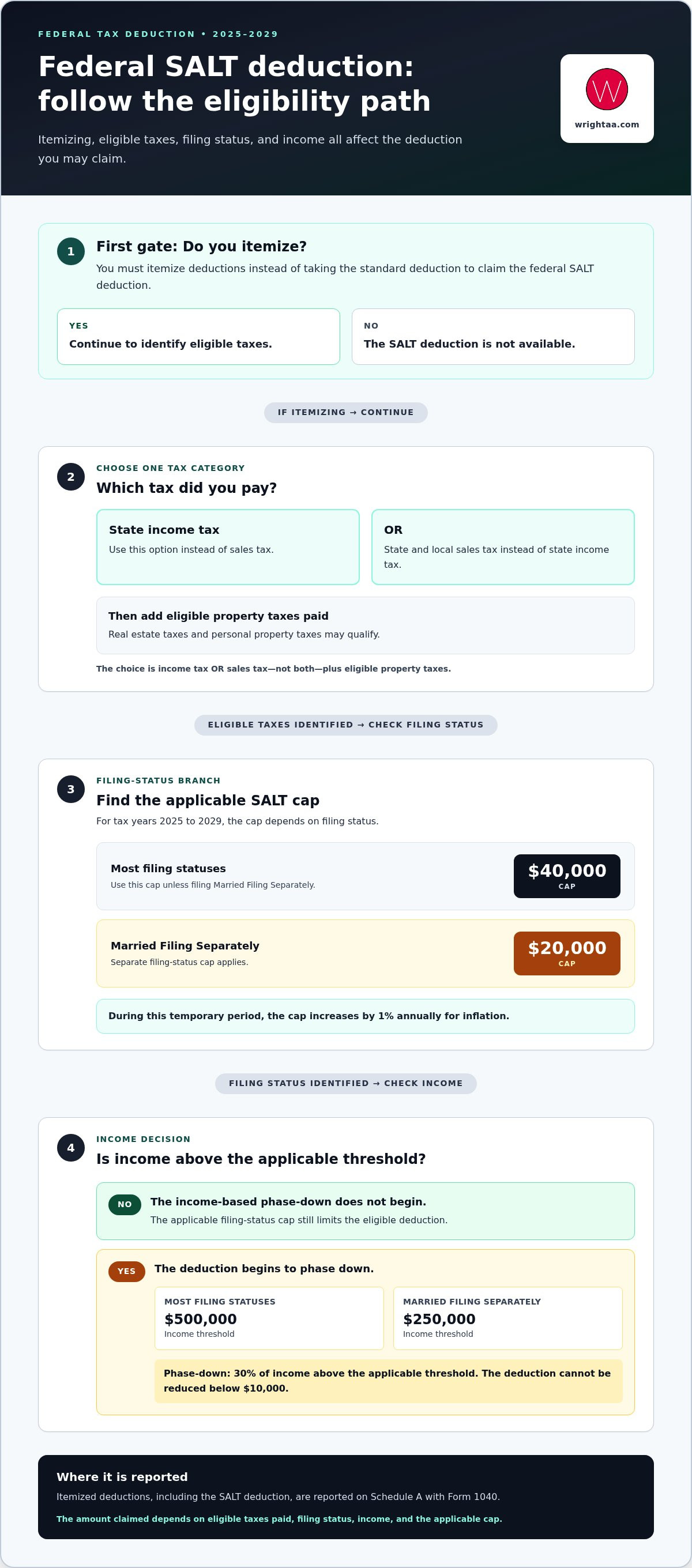
The federal SALT deduction is available only to taxpayers who itemize and can include state and local income or sales taxes, real estate taxes, and personal property taxes. For tax years 2025 to 2029, the cap is $40,000 for most filing statuses and $20,000 for Married Filing Separately. State and local tax (SALT) services for Rochester businesses also address the wider obligations behind the deduction, including compliance, nexus, and planning.
Claiming the deduction means choosing either state income tax or sales tax, then adding eligible property taxes paid. Itemized deductions are reported on Schedule A with Form 1040. But the deduction is only one part of the picture: business activity across state and local lines can create tax responsibilities that call for careful attention.
This article explains how the state and local tax (SALT) deduction works, which taxes may qualify, and what can trigger state tax obligations as a business grows or changes its operations. It also covers how compliance reviews, nexus analysis, and tax planning can help Rochester businesses understand their exposure and make informed decisions.
Key Takeaways
- Separate income and franchise tax questions from sales and property tax obligations to see the full state and local picture.
- Review where your business operates, who works there, and how you sell or deliver services to identify potential nexus concerns.
- For the federal deduction, distinguish eligible income or sales taxes from property taxes, and understand how itemizing and filing status affect the result.
- Build a regular process for tracking tax changes, records, and filing responsibilities so potential issues surface earlier.
- Consider tax planning and preparation alongside bookkeeping, payroll, or CFO support when business changes affect your tax position.
Income and franchise tax
Income and franchise tax work connects a business’s income and operations with its filing obligations across jurisdictions. For Rochester businesses, a review may involve New York rules, federal deduction limits, and activity in other states.
Income Thresholds and Phase-Down Rules
For tax years 2025 to 2029, the federal SALT deduction cap is $40,000 for most filing statuses and $20,000 for Married Filing Separately. The deduction begins to phase down above $500,000 in income, or $250,000 for Married Filing Separately. According to the Internal Revenue Service, the phase-down is 30% of income above the applicable threshold, and it can't reduce the deduction below $10,000. The cap increases by 1% annually for inflation during this temporary period.
To claim the SALT deduction, taxpayers must itemize instead of taking the standard deduction. Consider filing status, income, and eligible taxes together, since each can affect the deduction available.
Corporate Income Tax Apportionment
Apportionment determines how a corporation’s income is assigned among states when its operations cross state lines. A review considers the business’s activities and the applicable state rules, then checks whether reported income matches that footprint. New York State regulations generally follow Multistate Tax Commission guidance published in August 2021 on Public Law 86-272.
Enacted in 1959, Public Law 86-272 protects businesses from state income tax when their only in-state activity is soliciting orders for tangible personal property. Businesses should map sales and other in-state activity before relying on that protection.
For New York sales tax, Rochester businesses should classify each sale, identify where it takes place, and determine whether they have a collection obligation. The tax treatment depends on the transaction and the business’s operations.
For sales in Rochester and Monroe County, identify the applicable rate based on the sale’s location and taxable classification. Local rules can affect the combined rate, so include both location and transaction details in a sales tax review.
Credits and incentives depend on a business’s activities, expenditures, and eligibility. Review these factors alongside income tax preparation to identify potential opportunities and document the basis for any claim.
State income and franchise tax consulting can help organize filing responsibilities, assess apportionment, and address questions about tax exposure. Multi-state preparation calls for consistent income records and a clear picture of where the business operates. If a tax authority raises an issue, organized documentation can support the response and resolution process.
State income and franchise tax compliance, nexus, and planning
A New York nexus analysis considers a business’s in-state activity and how it conducts operations or sales. These connections can affect state income tax filings and other compliance responsibilities. Review changes in markets, staffing, products, and business structure.
Multi-Jurisdiction Tax Compliance
Businesses in the United States may face obligations across 50 states and thousands of local jurisdictions. A practical compliance review maps where the business earns income, maintains operations, and employs remote workers, then matches each activity to filing and payment responsibilities. For example, entering a new market or adding a service can change the state tax questions to examine.
Keep a calendar for returns, payments, registrations, and supporting records in each jurisdiction. Consistent bookkeeping helps reconcile income across filings and spot missing periods or inconsistent reporting. Because nexus rules and remote work can change a business’s filing obligations, revisit the analysis when operations change instead of relying on an outdated assessment.
Nexus for New York Business Activity
For a business operating in or selling into New York, nexus depends on the nature and location of its activities. Review where employees work, where operations take place, and how the company enters or serves the New York market. A remote employee or new line of business can change the facts relevant to a state income tax review.
Public Law 86-272 concerns a narrow set of in-state activities involving solicitation of orders for tangible personal property. As operations evolve, document what employees and representatives do, rather than relying only on a prior-year conclusion. A dated activity record can help support compliance decisions and identify questions for tax planning.
Unclaimed property compliance requires a separate review of records that may show outstanding obligations to customers, employees, vendors, or other owners. Reconcile accounts payable, payroll records, customer credits, and stale checks, then identify the owner, transaction, and reporting period. Voluntary disclosure is one route a business may use to address past unclaimed property issues with a state. Organize the underlying records first to distinguish valid liabilities from items already resolved.
Property tax compliance starts with tracking business assets and the information used to value them. Compare property records with accounting schedules, note disposals or changes in use, and check assessment details for accuracy. If a valuation appears inconsistent with documented property facts, an appeal may provide a way to submit supporting evidence. Keep asset descriptions, purchase records, and valuation materials together.
For state and local tax planning, connect each operational change to a compliance review. A useful sequence is to document the change, identify affected jurisdictions, assess filing and payment responsibilities, and assign recordkeeping tasks. Businesses entering markets, adding products or services, or changing operations should revisit their state tax position. A coordinated tax planning review can help organize these steps alongside broader business decisions.
State and local taxes eligible for deduction
The federal state and local tax deduction, commonly called SALT, covers eligible state and local income taxes or sales taxes, real estate taxes, and personal property taxes. On a federal return, taxpayers choose state income tax or sales tax, not both, and may also include eligible property taxes paid. For Rochester residents and business owners reviewing personal itemized deductions, the distinction matters: the deduction concerns qualifying taxes paid, not every tax-related business expense.
Start by sorting records into the deduction’s categories. Separate state income tax payments from sales tax, then gather documentation for real estate and personal property taxes. Compare the income tax and sales tax options using actual amounts paid. A business owner’s sales records alone do not establish the owner’s personal deductible sales tax. Keep payment records and tax documents together for the relevant filing year.
Itemizing is required. U.S. taxpayers claim the SALT deduction on Schedule A with Form 1040, rather than taking the standard deduction. The deduction’s value therefore depends on the taxpayer’s full itemized deductions, filing status, income, and eligible taxes paid. A careful filing review compares the total itemized amount with the standard deduction before determining which route applies.
For tax years 2025 to 2029, the federal cap is $40,000 for most filing statuses and $20,000 for Married Filing Separately. The cap increases by 1% annually for inflation during this temporary cap period. These limits apply to the combined eligible SALT deduction, not separately to every tax category.
Income also affects the temporary cap. For tax years 2025 to 2029, the deduction begins to phase down when income exceeds $500,000, or $250,000 for Married Filing Separately. According to the Internal Revenue Service, the phase-down equals 30% of income above the applicable threshold and cannot reduce the deduction below $10,000. Filing status and income must therefore be reviewed alongside the taxes paid.
The rules differ across periods. For tax years 2018 to 2024, the cap was $10,000 per return for Single, Head of Household, and Married Filing Jointly filers, and $5,000 for Married Filing Separately filers. In 2030, the cap reverts to $10,000, or $5,000 for Married Filing Separately. Use the rule for the specific tax year; don’t carry a prior-year cap into a different filing period.
- Income or sales tax: choose one category and compare documented amounts paid.
- Property taxes: add eligible real estate and personal property taxes paid.
- Filing review: check itemization, filing status, income, and the applicable year’s cap.
For Rochester taxpayers, accurate records help distinguish local payments from state payments and support the federal return. Organize receipts, tax statements, and payment records by year. This makes it easier to assess potential savings, understand exposure to applicable deduction limits, and prepare a consistent Schedule A filing under the relevant rules.
State and local tax risk management
A tax risk review connects filing obligations, supporting records, and business decisions. States have increased audit activity to help close budget deficits, making organized documentation and regular assessment important parts of managing state and local taxes.
For a New York State tax audit, prepare the returns and records that explain how each reported amount was calculated. Gather general ledgers, bank statements, sales invoices, purchase records, payroll documents, exemption certificates, and supporting schedules. Group documents by filing period and tax type so each transaction can be traced from its source record to the return.
For Rochester businesses, an audit file can include:
- Filed New York State returns and payment confirmations.
- Sales records, invoices, and customer exemption documentation.
- Payroll reports and records showing employee work locations.
- General ledger detail, bank records, and reconciliations.
- Asset schedules and property tax assessment documents.
Use a consistent process when an audit notice arrives. Identify the tax type and periods under review, assign someone to coordinate records, and match each request with its source documents. For example, reconcile reported sales with invoices and ledger totals before responding. Keep copies of materials provided and note unresolved questions. This approach supports clear communication and helps uncover gaps before they affect other returns.
Risk management also means reviewing changes before they create filing problems. A new product, remote employee, or market entry can affect tax obligations and the records needed to support them. Add a tax review to business planning when operations change. Compare the new activity with existing registrations, filing positions, payment routines, and recordkeeping practices. A written assessment helps owners identify changed responsibilities and decide who will maintain the supporting information.
Include credits and incentives in that assessment. Start with the business activity or expenditure, then identify the relevant state or local program and its eligibility conditions. Preserve invoices, project records, payroll details, and calculations that support a potential claim. Treat each credit as a documented tax position, not an assumed saving. A Rochester business expanding equipment or hiring should connect its records to the specific activity under review.
Local taxes add another layer to the review. Keep property records, assessment notices, and asset schedules aligned, then compare assessed details with business records. If an assessment contains a factual discrepancy, organize evidence before pursuing an appeal. For cash flow planning, map expected tax payments against filing dates and operating needs. These steps make compliance more visible and keep local obligations in view as the business changes.
Which Rochester, NY firms specialize in state and local tax consulting?
For a Rochester business, useful state and local tax (SALT) services should match the tax question at hand. State income and franchise tax planning, multi-state filings, nexus analysis, and local tax exposure are distinct needs. A business selling only in New York may need a different review from one with remote employees or customers across state lines. Start by defining the decision you need to make.
Look for a clear connection between the work and your operating facts. For example, a company entering a new market may need to understand whether its activity creates new filing responsibilities. A company with a tax notice may need help organizing records and addressing the issue. A business changing its legal or operating structure may need planning before those changes affect its tax position.
Before discussing the work, assemble a concise picture of the business:
- Where employees work and where business operations take place.
- Which states receive sales or service activity.
- What tax returns, notices, or filing questions need attention.
- Whether the business is adding markets, products, or services.
- How bookkeeping and internal records support reported income.
These details help frame the engagement around practical outcomes. A focused discussion can distinguish return preparation from forward-looking planning, or routine compliance from a specific nexus concern. For instance, a Rochester company hiring a remote worker should describe the worker’s location, role, and start date. Those facts help define which state tax questions belong in the review.
Ask how the work will connect analysis with the business’s next steps. A useful process identifies the issue, the records needed to examine it, and the decisions that follow. For a multi-state company, that may mean reviewing locations, activity, and filing history together. For a business considering expansion, it may mean addressing tax considerations before operations change.
Fit also depends on how tax work connects with everyday financial records. Clean bookkeeping makes income and expense information easier to trace. Payroll records can clarify where employees work, while cash flow planning helps owners account for tax payments alongside operating needs. These connections matter because a tax conclusion is useful only when the business can apply it to its decisions and records.
Choose the scope that reflects the specific question, not a broad label alone. A Rochester business seeking guidance on tax-related operating decisions can discuss business consulting as part of its planning process.
Wright CPAs: Tax Planning and Preparation
Wright CPAs, LLC helps businesses in Rochester, Buffalo, and Syracuse align tax planning and preparation with their financial records and operating decisions. Its services can help when a business is reviewing state and local tax (SALT) services Rochester, preparing for a new filing period, or adapting to operational changes.
Bookkeeping supports organized income and expense records, while Payroll Services help maintain payroll information relevant to business reporting. CFO Services provide financial guidance as owners consider cash flow and tax planning together. The best starting point depends on the business’s questions and the records available for a clear review.
For a conversation about your business’s tax planning and preparation needs, contact Wright CPAs, LLC.
Set a Clear Direction for Your Tax Decisions
Tax planning is most useful when it connects with decisions ahead. Before your next planning conversation, note changes in staffing, sales activity, or business structure, along with any tax questions they raise. This gives the discussion a practical starting point and connects financial choices with daily operations.
For businesses seeking state and local tax (SALT) services in Rochester, Wright CPAs offers Tax Planning and Preparation, supported by Bookkeeping and Payroll Services. These services help owners review business activity and prepare for tax decisions with a clearer view of the underlying information.
Bring your questions and the records that inform them. Contact Wright CPAs about SALT services to discuss a thoughtful next step for your business.
Frequently Asked Questions
How does the SALT tax work and how do you claim it?
The SALT deduction lets eligible taxpayers deduct certain state and local taxes on a federal return. To claim it, itemize deductions on Schedule A with Form 1040, choose state income taxes or sales taxes, and include eligible property taxes paid. For example, someone comparing the two tax options can use payment records to determine which category produces the more useful itemized deduction for that filing year.
What is the SALT deduction?
The SALT deduction is a federal income tax deduction for eligible state and local income or sales taxes, real estate taxes, and personal property taxes. It differs from a tax credit: a deduction reduces the income subject to tax rather than directly reducing the tax bill. The amount a taxpayer can claim depends on eligible taxes paid, itemization, filing status, income, and the rules for that tax year.
What state and local tax (SALT) services do tax firms in Rochester, NY offer?
Rochester businesses can choose support that fits their tax and recordkeeping needs. Wright CPAs, LLC offers Tax Planning and Preparation, Bookkeeping, Payroll Services, and CFO Services. These services support organized financial records and business tax planning. For example, a business preparing for an operational change can use its bookkeeping records to frame tax questions and guide planning decisions.
What New York State corporate income and franchise tax requirements affect Rochester businesses?
Rochester corporations should assess whether their business activity creates New York filing obligations and how income is treated when operations span states. The review can include the company’s activities, income sources, and apportionment factors. Businesses relying on Public Law 86-272 should examine whether their in-state activity remains limited to the law’s defined solicitation protection. Keep records describing operations and changes to support the analysis.
How can Rochester businesses appeal sales, income, or property tax assessments?
Begin by reviewing the assessment notice and identifying the amount or underlying facts in dispute. Compare it with relevant returns, invoices, exemption records, accounting schedules, or property details. For a sales tax issue, trace sample transactions to invoices and supporting documents. For a property assessment, gather records describing the asset. Then follow the applicable administrative review process and keep copies of submissions and correspondence.
What New York State sales tax rules apply to Rochester businesses?
Rochester businesses should classify each sale, identify where it takes place, and determine whether they must collect sales tax. The applicable Rochester and Monroe County rate depends on the sale’s location and taxable classification.


