

A useful year-end tax planning checklist starts with records that show how your business actually performed. An incomplete reconciliation or missing document can make it harder to assess your finances and decide what needs attention before the tax year closes. Start with your books, then use the information to frame the questions that matter for your business.
It’s reasonable to be unsure which records and decisions deserve attention before December 31. The right review depends on your business structure, activity, and circumstances, so general tax tips may not fit every owner. A clear process helps separate items that need action from questions that need further review.
Use this checklist to review bookkeeping, financial reports, cash flow, payroll records, business spending, estimated payments, and retirement planning questions. It also highlights why federal and New York requirements should be considered separately, and what information to bring to a year-end review. Tax outcomes depend on your facts and the rules in effect, but organized records can make planning discussions more focused.
Key Takeaways
- Use the year-end tax planning checklist to shape a review around your business structure, income, cash flow, and circumstances.
- Review financial records in a clear sequence so you can identify unresolved items and questions.
- Assess business changes, purchases, payroll, retirement planning, and estimated taxes as topics for review, not automatic tax moves.
- Separate year-end actions from filing and payment deadlines, and verify current federal and New York requirements.
- Turn your findings into a short, prioritized agenda grounded in your records and financial picture.
Why a 2026 year-end tax planning checklist starts with your financial picture
Begin with a snapshot of how your business is operating, rather than a last-minute search for deductions. Review your business structure, income sources, expenses, cash position, and major changes during the year. A sole proprietor with uneven project income may have different planning questions from an S corporation owner managing payroll. Personal circumstances can also affect which items deserve attention.
Year-end tax planning is the review of financial records and business decisions before the tax year closes, so potential questions and available choices can be considered in context. It doesn’t promise savings or provide universal instructions. Tax results depend on the facts, applicable rules, and choices available to each taxpayer.
Who should use a year-end tax planning checklist?
This checklist can help closely held businesses, self-employed professionals, and owners whose income or expenses have changed during the year. Individuals can also use the record-review steps to gather income and expense information. Business-specific topics, such as payroll or contractor records, apply only when relevant to your activities. Decide whether you’re reviewing business finances, personal finances, or both, and keep those records distinct.
That distinction matters when business activity and household finances affect one another. A change in business income, for example, may raise questions about estimated payments or retirement planning. A personal change may affect the broader tax picture. Treat these as prompts for review, not automatic recommendations. Identify what applies to you and set aside what doesn’t.
What makes a year-end review different from tax preparation?
Planning and preparation are connected, but they serve different purposes. Tax preparation reports relevant activity on a return after the year’s transactions have taken place. Planning reviews available facts and choices before the year closes, helping you frame questions about timing, cash flow, and decisions still ahead. That creates room for a considered conversation before filing work begins.
A potential purchase, for instance, may raise questions about business need, timing, and tax treatment. A tax deduction generally reduces the income subject to tax, but that alone doesn’t determine whether a purchase makes sense or whether an expense qualifies. Consider the business purpose and the rules that apply to your situation before drawing conclusions.
A practical starting point is orderly information: current records, a realistic view of cash flow, and a short list of changes or decisions to discuss. Wright CPAs, LLC provides proactive tax strategy, tax planning, and financial guidance for business owners. The checklist that follows turns that approach into a structured review for 2026.
Review your books, cash flow, and tax records before year-end
Useful planning starts with records that reflect what happened in the business. Before drawing conclusions from a profit figure or considering a tax question, compare your bookkeeping with the source documents behind it. Bank and credit-card statements, loan activity, and payroll records can reveal transactions that were missed, duplicated, or recorded in the wrong place. Reconciled records show where the numbers agree and where questions remain.
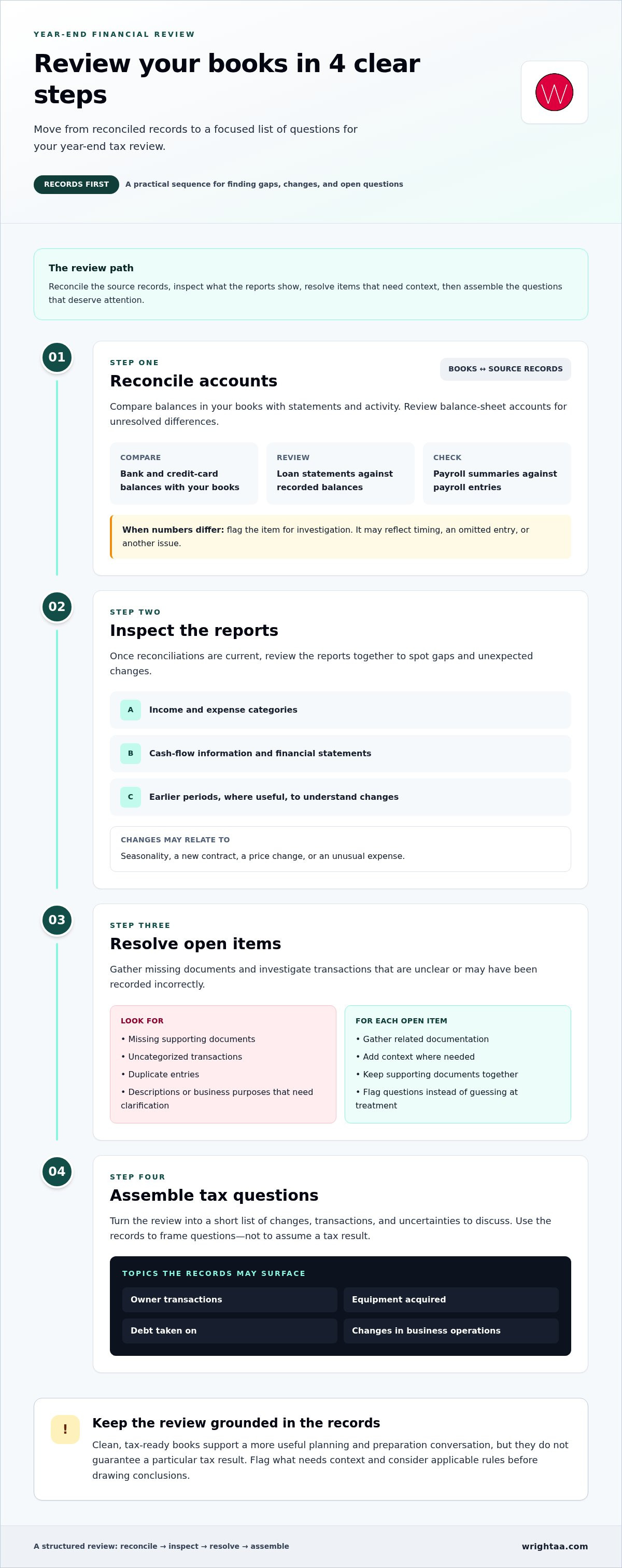
Work through the review in sequence. This makes the process manageable and helps you avoid basing decisions on incomplete information:
- Reconcile accounts. Compare bank, credit-card, and loan balances with your books, and review balance-sheet accounts for unresolved differences.
- Inspect reports. Review income and expense categories, cash-flow information, and financial statements for gaps or unexpected changes.
- Resolve open items. Gather missing documents and investigate uncategorized or duplicate transactions. Note entries whose business purpose needs clarification.
- Assemble tax questions. Record the changes, transactions, and uncertainties that may affect your year-end review.
Reconcile accounts and investigate open transactions
Start with the statements and records that support your bookkeeping. Compare payroll summaries with payroll entries, loan statements with recorded balances, and card activity with the transactions in your books. A difference may reflect timing, an omitted entry, or another issue that needs investigation. Keep supporting documents together, and flag items that need more context instead of guessing at their accounting or tax treatment.
As you review income and expense categories, look for transactions that appear more than once, lack a clear description, or may have been assigned to an unsuitable category. A receipt alone may not explain the business purpose. Add a brief note or gather related documentation so the item can be understood during review. Clean, tax-ready books support more useful planning and preparation, but they don’t guarantee a particular tax result.
Use financial reports to surface tax-planning questions
Once reconciliations are current, compare income and expense reports with cash-flow information. Where useful, look at earlier periods to understand whether a change reflects seasonality, a new contract, a price change, or an unusual expense. Pay attention to owner transactions and significant events, such as acquiring equipment, taking on debt, or changing how the business operates. The aim isn’t to assign a tax result yourself. It’s to identify what deserves a closer look.
Gather reconciliations, reports, and open-item notes in one review folder, then group questions by topic and urgency. Wright CPAs, LLC provides bookkeeping, full reconciliation of balance-sheet accounts, customized financial reporting, and cash-flow support. If keeping records current is a persistent challenge, Wright CPAs, LLC’s bookkeeping and financial reporting support can help provide a stronger foundation for tax planning.
Use this 2026 tax planning checklist to review business decisions
With your records assembled, review the decisions and changes that may shape your tax planning. Treat the year-end tax planning checklist as a set of questions, not a list of actions to take automatically. Eligibility, business purpose, entity structure, and current federal and New York rules can all affect how an item is handled. The goal is to identify what needs discussion while there’s still time to understand the options.
Review income, expenses, payroll, and contractor records
Compare recorded income with invoices, sales records, payment processor reports, and other source documents. Note outstanding invoices and unusual receipts, then ask whether they reflect completed work, a timing difference, or something else that needs review. Don’t assume an unpaid invoice or unfamiliar deposit has one standard tax treatment.
Check that payroll records and contractor information are organized and consistent with your books. Look for differences between payroll summaries and recorded wages, or contractor payments that don’t match the supporting records. Keep relevant agreements, invoices, payment details, and tax forms together. Reporting requirements and deadlines can change, so verify current IRS guidance before relying on a particular threshold or filing date.
Review expense categories for missing, duplicated, or misclassified entries. For a business expense, retain records that show what was purchased, when, and how it related to business activity. Ask how the expense should be treated instead of assuming that every cost is deductible or belongs in the same category. The details matter.
Discuss purchases, retirement planning, and estimated taxes
Prepare a short list of planned or recent business purchases. For each one, note its cost in your records, expected business use, purchase timing, and business purpose. Then ask how those facts may affect tax treatment under current rules. A potential deduction shouldn’t be the sole reason to buy equipment or another asset. Consider whether the purchase serves the business first.
Retirement planning also deserves a place in the conversation. Consider which plan contributions or options may be relevant given your business structure, income, cash needs, and personal circumstances. Limits and eligibility rules depend on the plan and current law, so don’t treat a general limit or strategy as a recommendation for every owner.
Finally, compare estimated tax records with year-to-date income and cash flow. Review payments already made, changes in earnings, and upcoming cash needs. Ask whether the amounts and timing still fit your circumstances, then verify applicable federal and New York payment requirements using current official guidance. The answers may depend on more than the business’s latest profit figure.
Bring these questions to a focused tax-planning review. Wright CPAs, LLC provides proactive tax strategy, estimated tax planning, and cash-flow guidance to help business owners understand their options in context. Explore tax planning support from Wright CPAs, LLC.
Check tax deadlines, documentation, and New York considerations
A tax-year closing date and a filing deadline are different markers. Some records or business decisions relate to activity before December 31, while returns, payments, payroll forms, and information reports may be due later. Keep these tasks in separate groups so you don’t mistake a filing date for the last day to take an action for the tax year.
For example, current federal guidance lists January 15, 2027, for the fourth-quarter 2026 estimated tax payment. For calendar-year entities, partnership and S corporation returns are generally due March 15, 2027, while C corporation returns and individual returns with Schedule C are generally due April 15, 2027. The 2026 W-2 and Form 1099-NEC deadline is February 1, 2027. Treat these as planning reference points, and verify which forms and dates apply to your business.
Build a deadline and documentation tracker
Use a simple table with four columns: item, responsible person, source record, and official deadline to verify. Include only the filing, payment, payroll, and information-reporting items relevant to your business. Record the government source and the date you checked each deadline, then gather supporting statements, receipts, payroll records, and prior-year tax materials in one organized place.
The year-end tax planning checklist should distinguish items tied to the close of the tax year from obligations due afterward. This makes it easier to assign responsibility and spot missing records before a deadline approaches. If a requirement depends on your entity type or filing status, mark it for review rather than assuming a general date applies.
Verify federal and New York State tax rules
Check IRS guidance for federal forms, payment rules, and deadlines that fit your circumstances. Then review New York State Department of Taxation and Finance guidance separately. Federal and state treatment can differ, including for certain depreciation provisions, so don’t assume a federal result carries over to a New York return. Flag entity-specific questions for qualified tax review.
For business owners in Buffalo, Rochester, and Syracuse, local professional support can help bring records and questions into a focused review. State and federal requirements depend on applicable law and the business’s facts. Before relying on a deadline, verify it against the relevant official source and note when you checked it. Revisit the tracker if guidance changes.
Wright CPAs, LLC supports year-end and mid-year reviews, estimated tax planning, and ongoing financial oversight. Schedule a tax planning review with Wright CPAs, LLC to discuss deadline questions alongside your supporting records.
Turn your year-end checklist into a clear tax planning conversation
A completed year-end tax planning checklist is most useful when it leads to a focused discussion, not a larger pile of papers. Before a review, distill what you found into a short agenda: decisions that may need attention, records that are still missing, and questions that depend on current tax rules. This keeps the conversation grounded in your business rather than general advice.
Prepare a focused agenda for your tax review
Bring reconciled financial records, relevant tax documents, and a concise summary of major business changes. Include unresolved items, such as an unusual transaction or a purchase whose treatment you’re unsure about. For each topic, note what you know, what you still need to document, and when a decision may be needed.
Use the review to sort questions into three practical groups:
- Decisions: Which choices may still be available, and what facts affect them?
- Documentation: What records or explanations would make an item easier to assess?
- Rules: Which questions depend on current federal or New York requirements?
Before the discussion ends, clarify who will gather missing information and who will follow up on each open question. The next step may be a document, a rule to verify, or a decision to revisit after more facts are available. This keeps the work clear without assuming that every issue has an immediate or universal answer.
Connect tax planning with ongoing financial clarity
Year-end planning can also reveal where your financial information needs a steadier structure throughout the year. Bookkeeping, customized financial reporting, and cash-flow visibility help owners connect business activity with upcoming decisions. Wright CPAs, LLC supports business owners and professional service providers in Buffalo, Rochester, and Syracuse with proactive tax strategy, tax-ready books, financial reporting, and ongoing financial oversight.
Tom Wright, CPA, MST, and the firm help business owners bring financial facts and tax questions into a clearer planning process. The goal is to clarify options, not promise a particular tax outcome. If your questions extend beyond tax planning into cash-flow forecasting, financial oversight, or broader business decisions, Wright CPAs, LLC CFO services can support that broader financial picture.
For another perspective as you prepare your agenda, the free guide 30 Tax Strategies Every Business Owner Should Know can help you identify topics to discuss in light of your circumstances and current rules. Use it as a source of questions, not as a substitute for individualized review.
Ready to turn your records and open questions into a focused review? Connect with Wright CPAs, LLC about year-end tax planning.
Make your next tax review a deliberate step
Make the next step a short, workable plan: choose the questions that matter most, note what information could clarify them, and set aside time to review your options before filing begins. A year-end tax planning checklist is most useful when it becomes part of how you make informed business decisions, not simply a task to complete once a year. Tax outcomes depend on your circumstances and the rules that apply, so thoughtful review matters more than assumptions about a particular result.
Tom Wright, CPA, MST, and Wright CPAs support business owners through proactive tax strategy and cash-flow planning, grounded in tax-ready bookkeeping, balance-sheet reconciliations, and customized financial reporting. This work can bring greater clarity to decisions ahead without promising a specific tax outcome.
Choose a next step that fits your business. Explore proactive tax planning and accounting support with Wright CPAs, and begin your year-end review with a clearer sense of what to ask and prepare.
Frequently Asked Questions
Do I need a tax professional for year-end tax planning?
Not every business owner needs the same level of help, but professional input can be useful when income changes, ownership shifts, or a major transaction raises questions. A tax professional can help distinguish decisions that need attention from routine recordkeeping. Wright CPAs works with business owners in Buffalo, Rochester, and Syracuse on tax planning and preparation. Use the year-end tax planning checklist to arrive with focused questions.
What records should I gather before a year-end tax review?
Gather more than transaction totals. Include prior-year returns, current-year financial statements, loan documents, asset purchase records, payroll summaries, and notices from tax agencies. If ownership or business structure changed, bring the related documents as well. Keep digital copies in clearly named folders by topic or month, and add a note when a document relates to an unusual event. This makes it easier to connect a number to its source.
Should I make a business purchase before the tax year ends?
Not solely for a possible tax deduction. First consider whether the purchase is useful, affordable, and aligned with the business’s operating needs. For example, compare the cost and expected business use of replacement equipment with the effect on cash available for payroll or other obligations. Then ask how timing and eligibility affect tax treatment under current rules. The right answer depends on the asset, business facts, and tax circumstances.
Are federal and New York State year-end tax rules the same?
No. Federal and New York State treatment can differ, so don’t assume an item handled one way on a federal return will be handled identically on the state return. Keep relevant supporting records and federal and state calculations together, then verify current requirements with the IRS and the New York State Department of Taxation and Finance. If an item depends on your entity or specific facts, flag it for professional review.
Can I still plan for taxes if my business books are behind?
Yes. Begin by collecting bank and card statements, sales records, payroll reports, and receipts for the period that needs attention. If you can’t identify a transaction, mark it for follow-up rather than assigning a category by guesswork. Wright CPAs provides bookkeeping and tax planning support to help business owners work with their financial records. Until the records are current, treat projections as provisional and avoid relying on them for consequential decisions.
How do estimated tax payments fit into year-end planning?
Estimated tax payments connect the year’s income picture with payments already made toward tax. Gather confirmation records for each payment and compare them with current income information and cash flow. A change in revenue, owner income, or business structure may prompt a fresh review, but it doesn’t by itself determine what you owe. Review how federal and state payment requirements apply to your circumstances, and verify current guidance before acting.


