

Separate business and personal finances before a deduction blurs the line. For small businesses, avoiding IRS red flags for small business tax returns starts with reporting income accurately, claiming expenses tied to business activity, and keeping records that support each deduction. A claim of 100% business use for a vehicle can draw scrutiny, so mileage logs and clear documentation matter.
It’s understandable to wonder whether a CPA can help reduce audit risk. A CPA can review bookkeeping, identify inconsistencies, and clarify how income and expenses relate to the business. This article explains which deductions, expense patterns, cash transactions, and financial habits may attract IRS attention. It also covers how separating personal and business activity can create clearer records when avoiding IRS red flags for small business filings.
Key Takeaways
- Keep home office and vehicle claims tied to actual business use, with records that explain how each deduction was calculated.
- Match reported income to tax forms and business records, and review unusual loss or deduction patterns before filing.
- Separate personal and business spending so each expense has a clear purpose and a traceable paper trail.
- Record cash sales and transactions consistently; the way money is received doesn’t change the need to report business income.
- A CPA can help review tax records and plan ahead; bookkeeping and tax preparation can support more consistent reporting.
1. Home office and vehicle deductions
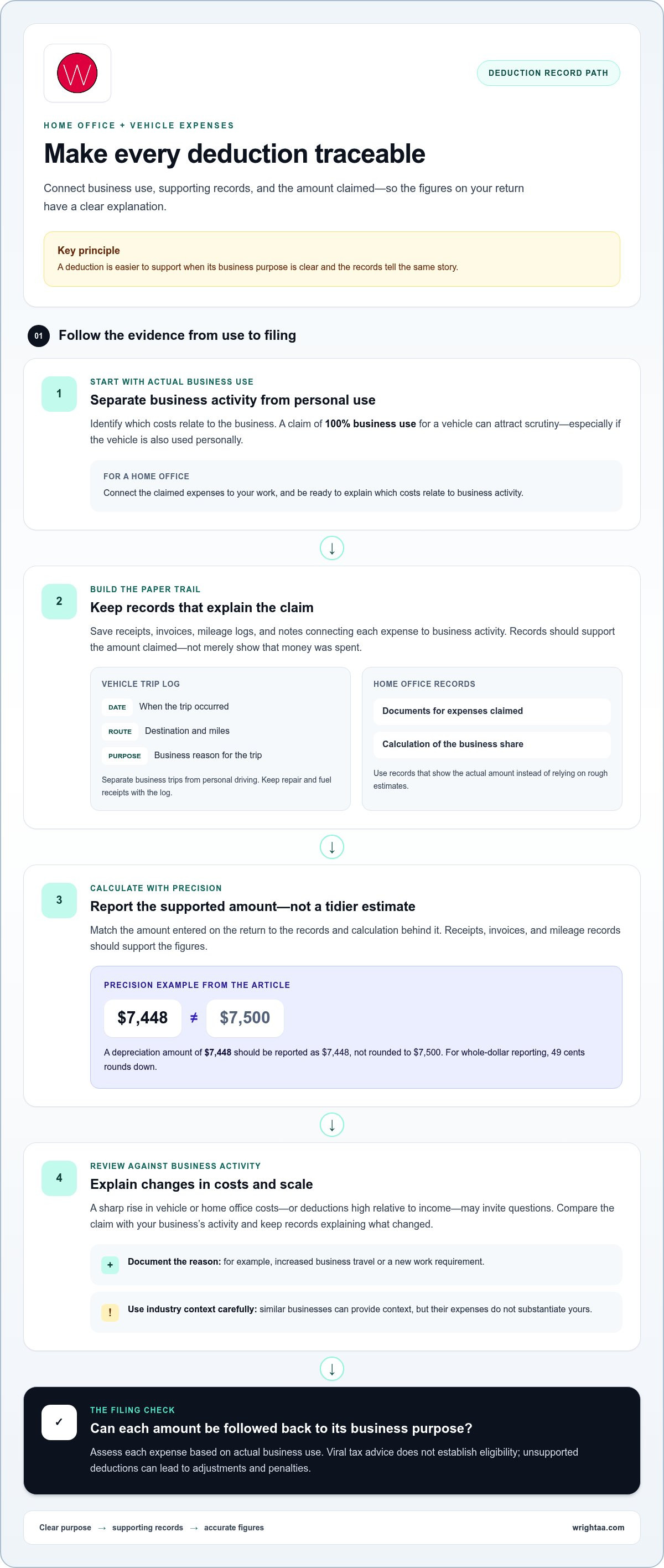
A deduction is easier to support when its business purpose is clear and the records tell the same story. For home office and vehicle costs, keep receipts, mileage logs, and notes connecting each expense to business activity. These records help explain the amount claimed, not just that money was spent.
Claiming 100% business use of a vehicle can attract scrutiny. If you also use the vehicle personally, maintain a mileage log that separates business trips from personal driving. Record the date, destination, business purpose, and miles for each trip. Keep repair and fuel receipts with those records, so the deduction has a traceable basis.
Home office claims also need a clear connection to your work. Save documents showing the expenses claimed and how you calculated the business share. For example, a contractor who works from home should be able to explain which costs relate to business activity and how the calculation was made. Avoid rough estimates when records can show the actual amount.
Precision matters. A depreciation amount of $7,448 should be reported as $7,448, not rounded to $7,500. For whole-dollar reporting, 49 cents rounds down. The goal is accurate reporting, not shaping figures to look simpler. Receipts, invoices, and mileage records should support the amounts entered on the return.
Compare deductions with the scale and activity of your business. A sharp rise in vehicle or home office costs, or deductions that are high relative to income, may invite questions. Similar businesses can provide context, but their expenses don’t substantiate yours. Keep records showing what changed, such as increased business travel or a new work requirement, and why the cost was ordinary and necessary.
Viral tax advice can leave out important conditions. A social post claiming every remote worker can deduct a home office, or every vehicle expense is deductible, doesn’t establish eligibility. Assess each expense based on your actual business use and keep supporting records. Unsupported deductions can lead to adjustments and penalties.
The IRS describes an independent contractor as someone who controls what work gets done and how it’s completed. A business may specify the desired result but generally doesn’t control the contractor’s methods. The working relationship matters more than the contract’s label.
For contractor reporting, track applicable filing deadlines and keep the required records. Payroll tax filing and deposit deadlines follow the business’s applicable schedule, while estimated tax payments should be calendared around expected tax and payment requirements. Repeatedly filing small-business payroll taxes late or failing to file can almost guarantee an IRS audit.
2. What are the most common reasons the IRS audits a return?
Missing income, unsupported deductions, and inconsistent figures can bring a tax return into focus. The IRS receives copies of W-2s, 1099s, and K-1s, so reported income can be compared with documents filed by employers, clients, and investment firms. Review each form against your books before filing, including forms from old brokerage accounts and side work.
Income and business structure also shape audit patterns. The IRS mostly audits individual tax returns reporting more than $200,000 in income and corporations with more than $10 million in assets. The IRS audit rate was 7.9% for returns reporting total income of $10 million or more during tax years 2015 through 2023. These figures describe past audit patterns, not a threshold that makes smaller returns immune.
Yes, audit patterns can differ with income and entity type, but business structure alone doesn’t determine whether a return is examined. The IRS’s reported patterns include individual returns above $200,000 in income and corporations with more than $10 million in assets. Structure also affects which forms and financial details a return must report.
A year-to-year income change isn’t automatically an error, but unexplained swings can make figures harder to follow. If revenue drops after you lose a major customer, retain the contract termination, invoices, and bank records showing the change. If income rises through a new service or online sales, reconcile deposits and platform statements with the tax return. Don’t smooth irregular results by averaging or rounding them.
Side-hustle income still belongs in the books, whether customers pay directly or through a digital platform. For 2026, according to the Internal Revenue Service, the third-party settlement organization reporting threshold is restored to $20,000 and 200 transactions. A platform’s reporting threshold is not a substitute for tracking business receipts. Keep statements, transaction histories, invoices, and records of related expenses.
Keep organized records of all business income and expenses. A simple monthly routine helps: match deposits to sales, compare tax forms with ledger entries, and file receipts alongside invoices. Include records of independent contractor payments and other income documents. This creates a trail for unusual losses or expense changes and helps identify missing forms before filing.
If you find an omitted 1099 after filing, taxpayers can amend their return using Form 1040-X. For an IRS notice, read the requested issue and response instructions, then match the notice to your return and supporting records. Organize the relevant forms, invoices, or bank statements before replying. A business consulting review can help clarify how entity choices and reporting habits affect your records; explore business consulting support.
3. Business losses and expenses outside industry norms
Unusually high deductions, repeated business losses, and sharp increases in expenses can prompt IRS scrutiny. The IRS looks closely at deductions that appear high compared with a business’s income or industry. For example, a return showing rising travel costs while revenue falls needs records explaining the change. These patterns don’t prove an error, but supporting details make the numbers easier to understand.
A business expense must be ordinary and necessary to qualify as a deduction. The cost should fit the work and serve a business purpose. A consulting firm’s software subscription may support client work; a family streaming account generally doesn’t. Before claiming an expense, record what it was, who used it, and how it supported business activity.
Compare each expense category with the business’s own prior returns and current activity. A sudden increase in travel, supplies, or contractor payments deserves an explanation tied to actual events. If travel on a return is 20% or more above the occupational norm, it might receive additional IRS scrutiny. Keep itineraries, invoices, and client or project notes that explain the trips and their business purpose.
Multiple years of losses can also prompt questions, especially when a return offers little evidence of an ongoing business effort. Keep organized records of revenue, expenses, customer activity, and steps taken to improve operations. If a product launch delayed income while design and production costs rose, preserve project documents and sales records. A clear timeline helps explain how the losses arose.
Personal and business spending can blur in shared accounts, making individual deductions harder to substantiate. Separate transactions where possible and label mixed-use costs when they occur. For a business meal, record the date, attendees, amount, and business purpose, then keep the receipt with that note. If you pay a business expense with a personal card, document the business portion and the reimbursement or accounting entry.
Before preparing a return, review the numbers by category and compare them with receipts, invoices, bank statements, and payroll records. Trace any sharp change to a specific cause, such as a new contract, equipment purchase, or lost customer. If revenue is low but costs remain high, confirm that each expense belongs to the business and has supporting records. A steady review can make a legitimate loss easier to explain and help catch personal charges before filing.
Business expense patterns that commonly attract scrutiny include deductions unusually high relative to income or industry norms, sudden increases, mixed personal and business costs, and repeated losses without organized supporting records. Each deduction should connect to a business purpose and records that substantiate its amount.
4. Cash transactions and currency transaction reports
Cash sales still count as business income, even when no card processor or 1099 records them. Record each transaction when it occurs, then reconcile the cash log with receipts, deposits, and sales records. If customer income totals $10,089, report $10,089 rather than rounding it to $10,000. Tips should also be included in the business’s income records and reported consistently.
Small business owners handling substantial cash should keep documentation for every transaction. A daily record can include the sale date, amount, receipt number, and deposit details. Compare the cash log with the register and bank statement during reconciliation. This can reveal missing sales or duplicate entries before the figures reach the tax return.
A currency transaction report is different from business income reporting. U.S. financial institutions must file a currency transaction report for a cash transaction over $10,000. That reporting requirement doesn’t replace the business’s duty to record its actual income. Don’t split or reshape transactions to avoid reporting; keep the original records and report the business activity accurately.
Keep information consistent across tax forms. The IRS receives copies of W-2s, 1099s, and K-1s, which can be compared with amounts on a return. For 2026, according to the Internal Revenue Service, the third-party settlement organization reporting threshold is restored to $20,000 and 200 transactions. That threshold determines when the organization reports transactions, not whether a business should track its receipts or profit.
For Form 1099-NEC and Form 1099-MISC, the reporting threshold increases from $600 to $2,000 starting in 2026. The thresholds were $600 before 2026. Keep payment records for contractors and vendors, then compare those records with forms issued and received. A missing form doesn’t make income disappear from the books.
Foreign assets can require separate reporting. Individuals must report foreign assets worth at least $50,000 on the last day of the tax year on Form 8938, or at least $75,000 if held at any time during the tax year. For married couples filing jointly, the corresponding thresholds are $100,000 on the last day and $150,000 at any time during the year.
Cryptocurrency activity also needs attention during tax preparation. Form 1040 includes a question about cryptocurrency activity, so owners should retain transaction histories and records showing purchases, sales, and transfers. Match those records to the return rather than treating digital transactions as invisible. Accurate reporting across cash, platform, foreign asset, and digital activity helps keep income, transactions, and business expenses coherent.
5. Separating personal and business finances
A clear boundary between personal and business spending gives each tax return a more traceable foundation. Use a dedicated business bank account for customer receipts and operating expenses, and reserve a personal account for household costs. This separation helps show how reported income moved through the business and which payments supported its work.
Start with a simple payment routine. Deposit customer revenue into the business account, pay business invoices from that account, and keep personal purchases off the business card. If you accidentally use a personal card for office supplies, save the receipt and record the business purpose and amount. If personal funds cover a business bill, document the transfer instead of leaving an unexplained deposit or expense.
Label owner activity consistently in your books. Record money added to the business separately from customer income, and distinguish personal withdrawals from business expenses. For example, a transfer to cover rent at home shouldn’t be recorded as a supplier payment. Clear labels help you explain what each transaction represents without relying on memory at filing time.
Shared purchases need careful allocation. If a phone supports both client calls and family use, keep a reasonable record of business activity and consistently calculate the business portion. For a meal involving a client, retain the receipt and note the meeting’s purpose. Don’t classify the full cost as a business expense just because a work conversation took place.
Reconcile the business account monthly. Match bank deposits to sales records, payments to invoices, and card charges to receipts. Investigate unmatched items while their purpose is still clear. A monthly review can identify duplicate entries, personal charges coded as business expenses, or customer payments missing from the ledger before they flow into a tax return.
Separate accounts also help explain credit activity. Keep loan proceeds, owner contributions, sales, and customer refunds identifiable in your records. A bank deposit isn’t automatically revenue; its source matters. Attach loan statements or transfer notes to the relevant entries, and keep documents showing how funds were used. This provides a fuller picture than a bank balance alone.
Before filing, compare the ledger with statements and supporting documents. Correct misclassified transactions in the books, then carry the corrected totals into the return. A tax professional can review unclear transactions and help establish a recordkeeping process suited to the business’s structure. For a focused review of how your business finances are organized, discuss your business structure and financial workflow.
Wright CPAs: Tax Planning and Preparation
Wright CPAs helps business owners align tax filings with financial records through Tax Planning and Preparation. When income, deductions, payroll records, or personal and business transactions are difficult to reconcile, Bookkeeping can help organize the underlying information. Payroll Services and CFO Services can also support consistent financial processes and ongoing business decisions.
Turn to Wright CPAs when you’re preparing to file, reviewing how business activity is recorded, or planning for tax considerations before making financial decisions. A careful review can help identify inconsistencies and clarify the records supporting a return, though it can’t guarantee that the IRS won’t examine it.
Contact Wright CPAs to discuss your tax planning and preparation needs.
Build a steadier financial rhythm
Tax readiness takes shape throughout the year, not only during filing season. Set a recurring time to review how money moves through the business, who records each transaction, and where supporting documents are kept. A clear routine makes financial decisions easier to explain and gives owners a more grounded view of what the business can sustain.
A thoughtful approach to avoiding IRS red flags for small business owners can also support better decisions beyond taxes. Wright CPAs offers Tax Planning and Preparation, Bookkeeping, and Payroll Services to connect tax filing with the records and processes behind it. This support can be useful when your business is growing, changing its operations, or bringing financial information into a more consistent order.
Choose a next step that fits the questions in front of you. Contact Wright CPAs about your tax concerns and discuss how to create a clearer foundation for the year ahead. Careful planning can help you move forward with greater clarity.
Frequently Asked Questions
Can using a CPA reduce my audit risk?
A CPA can help reduce preventable reporting errors by reviewing how records support a tax return. When avoiding IRS red flags for small business owners, a useful review compares income documents, bookkeeping entries, and deductions before filing. Wright CPAs offers Tax Planning and Preparation and Bookkeeping for business owners in Buffalo, Rochester, and Syracuse. A CPA’s review can strengthen the accuracy of your filing, while the IRS retains responsibility for selecting returns for examination.
How can I tell if my deductions are too high?
Review each expense category alongside revenue, prior-year figures, and the work your business actually performed. A sudden rise in travel costs, for example, calls for a clear business explanation and supporting records. Compare your figures with those of similar businesses for context, not as a fixed limit. No single deduction total establishes a problem; what matters is whether each amount reflects real business activity and has support.
What are the most common reasons the IRS audits a return?
Common attention points include income that doesn’t match tax documents, unusually high deductions, repeated losses, and irregular accounting. A return may also be selected randomly, so an audit doesn’t automatically mean the IRS found wrongdoing. Before filing, compare your return with the income forms you received and review major changes from the previous year. Keep explanations and supporting documents together so you can respond clearly if questions arise.
What records and receipts should small businesses keep to support tax deductions?
Keep receipts, invoices, bank and card statements, contracts, mileage records, and documents showing an expense’s business purpose. For example, attach a project note or client record to a travel invoice, and retain the vendor invoice for equipment. Store files by tax year and expense category, and back up digital copies securely. This makes it easier to connect a claimed deduction with the transaction and the work it supported.
What IRS rules apply to deducting meals, travel, vehicle use, and home office expenses?
Business deductions must be ordinary and necessary, and records should show how each expense relates to the work. For a meal, note its business purpose and participants; for travel, retain an itinerary and receipts. Vehicle records should distinguish business use from personal use. For a home office, keep the calculation and supporting expense documents. Apply the same method consistently, and don’t rely on broad social media claims as proof of eligibility.
What income reporting mistakes increase IRS audit risk for small businesses?
Common mistakes include leaving out a 1099, cash receipts, tips, or income from online sales. Another problem is reporting a total that conflicts with forms sent to the IRS. Reconcile sales records, payment-platform statements, bank deposits, and tax forms before filing. If a payer’s form arrives after you’ve prepared your books, add it to the review rather than assuming its absence from your records means the income doesn’t need to be reported.
How long should small businesses retain tax records under IRS rules?
Keep business records detailing all income and expenses for at least seven years. This gives you time to locate documentation if a return is questioned later. Preserve the filed return with its supporting records, including receipts, statements, invoices, and work-related notes. A consistent electronic filing system can make retrieval easier: label folders by tax year, then group documents by income, expenses, payroll, and assets.


