

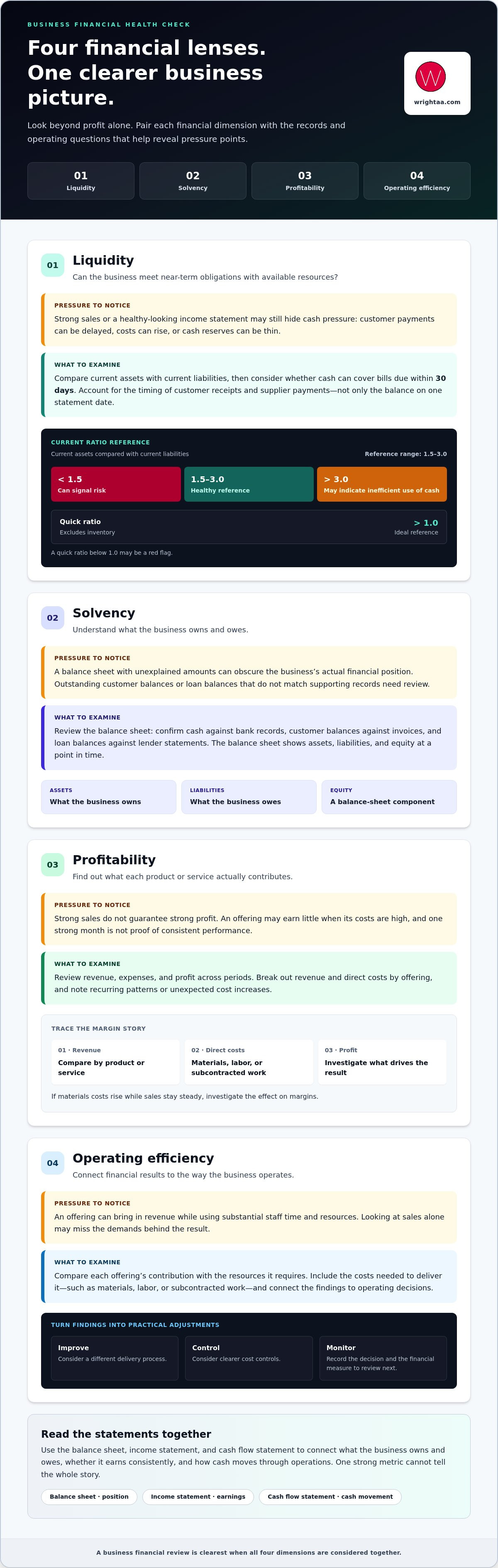
A business financial health checkup in Rochester should look beyond profit alone. Assess four dimensions: liquidity, solvency, profitability, and operating efficiency. Start with the balance sheet, income statement, and cash flow statement to understand what the business owns and owes, whether it earns consistently, and how cash moves through operations.
A healthy-looking income statement can still hide financial pressure. Delayed customer payments, rising costs, or a thin cash reserve may make obligations harder to meet, even when sales are strong. A useful review connects the numbers with the way the business operates.
This guide shows you how to check profitability by product or service, verify that your records are current, and interpret key financial indicators. You’ll also learn how to test cash flow against a hypothetical 20% revenue drop, spot warning signs, and decide how often to review your finances. The aim is a clearer view of where the business stands and what to adjust next.
Key Takeaways
- Break down revenue and costs by product or service to see which parts of the business contribute most to profit.
- Reconcile bookkeeping and keep financial statements current so decisions reflect the business’s actual position.
- Review liquidity, solvency, profitability, and operating efficiency together; one strong metric can’t tell the whole story.
- Test resilience by considering slower customer payments, rising costs, and a hypothetical revenue decline.
- Use regular financial reviews to spot trends early and shape practical adjustments to cash flow and tax planning.
Analyzing profitability by product or service
Use the first half of the year as a starting point for a mid-year profitability review. Compare revenue and costs for each offering, then connect the results to operating decisions.
Rochester’s Financial Empowerment Center serves people aged 18 and over who live, work, worship, or attend school in Monroe County. It’s a local counseling resource; the steps below focus on reviewing business profitability.
-
Review Profit and Loss Results
Examine the profit and loss statement for the first half of the year. Check revenue, expenses, and profit for each period, then note recurring patterns and unexpected cost increases. For example, if materials costs rise while sales remain steady, investigate the effect on margins. Don’t treat one strong month as proof of consistent performance.
-
Compare Budget and Actual Results
Compare budgeted figures with actual results in accounting records. Mark each difference as favorable or unfavorable, then trace it to a specific cause, such as lower sales, added labor, or delayed work. Separate timing differences from lasting changes in operations. Owners can use this variance analysis to revise spending plans and monitor whether the same gap appears again.
-
Compare Revenue and Costs by Offering
Break out revenue and direct costs by product or service category. Include the costs required to deliver each offering, such as materials, labor, or subcontracted work. Compare each category’s contribution with its demands on staff and resources. An offering with strong sales may still earn little if its costs are high. Use the analysis to decide what to improve, reprice, or reconsider.
-
Connect Financial Statements and SWOT Findings
Read the income statement alongside the balance sheet and cash flow statement. Together, they show earnings, what the business owns and owes, and how cash moves through operations. Then conduct a SWOT analysis: list strengths, weaknesses, opportunities, and threats that affect results. For example, repeat customers may be a strength, while reliance on one large account may create a threat.
-
Turn the Analysis Into Decisions
Use the findings to set specific adjustments for the second half of the year. A modest, well-communicated price change may improve the bottom line when costs have outpaced revenue. Consider whether an offering needs a different delivery process or clearer cost controls. Record the decision, its rationale, and the financial measure to monitor at the next review.
Bookkeeping accuracy and financial records
Reliable financial metrics depend on records that are accurate, current, and organized. For a business financial review, gather the core statements and trace each figure to its supporting records.
A CPA review can interpret financial statements and tax-related records, while bookkeeping focuses on recording and reconciling transactions. Financial advisory work uses that information to guide decisions about cash flow, spending, and business goals.
Prepare a balance sheet, income statement, and cash flow statement, along with supporting bank, credit card, payroll, and accounts receivable records. These documents connect reported results to actual transactions.
- Reconcile bank and credit card activity against the books. Match each transaction to a statement entry, receipt, or invoice, then resolve duplicates, missing entries, and unexplained differences. For example, recording a software charge twice can overstate expenses and distort monthly performance.
- Check that income and expenses are classified consistently. Review sales, payroll, rent, supplies, and other spending using the same categories across periods. If a contractor payment shifts from labor to miscellaneous expenses, comparisons become less useful. Consistent categories help owners interpret trends instead of chasing changes caused by coding.
- Review the balance sheet against supporting details. Confirm that cash agrees with bank records, outstanding customer balances match invoices, and loan balances align with lender statements. A balance sheet captures assets, liabilities, and equity at a point in time, so unexplained balances can obscure the business’s true position.
- Bring tax filings, payroll records, and other regulatory records up to date. Compare payroll summaries with recorded wage expenses, and confirm that filed returns correspond with the books. Accurate, current records provide a clearer view of performance and support decisions based on facts rather than estimates.
- Use the corrected records to track relevant metrics and prepare for decisions. Compare revenue, expenses, and cash movement across periods, then note which changes need explanation. If recurring reconciliation issues or inconsistent entries make the numbers difficult to rely on, bookkeeping support can help establish a clearer recordkeeping process.
Liquidity, solvency, profitability, and operating efficiency
Assess four dimensions together: liquidity, solvency, profitability, and operating efficiency. Each reveals a different pressure point in your business finances.
- Test liquidity by calculating current and quick ratios. The current ratio compares current assets with current liabilities; a range between 1.5 and 3.0 is a healthy reference, while below 1.5 can signal risk. Above 3.0 may point to inefficient use of cash. The quick ratio excludes inventory. Above 1.0 is ideal, while below 1.0 may be a red flag.
Then ask whether available cash can cover bills due within 30 days. Consider the timing of customer receipts and supplier payments, not only the balance on one statement date. A business can hold valuable inventory yet face pressure if it cannot turn that inventory into cash before obligations fall due.
- Review solvency by examining debt-to-equity and other solvency ratios. These measures show how much the business relies on borrowing compared with owner equity and resources. List outstanding loans and credit lines, then consider their interest rates and repayment terms alongside operating cash flow. A debt balance alone doesn’t explain financial pressure; scheduled repayments and the cash available to meet them matter.
Monitor the business credit score as another indicator of its position for future financing needs. Treat it as one part of the picture, not a substitute for reviewing liabilities, repayment schedules, and cash flow stability.
- Calculate gross margin, net margin, and EBITDA margin to examine profitability from different angles. Gross margin reflects revenue after direct costs; net margin includes the broader costs of running the business. Margins above 10% are described as healthy, while below 5% is concerning. These guideposts need context: a 15% margin may trail an industry average of 25%.
Compare each margin with the business’s own history and relevant industry averages. Use the income statement to review revenue and expense trends, consistent profit, and unexpected cost increases. A positive result in one period doesn’t establish a lasting pattern.
- Measure operating efficiency with days sales outstanding, inventory turnover, and the cash conversion cycle. Days sales outstanding shows how quickly sales turn into collected cash. Inventory turnover indicates how often inventory is sold and replaced. The cash conversion cycle connects operating spending with the time needed to recover cash through sales and collection.
Look for changes in these metrics across periods. If days sales outstanding rises while inventory turnover slows, cash may remain tied up longer. Identify the cause, such as slower collections or stock that moves less readily, before changing purchasing or credit practices.
- Track operating cash flow over time, because positive and stable operating cash flow is a strong indicator of financial viability. Rochester seasonal businesses, including landscapers, contractors, and hospitality businesses, can use a busy summer season to build reserves for slower months. Maintain a reserve for emergencies or opportunities, and manage vendor payments strategically.
Set the review frequency to match business conditions. Fast-growing or struggling businesses should review cash flow weekly, while seasonal operators should also compare busy-season inflows with slower-month obligations. This turns ratios into practical decisions about timing, reserves, and daily operations.
Revenue, payment-delay, and cost-inflation stress tests
Test whether cash flow can absorb lower revenue, slower customer payments, and rising operating costs. Use bookkeeping records to model each pressure and identify where financial stability weakens.
- Review accounts receivable by invoice age and customer. Compare payment dates with the agreed terms, then group outstanding balances by how long they’ve remained unpaid. A typical customer payment period to assess is 30-60 days. Customers paying later than 60 days can severely affect the bottom line and signal collection issues.
Look for patterns in the tracking: repeated delays from one account, disputes, or invoices that remain open after delivery. Customers past 90 days can be a financial red flag. Note the amount and timing of expected receipts, since recorded sales don’t provide cash until customers pay.
- Model a hypothetical 20% revenue drop against your current operating plan. Reduce forecast sales, then estimate how that change affects gross profit and cash available for upcoming expenses. Separate costs that move with sales from commitments that remain, such as recurring rent or scheduled debt payments.
Check whether the revised cash flow still covers payroll, suppliers, and other planned spending. If a lower sales forecast creates a shortfall, identify when cash becomes constrained. This makes the test useful for decisions rather than focusing on a single alarming revenue figure.
- Test cost inflation by reviewing recent supplier invoices, payroll expenses, and other operating costs. Identify which costs have risen and whether each increase affects one product, one service, or the whole business. Then adjust the forecast using the actual cost changes in your records, rather than assuming every expense behaves alike.
Compare revised costs with expected revenue and delivery volume. If materials become more expensive while customer pricing stays fixed, the margin narrows. Consider which expenses can be controlled, which require a pricing or process decision, and which are necessary to maintain operations.
- Combine the scenarios to test simultaneous pressure. For example, model a 20% revenue decline alongside slower collections and higher supplier costs. Use a cash flow projection to map expected receipts and payments by timing, not simply by accounting period.
Map when cash inflows arrive and when payroll, vendors, loan payments, and other obligations leave the account. This reveals whether a business can withstand several pressures at once. Update assumptions when customer payment patterns or supplier terms change.
- Turn each stress test into a response plan. Set a clear review trigger, such as a growing overdue balance, a cost increase that reduces margin, or projected cash falling short of scheduled expenses. Assign someone to track each signal and record the next action.
Keep the assumptions and results with monthly bookkeeping records. Compare the forecast with actual results at the next review, then refine the model. A consistent process shows whether collection practices, spending decisions, or operating plans are improving cash stability.
Business financial health assessment
Build a useful assessment from financial statements, trend comparisons, and clear review intervals. The goal is to turn indicators into strategic decisions business owners can act on.
- Compare the balance sheet, income statement, and cash flow statement across 6 months, 12 months, and 24 months. Review prior-year performance and year-over-year trends, then compare revenue and cost growth by driver. This shows whether a change is seasonal, recurring, or tied to a specific part of operations.
- Review tax, lending, and regulatory records alongside those trends. Check that tax filings, payroll, and other regulatory records are accurate and up to date. Revisit quarterly estimated tax payments before year-end if business results have changed. Also examine outstanding loans and credit lines, including interest rates, repayment terms, and the business credit score.
- Set the review rhythm to match the company’s conditions. Stable businesses should complete a financial health check once per quarter; high-growth, volatile, or cash-constrained companies should review monthly. A mid-year review uses six months of actual data to assess performance and plan adjustments. Monthly metric reviews and deeper quarterly analysis help owners catch shifts before they become harder to manage.
-
Identify Immediate Warning Signs
Look for customers past 90 days, a quick ratio below 1.0, and operating cash flow that turns negative or becomes unstable. Check whether bills due within 30 days can be paid from available resources. Rising costs, falling margins, or repeated bookkeeping discrepancies also warrant prompt attention. Track each sign against recent statements and identify its cause before setting a response.
-
Consider Checkup Costs
Consider the review’s scope, the condition of the records, and the depth of analysis required. A checkup focused on statements differs from work involving cash flow projections, tax planning, or lending records. The price depends on the case and is provided after a quote request; key cost factors include record complexity, review scope, and the analysis required.
- Turn the findings into a short action plan with an owner, a deadline, and a metric for each decision. Build a forecast for the next 6-12 months, then compare it with actual results during scheduled reviews. Business owners can use that forecast to align spending and savings goals with expected cash flow. For help translating financial findings into business decisions, explore business consulting.
Wright CPAs: Tax Planning and Preparation
Wright CPAs connects financial health reviews with Tax Planning and Preparation when business results point to tax decisions. Six months of financial data can support a reasonable estimate of projected tax liability, helping owners consider adjustments to quarterly estimated tax payments before year-end.
Tax planning also matters when stronger cash flow raises questions about equipment or vehicle purchases. Reviewing timing before year-end can help owners weigh potential tax benefits alongside operating needs. Bookkeeping keeps the underlying records organized, while CFO Services can support cash flow planning and financial decisions.
Turn to Wright CPAs when current financial results need to inform tax planning or a clearer cash flow plan. Contact Wright CPAs to discuss the next step for your business.
Make Your Next Financial Decision With Clarity
A financial review is most useful when it changes how you plan, not simply how you describe past results. Choose one pressure point to address, assign responsibility for tracking it, and revisit the plan as customer activity, costs, or business priorities shift. That steady practice can make a business financial health checkup in Rochester a starting point for more deliberate decisions.
Wright CPAs supports this work through Tax Planning and Preparation, Bookkeeping, and Payroll Services. Consistent records and a clearer view of business finances give owners more context and less guesswork as they approach the next decision.
Contact Wright CPAs to discuss your checkup. A thoughtful next step can help you move forward with greater confidence.
Frequently Asked Questions
What Does “Small Business Financial Health” Look Like?
Small-business financial health means the company can meet obligations, earn consistently, and adapt when conditions change. A business financial health checkup in Rochester should consider how these qualities work together, rather than rely on a single score. For example, a local contractor may show steady sales but still face strain if collections slow between projects. Health is reflected in the relationship between earnings, available cash, debt, and operating needs.
Can a profitable business be financially unhealthy?
Yes. Profit on an income statement doesn’t guarantee enough cash to cover near-term obligations. A business may record revenue from completed work before customers pay, or have debt payments that absorb available cash. For example, a firm can report a profit while delaying supplier payments or relying on credit for payroll. Compare accounting profit with cash movement and upcoming commitments to see whether earnings translate into financial stability.
What does a business financial health checkup include?
A checkup brings together financial statements, transaction records, and operating context. Alongside the balance sheet, income statement, and cash flow statement, examine customer concentration, upcoming commitments, and major changes in how the business earns revenue. For example, if one customer represents a large share of sales, consider how a delayed project or lost contract would affect the plan. End the review with specific decisions, assigned responsibilities, and measures for follow-up.
What financial ratios and benchmarks should a small business review?
Review current and quick ratios for short-term liquidity, debt-to-equity for leverage, and gross, net, and EBITDA margins for profitability. A current ratio between 1.5 and 3.0 is a healthy reference; below 1.5 may signal risk, while above 3.0 may reflect inefficient cash use. A quick ratio above 1.0 is ideal, and below 1.0 may be a red flag. Compare margins with the company’s industry and its own history.
How can a business assess cash flow, profitability, debt, and working capital?
Use a cash flow forecast to map expected receipts against scheduled outflows, then compare forecast results with actual activity. Review margins by revenue source, and list loans and credit lines with their interest rates and repayment terms. Working capital reflects short-term resources available after current liabilities; assess whether those resources can support ordinary operations. For example, a profitable seasonal business may need to plan for payroll and suppliers before its next busy period begins.
What steps are involved in getting a business financial health checkup?
Start by gathering current statements and supporting records, then reconcile unresolved entries so the review uses dependable figures. Compare recent results with prior periods, investigate significant changes, and assess cash, debt, and operating performance together. Next, test a realistic downside scenario and note where pressure would emerge. Finish with a written action plan, naming who will handle each decision and which indicator will show whether the change is working.


