

A physician’s tax plan is more than an annual return. Tax planning for physicians in Rochester includes reviewing estimated tax payments, retirement contributions, deductions, and the timing of income. The right approach also depends on whether a doctor earns a W-2 salary, has self-employment income, or combines both.
That distinction matters. A hospital-employed physician may focus on workplace benefits and withholding, while a self-employed doctor may also need to plan for business income and practice expenses. This article covers five areas to review, explains how priorities differ by income type, and shows when CPA support can help bring the pieces together.
Key Takeaways
- Review estimated tax payments as income changes, especially when combining a salary with additional clinical or consulting work.
- Compare workplace retirement options and charitable giving strategies, including qualified charitable distributions for eligible older physicians.
- Match retirement and business tax strategies to how your medical income is earned and whether you own a practice.
- Before considering an S corporation election, weigh payroll responsibilities, reasonable compensation, and the election deadline.
- Specialized CPA support can help connect tax planning with bookkeeping, payroll, and the financial structure of a practice.
1. What does tax planning for physicians include?
Tax planning brings income, deductions, retirement contributions, and payment timing into one working picture. For Rochester doctors, the first step is separating W-2 wages from practice, consulting, or other self-employment income. Those sources can have different withholding and payment needs. A change in employment, practice ownership, or household income should prompt a fresh review.
Physicians in Rochester, Buffalo, and Syracuse need to distinguish New York State income, payroll, and practice-related filing obligations. Map each obligation to your residence, workplace, practice entity, and business activities. Then keep separate accounts and records for personal and practice transactions. This helps identify which filings apply without assuming that every physician or medical practice has the same tax situation.
Estimated tax payments deserve attention when withholding does not cover income outside a paycheck. Review quarterly payments alongside current income, prior payments, and expected deductions. After a major change, such as adding consulting work or opening a practice, update your projection and schedule payments accordingly. Put estimated payments on your calendar rather than leaving them until filing time, and keep payment confirmations with your tax records.
For New York physicians, compare withholding and quarterly payments with projected taxable income, including self-employment earnings. Revisit the projection when income or contributions change, and retain payment records so you can spot a potential shortfall before filing. This gives you a clearer basis for managing underpayment risk instead of relying on withholding from a single paycheck.
Student loan interest may qualify for a deduction of up to $2,500 under IRC Section 221. For CME, equipment, and home-office costs, keep receipts and record the professional purpose, payment date, and business-use share. Separate practice purchases from personal spending, and distinguish expenses paid by a W-2 doctor from costs incurred by a self-employed physician. These records help establish which costs belong in the practice accounts and support the tax treatment claimed.
Common errors include mixing personal and practice transactions, overlooking additional income, and failing to reconcile records before filing. Compare consulting income reported on tax documents with deposits, then match equipment purchases to invoices. Keep payroll records, estimated payment confirmations, and receipts organized. Review the ledger before filing, especially after a change in employer, practice structure, or income source. Clear records make inconsistencies easier to identify and explain if a return is examined.
2. Tax planning for high-W-2 physicians and investors
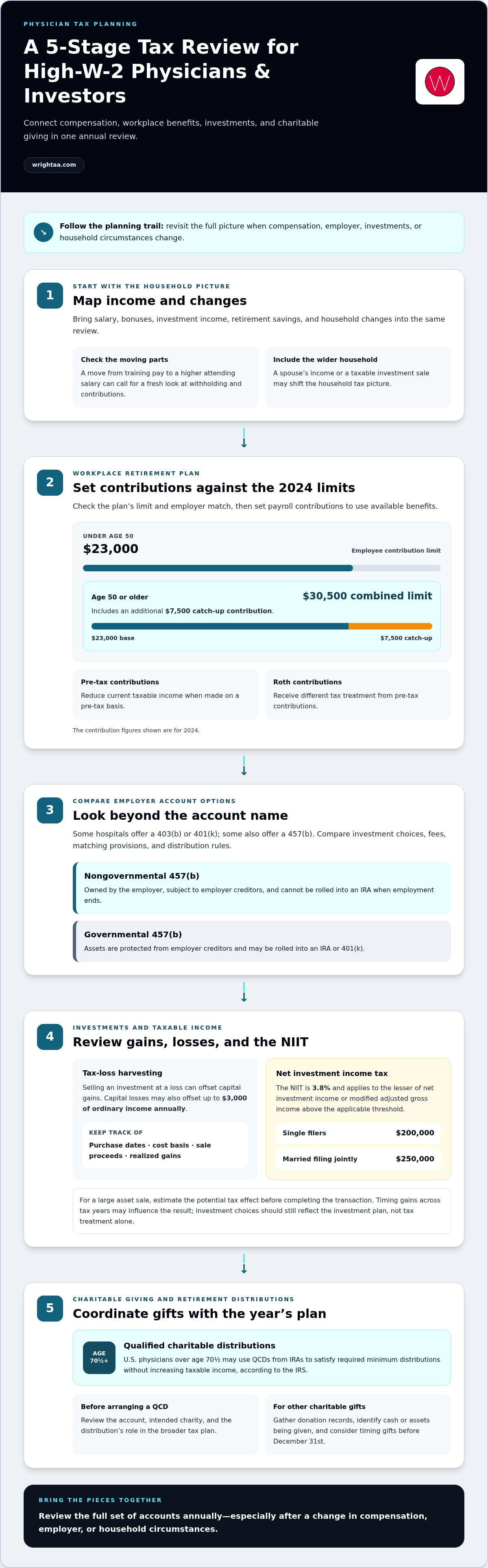
A high W-2 salary can simplify withholding, but it doesn’t settle every tax decision. A physician’s annual tax plan should account for salary, bonuses, investment income, retirement savings, and household changes. For example, a new attending physician moving from training pay to a higher salary should revisit withholding and retirement contributions promptly. A spouse’s income or a taxable investment sale can also shift the household picture.
Start with the employer retirement plan. For 2024, employees under age 50 could contribute up to $23,000 to employer-sponsored plans. Employees age 50 or older could contribute an additional $7,500 catch-up amount, for a combined limit of $30,500. Check the plan’s contribution limits and employer match, then set payroll contributions to use the available benefits. A contribution reduces current taxable income when made on a pre-tax basis, while Roth contributions receive different tax treatment.
Employer choice also shapes the available accounts. Some hospitals offer a 403(b) or 401(k), and some also offer a 457(b). Compare investment choices, fees, matching provisions, and distribution rules before allocating savings. A nongovernmental 457(b) is owned by the employer, remains subject to employer creditors, and cannot be rolled into an IRA when employment ends. That differs from a governmental 457(b), whose assets are protected from employer creditors and may be rolled into an IRA or 401(k).
Retirement planning changes later in a physician’s career. U.S. physicians over age 70½ may use qualified charitable distributions from IRAs to satisfy required minimum distributions without increasing taxable income, according to the Internal Revenue Service. That route can connect charitable giving with retirement-account distributions. Review the account, the intended charity, and the distribution’s role in the broader tax plan before arranging a gift.
Tax-efficient investing also includes managing gains and losses. Tax-loss harvesting means selling an investment at a loss and using that loss to offset capital gains. U.S. taxpayers may also use capital losses to offset up to $3,000 of ordinary income annually. Track purchase dates, cost basis, sale proceeds, and realized gains across accounts. A portfolio adjustment should still reflect the investment plan, not tax treatment alone.
Higher-income investors should include the net investment income tax in projections. The 3.8% tax applies to the lesser of net investment income or modified adjusted gross income above $200,000 for single filers or $250,000 for married couples filing jointly. A physician considering a large asset sale can estimate the effect before completing the transaction. Timing gains across tax years may influence the result.
Charitable planning belongs beside investment and retirement decisions. Gather donation records, identify the assets or cash being given, and consider timing gifts before December 31st. Coordinating those records with retirement contributions and investment sales gives a physician a clearer view of the year’s taxable income. Review the full set of accounts annually, especially after a change in compensation, employer, or household circumstances.
3. Tax planning strategies for medical professionals
A physician’s tax strategy should reflect how income is earned and which assets produce it. A W-2 doctor generally reviews workplace compensation and benefits, while an independent contractor tracks business income and expenses. A practice owner also considers payroll, entity structure, employee costs, and retirement-plan design. Each arrangement creates a different map of income, deductions, and records.
For self-employed physicians, a SEP IRA can connect retirement savings with practice income. For 2024, contributions could reach 25% of net self-employment income, capped at $69,000. Compare that structure with a solo 401(k), considering employee contributions, employer contributions, and plan administration. The right strategy depends on income, existing workplace plans, and whether the practice has eligible employees.
Real estate can create another planning question, especially when a physician’s spouse manages property. To qualify for Real Estate Professional Status, a non-practicing spouse must spend more than 750 hours in real property activities and more than half of their total working hours in real estate. Keep a contemporaneous activity log, including dates, tasks, and time spent. The record should distinguish active property work from general financial oversight.
When comparing Rochester tax advisors, consider their familiarity with physician compensation, contractor income, practice ownership, and real estate issues. Review credentials, scope of work, communication practices, and fees before choosing support. A productive discussion should cover how tax planning connects with bookkeeping, payroll, and business decisions.
A tax professional can help connect current decisions with a future practice sale or retirement. How a medical practice sale price is allocated affects the tax treatment of the proceeds, so planning should begin before terms are finalized. A physician approaching retirement can also evaluate Roth conversions or investment gains during lower-income years. For inheritance planning, consider how retirement and taxable accounts fit with intended beneficiaries and the broader estate plan.
Practice owners can also examine qualifying business purchases and real estate transactions. Section 179 may allow immediate expensing of qualifying business assets when eligible. A 1031 exchange may defer capital gains taxes when eligible property is reinvested in like-kind property, and resources from Cornerstone Real Estate Investment Services can help investors navigate options like Delaware Statutory Trusts. These strategies have different rules and purposes, so identify the asset, transaction timing, and intended use before treating either as part of the plan.
For physicians with rental property, tax treatment can depend on the work performed and the property’s activity. A spouse’s documented hours may matter for Real Estate Professional Status, while a physician’s clinical schedule makes accurate records especially useful. Organize income, expenses, and time logs by property. These records give your tax professional a clearer basis for evaluating deductions and connecting real estate decisions with your overall strategy.
4. S corporation elections for self-employed physicians
A self-employed physician may consider an S corporation election to reduce self-employment taxes. The election changes how business income is treated for federal tax purposes, while adding payroll and filing responsibilities. For physicians earning $300,000 or more, potential savings should be weighed against those added obligations. The comparison depends on net practice income, reasonable compensation, and administrative costs.
No business structure is automatically the most tax-efficient choice for every New York physician. A sole proprietorship is simpler, while a PLLC addresses professional entity structure. An S corporation is a federal tax election that may apply to an eligible business. Consider liability and licensing needs separately from tax treatment, then model income, payroll, and compliance before choosing.
Reasonable compensation is central to the S corporation approach. A physician working in the practice must receive compensation that reflects the work performed, with payroll taxes handled through payroll. Remaining eligible profit may be distributed separately, which can reduce exposure to self-employment taxes. For example, a physician earning $400,000 through a PLLC with an S corporation election may save roughly $9,800 per year in FICA taxes compared with operating as a sole proprietor.
That example is not a substitute for a full financial plan. Compare projected net income, reasonable compensation, payroll administration, and effects on retirement plans with your advisor. S corporation compensation is paid as wages, which can affect contribution calculations and benefits tied to earned income. Revisit the projections when practice income or staffing changes.
Timing matters. According to the Internal Revenue Service, an election must be filed no more than 2 months and 15 days after the beginning of the tax year the election is to take effect. A physician considering a midyear change should establish the intended effective date, prepare the election, and retain its filing records. Missing the timing window can affect when the chosen tax treatment begins.
New York practices should coordinate payroll, sales tax review, and any pass-through entity tax election with the broader filing calendar. Maintain payroll records for physician compensation and employee wages. Review actual practice transactions to determine whether sales tax obligations apply, and document the analysis. Evaluate a New York pass-through entity tax election alongside federal and state projections rather than treating it as a standalone filing.
Before making an election, compare the sole-proprietor return with projected S corporation wages, distributions, payroll filings, and retirement contributions. Include recurring compliance work in the analysis, not only a potential FICA difference. Using practice records gives you and your advisor a clearer view of both tax effects and operating responsibilities.
5. Why physicians may benefit from a specialized CPA
A physician’s tax picture can combine W-2 wages, practice income, consulting, investments, and real estate. A CPA familiar with medical income can bring those elements into one annual plan. For example, a physician adding consulting work may need to coordinate estimated payments, retirement contributions, and records across separate income streams. The value lies in seeing how one decision affects the rest.
That coordination matters because tax choices can shift over a career. A new attending may face a different income pattern from a physician approaching retirement or selling a practice. A specialized CPA can help model the effects of compensation, entity structure, retirement accounts, and timing before decisions become difficult to reverse. The physician can then compare choices using projected taxable income rather than isolated transactions.
Practice owners also need a clear view of business operations. Payroll records, bookkeeping, and cash flow inform tax projections and help separate practice costs from personal spending. For example, before hiring an employee or buying equipment, review the expected effects on cash needs and taxable income. An advisor familiar with medical practices can connect these details with your broader financial plan.
Self-employment tax can make long-term planning especially consequential. One estimate places the total at $918,000 over a 30-year physician career without appropriate tax planning. A CPA can help assess how practice income, entity elections, and retirement contributions interact over time. The important point is to review the structure as income and responsibilities change, rather than relying on one decision made at the practice’s start.
Tax planning can also connect real estate and charitable decisions with retirement planning. A physician who owns rental property may need to organize income, expenses, and activity records. A physician planning a charitable gift from an IRA should consider how the distribution fits with required distributions and taxable income. Because these decisions involve different accounts and timelines, document their purpose and expected tax treatment to keep the plan coherent.
Practice transitions call for another layer of coordination. How a medical practice sale price is allocated affects the tax treatment of the proceeds. Before finalizing a sale, model the proposed allocation, payment timing, retirement contributions, and personal cash needs. An advisor can also help organize tax records and projections for discussions with your legal and financial partners, while keeping each role distinct.
Look for a tax professional who can explain how physician income, practice finances, retirement accounts, and real estate fit together. Bring recent returns, payroll records, practice financial statements, and plans for major changes. Those materials give the conversation a practical starting point. To discuss tax planning and preparation for a medical practice, contact Wright CPAs, LLC.
Wright CPAs: Tax Planning and Preparation
Wright CPAs, LLC helps physicians bring tax decisions and practice finances into a coordinated plan. Its Tax Planning and Preparation can support doctors reviewing W-2 income, self-employment earnings, retirement contributions, or a possible S corporation election. When practice records need clearer structure, Bookkeeping and Payroll Services can help keep financial activity organized. CFO Services can add financial guidance for practice owners managing cash flow and weighing business decisions.
Consider tax planning for physicians Rochester when a change in income, practice ownership, staffing, or retirement plans raises new questions. A useful first step is to gather recent returns, income records, payroll details, and practice financial statements. These materials can help focus the discussion on your situation and planning priorities.
Contact Wright CPAs, LLC to discuss tax planning and preparation for your medical practice.
Make your next tax decision with a clearer plan
Choose an upcoming decision and prepare for it before it becomes urgent. A compensation change, practice expansion, property purchase, or retirement transition can affect several parts of your financial picture at once. Note the decision, its timing, and the records involved. This gives your planning conversation a practical starting point.
For tax planning for physicians in Rochester, the goal is more than completing another return. It is connecting current tax choices with the structure and direction of your work. Wright CPAs offers Tax Planning and Preparation, Bookkeeping, and Payroll Services to help bring tax and practice records into that conversation.
If a coming decision raises questions about your tax position or practice finances, contact Wright CPAs about physician tax planning. A thoughtful next step can make future choices easier to assess.
Frequently Asked Questions
What does tax planning for physicians include?
Tax planning for physicians in Rochester connects income, withholding, deductions, retirement accounts, and major financial decisions throughout the year. Start with last year’s return, then compare it with current pay statements, practice records, and investment activity. For example, if you add consulting work, track that income separately and update your projections. This helps identify decisions to address before filing, rather than treating the return as the entire plan.
Why is it important to have a CPA specializing in physicians?
A CPA familiar with physician finances can consider employment income, practice earnings, retirement accounts, and business operations together. This perspective is useful when moving from residency to an attending role, starting a practice, or combining employment with consulting. Bring recent returns and practice records to the discussion so the CPA can consider how changes in compensation or ownership may affect your overall tax picture.
Are 457(b) plans a good idea for physicians?
A 457(b) plan can complement a physician’s workplace retirement savings, but the plan type matters. A nongovernmental 457(b) is owned by the employer, is subject to employer creditors, and cannot be rolled into an IRA when employment ends. Governmental 457(b) assets aren’t subject to employer creditors and may be rolled into an IRA or 401(k). Compare each plan’s distribution terms and risks before deciding how much to contribute.
Can a medical practice owner claim the QBI deduction at a high income?
Possibly, but the phaseout can limit or eliminate the deduction for specified service trade or businesses. In 2026, for married joint filers in an SSTB, the phaseout runs from $403,500 to $553,500, and the deduction is eliminated above $553,500. For single filers, it phases out from $201,750 to $276,750. A practice owner should assess filing status, taxable income, and the treatment of the business income.
Can physicians use the qualified business income deduction?
Physicians may qualify when their income and business meet the deduction’s requirements, but medical services can face limits as a specified service trade or business. The deduction may also depend on taxable income and filing status. Separate practice income from W-2 wages when organizing records, then review how the income is reported. The deduction is not automatic simply because a physician owns a practice or receives income through a business entity.
How can high-income physicians still benefit from Roth accounts?
Direct Roth IRA contributions have income limits. For 2024, the modified adjusted gross income limit was $161,000 for single taxpayers and heads of household, and $240,000 for joint filers. Some physicians instead consider converting nondeductible traditional IRA contributions to a Roth IRA. One example is contributing $7,000 to a nondeductible traditional IRA before conversion. Review existing IRA balances and the tax effects before choosing this route.
How can practice owners save more for retirement?
Practice owners can compare a solo 401(k), SEP IRA, and defined benefit plan against earnings, employee eligibility, and existing workplace plans. In 2026, the solo 401(k) employee contribution limit is $24,500, according to the Internal Revenue Service. A defined benefit plan can allow larger contributions, particularly for older physicians, but requires actuarial calculations and funding commitments. Coordinate plan design with projected cash flow and staffing before adoption.
What tax planning services do Rochester, NY accountants offer physicians?
Tax planning for physicians in Rochester can involve tax preparation, bookkeeping, payroll, and financial guidance for practice owners. Wright CPAs, LLC provides these services to physicians and other professional practices in Rochester, Buffalo, and Syracuse. Consider support when income sources change, practice records need structure, or payroll and tax decisions need coordination. Contact Wright CPAs to discuss your practice’s finances, upcoming decisions, and planning priorities.


