

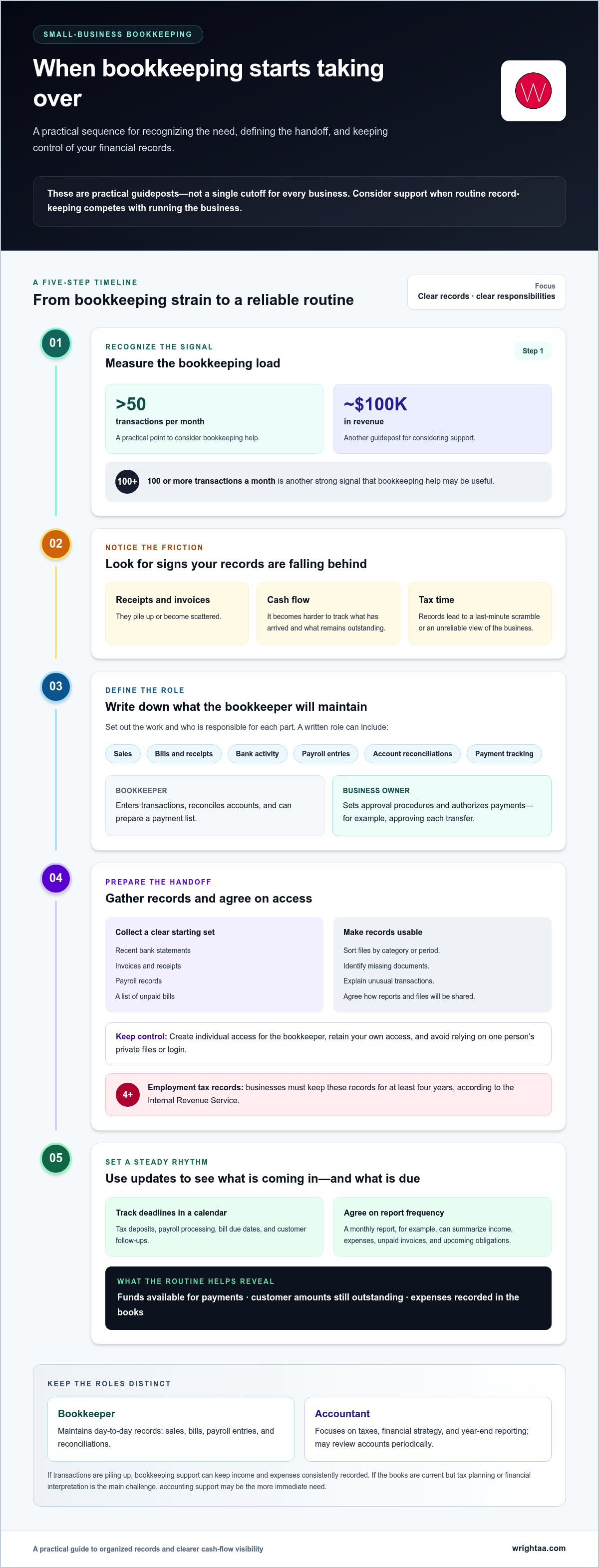
The clearest answer to when to hire your first bookkeeper is when routine record-keeping starts competing with the work of running your business. Consider getting help once you process more than 50 transactions per month or reach about $100K in revenue; 100 or more transactions a month is another strong signal. These are practical guideposts, not a single cutoff for every business.
It makes sense to manage the books yourself at first. But when receipts and invoices pile up, cash flow becomes harder to track, or tax time brings a scramble, your records may no longer give you a reliable view of the business.
This article explains when to hire your first bookkeeper, how to weigh the time you spend on bookkeeping, and how organized records can support tax preparation and cash-flow decisions. You’ll also learn how bookkeeping differs from accounting, so you can identify the kind of support your business needs.
Key Takeaways
- Use transaction volume and revenue as practical signals: consider bookkeeping help once activity exceeds 50 transactions per month or revenue reaches about $100K.
- Separate the roles: bookkeepers maintain financial records, while accountants focus on tax matters, strategy, and year-end reporting.
- Notice when overdue invoices, scattered receipts, or tax-time pressure make it harder to understand cash flow and meet financial deadlines.
- Compare the hours spent maintaining the books with the time available for running the business; recurring bookkeeping work can be handled without a full-time hire.
- Look for relevant industry experience, clear references, and communication that gives you a dependable view of your records.
1. Bookkeepers versus accountants
Bookkeepers and accountants work with the same financial records, but they handle different tasks. Bookkeepers maintain day-to-day records, including sales, bills, payroll entries, and reconciliations. Accountants focus on taxes, financial strategy, and year-end reporting, and may review accounts periodically. For example, a bookkeeper records a client payment; an accountant can use the organized records to assess tax implications and prepare year-end reports.
Knowing the difference helps you decide what to delegate first. If transactions are piling up, bookkeeping support can keep income and expenses consistently recorded. If the books are current but tax planning or financial interpretation is your main challenge, accounting support may be the more immediate need. Some businesses use both: a bookkeeper maintains the daily details, while an accountant interprets them at key points in the year—an approach often highlighted by small business advisory practices like ASAP Solutions.
Tax obligations can make that separation especially useful. In the United States, individuals generally must make estimated tax payments if they expect to owe $1,000 or more in taxes for the year, according to the Internal Revenue Service. A bookkeeper can keep income and expense records organized, while an accountant can help interpret tax information and plan for reporting. Keeping those roles clear reduces the risk of expecting routine data entry to replace tax guidance.
Choosing accounting software is part of setting up an effective bookkeeping process. First, list the records your business needs to maintain, such as sales, expenses, bank activity, and payroll entries. Then compare software based on whether it supports those workflows and produces reports you and your accountant can understand. A growing business may need different functions from one with fewer, simpler transactions.
Compatibility matters as much as features. Before choosing software, identify the bank accounts, payroll processes, and existing records it needs to work with. Check that transactions can be imported or entered consistently, reports shared with an accountant, and records exported in a usable format. If your business runs payroll, confirm that payroll information can be accurately reflected in the books rather than relying on disconnected totals.
Look at the work itself to identify when to hand it off. If daily entries and reconciliations are consuming your time, bookkeeping support may help. If tax questions, reporting, or financial strategy are the pressing concerns, accounting support may be more appropriate. Clear records and compatible software give both professionals a reliable foundation.
2. Cash flow, payment deadlines, and record-keeping
In the United States, tax and payroll recordkeeping depends on the business’s obligations and workers. The Internal Revenue Service requires businesses to keep employment tax records for at least four years. A bookkeeper can organize records and track payment dates, while the business owner remains responsible for setting approval procedures.
To bring in a bookkeeper, define the tasks, consider referrals, and look for experience relevant to your industry. Before sharing records or assigning payment-related tasks, agree on access, responsibilities, and how often you’ll review reports.
Start with a written role that names the records the bookkeeper will maintain, such as sales, bills, receipts, bank activity, payroll entries, and payment tracking. Clarify who enters transactions, reconciles accounts, reviews reports, and authorizes payments. For example, the bookkeeper might prepare a payment list while you approve each transfer. This keeps financial information organized without blurring control over cash.
Accurate, current records make cash flow easier to understand. When customer payments are recorded alongside invoices and business expenses, you can see what has arrived and what remains outstanding. A backlog of receipts can hide costs or distort reports. Record even small purchases in the right place and keep entries up to date so the books reflect actual business activity.
Set a routine for deadlines and updates. A calendar can track tax deposits, payroll processing, bill due dates, and customer follow-ups, while your books show the funds available for each payment. Agree on how often you’ll receive updates. A monthly report, for example, can summarize income, expenses, unpaid invoices, and upcoming obligations, helping you see the financial picture before making spending decisions.
Keep control of your financial records and accounting software. Create individual access for the bookkeeper, retain your own access, and agree on how files and reports will be shared. Avoid relying on one person’s private files or login. Clear records help another authorized person follow the transaction trail, while consistent software entries make reports easier to compare over time.
Before handing over the books, gather recent bank statements, invoices, receipts, payroll records, and a list of unpaid bills. Sort files by category or period, identify missing documents, and explain unusual transactions. This gives the bookkeeper a starting point for reconciling activity and establishing a regular process. Keep employment tax records for at least four years, as required by the Internal Revenue Service.
For businesses that need help coordinating payroll records and payment processes, payroll services can be a relevant next step. A defined role, preserved software access, and regular reports give the business a practical foundation for managing its records.
3. Comparing the time cost of DIY bookkeeping with hiring help
Track your bookkeeping time for several weeks before deciding whether to delegate. Include entering income and expenses, sorting receipts, reconciling bank activity, following up on invoices, and correcting errors. A small business should consider hiring a bookkeeper when bookkeeping takes more than five hours per week. This benchmark can help distinguish occasional administration from a recurring demand on your working week.
Time isn’t the only consideration. Compare the hours you spend on bookkeeping with the work those hours displace, such as serving customers, preparing proposals, or managing staff. If Friday afternoons disappear into matching transactions, note which business tasks remain unfinished. Consider whether your records are current and useful or whether entries regularly wait until tax time. A recurring backlog can consume attention even when you spend fewer hours entering data.
The right arrangement depends on the workload. A freelance or virtual bookkeeper can handle recurring tasks without being in the office full time. Part-time support may suit a business that needs regular reconciliations and reports, while an in-house hire may fit a larger daily workload requiring close coordination. Many small businesses don’t need a full-time bookkeeper. Choose based on transaction volume, payroll needs, reporting frequency, and how much oversight you can provide.
Before hiring, define the work and prepare the financial records. Gather bank statements, receipts, unpaid invoices, and existing accounting files. List which tasks need attention, such as coding expenses, reconciling accounts, or preparing monthly reports. Clear records can help a bookkeeper get up to speed within one to two weeks. Disorganized files may require additional cleanup before regular bookkeeping can begin.
Compare the time and workload before and after delegating. Keep a simple log of hours spent and note whether income and expenses are recorded on schedule. Also include the time needed to explain processes, answer questions, and review reports. Hiring doesn’t remove your role: approvals and business decisions still need your attention. A clear handoff makes it easier to assess the bookkeeper’s work against agreed tasks.
When bookkeeping takes five or more hours a week, or financial records repeatedly fall behind, professional help may free the owner to focus on other work. A part-time or fractional bookkeeper can provide regular bookkeeping and monthly reports without requiring a full-time presence, while outsourced firms like Financial Foothold can handle ongoing accounting operations and payroll administration. Compare the working arrangement with the actual volume and complexity of transactions, rather than assuming that a growing business needs an in-house employee. The right choice is the one that keeps records current while fitting the business’s day-to-day operations.
4. Benefits of professional bookkeeping for taxes and cash flow
Organized books give tax preparation a clearer foundation: transactions are categorized, accounts reconciled, and supporting documents arranged. This helps an accountant trace a reported expense to its receipt or invoice. For example, separating equipment purchases from recurring supplies makes year-end review more orderly. Accurate records don’t guarantee an outcome, but they help professionals assess the information available and identify inconsistencies before they become larger errors.
Consistent entries can also help you understand cash flow between reporting periods. A report comparing customer payments with upcoming bills can show whether available funds cover planned spending. If an invoice remains unpaid, you can distinguish recorded income from cash received. That distinction can inform decisions such as delaying a purchase, following up with a customer, or adjusting when you charge for your work.
Tax planning also depends on knowing what the business has earned and paid. In the United States, corporations generally must make estimated tax payments if they expect to owe $500 or more in tax, according to the Internal Revenue Service. Organized books give an accountant a more usable record of business activity when assessing tax information and preparing reports.
Make bookkeeping useful for tax work with a repeatable review process. Match bank activity to recorded transactions, attach receipts to expenses, and flag entries without clear descriptions. Then compare reports with source documents before sharing them for tax preparation. For example, a fuel charge without a receipt or business purpose may need clarification. A consistent record trail helps your accountant raise questions while the details are still accessible.
Accurate books can show where cash is going, not just whether sales are rising. Compare income by source with expenses by category, then investigate changes that need explanation. If materials costs rise while revenue stays steady, you can review purchasing or pricing decisions. A bookkeeper can keep the underlying entries organized so you and your accountant can focus on interpreting the pattern.
Clean records also make mistakes easier to find and correct. A duplicate payment, an expense entered twice, or a customer payment assigned to the wrong invoice can distort reports. Regular reconciliation can surface these errors sooner than a year-end review. Correcting the original entry supports a more reliable view of cash flow and reduces confusion during tax preparation.
Bookkeeping is most useful when it creates a dependable routine: record activity, reconcile accounts, review reports, and resolve unclear items. You can use that routine to prepare focused questions for your accountant and make decisions using current information. Bookkeeping doesn’t replace tax advice or business judgment. It gives those decisions a clearer financial foundation.
5. What qualifications and experience should a small business look for in a bookkeeper?
Look for experience that matches your business. A bookkeeper familiar with your industry may recognize common transaction types, reporting needs, and documentation patterns. For example, a firm with recurring client invoices needs someone comfortable tracking receivables and matching payments. Ask about similar businesses they’ve supported and the tasks they handled.
References can show how that experience works in practice. Ask about accuracy, communication, and how the bookkeeper handles unclear transactions. Request a specific example, such as resolving a mismatch between a bank statement and recorded expenses. A clear explanation of the process can tell you more than a general claim of attention to detail.
Credentials can be one useful signal, but they don’t replace relevant experience. Examples include Certified Public Bookkeeper, accredited by the National Association of Certified Public Bookkeepers, and Certified Bookkeeper, accredited by The American Institute of Professional Bookkeepers. Consider credentials alongside software experience, familiarity with your records, and the ability to explain the work in plain language.
For a local or virtual arrangement, consider whether the bookkeeper understands the laws and regulations relevant to your business’s location. Ask how they stay informed and handle changes to processes. A local business and a remote bookkeeper can work effectively when responsibilities, document access, and reporting expectations are clear.
Use a practical interview exercise. Present a sample transaction, such as a customer payment that differs from the invoice, and ask how the bookkeeper would investigate it. A capable candidate should describe a traceable approach: compare the invoice, payment record, and bank entry, then document any adjustment. This tests judgment and communication without giving access to sensitive financial information.
Before onboarding, write down the scope of work, reporting format, software access, approval boundaries, and preferred communication method. Specify who enters transactions, who reviews reconciliations, and how unresolved questions are recorded. Provide organized financial files and a named point of contact. Review the first reports together, correct misunderstandings, and refine the workflow before it becomes routine.
Choose someone who can make the records understandable, not simply process entries. If you’re shaping the business’s financial processes as well as hiring support, get guidance on structuring your business.
Wright CPAs: Tax Planning and Preparation
Wright CPAs can help business owners connect organized financial records with tax planning and preparation. When transaction volume grows, tax deadlines approach, or cash-flow reports leave important questions unanswered, coordinated support can bring the records and decisions into clearer alignment.
Bookkeeping maintains the financial details used to prepare tax information and review business activity. Wright CPAs also offers Payroll Services to support payroll processes and CFO Services to help owners use financial information for planning and cash-flow decisions. The right starting point depends on the work your business needs handled now.
If your books are falling behind or tax preparation feels disconnected from your day-to-day records, contact Wright CPAs to discuss your next step.
Build a steadier financial foundation
Deciding when to hire your first bookkeeper can change how you lead your business. Instead of leaving financial records for later, make bookkeeping part of a deliberate operating rhythm. Clear responsibility for the books gives you more room to focus on customers, staff, and the decisions shaping what comes next.
As your needs change, the right support may change too. Wright CPAs offers Bookkeeping alongside Tax Planning and Preparation and Payroll Services, connecting routine records with tax and payroll work. Start by identifying the bookkeeping tasks that need attention and the financial questions you want your records to answer.
Take the next step at a pace that suits your business. Contact Wright CPAs to discuss bookkeeping and consider what a more consistent financial process could make possible. A sound foundation starts with one clear decision.
Frequently Asked Questions
When should I hire a bookkeeper?
A practical answer to when to hire your first bookkeeper is when regular bookkeeping starts displacing work only you can do. Spending more than five hours per week on the books is a useful signal. Also consider whether you postpone decisions because you can’t get a current view of income and expenses. A short work log can show whether the pressure is occasional or part of your regular business routine.
What do bookkeepers typically charge?
Bookkeeping charges depend on the work involved, including transaction volume, payroll complexity, reporting needs, and whether records need cleanup. Ask for the scope to distinguish routine ongoing work from a one-time project. For a specific engagement, pricing depends on the case and is provided after a quote request; the factors include the condition of the records and the tasks required. Define the expected deliverables before comparing proposals.
What signs indicate a small business should hire its first bookkeeper?
Look for recurring operational problems: invoices remain unrecorded, receipts are difficult to match, or reports need repeated corrections. You may also postpone a hiring or purchasing decision because the figures feel incomplete, or find staff entering the same transaction in different places. These patterns suggest the process needs a clear owner, even before bookkeeping errors affect a tax filing.
How much revenue or transaction volume justifies hiring a bookkeeper?
Consider professional help when a business processes more than 50 transactions per month or reaches about $100K in revenue. A volume of 100 or more transactions a month is another practical signal. Treat these as guideposts, not automatic rules: recurring payroll, inventory, or multiple accounts can make records harder to manage at lower volumes. Compare the workload and complexity with the owner’s available time.
How much does a bookkeeper cost per month in the United States?
Monthly bookkeeping costs vary with transaction volume, payroll requirements, reporting detail, and the condition of existing records. A business with clean, straightforward books needs a different scope from one with missing documents or complex activity. For a specific engagement, pricing depends on the case and is provided after a quote request; the scope should spell out ongoing tasks, reporting, and any cleanup work.
Should a small business hire an in-house, part-time, freelance, or virtual bookkeeper?
Choose an arrangement that matches how often the work needs to be done and how closely it requires coordination. Part-time or freelance support can suit recurring tasks without a full-time role; virtual support can work when records and communication are managed digitally. An in-house hire may fit work requiring close daily coordination. For businesses in Buffalo, Rochester, or Syracuse, location can also shape how you prefer to work together.
What tasks should a first bookkeeper handle?
Set a clear starting scope: record income and expenses, organize receipts, reconcile accounts, track unpaid invoices, and prepare agreed reports. If payroll is included, clarify who prepares entries and who approves payments. For example, the bookkeeper can flag an unmatched bank transaction for your review rather than making an unsupported adjustment. Keep payment approvals and access responsibilities explicit.
How does a bookkeeper differ from an accountant or CPA?
A bookkeeper maintains day-to-day financial records; an accountant can use those records for tax work, strategy, and year-end reporting. The titles describe different tasks, so identify what you need done before arranging support. Transaction entry and reconciliations point toward bookkeeping, while interpreting financial results or planning tax reporting calls for accounting expertise. A CPA may also be an accountant, but the roles aren’t interchangeable.


