

What if a restaurant’s most valuable tax decisions were made well before filing season? For owners searching for tax strategies for restaurateurs Syracuse businesses can use, a practical starting point is dependable, organized records. Restaurant income and expenses can be challenging to categorize consistently, especially when payroll, sales channels, and business plans change.
Daily operations leave little time to untangle financial records. A steady bookkeeping and review process can make the numbers easier to understand and help keep tax questions in view throughout the year.
This 2026 checklist covers how to organize restaurant records, review income and expense categories, and prepare questions for planning discussions. It also explains how estimated-tax planning, cash-flow visibility, and periodic financial reviews can support business decisions. Use it to build a clearer picture of your Syracuse restaurant and prepare focused questions. The same recordkeeping principles apply to restaurant owners in Buffalo and Rochester.
Key Takeaways
- Make tax planning an ongoing business practice, not just a filing-season task.
- Compare point-of-sale summaries, bookkeeping records, and bank activity to understand restaurant performance.
- Document expenses and review tax decisions before filing when considering tax strategies for restaurateurs Syracuse businesses can use.
- Use a regular sequence of recordkeeping, financial review, and cash-flow planning to keep decisions in view throughout the year.
- Wright CPAs, LLC tax planning, bookkeeping, and customized financial reporting can support tax-ready records and more focused planning conversations.
Tax strategies for Syracuse restaurateurs: begin with a clear tax picture
Restaurant work moves quickly: staff schedules change, suppliers deliver, and sales come through multiple channels. Organized financial information helps owners see what the business earned and spent, and what it may need to plan for. Useful tax strategies for restaurateurs Syracuse businesses can consider start before return preparation, with reliable records and decisions reviewed throughout the year.
Tax strategy brings planning and recordkeeping together to inform business decisions before a return is prepared. It is different from filing. Income-tax planning, sales-tax tracking, and payroll-tax records have distinct purposes, so keep them separate while making sure they connect to the restaurant’s overall financial picture. Applicable rules can depend on the business and transaction, so review current guidance for the specific situation.
Which restaurant records create a useful tax starting point?
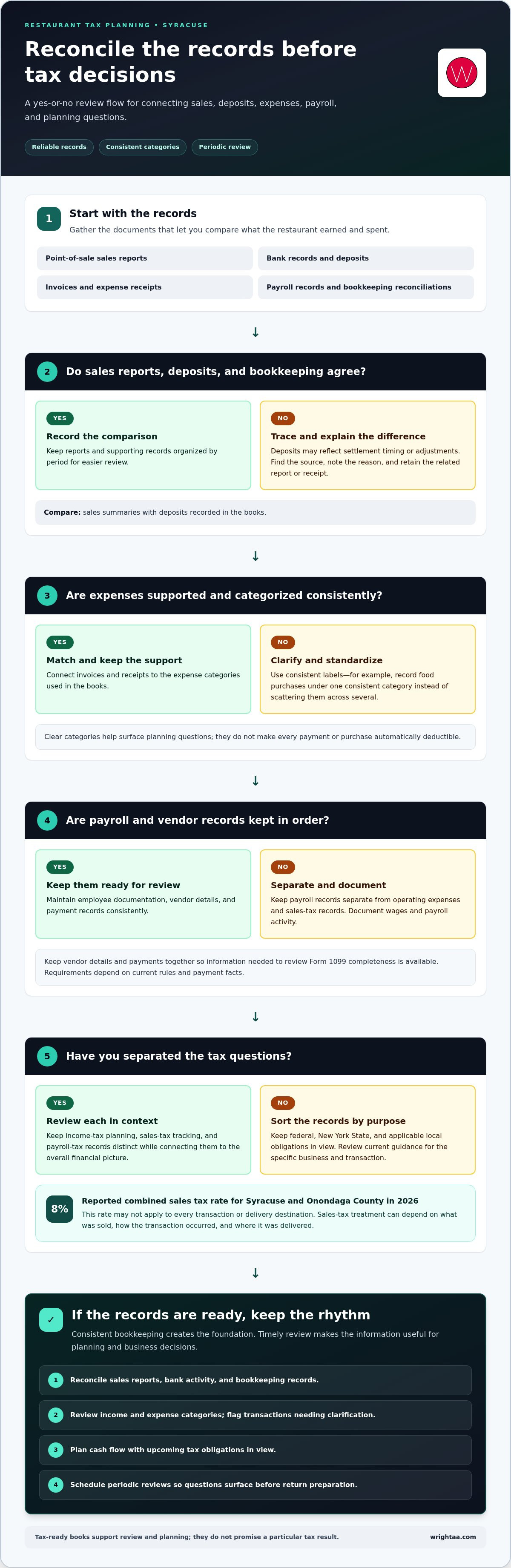
Gather sales reports, bank records, expense documentation, payroll records, and bookkeeping reconciliations. Use consistent categories so you can compare like with like. For example, record food purchases under a consistent category instead of scattering them across several labels. Compare point-of-sale summaries with bank activity and bookkeeping records rather than assuming the totals match.
Tax-ready books are organized, reconciled records that make a business’s financial activity easier to review and use in tax planning. They provide a working foundation, not a promise about tax treatment or a particular result.
Which Syracuse and New York tax details need attention?
Keep federal, New York State, and applicable local obligations in view. Sales-tax treatment can depend on what was sold, how the transaction occurred, and where it was delivered. Review current rules for the specific situation. The Sales taxes in the United States overview explains the broader state and local framework. For 2026, the combined sales tax rate reported for Syracuse and Onondaga County is 8%, but that rate may not apply to every transaction or delivery destination.
Keep payroll records organized separately from operating expenses and sales-tax records. Document wages and payroll activity so they can be reviewed in context. Clear categories help surface planning questions, but they do not make every payment or purchase automatically deductible.
Use this sequence to establish a practical rhythm:
- Reconcile sales reports, bank activity, and bookkeeping records.
- Review income and expense categories, and flag transactions that need clarification.
- Plan cash flow with upcoming tax obligations in view.
- Schedule periodic reviews so questions surface before return preparation.
Consistent bookkeeping creates the foundation; timely review makes the information useful. For restaurateurs, tax strategies for restaurateurs Syracuse owners consider are easier to evaluate when the records support thoughtful decisions and focused planning conversations.
Build a New York restaurant tax strategy on dependable books
Once you have gathered the records, compare them to see whether they agree. Reconciled books help you review revenue, expenses, and operating patterns, then bring specific questions to tax-planning discussions. For tax strategies for restaurateurs Syracuse owners are considering, dependable books provide a factual basis for decisions instead of relying on estimates or memory.
Point-of-sale summaries, bookkeeping records, and bank activity serve different purposes. A sales report may show what was rung up, while deposits can reflect settlement timing or adjustments. Compare the figures, record the reason for any difference, and keep the supporting detail together for review.
Reconcile sales, deposits, and restaurant expenses
Set a recurring time to compare point-of-sale reports with deposits, invoices, and categorized expenses. When figures differ, trace the amount to its source, note the explanation, and retain the related report or receipt. This gives restaurant owners and their accounting team a clearer record to review. The principles behind small business accounting in Buffalo, NY offer related context on building financial clarity through consistent records.
- Compare sales summaries with deposits recorded in the books.
- Match invoices and receipts to consistently used expense categories.
- Document unexplained differences and track them until they’re resolved.
- Organize reports and supporting records by period for easier review.
Clean records make financial decisions clearer. They help owners understand what the numbers show, identify open questions, and prepare focused conversations about the business.
Keep payroll and vendor records ready for review
Maintain payroll records and employee documentation in a consistent, organized way. Keep vendor details and payment records together so the information needed to prepare and file Form 1099s can be reviewed for completeness. Requirements depend on current rules and the facts of each payment, so use up-to-date official guidance rather than relying on an old checklist.
Tips and service charges need careful handling. Their treatment can depend on the facts and current tax rules, so document how the amounts are recorded and handled, then review the applicable treatment before making tax decisions. The IRS’s Publication 334, Tax Guide for Small Business provides a useful reference for business income, expenses, and recordkeeping.
Wright CPAs provides bookkeeping and tax-planning support to help businesses maintain tax-ready records and use financial information in planning conversations.
Evaluate Syracuse restaurant deductions and tax decisions carefully
A recorded expense is a starting point for review, not proof that it qualifies for a deduction. The business purpose, supporting documents, and rules that apply to the restaurant’s circumstances all matter. Document the transaction, identify the question, and review its treatment before relying on it in a return or business decision.
When considering tax strategies for restaurateurs Syracuse owners can use, distinguish routine operating costs from larger purchases and decisions about business structure or compensation. Each may raise different planning questions, and the right review depends on the business’s facts and applicable rules.
Review restaurant expenses and possible deductions
Supplies, rent, repairs, and professional services are examples of categories to organize and review, not automatic deductions. Keep invoices, receipts, and contracts, along with a clear note of the business purpose where useful. If it is unclear whether work counts as a repair or an improvement, record the details rather than relying only on the vendor’s description. Consistent documentation gives a tax-planning review a stronger foundation.
Use this decision framework to prepare questions for review:
Question: What expense or decision needs review?
Supporting records: Which invoice, agreement, payroll record, or other document explains it?
Planning consideration: How does it relate to restaurant operations, cash flow, or business plans?
Item to verify: Which current tax rule or fact-specific treatment needs confirmation?
Question: Is this a recurring operating expense or a longer-term purchase?
Supporting records: Keep the purchase details, date, business purpose, and related documents.
Planning consideration: Consider the restaurant’s operational need and timing alongside its financial picture.
Item to verify: Review the applicable tax treatment before recording or reporting it.
Question: Could a change in entity, owner compensation, or timing affect planning?
Supporting records: Gather current business and financial information relevant to the decision.
Planning consideration: Assess the choice in light of the restaurant’s circumstances, not in isolation.
Item to verify: Review current rules and implications for the specific business.
Plan for equipment purchases and business structure decisions
Start equipment planning with what the restaurant needs, when it needs it, and how the purchase fits cash flow. Separately review whether the cost is depreciated or receives another tax treatment. Don’t make a purchase solely to pursue a possible tax benefit. First assess the operational need, then review the tax treatment in light of the business’s circumstances.
Entity structure, owner compensation, and timing choices also depend on circumstances that can change. A decision that fits one restaurant may not fit another. Broader strategic business tax planning in Buffalo, NY offers related context for considering tax decisions as part of a wider business plan.
Bring records and open questions into a tax-planning review before making significant choices. This helps distinguish what the business needs from what requires tax analysis, without assuming a particular deduction or outcome.
Use this year-round tax planning checklist for Syracuse restaurants
A useful tax-planning rhythm follows the restaurant’s financial activity instead of waiting until filing time to gather the books. Keep transactions current through routine bookkeeping, then set aside time to review the results and consider decisions. For tax strategies for restaurateurs Syracuse owners can put into practice, a steady sequence makes financial questions easier to address before they become urgent.
- Keep the books current. Record income and expenses, process payroll information, and review cash activity as part of routine bookkeeping.
- Review business results. Compare current reports with prior periods and note meaningful changes in sales patterns, staffing, costs, or plans.
- Plan cash flow. Consider estimated-tax payments alongside operating needs and upcoming commitments. Requirements and timing depend on the business, so review current guidance to determine what applies.
- Revisit decisions. Bring questions about purchases, payroll, and tax estimates to periodic planning reviews, especially when circumstances change.
Prepare for a mid-year tax and financial review
Gather current bookkeeping and payroll information, along with income, expense, and cash-flow reports. Note changes such as shifts in sales channels, staffing, planned purchases, or business priorities. Customized financial reporting can bring these details into a clearer view, helping owners connect restaurant performance to planning questions instead of reviewing isolated figures.
Restaurant performance measures can help structure the review. Consider which indicators are useful to your operation and how they relate to decisions about staffing, purchasing, or cash reserves. This guide to financial KPIs for small business offers related context for choosing measures that support financial visibility.
Close the year with organized records and open questions
Before return preparation, reconcile balance-sheet accounts and gather supporting documents with the financial records. Write down unresolved questions about expenses, equipment, payroll, or tax estimates. A concise list keeps the review focused on items that need attention rather than leaving uncertainties buried in paperwork.
Year-round tax planning uses current financial information to guide decisions; a filing-only approach looks back after the year’s activity is complete. This distinction matters when estimated taxes are part of cash-flow planning. Review the business’s circumstances and applicable requirements and timing instead of assuming one schedule fits every owner or entity.
Wright CPAs, LLC provides bookkeeping, customized financial reporting, cash-flow management, and tax planning to support ongoing review. Explore tax planning and bookkeeping support to connect organized records with informed business decisions.
How Wright CPAs, LLC supports restaurateurs planning taxes in Syracuse
A checklist is most useful when records lead to thoughtful decisions. Wright CPAs, LLC brings proactive tax strategy, comprehensive tax planning, and tax preparation together with bookkeeping, customized financial reporting, and cash-flow management. For owners considering tax strategies for restaurateurs Syracuse businesses can use, these services connect day-to-day financial information with planning conversations throughout the year.
Tax-ready books provide a foundation for review. With income and expense information organized, owners can discuss how business activity, upcoming needs, and changing circumstances may shape planning. Wright CPAs, LLC supports income and deduction planning, estimated-tax planning, and mid-year or year-end reviews. The goal is clarity and informed decision-making, not a guaranteed tax result.
What an ongoing planning relationship can address
Clean books and periodic review give owners a useful starting point for questions about restaurant operations. Customized financial reporting can show how performance is developing, while cash-flow management brings upcoming commitments into view. Changes in staffing, planned equipment purchases, or sales patterns may warrant review in context. Ongoing oversight keeps those questions connected to the business’s broader financial picture.
Reviews can also help owners revisit income, expenses, and estimated-tax planning as circumstances evolve. The relevant considerations depend on the restaurant’s records and business facts. A planning conversation can clarify what information is available, what needs further review, and which decisions deserve attention before the next filing period.
Take the next step with a clear financial picture
Before a planning conversation, gather current bookkeeping reports, payroll records, cash-flow information, and questions that have come up during the year. Note an expense category that needs review, an upcoming purchase, or uncertainty about estimated taxes. A concise set of records and questions helps focus the discussion on your restaurant’s circumstances.
Wright CPAs, LLC provides tax planning and preparation alongside bookkeeping and financial reporting, helping owners take a deliberate approach to their finances. The process starts with the business’s current financial picture and the decisions ahead, then brings relevant tax questions into view.
- Prepare current books and supporting financial records.
- Gather payroll information and note open documentation questions.
- List upcoming business decisions that may affect cash flow or tax planning.
- Bring unresolved tax questions forward for review.
With organized information in hand, you can begin a planning relationship grounded in your restaurant’s needs. Explore Wright CPAs, LLC tax and accounting services and take a considered next step toward financial decisions that support your restaurant’s direction.
Give your restaurant’s next decisions a clearer foundation
Make financial clarity part of how you guide the business, not a task reserved for tax time. For owners weighing tax strategies for restaurateurs Syracuse restaurants can pursue, a planning relationship can turn questions about income, deductions, and estimated taxes into focused conversations grounded in current records and business priorities.
Wright CPAs, LLC brings proactive tax strategy and comprehensive tax planning together with tax-ready books and customized financial reporting. Cash-flow visibility and ongoing review can help you consider upcoming decisions in the context of the business, while tax preparation carries organized information into filing. No strategy can guarantee a particular tax result, but informed planning gives you a more deliberate way to assess choices as circumstances change.
Bring your current financial picture and the questions you want to resolve into the conversation. Explore tax planning and accounting support from Wright CPAs, LLC to take a considered next step toward financial decisions that support your restaurant’s direction.
Frequently Asked Questions
Is sales tax charged on restaurant meals in Syracuse?
Yes, restaurant meals sold in Syracuse are generally subject to sales tax, but the correct treatment depends on transaction details and current New York rules. The 2026 combined Syracuse and Onondaga County rate is 8%; deliveries to another jurisdiction may require a different rate based on destination. Keep dine-in, takeout, delivery, refunds, and tax collected distinguishable in reports. This is a useful tax strategies for restaurateurs Syracuse review point.
Are service charges treated the same as tips for restaurant payroll taxes?
No. Don’t assume service charges and tips receive the same payroll-tax treatment. The label alone may not tell the full story; how a charge is imposed, collected, and distributed can matter. Keep each type of payment identifiable in point-of-sale and payroll records, including amounts passed to employees. Review current federal and New York guidance in light of the specific arrangement before processing or reporting them.
Can a restaurant deduct meals its owner eats at the business?
Not automatically. An owner eating food from the restaurant for personal use shouldn’t simply record it as an ordinary business meal expense. Keep personal consumption separate from customer sales and operating costs, and document the circumstances if a meal has a genuine business purpose. The tax treatment depends on the facts and current rules, so have the entry reviewed before treating it as a deductible expense.
Can a restaurant deduct donated food?
A food donation doesn’t automatically qualify for a tax deduction. Keep a record of what was donated, when it left the restaurant, its documented value or cost, and the receiving organization. Separate donated inventory from food used in normal operations. Deduction eligibility and valuation depend on current tax rules and the business’s circumstances, so review the supporting records before including a donation in tax calculations.
Does a restaurant file its own business tax return separately from the owner’s return?
It depends on the restaurant’s legal and tax structure. A sole proprietorship generally reports business income through the owner’s individual return, while partnerships and corporations may have separate business return requirements. The entity name alone doesn’t answer every filing question, especially if elections or ownership changes are involved. Review the restaurant’s current structure and filing obligations with a tax professional, and keep business and personal records distinct.
What should a restaurant owner do if sales tax records do not match point-of-sale reports?
Investigate the difference and preserve the records instead of adjusting figures just to make them agree. Compare transaction totals, tax collected, refunds, discounts, and delivery locations, then trace the variance to the relevant reports or entries. Record what explains the difference and what remains unresolved. If the mismatch could affect a filing or payment, have the facts reviewed before submitting corrected information or taking further action.


