

What if the best CPA relationship is shaped less by tax season than by the rhythm of your projects? A creative agency may collect retainers, complete project work in stages, and wait for client payments while payroll and other expenses keep moving. A search for “CPA for creative agencies Buffalo” is often really a search for financial support that makes those patterns easier to understand.
It’s reasonable to want more than an annual filing. The right support should suit your agency’s stage and operating model while making tax obligations and day-to-day financial decisions clearer. This guide explains how to evaluate a CPA relationship around revenue patterns, tax planning, bookkeeping, and year-round financial visibility.
You’ll learn how ongoing services can clarify cash flow, how CFO guidance can support informed decisions, and what to prepare when exploring your needs in Buffalo. Wright CPAs is based in Buffalo and provides tax planning and preparation, bookkeeping, payroll, cash flow management, and CFO services. The aim is a steadier view of the business behind the creative work.
Key Takeaways
- Map how project milestones, retainers, and payment timing affect cash flow before assessing your agency’s financial needs.
- Pair consistent bookkeeping and reporting with tax planning to build a clearer financial picture throughout the year.
- When comparing a CPA for creative agencies Buffalo, consider whether the relationship includes ongoing guidance or focuses mainly on annual filing.
- Prepare a concise overview of your services, revenue patterns, payroll, and reporting challenges to make an introductory discussion more useful.
- Wright CPAs is a Buffalo-based firm offering tax, bookkeeping, payroll, cash flow management, and CFO services to support financial decision-making.
Why a creative agency in Buffalo may need more than annual tax filing
An agency owner has two kinds of work to keep in view: the creative work clients see and the financial structure that allows the business to deliver it. Project schedules, client approvals, staffing, and expenses all move on different timelines. When financial records are updated only for tax filing, it can be harder to see how those moving parts affect the agency during the year.
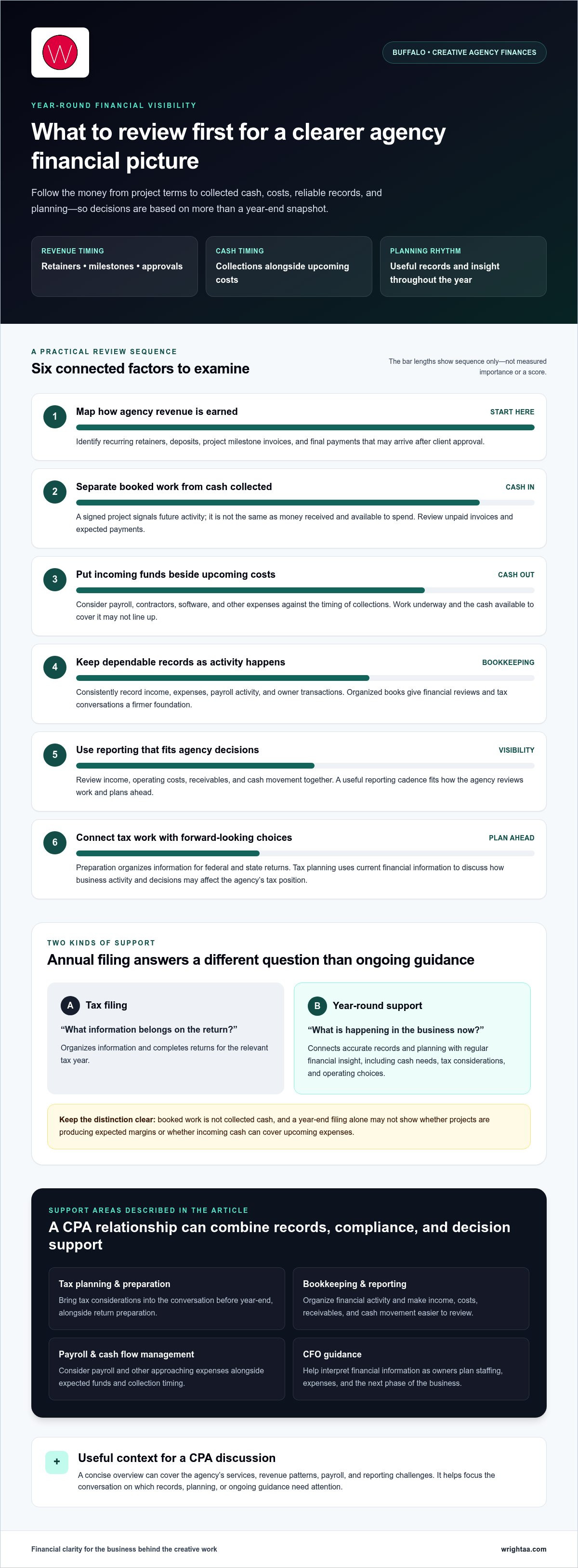
Tax filing answers an important question: what information belongs on the return? It doesn’t necessarily show whether current projects are producing the expected margin, whether incoming cash can cover upcoming expenses, or how a business decision may affect taxes. Those questions call for usable financial records and planning alongside compliance. Understanding the principles of accounting helps explain why consistent records matter: decisions are only as clear as the information behind them.
Year-round CPA support connects accurate records and tax planning with regular financial insight, so owners can make decisions using more than a year-end snapshot. For an agency considering a CPA for creative agencies Buffalo, the distinction is between completing a filing and building a clearer view of the business as it operates.
Where agency revenue patterns create financial uncertainty
Revenue can arrive in stages. An agency might invoice a deposit, bill at project milestones, and collect the final amount after client approval. Another may rely more heavily on recurring retainers. If invoices remain outstanding or a project shifts, the timing of available cash for payroll, contractors, software, and other costs may not match the schedule of work underway.
Booked work and collected cash are different planning signals. A signed project can indicate future activity, but it isn’t the same as money received and available to spend. Reviewing receivables alongside expenses and expected payments helps owners spot timing gaps. It also provides a more grounded basis for decisions such as when to schedule discretionary spending.
What a Buffalo agency owner wants from a CPA relationship
Useful support starts with dependable bookkeeping, understandable reporting, and tax planning connected to the records. Together, these elements can help an owner see what has been earned, what remains unpaid, and which obligations or choices may need attention. Reporting is most useful when it arrives at a cadence that fits how the agency reviews its work and plans ahead.
Wright CPAs is based in Buffalo and serves clients locally and throughout the United States, including businesses in Rochester and Syracuse. A local relationship can make it easier to connect financial discussions to the realities of running a business in Western and Central New York. The practical question is whether the support makes the agency’s records and decisions easier to understand.
That clarity can change the quality of routine conversations. Rather than waiting until tax documents are due to assemble a picture of the year, an owner can use organized records to discuss cash needs, tax planning, and operating choices while there is still time to plan. The right rhythm depends on the agency’s work, but the aim is steady visibility, not paperwork for its own sake.
Which CPA services can support a creative agency beyond tax returns?
A useful CPA relationship brings together three connected functions: compliance, dependable financial records, and decision support. Tax preparation addresses reporting obligations, while bookkeeping organizes the activity behind those reports. Decision support helps owners interpret the numbers as they plan staffing, expenses, and the next phase of the business. The right scope depends on the agency’s structure and needs, since not every agency requires every service.
For a closer look at how records and reporting fit together, Wright CPAs explains the role of small business accounting in Buffalo. For an agency, the central question is practical: which parts of the financial picture need regular attention, and which need specialized support at particular points in the year?
Tax planning and preparation across the business year
Tax preparation focuses on organizing information and completing federal and state returns for the relevant tax year. Tax planning is forward-looking. It uses current financial information to discuss how the agency’s business activity and decisions may affect its tax position. Planning doesn’t guarantee a particular result, but it can bring tax considerations into the conversation before year-end rather than leaving them as an afterthought.
Organized books give those conversations a firmer foundation. When income, expenses, payroll activity, and owner transactions are recorded consistently, it’s easier to review the agency’s financial position and identify questions that merit attention. That makes ongoing bookkeeping relevant to tax work, rather than a separate task performed only to prepare a return. Agencies can explore how strategic business tax planning in Buffalo fits into a broader approach to financial decisions.
Bookkeeping, payroll, cash flow, and CFO guidance
Bookkeeping records financial activity; reporting turns those records into a view of the business. Depending on the agency’s needs, useful reports can help owners review income, operating costs, receivables, and cash movement together. Cash flow management focuses on timing: what funds are expected, what expenses are approaching, and where a gap may need attention. It complements bookkeeping but serves a different purpose.
Payroll support is relevant when an agency has employees and payroll responsibilities. It can sit alongside bookkeeping and tax planning while remaining distinct from both. CFO services, in turn, offer a higher-level perspective on financial decisions. An agency might use that guidance to consider hiring, capacity, spending, or growth plans using its financial information, rather than treating CFO support as routine transaction entry.
A CPA for creative agencies Buffalo can be evaluated by how clearly the firm connects financial services to the agency’s operating model. Wright CPAs provides tax planning and preparation, bookkeeping, payroll, cash flow management, and CFO services. An agency considering a more connected financial approach can learn about Wright CPAs’ accounting and advisory support and consider which services align with its current priorities.
How to compare CPA approaches for a creative agency
A CPA relationship should fit the decisions an agency needs to make, not just the documents it needs to file. Some owners need help with a defined tax return or a specific consulting question. Others want regular bookkeeping, reporting, and planning throughout the year. Neither approach is automatically better. The useful comparison is whether the scope matches the agency’s workload, priorities, and desired level of financial visibility.
A CPA can provide useful business insight when the work is connected to the agency’s actual records and questions. Look for a clear explanation of what information you’ll receive, how often you’ll review it, and how financial questions fit into the engagement. A report that arrives without context may be less useful than a focused conversation about what the numbers mean for upcoming decisions.
One-time tax preparation or a monthly accounting relationship?
Project-based tax work is designed around a defined need, such as preparing a return or addressing a particular tax question. A monthly relationship may include recurring bookkeeping and financial reporting, with proactive tax strategy as part of ongoing financial discussions. The scope matters more than the label: understand what work is included, what remains your responsibility, and how additional needs are handled.
A predictable monthly scope can suit an agency that wants regular records and planning. If the business mainly needs a return prepared, a defined engagement may be a better fit. Compare the support you expect to use with the work included, rather than assuming a broader arrangement is necessary.
| Project-based tax work | Ongoing accounting and advisory | |
|---|---|---|
| Primary focus | A defined filing or tax question | Recurring records, reporting, and planning |
| Financial visibility | Often centered on information needed for the project | Can provide a regular view of financial activity |
| Best evaluated by | Clarity of deliverables and responsibilities | Fit between cadence, reporting, and agency priorities |
Signs the service scope fits the agency’s current needs
Start with the work you need handled. If tax planning is a priority, consider whether it connects to organized bookkeeping and timely reporting. If payroll is part of the agency’s operations, include that need in the scope. Then consider whether the reporting cadence is frequent enough to inform decisions without creating a process the team won’t use.
As the agency grows, questions may shift from recording past activity to assessing future capacity. For example, owners may want to weigh a hiring plan against expected revenue and operating costs. That’s where CFO guidance may become relevant, distinct from routine bookkeeping. Wright CPAs provides CFO services in Buffalo for businesses seeking strategic financial guidance.
Before choosing a CPA for creative agencies Buffalo, outline the decisions you want the financial relationship to support, the reports you need, and who will provide or organize the underlying records. Wright CPAs is a Buffalo-based tax, accounting, and consulting firm serving clients locally and throughout the United States, including Rochester and Syracuse. Explore Wright CPAs’ website to learn about its accounting and advisory services.
A practical checklist for preparing to work with a Buffalo CPA
A focused first conversation begins with a clear picture of the agency, not a polished presentation. Before meeting with a CPA, gather the information you have, note what remains unclear, and decide which business questions you want financial support to answer. You don’t need to resolve every bookkeeping issue first. A concise, candid overview gives the conversation a useful starting point.
Gather the agency’s financial picture
Collect current bookkeeping records, recent tax returns, and any financial reports already prepared. The goal is to show how the business is tracked today, not to create a perfect file. Include a short description of the agency’s services and its revenue mix, such as project work, retainers, or another arrangement. Describe payment timing in general terms; confidential client names and contract details aren’t needed.
Use this sequence to organize the discussion:
- Summarize the work. Describe the services the agency provides and how revenue is generally earned and collected.
- Identify operational details. Note whether the business has employees, payroll responsibilities, contractors, or other recurring financial processes that affect its records.
- List open questions. Write down concerns about cash flow, payroll, tax planning, or financial reports that are difficult to interpret.
Organized records make CPA collaboration more useful because they give financial questions a shared, reliable starting point. Even if records need attention, bringing what’s available can help reveal where processes or reporting need clarification.
Define the working relationship and desired outcomes
Next, decide what information would help you run the agency with more confidence. Do you want to understand cash movement more regularly, prepare for tax conversations earlier, or see whether current reports answer the questions you face? Name the decisions behind those questions, such as planning a hire, reviewing expenses, or setting priorities for an upcoming period. This helps distinguish an immediate filing need from longer-term planning or advisory support.
Consider how often decision-makers would use financial reports and which details matter most to them. Some owners may want a concise view of income, expenses, and cash; others may need reporting that helps them evaluate project activity or upcoming obligations. Be prepared to discuss who maintains the books, who gathers records, and what support the agency expects from its CPA. Clear responsibilities help keep the relationship workable.
For a CPA for creative agencies Buffalo, fit depends on the agency’s actual needs, not on a generic checklist of services. Bring your notes, records, and priorities into the conversation, then discuss how tax planning, bookkeeping, payroll, cash flow management, or CFO guidance can support them. To discuss your agency’s accounting needs, share the questions you’ve identified and the financial clarity you’re seeking.
How Wright CPAs can support a creative agency in Buffalo
Wright CPAs, LLC is a Buffalo-based, full-service tax, accounting, and consulting firm. Founded in 2012, it serves clients locally and throughout the United States, including businesses in Rochester and Syracuse. For an agency seeking a CPA for creative agencies Buffalo, the value of a relationship depends on how financial support fits the business’s real operations and priorities.
An agency’s needs can change as its work and team evolve. A focused need may be tax preparation and planning. Ongoing bookkeeping helps keep financial records organized, while payroll services support agencies with payroll responsibilities. Cash flow management helps owners examine the timing of funds and obligations. CFO guidance offers a broader perspective for weighing financial decisions. These services can be used separately or as parts of a wider accounting relationship, based on the agency’s circumstances.
Build financial clarity around the agency’s actual needs
The starting point is the question the owner needs answered. If the main concern is tax readiness, organized bookkeeping and tax planning can work in tandem. If cash timing is difficult to interpret, cash flow management can support the review of regular records. If decisions involve future capacity or spending, CFO guidance can add a strategic lens to the financial picture.
These functions have distinct roles. Bookkeeping records activity; tax planning considers how business decisions relate to tax obligations; payroll supports the agency’s payroll processes; and cash flow management focuses on the movement and timing of funds. CFO services can help owners use financial information to think through broader decisions. Wright CPAs provides these services to help agencies match financial support to their current needs, without assuming every business requires the same scope.
Take the next step with a Buffalo CPA
A productive conversation can begin with a concise summary: what the agency does, how it earns revenue, whether payroll is part of its operations, and what feels unclear in its current financial picture. Then identify whether the immediate priority is tax preparation, ongoing accounting, or advisory guidance. This gives the discussion a clear shape and helps distinguish an immediate task from longer-term support.
As a Buffalo-based firm serving clients locally and throughout the United States, Wright CPAs provides a local point of connection and works with businesses beyond the region. The aim is to understand the agency’s financial questions and provide a suitable scope of tax, accounting, and consulting support. Talk with Wright CPAs about your agency’s financial needs.
Give your next financial decision a clearer foundation
The next useful step doesn’t have to be a complete financial overhaul. Choose one decision you expect to face soon, such as adjusting capacity, planning a hire, or setting a spending priority. Then consider what information would make that decision easier to approach. This gives your CPA conversation a practical starting point and connects financial support to the agency’s day-to-day direction.
A strong CPA for creative agencies Buffalo relationship should make the numbers more meaningful to the people making decisions. You bring the context of your work, goals, and questions. The CPA relationship can then be shaped around the information and guidance that help you move forward with greater clarity.
Wright CPAs provides support ranging from tax preparation to ongoing accounting and advisory services. Start a conversation about your agency’s financial priorities and take the next step toward a steadier view of the business behind the creative work.
Frequently Asked Questions
Does a creative agency need a CPA or a bookkeeper?
An agency may need a bookkeeper, a CPA, or both, depending on its responsibilities and goals. A bookkeeper maintains records, while a CPA can support tax preparation and planning and may provide broader accounting or advisory guidance. For example, an owner who can’t tell whether reported income includes unpaid invoices may need bookkeeping clarity before a CPA can advise on planning. The CPA for creative agencies Buffalo relationship should match the agency’s needs, rather than replacing one role with another by default.
Can a CPA help a creative agency plan for uneven project income?
Yes. A CPA can help an agency use its financial information to plan around the timing of project income and expenses. For instance, an owner could review expected client payments alongside recurring costs before deciding when to commit to a new expense. The usefulness of that discussion depends on current records and the agency’s circumstances. Planning can support informed decisions, but it can’t ensure clients pay on time or guarantee revenue or tax outcomes.
Should a creative agency choose monthly accounting or annual tax preparation?
Choose based on how much financial support the agency needs between tax filings. Annual preparation may fit an owner seeking help with defined federal and state returns. A monthly accounting and advisory retainer can combine ongoing bookkeeping, financial reporting, and proactive tax strategy. Consider whether the agency needs a regular view of its finances, which recordkeeping tasks it can handle internally, and whether tax questions tend to arise throughout the year rather than only at filing time.
Can a Buffalo CPA work with a creative agency outside Buffalo?
Yes. Wright CPAs is based in Buffalo and supports clients locally and throughout the United States, including businesses in Rochester and Syracuse. A business doesn’t need to be in Buffalo to work with the firm on its accounting needs. Before an initial conversation, an out-of-area agency can outline its current records, the decisions it wants to support, and the kind of tax or accounting guidance it’s seeking.
When should a creative agency bring a CPA into its financial planning?
Bring a CPA into the discussion when a financial question could benefit from timely planning, rather than waiting until filing work is underway. A change in revenue mix, an upcoming hire, or a new business structure can prompt questions about records, tax planning, or reporting. The right moment depends on the decision and the agency’s circumstances. Sharing the question early gives the conversation room to consider relevant financial information.
Can a CPA help a creative agency understand cash flow?
Yes. A CPA can support cash flow management by helping an agency use its records to examine expected receipts and planned outflows. For example, comparing a client’s anticipated payment date with upcoming payroll or software expenses can help an owner assess timing before making another commitment. The review can inform planning, but it can’t control when a client pays or remove the possibility of cash pressure. Clear records make the discussion more grounded.
What should a creative agency prepare before meeting with a CPA?
Bring recent tax returns, available bookkeeping records, and financial reports, even if some items are incomplete. Add a short description of how the agency earns revenue, whether it has payroll responsibilities, and which financial decisions feel difficult to make with current information. For example, note whether you’re weighing a hire or trying to understand a recurring expense. You don’t need perfect books to begin; a clear account of your questions helps frame a useful discussion.


