

A business is more than a source of income; it's a structural intervention in your life's landscape. Many owners in our region find themselves reactive, treating their finances like a series of repairs rather than a cohesive design. You've likely felt the weight of a surprise tax bill or the unease of a disconnected personal and professional balance sheet. It's a common tension, but it isn't a requirement for success. When you prioritize intentional business cash flow management Rochester, you stop managing crises and start curating a legacy.
We understand that you want more than just survival. You deserve a predictable tax outcome and a clear roadmap for your eventual exit. This guide offers a sophisticated look at integrating tax strategy and long-term intentionality into your business architecture. We'll walk through the implications of the One Big Beautiful Bill Act, the 7% IRS underpayment interest rate, and the specific CFO services that bridge the gap between daily operations and lasting wealth. By the end, you'll have the clarity needed to build a business that serves your life with the same precision you bring to your craft.
Key Takeaways
- Transition from reactive bookkeeping to a proactive financial architecture that aligns your business operations with your long-term personal vision.
- Learn to treat tax strategy as a continuous design process rather than a seasonal event to ensure predictable outcomes within the New York tax landscape.
- Establish a steady operational rhythm through intentional business cash flow management Rochester, ensuring your firm maintains structural resilience during periods of growth.
- Build for the future by optimizing your business entity now, creating a clear roadmap for a legacy that retains its value and clarity beyond your tenure.
- Discover how a disciplined CFO perspective provides the technical foundation and quiet authority needed to navigate complex financial transitions with confidence.
The Architecture of Intentionality: Beyond Basic Business Accounting
Financial planning is the deliberate intersection of your personal vision and the physical structure of your business. It's an act of creation. For the Rochester business owner, true success requires a shift from recording history to designing it. We call this Financial Intentionality. It's the practice of ensuring every ledger entry and operational decision serves a larger, more permanent purpose. While basic accounting keeps you compliant, it doesn't build a legacy. Visionary owners require a CFO-level lens that views daily operations as part of a grander architectural scheme. When you master business cash flow management Rochester, you're not just moving money; you're placing the cornerstones of a lasting institution.
The Dual Nature of the Business Owner’s Economy
A business owner exists in a symbiotic state. Your personal financial health is inextricably linked to the structural integrity of your firm. When these two worlds are siloed, the entire structure becomes unstable. You might see a healthy balance sheet while your personal liquidity remains trapped. In our local market, achieving effective business cash flow management Rochester requires a holistic view. Rochester’s economic context is both traditional and evolving, demanding a financial framework that is both grounded and agile. An intentional structure ensures that as the business grows, the owner’s personal security matures alongside it. This synergy is the difference between a business that owns you and a business you truly own.
Why Traditional Accounting Fails the Visionary Owner
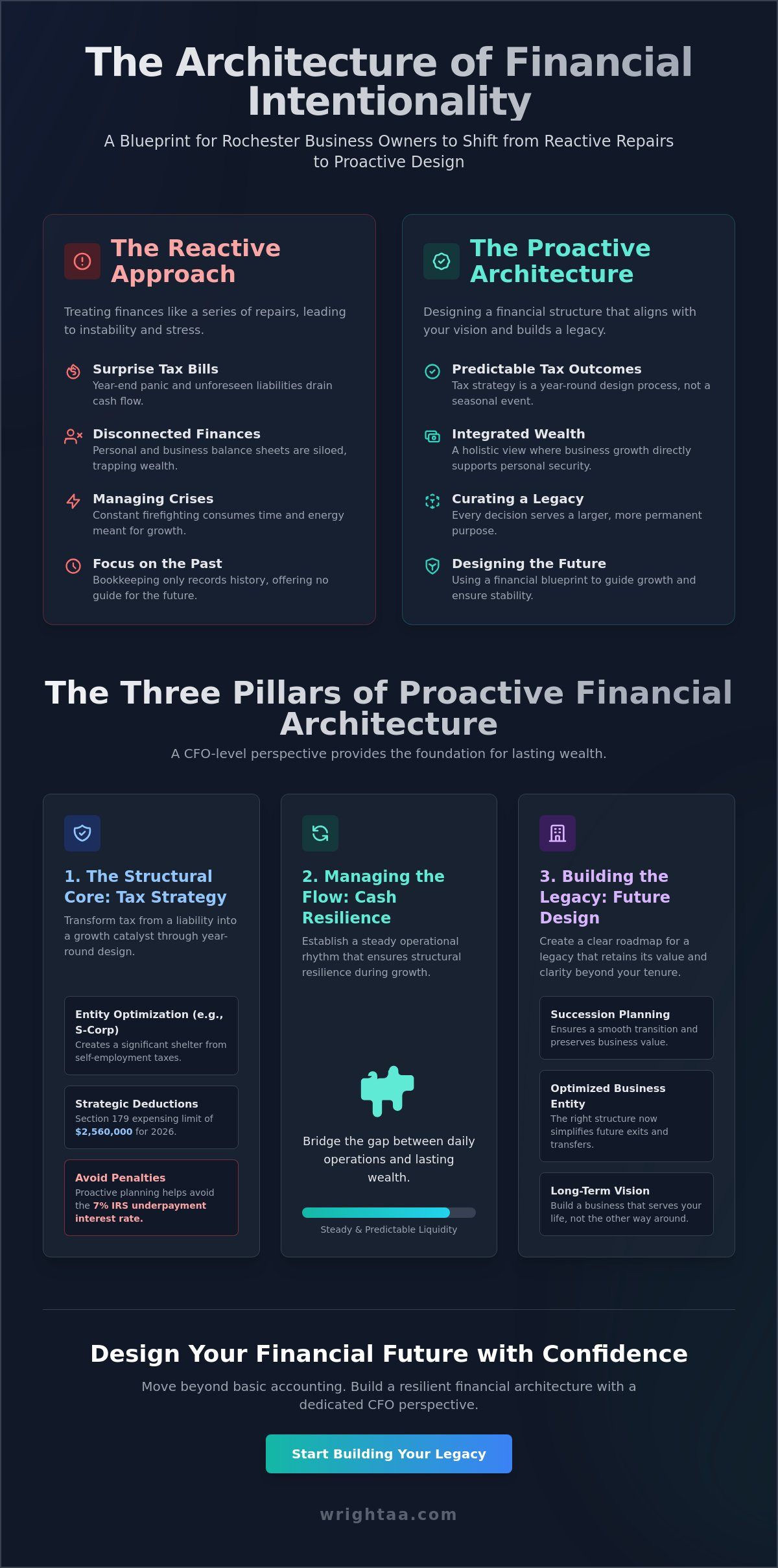
Most accounting is reactive. It's a study of the past, much like examining a building’s foundation after the frost has already caused it to crack. Reactive bookkeeping tells you where you’ve been, but it offers no guidance on where you’re going. Year-end tax preparation is a necessary compliance task, but for a growth-minded firm, it's insufficient. It lacks the foresight to optimize cash flow before the fiscal year concludes. Accounting records the past. Strategy designs the future. Proactive planning serves as the architectural blueprint for your growth. It's the difference between reacting to a surprise tax bill and executing a strategy that was designed months in advance. By the time the year ends, the outcomes should be predictable, not a source of anxiety.
The Structural Core: Proactive Tax Strategy as a Growth Catalyst
Tax strategy is the structural core of a resilient enterprise. It shouldn't be an afterthought or a seasonal panic. Instead, we view it as a year-round design process. For owners focused on business cash flow management Rochester, tax planning is the primary lever for capital preservation. When you anticipate your liabilities, you transform a potential crisis into a manageable operational cost. This foresight allows you to retain liquidity, ensuring that the rhythm of your business remains steady even as the fiscal year draws to a close.
The foundation of this strategy begins with entity selection. Choosing between an LLC and an S-Corp is like selecting the skeleton of a building. It dictates how the structure handles weight. An S-Corp designation, for instance, can serve as a significant shelter from self-employment taxes, provided the payroll is structured with discipline. When proactive tax planning is integrated into your architecture, it fuels reinvestment. It turns saved tax dollars into the raw materials for your next phase of growth, whether that involves new equipment or expanding your team.
Designing for Tax Efficiency in New York
New York State presents a unique set of architectural challenges. Western New York business owners must navigate specific complexities to protect their equity. Using strategic deductions, such as the Section 179 expensing limit of $2,560,000 for 2026, allows for immediate reinvestment in tangible assets. We apply an "Architecture of Finance" approach to help you Manage your finances with precision. By focusing on the intersection of traditional building methods and modern tax sensibilities, we help you reduce self-employment tax and build long-term business equity. It's about ensuring your financial structure is as durable as the Rochester landscape it inhabits.
The CFO Perspective on Tax Liability
Transforming tax from an unpredictable cost into a controlled variable requires a shift in perspective. CFO-level guidance provides this clarity. With fixed-fee monthly oversight, your tax liability becomes a known quantity rather than a seasonal storm. This level of predictability is essential for maintaining a healthy burn rate. You might find that our insights into small business accounting in Buffalo, NY offer the same clarity required for your Rochester operations. If you're ready to move beyond reactive filing, our tax strategy services can help you design a more efficient future. We prioritize substance over spectacle, ensuring your financial foundation is both elegant and secure.
Managing the Flow: Designing Cash Resilience for Rochester Owners
Cash flow is the steady, rhythmic pulse of a healthy business structure. It isn't merely about the volume of capital but the timing of its movement. For maturing firms in our region, business cash flow management Rochester requires navigating the delicate duality between burn rate and growth rate. You must understand how quickly you're consuming resources to build, and how efficiently that investment translates back into liquid strength. When these forces are out of balance, even a profitable firm can feel structurally unsound. It's the difference between a building that stands firm and one that sways under pressure.
Resilience is built on data. Specific financial KPIs provide the necessary pulse for this resilience. These indicators allow you to see through the noise of daily transactions to the underlying health of the enterprise. A fractional CFO serves as the lead architect in this process. They don't just look at balance sheets; they optimize the entire cash conversion cycle. This involves refining the internal mechanics of how you move from an initial outlay to a realized profit. By focusing on internal cycle optimization, you ensure the business generates its own momentum rather than relying on external injections.
The Sensory Details of Cash Flow
There's a specific calm that accompanies a predictable cash cycle. It's the financial equivalent of a well-ventilated, open space. Managing receivables and payables with architectural precision creates this sense of order. When you align your obligations with your income streams, you eliminate the friction of uncertainty. Cash reserves provide a form of spatial openness. They give you the room to breathe, to think, and to make intentional decisions without the pressure of immediate scarcity. A disciplined approach to your ledger ensures that your business remains a place of purpose, not a site of constant repair.
Operational Benchmarking in the Rochester Market
Context matters. A law firm in Rochester operates within a different structural environment than a manufacturing plant or a creative studio. Local industry benchmarks help you understand where your firm stands relative to its peers. For those requiring a CPA for law firms, precision in three-way reconciliation is vital. This process protects the structural integrity of the firm by ensuring that bank balances, book balances, and client trust accounts align perfectly. It's a rigorous commitment to design excellence that prevents small discrepancies from becoming foundational cracks. In the Rochester market, this level of detail is what separates a transient business from a permanent institution.
Building the Legacy: Succession Planning and Entity Optimization
Succession planning is the final act of architectural discipline. It's the process of ensuring a structure outlasts its builder, standing firm long after the original blueprints have faded. For owners who've prioritized business cash flow management Rochester, this transition is the ultimate test of their design. A business must possess structural independence to be truly transferable. Entity optimization isn't just about tax efficiency; it's about creating a vehicle that can carry your vision forward under new stewardship. There's a quiet, poetic resonance in this. A well-prepared business remains a cornerstone of the Rochester community, preserving local culture and employment for the next generation.
Preparing for this transition requires a series of deliberate financial steps. You must move from a model where the owner is the primary engine to one where the business's internal systems drive its value. This involves a rigorous audit of your current processes and a commitment to transparency. In the Rochester market, where reputation and longevity are highly valued, a clear succession plan is a mark of professional maturity. It suggests that you value the permanence of your work over the transience of a quick exit.
The Exit as a Design Choice
A successful exit is a deliberate choice, not a reaction to fatigue. To maximize value, you must prioritize structural integrity over simple top-line revenue. Potential successors look for stability. They want clean, CFO-verified financials that act as a transparent inspection report of the firm's health. This level of clarity is built over time. Most effective transitions begin five to ten years before the final walkthrough. During this period, business cash flow management Rochester shifts from supporting rapid growth to demonstrating long-term sustainability and autonomous operation. It's about proving the building can stand without its original supports.
New Business Formation and Entity Evolution
Your business entity should evolve as your goals mature. While you may have followed a checklist for starting a business in Buffalo, NY during your early days, your current structure might need refinement. There are specific moments when restructuring an existing entity becomes necessary to meet new financial or legacy goals. New York's regulatory environment is complex. Continuity depends on navigating these rules with precision. Whether you're optimizing for a family transition or an external sale, the technical choice of entity dictates the ease of the transfer. If you're ready to secure your firm's future, our business consulting services provide the disciplined guidance needed for a graceful transition.
Designing Your Financial Future with Wright CPAs, LLC
Wright CPAs, LLC functions as the lead architect for your financial clarity. We don't just record numbers; we design systems that sustain both your professional legacy and your personal life. For the Rochester owner, this means moving beyond the noise of annual tax deadlines and reactive bookkeeping. We view your financial structure as a permanent, thoughtful intervention. It requires a foundation that is both grounded in technical excellence and visionary in its intent. Our firm serves as a partner in this design, ensuring every ledger entry supports the grander architectural scheme of your enterprise.
Our collaborative relationship is built on a fixed-fee monthly retainer model. This structure eliminates the friction of transactional billing and fosters a steady, unhurried dialogue. It allows us to maintain constant oversight of your firm's structural integrity throughout the year. When you have a dedicated team monitoring the pulse of your operations, business cash flow management Rochester becomes a deliberate practice rather than a source of seasonal stress. This model provides the spatial openness you need to lead with confidence, knowing that your financial environment is being curated with disciplined precision.
The Wright Approach: CFO-Level Guidance
We believe in the intersection of modern technology and traditional professional discipline. Our process begins with deep listening and contextual awareness. We seek to understand the specific geographic and cultural landscape of your Rochester business before we suggest a single strategic adjustment. This approach ensures that our advisory work is deeply personal and highly effective. Our CFO services are designed to elevate your daily life by removing the weight of financial ambiguity. We provide the technical foundation that allows you to focus on your craft, secure in the knowledge that your business's internal environment is optimized for resilience and growth.
Your Next Strategic Intervention
The path from reactive accounting to intentional financial design is a steady progression. It requires a shift in perspective from managing wealth to designing the business that creates it. By integrating tax strategy, cash flow optimization, and long-term legacy planning, you create a structure that is both beautiful and functional. This is the essence of financial intentionality. It's a commitment to quality over quantity and substance over spectacle. Wright CPAs, LLC has seen how this transition transforms not just the balance sheet, but the very nature of how an owner interacts with their work.
If you're ready to assess the structural integrity of your firm, we invite you to a contemplative consultation. This is an opportunity to explore how a disciplined approach to business cash flow management Rochester can provide the clarity you've been seeking. We'll examine your current framework and identify the strategic interventions needed to align your business with your long-term vision. This is your first step toward total clarity in Rochester business financial planning. Let's build a financial future that stands as a testament to your hard work and intentionality.
Curating a Foundation for Lasting Clarity
Building a business that outlasts its creator requires more than effort; it requires a disciplined commitment to structural integrity. You've seen how proactive tax strategy and entity optimization serve as the framework for this endurance. Refining your business cash flow management Rochester is the first step in this elevation. It's the transition from merely inhabiting a space to intentionally designing the environment where your vision can flourish. When the rhythm of your operations aligns with your personal intent, the entire enterprise gains a sense of calm and purpose.
Since 2012, Wright CPAs, LLC has acted as the lead architect of financial clarity for visionary owners who value substance over spectacle. Our approach combines specialized expertise in New York State tax law with a modern, fixed-fee monthly retainer model. This structure ensures your costs are predictable and our advisory remains steady throughout the year. We prioritize technical precision to ensure your business structure remains resilient through every season of growth and eventual transition.
The path to a curated legacy is deliberate and unhurried. We invite you to step away from the noise and begin a more intentional chapter for your enterprise. Begin your journey toward financial clarity with Wright CPAs, LLC. Your future deserves a foundation built with purpose.
Frequently Asked Questions
How is financial planning for business owners different from personal planning?
Financial planning for business owners is an integrated discipline that treats the company and the individual as a single, symbiotic ecosystem. While personal planning focuses on wealth preservation, business planning focuses on the structural integrity of the engine that creates that wealth. This duality ensures that your personal security isn't sacrificed for operational growth. It requires a holistic view of liquidity, risk, and long-term legacy.
Do I need a CFO if my Rochester business is still in the growth stage?
A fractional CFO is essential during the growth stage because this is when business cash flow management Rochester is most vulnerable to instability. Rapid expansion often creates foundational cracks that basic bookkeeping cannot detect. CFO services provide the technical lens needed to balance your burn rate with sustainable growth. This foresight ensures your expansion is built on a stable, intentional foundation that can withstand market fluctuations.
How does New York State tax law affect my business’s financial plan?
New York State tax law introduces specific complexities that dictate how a business must be structured to preserve capital. With the sweeping reforms of the One Big Beautiful Bill Act in 2026, these regulations act as the environmental conditions of your firm. Proactive planning ensures you utilize every available deduction, such as the 100% bonus depreciation for certain fixed assets, to fuel local reinvestment and maintain structural resilience.
What are the benefits of a fixed-fee accounting model for financial planning?
A fixed-fee model provides total cost predictability and eliminates the transactional friction of hourly billing. This approach fosters a serene, unhurried advisory relationship where deep listening and contextual awareness take priority. It allows for continuous oversight of your financial architecture without the hesitation of unbudgeted expenses. You gain the freedom to seek guidance whenever a strategic intervention is required for your business.
Can proactive tax strategy really increase my business’s valuation?
Proactive tax strategy directly increases business valuation by demonstrating structural maturity and predictable profitability. Potential successors value a firm with clean, optimized financials and a history of disciplined tax planning. It proves that the business is a self-sustaining institution rather than a series of reactive decisions. A well-designed tax framework makes the eventual transition process more seamless and significantly more lucrative.
How often should I review my business’s financial architecture with a CPA?
You should review your financial architecture monthly for operational oversight and quarterly for strategic adjustments. Monthly reviews ensure that your bookkeeping and payroll remain aligned with your immediate cash flow goals. Quarterly sessions allow for deeper interventions, such as adjusting for the 7% IRS underpayment interest rate on missed quarterly payments. This steady rhythm prevents small discrepancies from becoming foundational failures over time.
What is the role of entity selection in a long-term financial plan?
Entity selection is the skeletal structure of your business’s financial plan. Choosing between an LLC or an S-Corp dictates your liability, your tax burden, and the ease of future ownership transfers. It's a foundational design choice that must be revisited as your business matures and your goals evolve. The right entity ensures that your structure remains agile enough to meet your specific legacy and succession objectives.
How do Wright CPAs, LLC coordinate with my existing investment advisors?
Wright CPAs, LLC provides the technical financial data and tax insights that your investment advisors need to make informed allocation decisions. While we don't offer investment management, our role is to ensure the business provides the necessary liquidity for your external portfolios. We act as the technical architects of the business engine, coordinating with your other professionals to ensure your entire financial landscape is cohesive and disciplined.


