

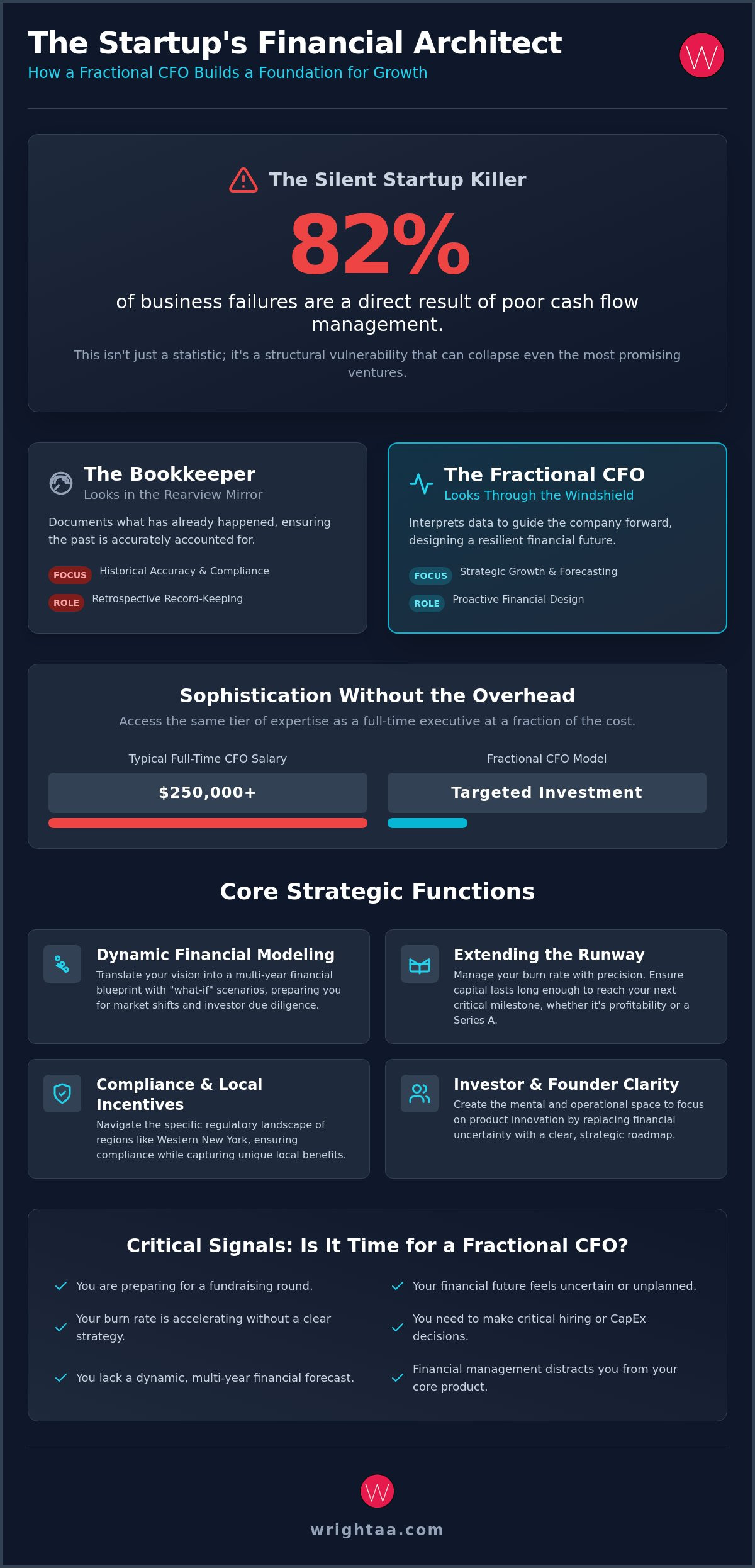
Approximately 82% of businesses that fail do so because of poor cash flow management. This isn't merely a data point. It's a structural vulnerability that can collapse even the most visionary startup. You likely understand the tension of managing a burn rate while trying to maintain the pace of innovation. Understanding the benefits of a fractional CFO for startups is the first step toward replacing that uncertainty with a grounded, intentional financial structure.
Building a company requires the same discipline as designing a physical space. A strategic partner offers the expertise to stabilize your foundation without the weight of a permanent, expensive hire. This article explores how a fractional CFO provides the clarity needed to scale with confidence. We'll outline how to create a 24 month roadmap that satisfies investor due diligence and grants you the freedom to focus on your product development. You'll learn why a sophisticated financial framework is not a luxury, but the very scaffolding that allows your vision to endure.
Key Takeaways
- Distinguish between retrospective bookkeeping and the strategic foresight required to design a stable financial foundation for your enterprise.
- Explore the benefits of a fractional CFO for startups through dynamic financial modeling that protects your cash runway and prepares you for growth.
- Navigate the specific regulatory landscape of Western New York, ensuring compliance while capturing local incentives unique to the Buffalo and Rochester ecosystems.
- Identify the critical milestones and structural signals that indicate when your startup requires professional financial stewardship to avoid accumulating financial debt.
- Discover how integrating CFO services with proactive tax strategy creates the mental and operational space needed to focus on product innovation.
The Architecture of Leadership: Defining the Fractional CFO for Startups
Structure defines the limits of growth. In the startup ecosystem, this structure isn't made of steel or glass, but of capital and strategy. A fractional CFO provides high-level financial strategy on a part-time or contract basis, acting as a fractional executive who integrates deeply into your leadership team without the permanence of a full-time hire. For many founders, the benefits of a fractional CFO for startups begin with a fundamental shift in perspective. This role moves the needle from mere survival to intentional design.
A fractional CFO is a strategic partner who translates a founder's vision into a rigorous financial blueprint.
There is a necessary distinction between maintaining records and designing a future. A bookkeeper documents what has already happened; they look through the rearview mirror to ensure the past is accounted for. A CFO looks through the windshield. They interpret data to guide the company forward. While a full-time CFO often commands a salary exceeding $250,000, the fractional model allows early-stage companies to access this same tier of expertise at a fraction of the cost. It's about accessing the intellect you need, exactly when you need it.
Specialized firms like SD Mayer offer the necessary infrastructure to implement these high-level strategies, providing outsourced CFO and controller solutions that help startups navigate complex financial landscapes.
Beyond Bookkeeping: The Strategic Shift
Reporting serves as the floor of your financial house. It's necessary for stability, but it isn't the ceiling. Forecasting represents the height of your potential. When you move from reactive firefighting to proactive financial design, the nature of your decision-making changes. You stop asking if you can afford a new hire and start knowing exactly when that hire will generate a return. Financial intentionality ensures that every dollar spent is a deliberate brick laid in the foundation of your company. It transforms data from a static report into a living guide for growth.
The Fractional Model: Sophistication Without Overhead
Extending the Runway: Strategic Modeling and Cash Management
Cash is the oxygen of a startup. Without a steady supply, even the most innovative vision remains breathless. If cash is oxygen, then the fractional CFO manages the respiratory system of the business, ensuring that every breath is deep, measured, and sustainable. One of the primary benefits of a fractional CFO for startups is the ability to extend the runway through precise burn rate management. This isn't just about spending less; it's about ensuring that your capital lasts long enough to reach the next significant milestone, whether that is a Series A round or reaching profitability.
Rigorous cash flow management acts as a structural fail-safe, preventing the sudden death that often claims startups before their products reach maturity. According to industry data, 82% of businesses that fail do so because of poor cash flow management. A fractional CFO mitigates this risk by providing the intentional financial structure needed to navigate periods of high burn with clarity. They ensure that the company's financial health is not left to chance but is instead a product of deliberate design.
Dynamic Financial Modeling
A static spreadsheet is a snapshot of the past. A dynamic financial model is a map for the future. We create multi-year projections that align directly with your product roadmaps, allowing you to see the financial impact of every development decision. This process involves identifying the key levers that drive your revenue and unit economics. When you understand these variables, you can tell a compelling story to future investors. You aren't just showing them numbers; you're showing them a resilient architecture for growth. These models allow for "what-if" scenarios that prepare you for market shifts before they happen.
The Art of Cash Flow Management
Effective cash management requires a balance of technical precision and strategic timing. We optimize your accounts payable and receivable to maintain maximum liquidity, ensuring that cash stays in the business as long as possible. Treasury management is equally vital. We ensure that idle cash is working for the company, perhaps through low-risk interest-bearing accounts, rather than sitting stagnant. This level of oversight transcends the standard practices of small business accounting in Buffalo, NY, moving from record-keeping to architectural planning. Founders who prioritize this level of financial discipline often find they can lead with greater presence. If you're ready to stabilize your foundation, exploring professional CFO services can provide the clarity you need to scale with confidence.
Navigating the Western New York Ecosystem: Local Benefits and Compliance
The geography of a startup dictates its financial climate. While coastal hubs often command high-velocity burn rates, the Western New York ecosystem offers a different topography. Buffalo, Rochester, and Syracuse provide a unique environment where capital can endure longer and work harder. One of the primary benefits of a fractional CFO for startups in this region is the ability to unlock local incentives that remain invisible to national firms. A CFO who understands the specific economic cadence of the Rust Belt can transform regional advantages into strategic growth.
Leveraging the "WNY advantage" requires more than just living in the region. It demands a sophisticated understanding of how lower overhead costs interact with state-level opportunities. By maintaining a lower burn rate in cities like Buffalo, founders can hit more milestones before seeking their next funding round. This regional stability creates a sense of calm, allowing the leadership team to focus on innovation rather than constant survival. A local CFO acts as a guide through this landscape, connecting the business with regional venture groups and networking circles that are often inaccessible to outsiders.
Unlocking New York State Tax Incentives
New York offers a complex architecture of credits and regulations. Navigating the R&D tax credit requires precision at both the federal and state levels to ensure no capital is left on the table. For those starting a business in Buffalo, NY, the financial lens must remain focused on evolving local requirements. You must account for the New York LLC Transparency Act, which became effective January 1, 2026. This law requires specific beneficial ownership disclosures that, if missed, can create unnecessary friction during due diligence. Compliance with the Freelance Isn't Free Act and NYS labor laws is not optional. It's a structural necessity. A fractional CFO ensures your business is tethered to these legal realities, preventing future liabilities from eroding your foundation.
Local Presence, National Reach
A Buffalo-based CFO understands more than just the numbers. They understand the cultural and economic climate of the region. They provide a bridge to local banks and lenders in Syracuse and Rochester who value face-to-face relationships and regional commitment. While modern technology allows us to support businesses as they expand nationally, our roots in Western New York provide a grounded perspective. We help you build relationships with local venture groups like Launch NY or the UB Cultivator program. This local expertise ensures that while your vision may be national, your foundation remains secure and contextual. It's about building a structure that is both permanent and flexible.
Identifying the Threshold: When Does Your Startup Need a CFO?
Startups often wait too long to seek professional financial guidance. This delay results in "financial debt," a collection of structural flaws and reporting gaps that become increasingly difficult to clear as the company scales. While a founder can manage early receipts, the transition to a system-led growth model requires a different level of expertise. Involving a strategic partner from Day One can save six figures in future errors by preventing the structural rot that occurs when growth outpaces oversight. One of the primary benefits of a fractional CFO for startups is the ability to recognize when your current financial processes have reached their limit.
The shift from founder-led finances to system-led growth is a silent but critical milestone. It marks the moment when the business moves beyond the direct reach of its creator and begins to breathe on its own. Without a sophisticated financial framework, this growth can feel chaotic rather than intentional. A fractional CFO provides the discipline needed to ensure the business remains grounded as it ascends.
The Five Signs of a Needed Transition
- Preparation for Funding: You are preparing for a Seed or Series A round and need a narrative that survives investor due diligence.
- Data Without Insight: Your financial data is accurate, but it provides zero strategic insight into your next move.
- Operational Anxiety: You are losing sleep over cash runway and burn rate calculations that no longer feel certain.
- Investor Pressure: Investors are asking for sophisticated reports that your current team doesn't know how to generate.
- Strategic Pivots: You need a partner to evaluate the financial impact of a major shift in your business model before you commit resources.
The Cost of Delay
A poor financial foundation leads to more than just messy books; it leads to dilution. When your numbers are unclear, investors perceive higher risk, which often translates into lower valuations and lost equity. There is also the tangible risk of audit failures or compliance penalties in New York State. With the LLC Transparency Act now in full effect as of January 1, 2026, the cost of regulatory oversight has never been higher. Understanding your financial KPIs for small business is the first step in protecting what you've built. If you find yourself reacting to financial fires rather than designing a future, it's time to connect with a CFO advisor who can restore clarity to your vision.
Designing Financial Clarity: The Wright CPAs Approach to CFO Advisory
At Wright CPAs, we view finance as an architectural discipline. It is intentional, serene, and deeply rooted in the specific context of your business goals. One of the core benefits of a fractional CFO for startups is the presence of a partner who values deep listening before beginning the creative process of financial modeling. We don't offer generic templates; we design bespoke frameworks that reflect the unique site and structure of your enterprise. Our fixed-fee monthly retainers provide the predictable cost structure startups need, ensuring that high-level guidance remains a stable foundation rather than a fluctuating expense.
This approach mirrors the relationship between an architect and the built environment. We recognize that your startup's financial structure is not merely a technical exercise but a poetic one, representing the intersection of your personal vision and market reality. By establishing a quiet, confident authority over your numbers, we create the spatial openness you need to lead with purpose. Every decision we make is a deliberate brick laid in the foundation of your long-term success.
The Intersection of Tax and Strategy
A common gap in the modern financial market is the separation of strategic advisory from tax compliance. We address this by integrating outsourced CFO services in Buffalo, NY with proactive tax strategy. Having a leader who understands the intricacies of business tax planning in Buffalo, NY offers a distinct competitive advantage. We harmonize your monthly advisory with annual tax preparation, ensuring that your corporate structure is optimized for your long-term exit goals. Whether your business is structured as an LLC or an S-Corp, the choice must be a permanent, thoughtful intervention that supports your ultimate trajectory. This holistic oversight ensures that R&D credits and local incentives are built into your model from the beginning, rather than added as an afterthought.
Your Blueprint for Success
Your journey begins with an initial financial assessment, what we consider a site survey for your business. We examine the existing materials of your financial history to identify where the foundation is strong and where it requires reinforcement. This process is unhurried and methodical, guiding you through a narrative of your business that reveals both challenges and opportunities. We look at your internal controls, your reporting cadences, and your current cash management habits to ensure they can support the weight of future growth.
The Wright CPAs promise is one of clarity, substance, and a disciplined path to growth. We provide the scaffolding that allows your vision to endure the pressures of the marketplace. When you have a clear financial roadmap for the next 18 to 24 months, the fear of making an expensive hiring mistake or running out of runway begins to dissipate. Design your financial future with a Wright CPAs consultation and discover how intentional structure creates the freedom to innovate.
Designing a Foundation for Enduring Success
Building a permanent structure requires a commitment to both vision and discipline. We've explored how high-level financial strategy serves as the scaffolding for sustainable growth. By moving beyond retrospective bookkeeping and embracing dynamic modeling, you protect your company’s most vital resource: its runway. Realizing the benefits of a fractional CFO for startups means choosing a partner who understands the specific cultural and economic topography of Western New York. This strategic alignment ensures that every decision is a deliberate step toward a stable future.
Since 2012, Wright CPAs has focused on providing visionary financial leadership to founders who value substance over spectacle. Our fixed-fee monthly retainers ensure that your growth remains predictable and your costs remain transparent. We bring specialized expertise to the Buffalo and Rochester startup ecosystems, helping you navigate local compliance while you focus on the poetry of your product. When your financial foundation is intentional, you gain the clarity needed to lead with purpose.
Elevate your startup strategy with Wright CPAs CFO Services. Your vision deserves a structure designed to endure the weight of its own potential.
Frequently Asked Questions
What is the difference between a fractional CFO and a traditional CPA?
A traditional CPA primarily focuses on historical compliance and the accuracy of past records. They ensure your tax filings meet legal requirements and your books are balanced. A fractional CFO functions as an architect for your future. They use historical data to design strategic forecasts, manage cash runways, and guide high-level decision-making. One ensures the building is to code; the other designs the expansion.
How much does a fractional CFO for a startup typically cost?
The cost depends on the complexity of your financial topography and the level of engagement your growth requires. Most engagements are structured as fixed-fee monthly retainers, which provides the predictability startups need for their burn rate. This model allows you to access executive-level intellect at a fraction of the cost of a full-time hire. It eliminates the need for a $200,000 plus salary and equity package.
Does my startup really need a CFO if we aren’t raising venture capital yet?
Financial intentionality is a requirement for any business that intends to endure. Even without venture capital, you must manage unit economics and burn rates to reach profitability. One of the primary benefits of a fractional CFO for startups is establishing a disciplined foundation before complexity makes it difficult to do so. This proactive design prevents the accumulation of financial debt that often hampers later growth.
Can a fractional CFO help with my Buffalo-specific business tax credits?
A local advisor understands the specific incentives available within the Western New York ecosystem. We navigate regional opportunities like the New York State R&D tax credit and local tax nexus requirements. This regional expertise ensures that your business captures every available resource while remaining compliant with state-specific labor laws and transparency acts. It's about building a structure that is contextual to its environment.
What software and technology does a fractional CFO typically implement?
We implement a digital infrastructure that favors clarity and automation. This typically includes cloud-based accounting platforms, dynamic forecasting software, and integrated payroll systems. These tools function as the nervous system of your business. They provide real-time data that allows you to see your financial position with absolute transparency, which is essential for making unhurried, confident decisions.
How many hours a month does a fractional CFO usually work with a startup?
The rhythm of work is steady but flexible. Some months require intensive involvement, such as during a pivot or a fundraising round. Other periods may only require a few hours of high-impact strategic review and KPI analysis. The fractional model is designed to scale with your needs. It ensures you have the right amount of leadership without the weight of unnecessary overhead.
Will a fractional CFO help me prepare for a Series A funding round?
Preparation for a significant funding round is a core function of the role. A CFO builds the data rooms and sophisticated financial models that investors demand during due diligence. They translate your product vision into a rigorous financial narrative. This builds trust with venture groups and ensures you aren't caught off guard by technical questions regarding your unit economics or long-term projections.
How do I know if I am ready to hire a fractional CFO for my Rochester business?
You're ready when your financial data no longer provides the clarity you need to lead. If you feel a sense of unease regarding your cash runway or if your current accounting team can't answer strategic "what-if" questions, you've reached the threshold. This transition marks the move from reactive bookkeeping to intentional financial stewardship. It's the moment you decide to build a foundation that can support your highest ambitions.


