

What if tax season wasn't a seasonal storm to be weathered, but a permanent structure designed for stability? For many owners, the approach of April feels like a reactive scramble against the clock. You likely recognize the tension of missing an IRS deadline or the quiet anxiety that comes from an unknown tax liability. It's a common experience to feel as though your financial records are a collection of loose materials rather than a finished work. This lack of organization can disrupt your cash flow and obscure the path toward growth.
By establishing a deliberate tax planning calendar for small business, you shift from defense to design. We promise to help you transform this cycle into a strategy that prioritizes structural organization and legal tax minimization. This article provides a comprehensive quarterly roadmap for 2026, guiding you through federal and New York State requirements with precision. We will examine the essential dates and strategic interventions that ensure your business remains both compliant and optimized for the year ahead. Through this framework, you can achieve a predictable financial environment and the peace of mind that comes from true preparation.
Key Takeaways
- Learn how a tax planning calendar for small business serves as a structural blueprint, aligning federal deadlines with your long-term vision.
- Identify the critical quarterly milestones for 2026 that transform tax preparation from a seasonal event into a permanent, deliberate strategy.
- Master the local nuances of New York State filings, ensuring compliance for businesses rooted in the Buffalo and Rochester landscapes.
- Integrate rhythmic monthly habits into your operations to maintain financial clarity and predict upcoming liabilities with confidence.
- Explore how a proactive tax strategy and fixed-fee model can provide the spatial breathing room necessary for visionary business growth.
The Architecture of Intentionality: Why Your Business Needs a Tax Planning Calendar
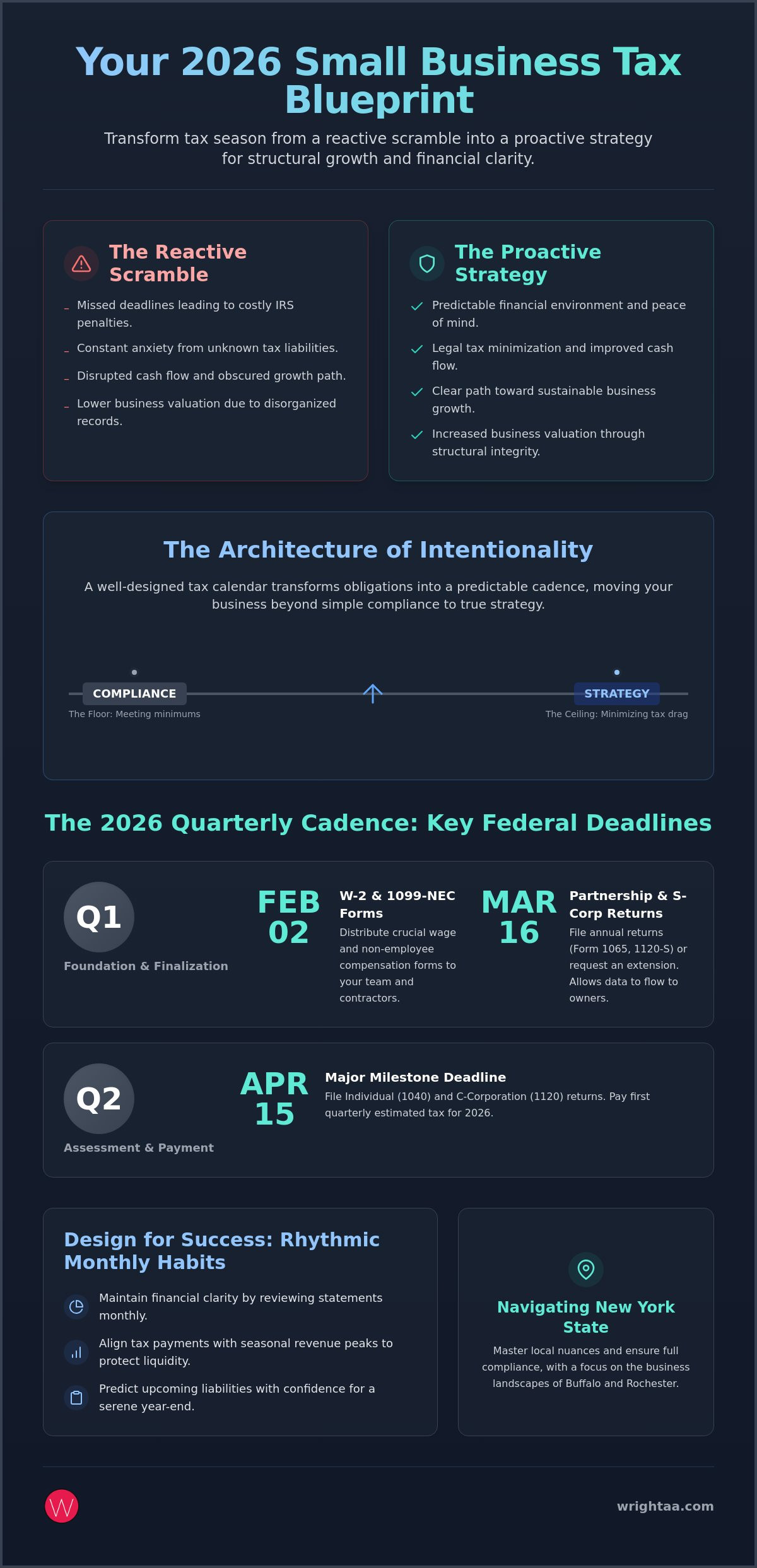
A building requires a stable foundation before the walls can rise. Your business financial health follows a similar logic. A tax planning calendar for small business is more than a collection of dates. It's a structural blueprint that provides the clarity necessary for visionary decision-making. While the U.S. tax system often feels like a labyrinth of complex requirements, a well-designed calendar transforms these obligations into a predictable cadence. It allows you to view your finances not as a series of obstacles, but as a landscape to be thoughtfully navigated.
There is a fundamental duality between simple compliance and true strategy. Compliance is merely the act of meeting the minimum requirements to exist. It is the floor. Strategy, however, is a deliberate intervention. It is the ceiling. Moving beyond basic filing allows you to reduce tax drag, the unnecessary friction that slows your annual cash flow. When your tax obligations are mapped out months in advance, you can allocate capital with greater confidence. This foresight ensures that your business remains agile, rather than being weighed down by the inertia of late-season surprises.
A well-timed calendar also impacts long-term business valuation. Potential buyers or partners look for structural integrity. Disorganized records and unexpected liabilities suggest a lack of discipline. Conversely, a business with a clear, proactive tax history demonstrates a refined level of management. This structural organization increases market value by proving that the business is built on a foundation of rigorous, intentional oversight.
The Cost of Reactive Accounting
Reactive accounting is often expensive. When you scramble at the last minute, you risk missing quarterly estimated payments. These missed deadlines incur hidden penalties that erode your margins. In Western New York, business owners frequently overlook specific regional deductions during the rush of tax season because they lack the time for deep analysis. Proactive tax planning is a rigorous, year-round discipline that ensures every financial decision in 2026 serves your broader objectives.
Designing for Predictability
Predictability is a choice. You can use your calendar to align tax obligations with your seasonal revenue peaks. This ensures that large payments don't arrive during lean months, protecting your liquidity. Monthly oversight creates a serene year-end experience. It replaces the chaos of April with a quiet, steady review. This practice establishes a baseline for financial intentionality. It's about creating a space where your business can breathe and grow without the constant pressure of unknown liabilities.
The Quarterly Cadence: Mapping Your 2026 Federal Deadlines
A structure is built in stages, each phase relying on the integrity of the one before it. Your financial year follows a similar rhythm. By utilizing a tax planning calendar for small business, you move through the seasons with a sense of steady progress rather than frantic repair. This quarterly cadence ensures that your business remains upright and resilient, regardless of external shifts in the economic climate. For a detailed list of all federal tax events, IRS Publication 509 serves as the primary technical manual for these essential dates.
Q1 and Q2: Foundation and Assessment
The first quarter of 2026 is a period of reconciliation and finalization. It's the time to close the books on the previous year while setting the stakes for the new one. On February 2, 2026, the deadline arrives for sending W-2 and 1099-NEC forms to your team and contractors. This is a foundational step in payroll transparency. By March 16, 2026, Partnerships and S-Corporations must file their annual returns or request an extension. This early deadline allows the financial data to flow through to individual owners before the April rush.
Quarter two shifts the focus toward performance audits and mid-year strategy pivots. April 15, 2026, is a significant milestone. It marks the deadline for individual returns, C-Corporation filings, and the first quarterly estimated tax payment for the 2026 tax year. This is the moment to assess if your current trajectory aligns with your projected liabilities. If your revenue has scaled faster than anticipated, a mid-year adjustment prevents a large, unexpected bill later. Engaging in proactive tax planning during this window provides the clarity needed to make informed investments in your business infrastructure.
Q3 and Q4: Refinement and Execution
As the year moves into the third quarter, the focus turns to recalculation. June 15 and September 15 serve as vital checkpoints for estimated payments. This is also the critical window for reviewing S-Corporation reasonable compensation. By September 30, you should ensure your salary levels meet federal requirements while remaining tax-efficient. It's an ideal time for tax-loss harvesting, where you intentionally realize losses to offset gains, refining the overall tax landscape of your portfolio.
The final quarter is the season of execution. With the "One Big Beautiful Bill Act" making 100% bonus depreciation permanent for 2026, businesses have a powerful tool for growth. You can also utilize the Section 179 deduction, which has a maximum limit of $2.56 million for the year. December 31 is the final day for tax-saving expenditures and retirement contributions. These moves are the finishing touches on your annual strategy, ensuring that every dollar spent contributes to the long-term stability of your professional environment.
- January 15, 2026: Final 2025 estimated tax payment due.
- March 16, 2026: S-Corp and Partnership returns (Forms 1120-S and 1065).
- April 15, 2026: Individual and C-Corp deadlines; Q1 estimated payments.
- September 15, 2026: Q3 estimated payment checkpoint.
- December 31, 2026: Deadline for 2026 expenditures and retirement funding.
Navigating New York State: Local Nuance for Buffalo and Rochester Businesses
The local landscape requires its own set of blueprints. While federal guidelines provide the overarching frame, the New York State Department of Taxation and Finance introduces specific rhythms that demand equal attention. For those operating in Western New York, integrating these state requirements into your tax planning calendar for small business is essential for maintaining operational flow. The transition from federal to state compliance is like moving from a building's structural steel to its interior systems; both must be perfectly aligned for the environment to function.
New York has recently extended the top corporate franchise tax rate of 7.25% for businesses with income over $5 million through 2029. Additionally, the state has decoupled from federal provisions regarding 100% bonus depreciation for certain property. This divergence means your state strategy may look different from your federal one. Implementing specific tax planning strategies mid-year can help you navigate these nuances without disrupting your cash flow. By anticipating these differences in June or July, you avoid the friction of year-end adjustments.
Geography also dictates specific obligations and exemptions. Business owners in Buffalo and Rochester can note that the Metropolitan Commuter Transportation Mobility Tax (MCTMT) remains a downstate concern. This exempts Erie and Monroe County enterprises from a burden faced by their counterparts in the Hudson Valley or Long Island. However, local property tax cycles in Erie and Monroe Counties present their own seasonal requirements. In Buffalo, city tax installments often fall in July and December, while Monroe County town and county taxes typically come due in February. Mapping these local cycles ensures your capital remains available when the community infrastructure requires it.
NYS Sales and Payroll Tax Checkpoints
Sales tax filings follow a distinct quarterly cycle. Returns are due on the 20th of the month following the reporting period: April 20, July 20, October 20, and January 20. Larger filers participating in the PrompTax program must adhere to an even more accelerated pace, requiring precise cash flow management. Alongside these dates, you must manage NYS unemployment insurance and withholding reporting. Ensuring compliance with Buffalo-specific business licensing renewals in the first quarter adds another layer of security to your professional foundation.
Specialized Considerations for WNY Law Firms
Legal practices face unique structural requirements that demand a higher level of financial discipline. Maintaining the integrity of IOLTA accounts through three-way reconciliation isn't just a best practice; it's a regulatory necessity in New York. A CPA for law firms Buffalo NY can help design a cadence that ensures partner distributions and tax withholdings occur with intentionality. This strategic timing prevents the anxiety of unknown liabilities and allows partners to focus on the poetry of their practice rather than the mechanics of their ledger.
Beyond the Deadline: Monthly Habits that Design Success
A blueprint remains static without the daily labor of maintenance. While quarterly milestones provide the structural frame, the monthly habits of a tax planning calendar for small business provide the lasting durability. It's the difference between a building that merely stands and one that thrives. Each month serves as a micro-cycle of intentionality, allowing you to refine your financial environment before the next season arrives. This steady rhythm prevents the accumulation of errors and ensures your business remains a finished work throughout the year.
The first week of every month should be dedicated to reconciling the previous month’s architecture. This is the process of ensuring every transaction aligns with your records. During the second week, the focus shifts to reviewing cash flow management and upcoming liabilities. It's a time to look at the horizon and ensure your liquidity matches your planned obligations. By the third week, you should analyze your growth opportunities through financial data. The final week is reserved for gathering documentation, ensuring the materials for your next quarterly checkpoint are organized and ready for review.
The Ritual of Monthly Reconciliation
Waiting until the end of the year to reconcile your books is a fundamental failure of design. It's like inspecting a foundation only after the roof has been installed. Modern accounting utilizes technology to automate the capture of environmental financial data, making this ritual a quiet, steady task rather than a frantic reconstruction. Understanding financial kpis for small business during this first week provides the clarity needed to adjust your strategies before they are set in stone. It ensures that your financial landscape remains accurate and reflective of your true position.
CFO-Level Financial Oversight
True oversight moves from asking "What happened?" to asking "What is next?" This shift in perspective is what separates a historian from a visionary creator. Monthly reviews allow you to design a cash reserve strategy specifically for 2026 tax obligations. You shouldn't be surprised by a liability when you've been watching it grow in real-time. These regular intervals of reflection support outsourced CFO services Buffalo NY, where proactive strategy replaces reactive repair. It creates a space where your business can expand with confidence, backed by rigorous financial discipline.
If you're ready to move beyond basic bookkeeping toward a model of financial intentionality, explore our Tax Planning and CFO Services to build a more resilient future.
Designing Your Strategy: How Wright CPAs, LLC Elevates Tax Planning
A blueprint is only as effective as the firm that executes it. At Wright CPAs, LLC, we view the tax planning calendar for small business as a living document that requires constant, thoughtful attention. It's not a static list of deadlines but a dynamic roadmap tailored to the specific contours of your enterprise. By integrating modern technology with deep human insight, we ensure your financial structure remains both resilient and adaptable to the shifts of the 2026 fiscal environment. We prioritize the site and structure of your business, ensuring every strategic intervention feels both permanent and purposeful.
Fixed-Fee Monthly Retainers: A New Blueprint
Traditional accounting often relies on the billable hour. This model creates inherent friction and discourages the very dialogue necessary for visionary growth. We've replaced this outdated method with fixed-fee monthly retainers. This approach provides predictable costs, allowing you to focus on your business rather than the clock. It creates a space for continuous business tax planning Buffalo NY where strategy is an ongoing conversation rather than a year-end emergency. Our proactive tax strategy replaces reactive repair with intentional value, ensuring your cash flow remains steady as you scale. We invite you to experience a more curated approach to your finances, where every interaction adds value to your long-term objectives.
Your Partners in Financial Clarity
Our commitment is rooted in the specific geographic and cultural contexts of the Buffalo, Rochester, and Syracuse business communities. We understand the local materials of the New York State tax code and how to build within them. By moving beyond simple preparation toward true financial intentionality, we help you design a business that serves your life. This is the intersection of discipline and artistry. It's time to transform your tax season from a reactive scramble into a deliberate, well-executed strategy. We work beside you to ensure your financial architecture is as inspiring as the work you do every day.
To begin crafting your bespoke financial roadmap for the year ahead, schedule a strategy session with Wright CPAs, LLC today.
Building Your Financial Legacy
A resilient business is not an accident of timing; it's the result of deliberate design. By implementing a tax planning calendar for small business, you move from the chaos of reactive filing to the clarity of a structural roadmap. We've explored how federal deadlines, New York State nuances, and rhythmic monthly habits form a cohesive blueprint for stability. This level of intentionality ensures your cash flow remains steady and your liabilities are never a surprise. It allows you to focus on the poetry of your work rather than the mechanics of compliance.
Our Buffalo-based team provides a national reach with the localized care your specific environment deserves. We offer specialized expertise for New York law firms and utilize a fixed-fee monthly accounting model to ensure your growth remains predictable and unhurried. We don't just prepare documents; we architect strategies that protect your vision. It's time to replace the friction of the billable hour with a partnership rooted in your long-term success. Design your financial future with Wright CPAs, LLC and step into 2026 with a sense of calm and purpose. Your business deserves a foundation as enduring as your ambition.
Frequently Asked Questions
What are the key federal tax deadlines for small businesses in 2026?
Federal deadlines for 2026 begin with the distribution of W-2 and 1099-NEC forms by February 2. Partnerships and S-Corporations must file their annual returns by March 16, while sole proprietors and C-Corporations follow an April 15 deadline. Quarterly estimated payments are due on April 15, June 15, September 15, and January 15, 2027. Maintaining a tax planning calendar for small business ensures these structural milestones are met with precision.
Do New York State businesses have different tax deadlines than federal ones?
New York State deadlines often mirror the federal schedule but require separate attention. Annual returns for partnerships and LLCs are due on March 15, which is one day earlier than the federal S-Corp deadline. Sales tax filings follow their own rhythm, typically due on the 20th of the month following the reporting quarter. These local nuances are essential for maintaining compliance within the state's specific regulatory environment.
How much should a small business set aside for quarterly estimated taxes?
A prudent strategy involves setting aside 25% to 30% of your net business income. This reserve accounts for federal and state income taxes along with self-employment obligations. Utilizing the safe harbor rule, which focuses on paying 100% or 110% of the previous year's liability, provides a stable foundation. This approach protects your cash flow from the erosion of unexpected year-end bills.
What happens if I miss a quarterly tax payment deadline in New York?
Missing a New York State quarterly payment triggers the immediate accrual of penalties and interest. The state calculates these charges from the original due date until the liability is satisfied. Underpayment penalties can be significant even if you file your final return on time. Proactive oversight prevents these avoidable costs from disrupting your business's financial architecture.
Is a tax planning calendar different for an LLC versus an S-Corp?
The architecture of your calendar shifts based on your entity type. S-Corporations face an earlier federal filing deadline of March 16 and require rigorous monthly payroll oversight to maintain reasonable compensation. Single-member LLCs typically align with the individual April 15 deadline. Each structure demands a unique cadence of reconciliation and reporting to ensure the integrity of the financial framework.
How often should a Buffalo business owner meet with their CPA for planning?
A monthly cadence is the most effective way to ensure financial clarity. Annual meetings are retrospective; they record history rather than design the future. Monthly touchpoints allow you to adjust your tax planning calendar for small business as revenue fluctuates. This steady dialogue replaces the anxiety of the unknown with a quiet, confident strategy for growth.
What specific tax records should I keep on a monthly basis for 2026?
You should maintain digital copies of bank statements, credit card reconciliations, and payroll reports every month. In 2026, the standard mileage rate has increased to 72.5 cents per mile, making accurate vehicle logs more valuable than ever. Capturing this environmental data in real-time ensures your documentation is complete before the quarterly checkpoints arrive.
Can proactive tax planning help reduce my self-employment tax?
Proactive planning is a powerful tool for managing self-employment tax liabilities. By electing S-Corporation status, you can divide income between a reasonable salary and shareholder distributions. Only the salary portion is subject to self-employment taxes, which can result in significant annual savings. This strategy requires a disciplined approach to payroll and distributions to remain compliant with federal guidelines.


