

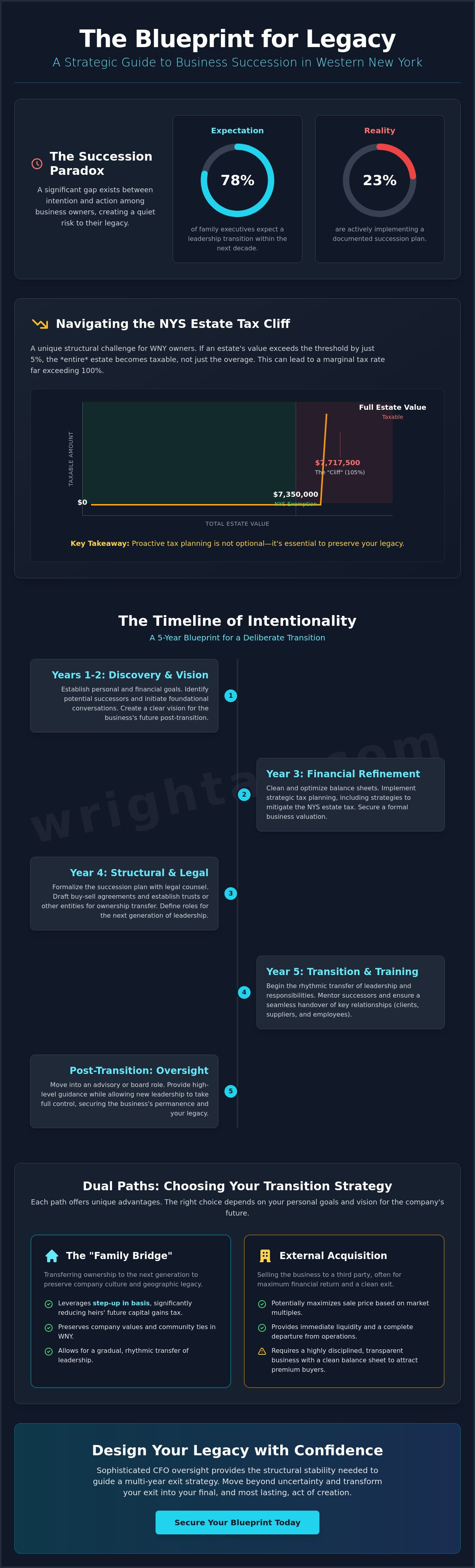
A business is more than a sequence of transactions. It is a permanent intervention in the landscape of Western New York's economy. While 78% of family executives expect a transition within the decade, Deloitte research shows only 23% are actively implementing a plan. This "succession paradox" creates a quiet risk for the legacy you've spent decades constructing. Effective business succession planning Buffalo NY requires more than a simple exit. It demands a deliberate design for permanence and financial clarity.
It's natural to feel the weight of letting go. The uncertainty of current WNY valuations and the looming New York State estate tax cliff, which captures the entire estate if it exceeds $7,717,500 by just 5%, can feel overwhelming. You've built a structure of substance. You deserve a transition that honors that work. There is a profound relationship between the way a business is built and the way it is handed over to the next generation.
This article explores how to transition your business with clarity while minimizing tax exposure. We will walk through a financial blueprint that addresses tax strategy and cash flow management; providing the peace of mind that your legacy is secure and your intentions are realized.
Key Takeaways
- Reframe your exit as a final architectural intervention, moving beyond a sudden departure toward a deliberate and poetic transition.
- Discover how business succession planning Buffalo NY leverages the step-up in basis and local market multiples to maximize the value transferred to your heirs.
- Compare the nuances of the "Family Bridge" against external acquisitions to determine which path best preserves your company's cultural and geographic legacy.
- Follow a five-year blueprint that moves from initial discovery to the refinement of balance sheets and tax strategies.
- Learn how sophisticated CFO oversight provides the structural stability needed to guide a multi-year exit strategy with confidence.
The Architecture of Exit: Why Succession Planning is Business Design
A business is a permanent intervention. It occupies a specific site in the community and a specific space in the lives of its owners. When we view an exit as a poetic conclusion rather than a sudden departure, the entire process shifts. It moves from a legal necessity to a deliberate act of design. In Western New York, where history and heritage are etched into the landscape, succession planning serves as the final blueprint for a leader's career journey. It's the moment where the visionary ensures the structure can stand without their daily presence.
A sudden exit is often a reaction to external pressures. It is abrupt. It lacks the grace of a planned transition. Conversely, a designed transition allows for a rhythmic transfer of leadership. It mirrors the clarity found in architectural openness; where every line has a purpose and every space is intentional. This is the essence of business succession planning Buffalo NY. It's a proactive financial strategy that ensures the structure remains standing long after the original architect has stepped away. Clarity in leadership transfer creates the same sense of security as a well-poured foundation.
The Human Element of Business Permanence
A business is a living structure. It requires a foundation that can support the weight of the next generation. For many owners, the intersection of personal identity and corporate longevity is deeply felt. The business isn't merely an asset; it's a reflection of their values. Effective business succession planning Buffalo NY transforms a personal milestone into a communal legacy. Moving beyond the fear of retirement requires a shift in perspective. It's an opportunity to find excitement in the concept of legacy. When the owner views the transition as a way to ensure the business's permanence, the emotional difficulty of letting go begins to dissolve. It becomes an act of creation.
Succession as a Strategic Financial Intervention
Waiting for a buyer is a reactive mistake. It places the owner in a position of weakness. A proactive approach maintains business value during a shift. It prevents the organizational culture from crumbling. Intentionality is the primary tool here. By cleaning balance sheets and optimizing tax strategies years in advance, owners protect the integrity of the firm. According to Chase Survey data from May 2026, 40% of small business owners plan to retire in the next decade. Yet, 70% remain in the early stages of planning or have no formal plan at all. This gap represents a significant risk to the economic fabric of Buffalo. A strategic intervention ensures that the transition is a seamless continuation rather than a disruptive break.
Strategic Pillars: Tax Efficiency and Valuation in Western New York
The structural integrity of a business depends on the precision of its financial components. In the context of business succession planning Buffalo NY, tax efficiency and valuation serve as the primary load-bearing walls. They determine whether the transfer of ownership is a graceful transition or a destabilizing event. One of the most potent tools in this design is the step-up in basis. By allowing heirs to inherit assets at their current market value, we protect the next generation from a significant capital gains burden. This isn't merely a technical maneuver; it's an act of preservation.
Achieving this level of protection requires early intervention. Integrating business tax planning Buffalo NY into your exit blueprint ensures that every financial decision aligns with the ultimate goal of legacy. Financial clarity is the most attractive material to a potential buyer. It signals a business that is disciplined, transparent, and built to endure. When a buyer sees a clean balance sheet, they see a structure they can trust.
Navigating the New York State Estate Tax Cliff
The New York State estate tax cliff is a unique structural challenge for Western New York owners. In 2026, the individual exemption stands at $7,350,000. If an estate’s value exceeds 105% of this amount, which is approximately $7,717,500, the entire estate is taxed rather than just the portion above the threshold. Because of this steep calculation, the NYS cliff can result in taxes exceeding 100% of the marginal dollar earned beyond the threshold. Strategic gifting and trust structures are essential to keep the estate below this boundary. Owners often utilize the Five Phases of Succession Planning to time these transfers with technical precision.
Valuation as a Reflection of Financial Health
Valuation is a duality. It exists as both Fair Market Value, the baseline for a standard transaction, and Strategic Value, which accounts for the unique synergies a specific buyer might bring. In the Buffalo market, local multiples and EBITDA serve as the measuring tape for success. Understanding financial kpis for small business is critical because these metrics dictate your eventual sale price. Cleaning the books years before a transition is like refinishing the facade of a building; it reveals the true quality of the underlying structure. If you are ready to begin this refinement, our team can help you develop a tailored tax strategy that honors your long-term vision.
Dual Paths: Navigating Family Transitions vs. External Acquisitions
Every successful venture eventually reaches a fork in its narrative. One path leads toward the preservation of a family lineage; the other toward the broader marketplace. Choosing between these trajectories is a core element of business succession planning Buffalo NY. It's a decision that dictates the future shape of the organization and the financial security of its founders. While the emotional weight of these choices differs, the need for a rigorous financial blueprint remains constant. The goal is to ensure the transition doesn't disrupt the business's foundational strength.
The tax consequences of these paths are distinct. Internal transfers often leverage the federal annual gift tax exclusion, which is $19,000 per recipient in 2026. External sales involve different capital gains considerations and valuation multiples. Regardless of the path you choose, a Buy-Sell Agreement serves as the essential contract for stability. It defines the terms of the transfer, setting clear boundaries that protect the business from unforeseen events. Whether you're passing the torch to a child or a third-party buyer, this document ensures the legacy is transferred with clarity, a hallmark of effective business succession planning Buffalo NY.
The Poetics of the Family Succession Plan
The "Family Bridge" is a delicate structure. It requires balancing equity among those who remain active in the daily rhythm of the business and those who are passive heirs. This is where a Family Council becomes essential. It provides a dedicated space for communication, ensuring that structural harmony is maintained across generations. Designing a comprehensive training period allows successors to perform a slow, deliberate walkthrough of their future responsibilities. This intentionality prevents the friction that often arises during a sudden transfer of power. It turns a change in leadership into a seamless continuation of the original vision.
Preparing for the External Buyer
External acquisitions offer a different set of opportunities. Preparing for an "Open Market" sale or private equity investment requires a focus on transparency and decluttering. Sophisticated buyers looking at Buffalo's closely held businesses prioritize a clean financial narrative. They seek documented processes that prove the business can thrive independently of its creator. If the company is too reliant on its original architect, its value diminishes in the eyes of an outsider. The objective is to build a structure that's self-sustaining. When the business can function without the owner's daily intervention, it becomes a far more attractive asset for acquisition.
The Timeline of Intentionality: A 5-Year Blueprint for Buffalo Owners
Time is a dimension of design. In the context of business succession planning Buffalo NY, a five-year horizon is the minimum required for a transition of substance. Rushing this process often leads to structural failure. Much like a building constructed on unstable soil, a hurried exit lacks the integrity needed to support the next generation of leadership. A rhythmic, multi-year approach allows for the steady refinement of the organization's financial and operational systems. It ensures that the final handoff is a moment of quiet confidence rather than a chaotic scramble.
The timeline begins with a survey of the site. In Year 5, the focus is on discovery. This is the phase where we identify personal goals and establish a preliminary valuation. By Year 3, the project moves into refinement. We optimize tax structures and clean the balance sheets to reveal the true quality of the underlying asset. Year 1 represents the final walkthrough. This is when legal documents are finalized and the leadership handoff occurs. This unhurried pace allows for deep listening and the careful adjustment of plans as market conditions evolve.
Phase 1: Assessing the Foundation
Every successful transition begins with the "Why." Identifying the motivation behind your exit strategy is essential for choosing the right path. During this phase, we conduct a gap analysis. This is a technical comparison between the current value of the business and the financial requirements of your retirement. Engaging a multidisciplinary team of CPAs and attorneys early in the process—including specialists like the Law Offices of Matthew T. Desrochers, P.C. for matters involving family law or debt relief—ensures that all professional perspectives are aligned from the start. It's about understanding the relationship between the business's current state and its future potential.
Phase 2: Reinforcing the Structure
Once the foundation is understood, we begin reinforcing the structure for the coming shift. This includes implementing retention plans for key employees. These individuals provide the institutional memory that keeps the business stable during a change in ownership. We also address the duality of the deal structure; choosing between an asset sale and a stock sale based on tax implications and liability protection. The final tax strategy must prioritize the owner's post-exit liquidity, ensuring that the transition provides the necessary materials for their next chapter. If you're ready to begin your discovery phase, our team provides the business consulting expertise required to draft your five-year blueprint.
Designing Your Legacy with Wright CPAs, LLC
The transition of a business is the final professional intervention of an owner's career. It is a moment that requires both a visionary perspective and a grounded understanding of the local landscape. At Wright CPAs, LLC, we view this process as a collaborative design project. Our approach is sophisticated, intentional, and deeply rooted in the specific geographic context of Western New York. Effective business succession planning Buffalo NY is not a single transaction; it's a multi-year strategy that ensures the structural integrity of your legacy remains intact as you step away from daily operations.
Local expertise matters when navigating the nuances of the Buffalo and Rochester markets. We understand the value of the built environment and the businesses that inhabit it. Our role at Wright CPAs, LLC is to guide you through the walkthrough of your exit; moving from the role of an active owner to that of a successful retiree. This journey requires a partner who values substance over spectacle. We prioritize deep listening and contextual awareness to ensure that every financial decision reflects your personal intentions and the unique needs of your organization.
The CFO as the Lead Architect of Your Exit
Visionary financial guidance is the cornerstone of a successful transition. While traditional tax preparation looks backward, our outsourced CFO services Buffalo NY provide the forward-looking oversight needed for a multi-year exit. Wright CPAs, LLC moves beyond the technical exercise of bookkeeping to act as the lead architect of your financial future. This level of involvement ensures that your business maintains its value and operational rhythm during the most critical phases of the succession timeline.
We believe in the serenity of order. Our advisory services at Wright CPAs, LLC are delivered through fixed-fee monthly retainers, providing the predictable costs necessary for long-term planning. There are no hidden fees or unexpected invoices. This transparency allows you to focus on the poetry of your transition rather than the mechanics of the bill. Knowing your financial house is in order brings a sense of calm that is essential when making high-stakes decisions about your business's future.
Begin Your Design Process Today
Every great structure begins with a conversation. Wright CPAs, LLC supports closely held businesses and law firms through the complexities of leadership transfer and tax strategy. Our process starts with a deep-listening consultation to understand the "why" behind your exit. We examine the intersection of your personal identity and your company's longevity; ensuring the final blueprint honors both. This is the essence of business succession planning Buffalo NY. It is a disciplined, artistic approach to financial permanence. When you are ready to design a legacy of intentionality, we are here to lead the way. Contact Wright CPAs, LLC to begin your walkthrough.
Constructing Your Final Professional Intervention
A business is a lasting contribution to the Western New York landscape. Transitioning that business requires a balance between the current site and the future vision. By embracing a rhythmic five-year blueprint, you protect the structural integrity of your organization while navigating the unique challenges of the New York State estate tax cliff. This proactive approach ensures that the step-up in basis and local market valuations work in your favor; securing a legacy of financial intentionality.
Effective business succession planning Buffalo NY is the path to a serene retirement. Wright CPAs, LLC provides the CFO-level financial guidance needed to guide this transition with technical precision. We offer specialized expertise in Buffalo's closely held businesses and a fixed-fee advisory model for predictable financial clarity. It's time to move from the role of active creator to that of a visionary retiree.
Design your business legacy with Wright CPAs, LLC. Your life's work deserves a finish as intentional and permanent as its beginning.
Frequently Asked Questions
Is business succession planning only for large corporations in Buffalo?
Business succession planning Buffalo NY is essential for organizations of all sizes, from solo law practices to multi-generational family firms. Small businesses often face more concentrated risk because their value is tied closely to a single individual. Designing an exit strategy ensures the structure remains standing even when the original architect is no longer on-site.
How long does the succession process typically take in New York State?
A thorough succession process typically requires a three to five-year horizon to achieve optimal results. This period allows for the refinement of balance sheets and the unhurried transfer of institutional knowledge. Rushing the walkthrough of a leadership handoff often leads to structural instability or unforeseen tax liabilities that could have been avoided with patience.
What is the New York State estate tax cliff and how does it affect me?
The New York State estate tax cliff is a provision where the entire estate becomes taxable if its value exceeds 105% of the exemption amount. In 2026, the individual exemption is $7,350,000. If your estate is valued at $7,717,500 or more, you lose the exemption entirely. This results in a tax bill that can exceed the actual value of the marginal dollar earned beyond the threshold.
How do I determine the value of my Buffalo-based small business?
Determining value involves a duality of technical analysis and market context. We examine EBITDA and apply local market multiples specific to the Western New York economic climate. Cleaning the books and optimizing cash flow management before a valuation reveals the true quality of the business's foundation to potential buyers, ensuring the price reflects the integrity of the work.
Can I stay involved in the business after a succession or sale?
You can certainly remain involved through a consulting or advisory capacity after the official transfer. Many owners choose a phased walkthrough, serving as a mentor to the new leadership for a defined period. This ensures a seamless transition and maintains the organizational culture while allowing the owner to step back from the weight of daily operations.
What is a buy-sell agreement and why do I need one?
A buy-sell agreement is a foundational contract that dictates how an owner's share is redistributed if they leave the business. It acts as a structural safety net, preventing internal conflict and ensuring the business continues to function without disruption. It's the primary tool for maintaining harmony among active and passive stakeholders during a shift in ownership.
How often should I update my business succession plan?
It's prudent to revisit your plan every three to five years or whenever a significant life event occurs. Changes in tax regulations, such as the 2026 federal exemption shift to $15 million, require a careful reassessment of your strategy. Regular updates ensure that business succession planning Buffalo NY remains aligned with both your personal goals and the current economic environment.
What are the tax differences between a family transfer and a third-party sale?
Family transfers often utilize the federal annual gift tax exclusion, which is $19,000 per recipient in 2026, to move value over time. Third-party sales are typically taxed as capital gains and may involve more complex negotiations regarding asset versus stock sale structures. The choice of path dictates the tax burden, making an intentional tax strategy a critical component of the final design.


