

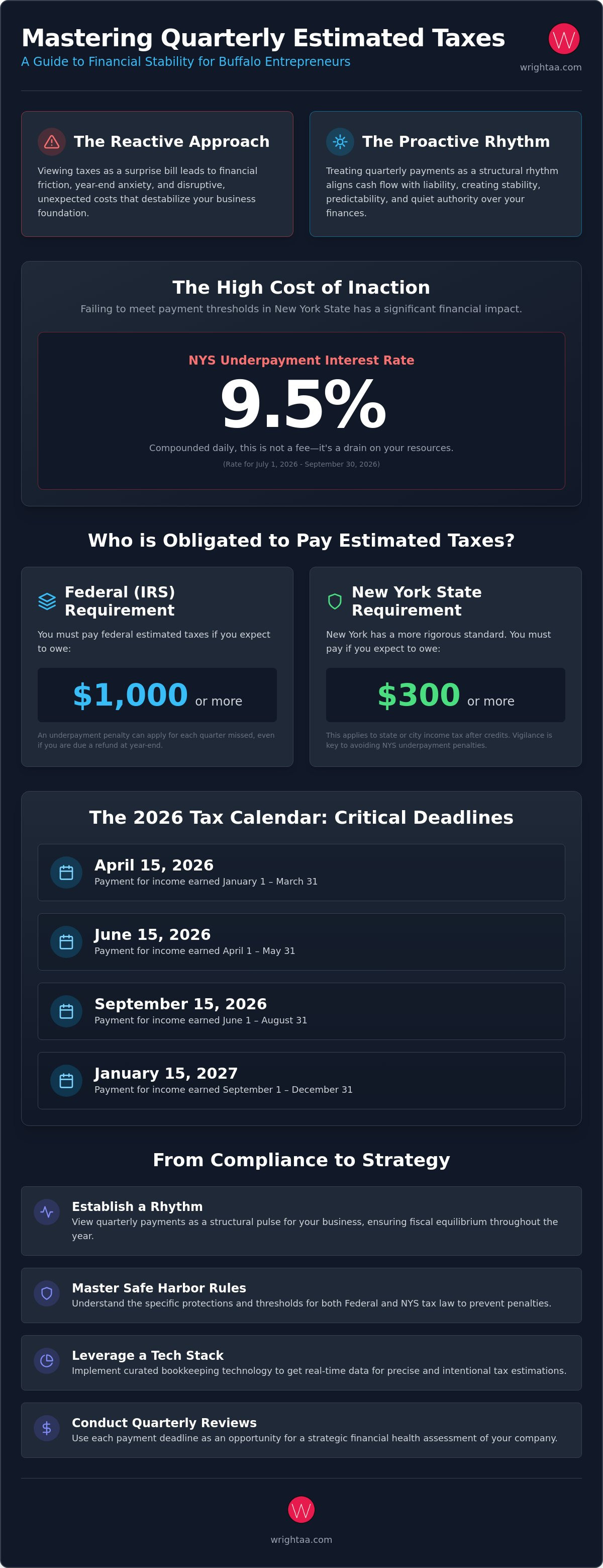
What if the quarterly tax deadline wasn't a source of friction, but a rhythmic pulse that stabilized your business's foundation? For many Buffalo business owners, the arrival of a surprise tax bill feels like an architectural flaw in an otherwise sound plan. It's often the result of a disconnect between federal 1040-ES expectations and the specific nuances of avoiding underpayment penalty NY. With the current interest rate for New York State underpayments set at 9.5% through September 2026, the cost of silence is simply too high.
You likely recognize the tension that builds as the September 15 deadline approaches. It's a common anxiety, rooted in the complexity of balancing state and federal obligations while protecting your monthly cash flow. This guide provides a clear path toward financial intentionality. You'll learn how to leverage Safe Harbor protections and follow a precise 2026 tax calendar to maintain your firm's equilibrium. We'll explore the specific $300 threshold for IT-2105 filings and the MCTMT requirements, allowing you to replace uncertainty with a sense of quiet, disciplined authority over your financial future.
Key Takeaways
- View quarterly payments as a structural rhythm rather than a burden, ensuring your business maintains equilibrium throughout the fiscal year.
- Identify the critical 2026 deadlines for federal and state filings to prevent interest charges from disrupting your cash flow.
- Master the nuances of avoiding underpayment penalty NY by understanding Safe Harbor protections and the specific $300 threshold for state income tax.
- Implement a curated bookkeeping tech stack that provides the real-time data necessary for precise, intentional tax estimations.
- Transform compliance into a visionary tax strategy through quarterly reviews that serve as an architectural assessment of your company's financial health.
Understanding the Structural Necessity of Quarterly Estimated Taxes
Quarterly estimated taxes are often viewed as a seasonal burden. In reality, they represent the structural framework of the U.S. Income Tax System for those who operate outside the traditional employer-employee relationship. For a Buffalo entrepreneur, these payments are a pay-as-you-go method of ensuring financial equilibrium. When you work for yourself, there is no centralized entity to withhold tax from your earnings. Your net profit is the raw material of your business, but it arrives without the architectural refinement of pre-calculated tax deductions. By making regular contributions, you align your cash flow with your eventual liability, shifting from a reactive state to one of rhythmic stability.
The IRS and New York State require these installments to maintain a steady influx of revenue throughout the year. Without them, the gap between earning and paying becomes too wide, creating a precarious financial environment. Approaching these obligations with intentionality is the primary strategy for avoiding underpayment penalty NY. It transforms a potentially volatile year-end bill into a series of manageable, quiet interventions. When you treat your tax obligations as a recurring design element of your business, you protect the foundation you've built from sudden, disruptive shocks.
Who is Obligated to Pay in New York?
The obligation begins when your expected tax debt reaches specific thresholds. For federal purposes, the IRS generally requires estimated payments if you expect to owe $1,000 or more. However, New York State maintains a more rigorous standard. Buffalo-based sole proprietors and S-Corp owners must pay estimated tax if they anticipate owing $300 or more in state or city income tax after credits. Partners in law firms must be particularly vigilant. Because their income is often distributed in significant, irregular intervals, maintaining personal estimates is a necessary discipline to protect both personal and professional liquidity. Avoiding underpayment penalty NY requires a constant awareness of these dual thresholds.
The Cost of Underpayment: Penalties and Interest
The 2026 Tax Calendar: Critical Deadlines for WNY Entrepreneurs
The tax year possesses a distinct, unhurried cadence that exists independently of your business's internal cycles. While your fiscal operations may ebb and flow with the seasons in Western New York, the regulatory environment demands a fixed adherence to four specific temporal pillars. These dates are the structural anchors of your financial year. Ignoring them creates a misalignment that often leads to unnecessary friction. For those focused on avoiding underpayment penalty NY, these deadlines are not suggestions; they are the essential milestones of a disciplined financial walkthrough.
Consistency is the primary material used to build a stable tax position. Many entrepreneurs mistakenly believe their personal tax deadlines shift if their business operates on a non-calendar fiscal year. However, for individual income tax and self-employment obligations, the calendar remains resolute. Aligning these payments within a broader, proactive tax strategy ensures you aren't merely reacting to dates, but designing your financial future with intent and clarity.
2026 Federal (IRS) Payment Windows
The federal landscape requires four precise interventions to maintain equilibrium. April 15, 2026, serves as the cornerstone, where you set the foundation for the year ahead by settling previous obligations and initiating the first payment for the new cycle. By June 15, 2026, you must assess the growth of your spring revenue and adjust your second installment accordingly. The final two windows, September 15, 2026, and January 15, 2027, complete the structure. Failing to meet these specific windows can trigger IRS Underpayment Penalties, which accrue based on the duration of the shortfall. Each payment is a quiet commitment to your business's long-term health.
New York State (NYS) Filing Specifics
In New York, the rhythm of compliance requires a dual focus. You must align your NYS Form IT-2105 deadlines exactly with your federal windows to ensure a seamless flow of data and capital. In Buffalo, we must also stay mindful of state-level holidays that might shift a deadline by twenty-four hours. If a due date falls on a Saturday, Sunday, or a legal holiday observed by the state, the payment is considered timely if made on the next business day. Precision in these moments is vital. Ensuring your state payments are correctly credited to your specific tax district prevents the administrative noise that often accompanies surprise notices. Avoiding underpayment penalty NY is a matter of respecting these local nuances while maintaining a visionary perspective on your total tax liability.
Calculating Your Liability: Federal vs. New York State Requirements
Calculating your tax liability is a study in dualities. You must look backward at 2025 performance while projecting the visionary growth of 2026. This process requires balancing federal self-employment tax with the specific nuances of the New York State code. Relying on a static "set and forget" model often creates unnecessary cash flow strain during high-revenue quarters. Proactive calculations are the only certain way of avoiding underpayment penalty NY while preserving your monthly liquidity. Instead, integrating business tax planning Buffalo NY into your monthly rhythm allows for a more fluid adjustment to your estimates. It's about maintaining a constant connection between your current earnings and your future obligations.
The Safe Harbor Rule: Protecting Your Cash Flow
Avoiding underpayment penalty NY is most effectively achieved through the Safe Harbor rule. These provisions act as a structural safety net, providing a clear, mathematical path to compliance. Generally, you must pay at least 90% of your 2026 tax liability or 100% of the tax shown on your 2025 return. For Buffalo entrepreneurs with a 2025 New York Adjusted Gross Income over $150,000, the requirement increases to 110% of the prior year's tax. Using these benchmarks offers a sense of financial clarity. It removes the guesswork from your quarterly installments and ensures your business remains on solid ground, regardless of how your income fluctuates throughout the year.
NYS-Specific Deductions and PTET Considerations
New York's tax environment offers specific levers that can optimize your cash position. For example, many Buffalo LLCs benefit from the Pass-Through Entity Tax (PTET). This election allows the entity to pay the tax at the corporate level, potentially providing a valuable federal deduction for the owners. When you utilize small business accounting Buffalo NY, you gain access to a curated view of available credits and deductions that are unique to the state. State-level credits act as a direct reduction of your calculated liability, effectively lowering the ceiling of your required quarterly payments. This precise approach ensures you aren't overextending your cash flow in the name of compliance, allowing you to reinvest those funds back into your business's growth.
Intentional Record-Keeping: Preparing for Seamless Payments
A clear financial record is the blueprint of a stable business. It requires a curated tech stack that mirrors a minimalist and clean aesthetic, ensuring that your data remains both accessible and unburdened by noise. Selecting the right tools is not merely a technical choice; it is a commitment to functional clarity. Real-time bookkeeping provides the tactile data necessary for making accurate quarterly estimations. When your financial environment is orderly, the path to avoiding underpayment penalty NY becomes visible and steady. It allows you to move away from the chaos of year-end reconciliation toward a more unhurried, rhythmic approach to compliance.
Buffalo law firms, in particular, must navigate the delicate intersection of operating capital and client trust funds. The management of IOLTA accounts requires a rigorous separation of environments to maintain ethical and financial integrity. This specific complexity is why many practices seek a CPA for law firms Buffalo NY who understands the intersection of legal requirements and proactive tax strategy. By isolating these distinct financial streams, you ensure that your personal tax estimates are based on true earnings rather than temporary cash flow. Our CFO services can help you architect a record-keeping system that ensures this level of sophisticated financial clarity.
Methods of Payment: Digital vs. Traditional
In a modern financial environment, the materials you use to fulfill your obligations matter. Utilizing IRS Direct Pay and NYS Web File offers a sense of immediate confirmation that traditional paper vouchers cannot provide. These digital platforms act as the structural joints of your tax plan, providing a secure and permanent record of every transaction. Relying on paper checks introduces unnecessary friction and the risk of transit delays. To further protect your liquidity, consider establishing a monthly tax savings transfer. This practice ensures that the funds are already carved out of your operating budget, making the quarterly payment a quiet, non-disruptive event.
Tracking KPIs for Tax Readiness
Your Profit & Loss statement should serve as a sensory guide throughout the year. Monitoring specific financial kpis for small business allows you to predict your eventual liability with precision. In the weeks leading up to a deadline, a deep walkthrough of your current revenue and expenses reveals the true shape of your tax obligation. This real-time awareness helps you identify deductible expenses as they occur, rather than searching for them in a hurried state months later. When your data is refined and current, you possess the visionary perspective needed to maintain business equilibrium.
Strategic Tax Planning: Beyond Simple Compliance
True financial intentionality requires moving beyond the reactive nature of annual filing. It involves a shift toward a visionary tax strategy that anticipates the future rather than simply accounting for the past. This foresight often extends to retirement and estate planning, where specialized firms such as Strategic Asset Preservation, Inc help individuals harmonize their business success with long-term wealth preservation. While the previous sections focused on the technical requirements of avoiding underpayment penalty NY, this final stage is about the structural integrity of your entire business. A well-designed tax plan is like a building's foundation; it's often invisible, yet it determines the height and stability of everything built upon it. Filing a return is a snapshot. Strategy is the blueprint.
Quarterly check-ins function as an architectural review of your business health. These moments allow us to step back and assess whether the current financial trajectory aligns with your long-term goals. We look at the intersection of your internal operations and the external regulatory environment of Western New York. This unhurried, methodical process ensures that your tax obligations remain a rhythmic part of your growth rather than a sudden obstruction. It's a quiet discipline that pays dividends in both capital and peace of mind.
Proactive Strategy vs. Reactive Filing
Successful Buffalo businesses recognize that their CPA is a year-round partner in their success. Relying on a once-a-year interaction creates a fragmented view of your finances. Instead, utilizing outsourced CFO services Buffalo NY allows you to automate the calculation and submission of your estimates. This level of oversight provides the clarity needed to make bold, informed decisions. We call this the Architecture of Finance. It is a disciplined approach to designing a more profitable and serene future for your firm.
Partnering with Wright CPAs, LLC for Long-Term Clarity
At Wright CPAs, LLC, we value substance over spectacle. Our approach is rooted in deep listening and a rigorous commitment to understanding the specific geographic and cultural context of your business. We don't just offer technical expertise; we offer a refined perspective on how your financial choices impact your daily life. By transitioning to a fixed-fee advisory model, you gain predictable financial oversight that removes the friction of hourly billing. Avoiding underpayment penalty NY is a natural byproduct of this comprehensive, intentional relationship. It is about building something permanent and thoughtful.
Take the first step toward a serene financial environment and a structure that supports your highest ambitions. Schedule a consultation to begin architecting your 2026 tax strategy.
Architecting a Season of Financial Equilibrium
Navigating the complexities of state and federal obligations requires more than simple compliance; it demands a commitment to structural integrity. By aligning your business with the fixed rhythm of quarterly deadlines and utilizing Safe Harbor protections, you replace the friction of surprise bills with a steady, unhurried confidence. We've moved through the technical requirements and the necessity of real-time data to reach a place of visionary oversight. These practices are the materials you use to build a business that remains resilient against year-end shocks. Achieving this level of clarity is the most certain path toward avoiding underpayment penalty NY while protecting your firm's liquidity.
Based in Buffalo and serving the unique needs of Western New York, our firm specializes in law firm accounting and proactive CFO-level guidance. We focus on substance over spectacle, helping you design a financial environment that supports your highest ambitions. Whether you're managing complex IOLTA accounts or scaling a growing practice, your tax strategy should be as thoughtful and permanent as the work you do. Design a more intentional tax strategy with Wright CPAs, LLC and experience the peace of a disciplined financial walkthrough. Your future is a structure worth designing with care.
Frequently Asked Questions
What happens if I miss a quarterly tax deadline in New York?
Interest begins to accrue the moment a deadline passes. For the third quarter of 2026, New York State applies a 9.5% interest rate, which is compounded daily on the unpaid balance. You may also face a late payment penalty of 0.5% for each month the tax remains unpaid, reaching a maximum of 25%. Precision in your timing is the most effective method for avoiding underpayment penalty NY and preserving your business's capital.
Can I pay my federal and New York state estimated taxes together?
Federal and state payments must be handled as distinct transactions. The IRS and the New York State Department of Taxation and Finance operate separate collection systems, requiring individual submissions through IRS Direct Pay and the NYS Online Services portal. While you should calculate these liabilities simultaneously to maintain a cohesive financial walkthrough, the capital must be directed to each agency through its specific digital channel to ensure proper credit.
How do I know if I need to pay quarterly taxes for my Buffalo side hustle?
You are required to make estimated payments if you anticipate owing $300 or more in New York State income tax after accounting for withholdings and credits. This threshold is significantly lower than the federal requirement of $1,000. For a Buffalo-based side hustle, even modest net profits can quickly reach this limit. Monitoring your net earnings in real-time ensures you identify this obligation before it results in preventable interest charges.
Do I have to pay estimated taxes if this is my first year in business?
New business owners are not exempt from the pay-as-you-go requirement. While you don't have a prior year return to use as a Safe Harbor benchmark, you must still estimate your current year's net profit and pay accordingly if you cross the $300 state or $1,000 federal thresholds. Architecting your tax plan from the first day of operations prevents a large, disruptive bill and potential penalties when you file your inaugural return.
What is the Safe Harbor rule for New York State taxes in 2026?
The Safe Harbor rule offers a structural safety net for avoiding underpayment penalty NY. In 2026, you can avoid penalties by paying at least 90% of your current year's tax or 100% of the tax shown on your 2025 return. If your 2025 New York Adjusted Gross Income exceeded $150,000, or $75,000 if married filing separately, the requirement increases to 110% of the prior year's tax to maintain compliance.
How do I calculate self-employment tax for my quarterly payments?
Self-employment tax is a federal obligation calculated at a rate of 15.3% on 92.35% of your net business earnings. This covers Social Security and Medicare contributions. While New York State does not impose a separate self-employment tax, your state income tax is calculated on the same net profit figure. Balancing these dual liabilities requires a disciplined approach to ensure your quarterly installments reflect the true cost of your professional autonomy.
Can I change my estimated payment amount if my income drops mid-year?
You can and should adjust your payments if your revenue fluctuates. The annualized income installment method allows you to recalculate your required payment based on your actual year-to-date earnings. This flexibility is essential for businesses with seasonal cycles or unexpected shifts in income. It ensures your installments remain proportional to your current cash flow, preventing you from overextending your resources during leaner months while still meeting your legal obligations.
What forms do I need for NYS quarterly estimated tax payments?
New York State utilizes Form IT-2105 for estimated tax payments. This form is used to report and pay estimated income tax, as well as the Metropolitan Commuter Transportation Mobility Tax if applicable. Most taxpayers find that using the state's Online Services portal is the most efficient and secure method for submission. It provides immediate confirmation, ensuring your payment is documented and your business remains on a stable, compliant path throughout the year.


