

What if the most useful board packet starts with a decision, not a stack of reports? Preparing financial statements for board meetings is more than assembling numbers. Board members need a clear view of performance, cash, and financial position, with enough context to understand what changed, why it changed, and whether it affects a decision.
It’s reasonable to wonder which statements and comparisons belong in the packet, especially when some directors don’t work with financial reports every day. An income statement, balance sheet, and cash flow statement provide a strong foundation. Pair them with relevant comparisons and plain-language explanations of meaningful variances so directors can interpret the figures without guessing.
This guide explains how to prepare accurate, readable board financials that support strategic oversight rather than burying discussion in operational detail. You’ll learn what to include, how to present results and cash clearly, and how to connect variances to risks, decisions, and next steps. Reconciled books, customized reporting, and concise commentary help the board spend less time decoding the numbers and more time considering what they mean for the business.
Key Takeaways
- Start with the questions the board needs to answer, then shape the packet around oversight, planning, and resource decisions.
- Use the income statement, balance sheet, and cash flow statement to give directors distinct views of results, financial position, and cash.
- Keep the summary focused, and use supporting schedules to preserve detail without crowding the main report.
- Make preparing financial statements for board meetings a consistent workflow, from closing the period to reviewing reconciliations and commentary.
- Customized reporting and reconciled balance-sheet accounts can help make financial information more reliable and relevant to board discussions.
Preparing Financial Statements for Board Meetings Starts With the Board’s Questions
A board packet works best when it answers defined oversight and decision questions. Routine performance review helps directors see whether the business is moving as planned. A discussion about changing a plan, committing resources, or taking corrective action calls for different context. Preparing financial statements for board meetings starts with identifying what the meeting needs to accomplish.
Board members may have different levels of financial experience. Clear labels, consistent comparisons, and brief explanations help everyone follow the same picture without stripping away important detail. The statements provide a structured view of business activity and position. A basic overview of the types and purpose of a financial statement can help frame that structure.
Board-ready statements connect reliable figures with the questions directors must resolve.
Define the decisions and oversight questions first
Before gathering reports, review the agenda and identify what directors need to understand, discuss, or decide. This step keeps the packet focused on the business rather than on every detail the accounting system can produce.
Questions may include:
- How did results compare with the plan, and what explains meaningful differences?
- What does the current financial position show about assets, obligations, and available resources?
- Can expected cash needs be met, and what factors could affect liquidity?
- Is progress toward a strategic plan on track, or does the board need to revisit assumptions?
Separate information from decisions. Directors may need to understand a change in expenses without being asked to approve a response. If the agenda includes a decision about hiring, investment, or a revised plan, make the request explicit and provide the financial context needed to weigh it. Don’t blur routine review with a request for action.
Use the agenda as the packet’s frame. Include information that supports the discussion, and leave out details that don’t help directors assess performance, risk, or a choice before them.
Set a clear reporting period and comparison
State the period covered on each report and use consistent dates throughout the packet. A monthly income statement beside a year-to-date cash report can confuse readers if the different time frames aren’t clearly labeled. Keep the period and any “as of” dates visible, especially when one statement covers activity over time and another shows a position at a point in time.
Comparisons give figures meaning. Depending on the board’s questions and the records available, show results against the approved budget, a prior period, or a relevant plan. Use the same comparison consistently, and explain any change in method rather than presenting unlike periods as directly comparable.
Add context before directors have to infer it. A delayed customer payment, seasonal pattern, or one-time expense may explain a variance when relevant. State what changed, why it matters, and whether it affects a decision or forecast. This makes the reporting period more than a date range: it gives directors a clear basis for interpreting the numbers.
Which Financial Statements to Prepare for a Board Meeting
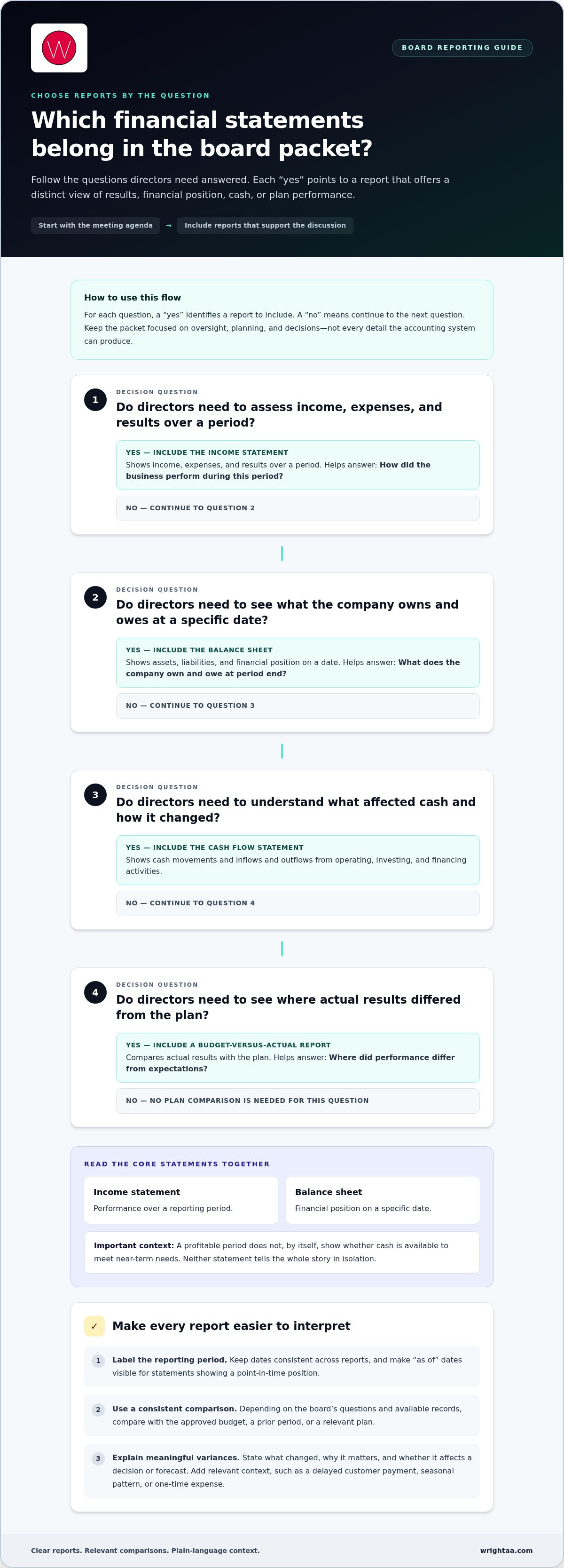
The right board packet usually starts with a few core reports, then adds supporting views that answer questions on the agenda. Each report offers a different lens: one shows results over time, another shows the company’s financial position on a particular date, and another traces cash movement. Preparing financial statements for board meetings means choosing reports that work together, not treating them as interchangeable.
| Report | What it shows | Board question it helps answer |
|---|---|---|
| Income statement | Income, expenses, and results over a period | How did the business perform during this period? |
| Balance sheet | Assets, liabilities, and financial position on a date | What does the company own and owe at period end? |
| Cash flow statement | Cash movements from operating, investing, and financing activities | What affected cash, and how is it changing? |
| Budget-versus-actual report | Actual results compared with the plan | Where did performance differ from expectations? |
Use the income statement and balance sheet together
The income statement summarizes activity across the reporting period. It brings income and expenses into view so directors can see the resulting profit or loss and consider what drove it. The balance sheet is a snapshot at a specific date. It presents assets and liabilities, helping directors understand the company’s financial position at that point.
The income statement describes performance over a period; the balance sheet shows financial position on a date. Read them together. A profitable period, for example, doesn’t by itself show whether cash is available to meet near-term needs. A change in assets or liabilities is also easier to interpret alongside the activity and business context that shaped it. Neither statement tells the whole story in isolation.
Add cash flow and budget-versus-actual views when useful
A cash flow statement shows how cash moved during the period, including inflows and outflows. It can help directors discuss whether operations are generating cash and how cash needs relate to obligations, planned spending, or other demands. The report complements the balance sheet: one traces movement over time, while the other records a position on a particular date.
A budget-versus-actual report shows performance against the plan. Focus commentary on differences that matter to the board’s discussion rather than listing every variance. If revenue is below plan or an expense is higher than expected, explain the underlying cause and whether it changes a forecast, risk, or decision. Related measures can add useful context. The financial KPIs for small businesses guide explores performance measures that can help frame those discussions.
Choose the report mix to fit the agenda. A board considering a change in spending may need budget comparisons alongside cash flow; a routine review may call for a concise view of results and financial position. Customized financial reporting can align these views with the questions directors need to address. Financial reporting support can help make the numbers clearer and more useful for board discussion.
How to Make Board Financial Reports Clear Without Hiding Important Detail
A complete board packet doesn’t need to reproduce every line of the accounting system. Its purpose is to help directors understand the financial picture and engage with the issues before them. Clarity comes from choosing the right level of detail, not from removing information that matters.
Use a concise summary to orient readers, then include the underlying statements and clearly labeled supporting schedules for reference. The summary shouldn’t replace the financial records. It should direct directors to relevant detail, whether they want to examine a cost category, understand a change in receivables, or follow up on a specific variance.
Match detail to the board’s purpose
Let the agenda determine what belongs in the main report. A discussion about cash needs may call for a focused summary of cash trends, with a supporting schedule available for detail. A review of results may need a clear statement and comparison. Keep material information visible, even when it requires more explanation.
| Decision-focused summary | Detailed supporting schedule |
|---|---|
| Highlights the result, key change, and board question | Shows the underlying accounts or transactions behind the change |
| Uses familiar labels and concise explanations | Preserves detail for review and follow-up |
| Stays near the core statements in the packet | Appears in a clearly named appendix or referenced schedule |
For example, a summary might note that a major expense category is above plan and point to a schedule showing its components. Directors can first understand the issue, then review the detail if it affects their discussion. This approach respects different levels of financial familiarity without obscuring the source figures.
Explain trends and variances with care
A variance is a prompt for explanation, not an explanation by itself. Compare actual results with an approved budget or another consistent reference when available. Then state what changed, what is known about the cause, and why it matters to the business. Separate confirmed information from an estimate or possible driver, and identify whether the issue calls for board attention.
Plain language helps. Instead of relying on an unexplained accounting label, describe the change in terms directors can use. For instance, an expense increased because a planned project began earlier than expected. If the reason isn’t clear yet, say so and outline what remains to be understood. Don’t present an assumption as a settled fact.
Keep presentation consistent across reporting periods. Use the same headings, date formats, units, and comparison basis so readers can recognize patterns without relearning the layout. A chart can make a trend easier to see, but only when it clarifies the underlying figures. Label its period, units, and comparison, and avoid decorative visuals that compete with the message.
Thoughtful preparation makes financial statements easier to use without flattening their meaning. When preparing financial statements for board meetings, preserve the source detail, make the path to it clear, and give each important variance enough context to support a useful question or decision.
Practical Financial Statement Workflow for Board Meetings
A dependable board packet takes shape through a clear sequence. Start with the records, resolve gaps before building reports, then review the finished packet as a director would. This workflow helps catch errors before they carry forward and gives the numbers a sound foundation.
Close and review the underlying records
First, define the reporting period and confirm the accounting basis used for the statements. Gather records for that period, including transaction details and documentation needed to support entries. Complete records matter: missing or misclassified activity can affect multiple reports and weaken the story the packet presents.
Next, reconcile balance-sheet accounts to the underlying records. Investigate unexplained differences rather than carrying them into the statements without context. Review unusual, duplicate, incomplete, or unclear entries, and note what needs clarification. Reconciliation doesn’t mean every question disappears. It means differences are identified and handled deliberately before directors rely on the figures.
Prepare, validate, and circulate the packet
Once the records have been reviewed, use them to generate the core statements and comparisons relevant to the board agenda. Keep supporting schedules tied to the figures they explain. Then follow this final review:
- Confirm the reporting frame. Check that each report covers the intended period, uses consistent dates, and clearly identifies its accounting basis where relevant.
- Check the figures and structure. Review totals, calculations, headings, labels, and units. Confirm that supporting schedules agree with the related statement and that reports present a consistent view.
- Write concise commentary. Explain significant movements in plain language, including known drivers and their implications. Distinguish confirmed causes from items still under review.
- Flag open questions. Identify unresolved matters, what is known so far, and whether the board’s input or a follow-up discussion is needed.
- Review the packet as a whole. Check that its sequence is easy to follow, comparisons are clearly labeled, and no important note is separated from the figure it explains.
This final pass is more than proofreading. A report may be mathematically correct yet difficult to interpret if its comparison period differs from the supporting schedule. Check the relationship between reports as well as each report on its own. When preparing financial statements for board meetings, the review should leave directors with a coherent set of figures and a clear view of any remaining uncertainty.
Consistent bookkeeping supports this process by keeping financial records organized and ready for review. The small business accounting guide offers broader context on the role of bookkeeping in financial clarity. Wright CPAs provides bookkeeping, financial reporting, and CFO-level guidance to help businesses build a practical reporting process. Explore financial reporting support for help making board materials clear, consistent, and useful.
Build a Board-Ready Reporting Rhythm With Wright CPAs
A strong board packet is not a one-time assembly. It grows from reliable records and a reporting rhythm that helps owners and directors see what has changed, what needs attention, and what should happen next. Clean, tax-ready books provide a dependable starting point. Full reconciliation of balance-sheet accounts helps surface discrepancies before figures become part of board materials.
That foundation also supports continuity. When reports use a consistent structure from one meeting to the next, directors can focus on emerging patterns rather than relearning the format. A recurring view of results and cash helps management prepare for questions, explain shifts, and bring relevant choices forward.
Connect recurring reporting with forward-looking decisions
Ongoing reporting gives owners a clearer view of financial performance over time. Cash-flow visibility adds perspective for planning expected needs and weighing possible commitments, without making future outcomes certain. The statements show recorded financial information; management’s commentary interprets it, explains assumptions, and identifies decisions or follow-up. Keeping those roles distinct helps directors see where the figures end and judgment begins.
For businesses that want ongoing decision support alongside reporting, outsourced CFO services can connect financial information with planning discussions. The focus is on making the numbers relevant to the choices management and the board are considering, not on adding detail for its own sake.
Choose a next step that fits your reporting needs
Start by clarifying the questions directors need to address. Review whether the underlying records are complete and reconciled, then shape a reporting package around the board’s agenda. As the reporting rhythm develops, note which explanations prompt useful discussion and which schedules directors need for follow-up. That feedback can guide future packets while keeping the core reports consistent.
Wright CPAs provides Financial Reporting & Insights, customized business reporting, bookkeeping, cash-flow visibility, and CFO-level guidance. These services help businesses make financial information simple, meaningful, and actionable, while tailoring reports to the company’s needs and the board’s questions.
Preparing financial statements for board meetings becomes more purposeful when reliable books, clear reporting, and thoughtful interpretation work together. The next step is to identify where your current process needs support, whether that’s maintaining clean records, improving cash-flow visibility, or building reports around recurring board questions. Explore Wright CPAs’ financial services to find support that fits your reporting needs.
Give Each Board Meeting a Clear Financial Starting Point
Let the next reporting cycle begin with one practical question: what should directors be better equipped to decide after reviewing the numbers? That answer can guide how you refine the packet over time, which follow-up belongs on the agenda, and where management needs a clearer view before the next discussion. Preparing financial statements for board meetings becomes an ongoing discipline, not just a task before a meeting.
Wright CPAs supports that rhythm through customized financial reporting, full reconciliation of balance-sheet accounts, and CFO-level guidance with cash-flow visibility. The goal is to make financial information useful to the people responsible for acting on it, while keeping reporting aligned with your business’s needs.
Explore Wright CPAs’ financial reporting and advisory services and take a considered next step toward board materials that support clear discussion and informed action. A steady process can help your next board conversation begin with greater confidence.
Frequently Asked Questions
Do board financial statements need to be audited?
No. Including financial statements in a board packet doesn’t make them audited. Whether an audit or another independent examination is needed depends on the organization’s circumstances and applicable obligations, which may include its governing documents or lender arrangements. Don’t describe management-prepared reports as audited. If the board raises the question, clarify what level of review the statements have received and avoid making claims about their status that the reporting process does not support.
How often should financial statements be prepared for board meetings?
Choose a cadence that fits the board’s meeting schedule and oversight needs. For preparing financial statements for board meetings, set the reporting cutoff and packet deadline in advance, then use a consistent period so directors can compare results meaningfully. For example, if a meeting reviews a completed quarter, identify the quarter-end date and note whether later activity is excluded. Explain timing limitations plainly so readers know how current the information is.
Should board financial statements use cash or accrual accounting?
Use the accounting basis that fits the organization’s established records and reporting needs, and label it clearly. Cash and accrual accounting can place activity in different periods, so a revenue figure on one basis may not be directly comparable with a figure prepared on another. If management proposes changing the basis, explain why and consider how the change affects trend comparisons. Make the basis clear before directors rely on the reports for a decision.
What should I do if the financial statements are not finalized before the board meeting?
Mark the reports as preliminary and identify what remains incomplete; don’t present them as final. For instance, if a key account reconciliation is still underway, state which report could be affected and what is known so far. Keep confirmed figures distinct from estimates or unresolved items. If directors need to discuss the topic, frame it as a provisional update rather than a settled basis for approval, then circulate corrected or completed reports when available.
Should financial reports include forecasts as well as actual results?
They can, if forward-looking information helps the board consider a plan or resource decision. Keep forecasts separate from statements of recorded results, and label the forecast period, assumptions, and important dependencies. For example, a projection that assumes a planned contract begins on schedule should identify that assumption. If circumstances change, update the forecast narrative rather than allowing an earlier estimate to appear like a completed outcome.
How can I protect confidential information in a board financial packet?
Include only the level of sensitive detail directors need for oversight, and follow the organization’s approved process for sharing and storing materials. Before distributing the packet, check recipients and attachments, especially when a schedule contains employee, payroll, or customer-level data. If the board’s question can be answered with totals or a grouped summary, use that view instead of exposing individual records. Keep access to underlying detail limited to appropriate recipients.


