

What if tax-time expense review began with clear records instead of a search through inboxes, receipts, and bank statements? Learning how to organize business expenses for taxes is less about building a perfect filing system and more about creating a routine you can maintain.
If transactions are spread across personal and business accounts, or you’re unsure how to categorize a purchase, it’s easy to worry that something important has been missed. A consistent process makes expenses easier to identify and review throughout the year.
This guide explains how to record expenses, separate business and personal spending, and connect receipts and other supporting documents to the right transactions. You’ll also learn how to review categories and reconcile records, so year-end books are clearer and tax preparation is more manageable. Clean, regularly reviewed books give you a more useful view of business spending throughout the year, not just at filing time.
Key Takeaways
- Learn how to organize business expenses for taxes with a repeatable process for recording, categorizing, and reviewing transactions.
- Choose categories that reflect your business activity and make spending easier to understand in financial reports.
- Use bookkeeping software or a well-maintained spreadsheet to capture expenses, attach supporting documents, reconcile accounts, and review records.
- Keep receipts, invoices, statements, and business-purpose notes connected to transactions so details are easier to revisit.
- Understand why organized records support tax preparation, while keeping recordkeeping separate from deciding whether an expense is deductible.
How to Organize Business Expenses for Taxes: Why a System Matters
A vendor charge may appear in a bank feed, its invoice may sit in an email, and a paper receipt may be waiting in a folder. When each part of a purchase is stored somewhere different, tax review means piecing together the details after the fact. The challenge isn’t only finding the amount. It’s connecting each transaction to its purpose and supporting records.
A useful answer to how to organize business expenses for taxes starts with a simple distinction: bookkeeping records and arranges transactions; tax review determines their treatment. A category such as software, travel, or supplies describes the transaction in your books. The label alone doesn’t establish whether the cost qualifies for a deduction. The general concept of a business expense offers context, but a specific transaction’s tax treatment depends on the applicable rules and circumstances.
What does it mean to organize business expenses?
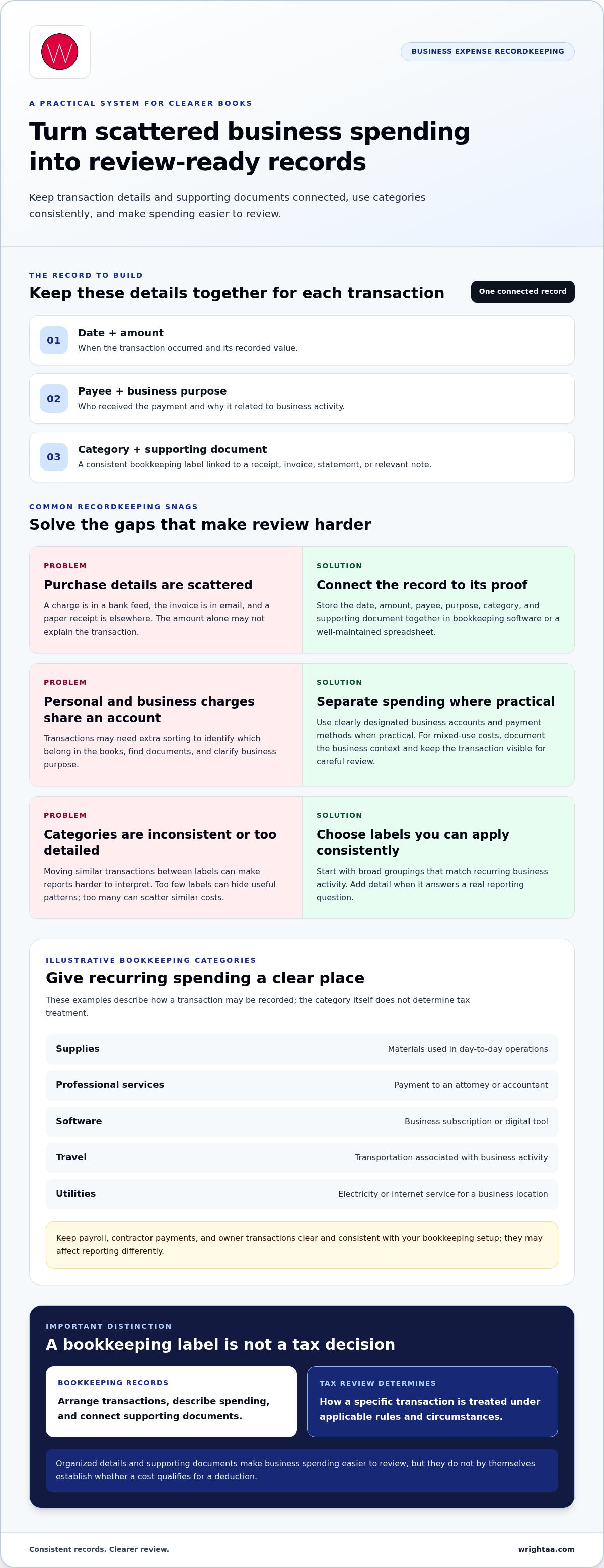
For each transaction, aim to keep a consistent record of:
- Date and amount: when the transaction occurred and its recorded value.
- Payee and purpose: who received the payment and why it related to business activity.
- Category and supporting document: the bookkeeping label and a linked receipt, invoice, statement, or relevant note.
Store these details together in your bookkeeping system or a well-maintained spreadsheet. Connecting them makes it easier to follow spending from the original purchase through account reconciliation and financial review.
Tax-ready expense records are organized transaction details and supporting documents that make business spending easier to review. They don’t, by themselves, establish deductibility.
Why separate business and personal spending?
When personal and business purchases share an account or card, each transaction may need extra attention. You may have to identify which charges belong in the books, locate the related documents, and clarify the business purpose. Using clearly designated business accounts and payment methods where practical gives you a cleaner starting point and reduces sorting during routine bookkeeping.
If a cost serves both personal and business purposes, document the business context and keep the transaction visible for careful review. Don’t assume that placing the full amount in a business category settles its tax treatment. Mixed-use expenses can require additional documentation and tax review; the applicable rules depend on the type of cost and circumstances.
A consistent system doesn’t promise a particular tax result. It gives each transaction a clear place and preserves the context needed for review. Regular bookkeeping, reconciled accounts, and connected documentation help business owners approach tax preparation with more coherent records and a clearer view of spending.
Choose Expense Categories That Make Business Spending Easier to Review
Categories give each transaction a consistent place in your books. Their purpose is practical: to show what the business spends money on and make financial reports easier to read. A useful chart of accounts reflects how your business operates, not every category another company happens to use. Clear labels also help you compare spending across periods and spot entries that may need a closer look.
Which expense categories can a small business start with?
Begin with broad groupings that match recurring activity. The examples below are bookkeeping records, not tax advice. A category describes how a transaction is recorded; it doesn’t determine whether the cost is deductible. Review tax treatment using current IRS guidance and your business circumstances.
| Bookkeeping category | Illustrative transaction recorded |
|---|---|
| Supplies | Materials used in day-to-day operations |
| Professional services | Payment to an attorney or accountant |
| Software | Business subscription or digital tool |
| Travel | Transportation associated with business activity |
| Utilities | Electricity or internet service for a business location |
Some transactions deserve distinct treatment rather than being folded into a broad operating-cost label. Payroll, contractor payments, and owner transactions can affect reporting differently, so keep categories clear and consistent with your bookkeeping setup. If an item’s tax treatment is uncertain, preserve its details for review instead of treating the category as a tax decision.
How should you tailor categories to your business?
A professional service firm may want visibility into software, professional fees, and costs tied to client work. An e-commerce business may need useful distinctions for inventory-related purchases, shipping, and payment processing. The right level of detail depends on what helps you understand the business, not on how long the category list is.
Start with categories you can apply consistently. Add a more specific label when it answers a real reporting question, such as whether a particular kind of cost is rising or how spending differs across business activities. Too many near-duplicate labels can scatter similar transactions and make reports harder to interpret. Too few can hide meaningful patterns. Aim for a structure that is simple to maintain and detailed enough to support decisions.
Consistent labels also give customized financial reporting a stable foundation. If the same kind of transaction moves between categories from month to month, comparisons lose clarity. For a closer look at how bookkeeping structure supports financial visibility, explore small business accounting in Buffalo, NY. A thoughtful category structure makes spending easier to review and reports more useful. Bookkeeping and tax planning can then connect that day-to-day picture with year-round financial oversight. Learn how bookkeeping and tax planning support fits into that broader process.
A Repeatable Workflow for Recording and Reconciling Business Expenses
A dependable expense process is a short sequence, repeated from the moment a purchase happens through review of the books. It works whether you use bookkeeping software or a well-maintained spreadsheet. The right tool is one you can keep current and use to connect transaction details, categories, and supporting evidence.
How do you capture and categorize expenses as they happen?
Record the details while the purchase is still easy to recall. Include what was purchased, who was paid, the business purpose, and the category that best describes the transaction. Attach or link the receipt or invoice to the entry, so the explanation and evidence stay together rather than requiring a separate search later.
If the purpose or classification isn’t clear, don’t guess. Mark the entry for follow-up, preserve the available documentation, and return to it during review. A temporary note such as “confirm purpose” is more useful than assigning a confident but possibly inaccurate category.
Use this five-part workflow as the structure for how to organize business expenses for taxes throughout the year:
- Capture: Enter the transaction details in your bookkeeping system or spreadsheet.
- Categorize: Apply the consistent bookkeeping label that best describes the spending.
- Attach evidence: Link the receipt, invoice, statement, or relevant business-purpose note.
- Reconcile: Compare recorded activity with statements from the relevant bank, credit card, or payment accounts.
- Review: Resolve entries that are missing information, duplicated, or assigned to a category that doesn’t fit.
How does reconciliation improve expense records?
Reconciliation means comparing what your books show with the activity recorded by the related financial account. Work through the entries and look for statement charges that aren’t in your books, entries that appear more than once, or amounts and dates that don’t line up. Investigate differences and make corrections with a note or supporting record where needed, rather than treating an unexplained balance as settled.
Reconciliation brings recorded spending and account activity into agreement, helping surface missing or miscategorized transactions before you rely on the reports.
Choose a recurring review rhythm that suits your transaction volume and how your business operates. A business with frequent activity may need a different routine from one with fewer transactions. The important point is to make review a regular part of bookkeeping rather than leaving every question for year-end. Consistent bookkeeping and full reconciliation of balance-sheet accounts can help keep the wider financial picture coherent, too.
Reliable records make financial reports more useful because the figures have been checked against account activity. That foundation supports clearer comparisons and a more informed view of business performance, including the financial KPIs small business owners may use to understand their operations.
Receipts, Mixed-Use Costs, and Other Recordkeeping Questions to Resolve
A transaction entry tells you that money moved. Supporting documents help explain what the payment was for and why it appears in the business records. Receipts, invoices, account statements, and concise business-purpose notes can each add context. Together, they make it easier to review a charge without relying on memory or treating a bookkeeping label as proof that an expense qualifies for a tax deduction.
What supporting documents should accompany an expense?
Where available, match a receipt or invoice to the transaction it supports. A statement can help confirm that a payment cleared, while a note can explain an unusual purchase or its business context. For mixed-use costs, record what portion or use relates to the business as information for review. Keep the note factual, and don’t assume that recording a business purpose settles the tax treatment.
Store records in a secure, searchable location, using a consistent naming or filing approach so documents can be found by date, payee, or transaction. A digital copy and a separate backup can help preserve access if a device or folder becomes unavailable. Choose a method that fits your workflow, and make sure supporting files remain connected or easy to match to the bookkeeping entry.
Cash purchases and reimbursements need particular care because a card or bank feed may not provide the full story. For a cash expense, note the date, amount, payee, purpose, and any available receipt. For a reimbursed purchase, retain the original documentation and a record of the reimbursement, so the underlying cost and repayment aren’t mistaken for separate expenses.
How can you prepare records for year-end review?
Before tax preparation, review the books for uncategorized entries, unresolved differences, and transactions without supporting documents. Gather missing context while the purchase is still familiar. If you can’t determine the appropriate tax treatment, keep the transaction visible with a clear question rather than making an unsupported assumption or deleting the record.
Organizing records and determining deductibility are related, but distinct tasks. A receipt can support review; it doesn’t automatically establish that a cost is deductible. Documentation and retention rules can depend on the transaction and applicable federal and New York State requirements. Check current IRS and New York State guidance for the specific rules that apply, rather than relying on a general rule of thumb.
This is one reason a steady recordkeeping process matters. Clean, reconciled books give business owners and tax preparers a clearer set of information to review, while tax planning can connect that year-round financial picture to tax decisions. For broader context, explore strategic business tax planning in Buffalo, NY.
Wright CPAs provides bookkeeping and tax preparation support to help business owners keep records organized for year-end review.
Turn Organized Expenses Into Tax-Ready Books With a Clear Next Step
An expense system becomes useful when it holds together beyond the transaction itself. Categories show where spending belongs, consistent entries keep records current, supporting documents add context, and reconciliations help confirm that the books reflect account activity. Together, these practices give you a more coherent foundation for tax preparation and financial review, without guaranteeing a particular tax outcome.
To put how to organize business expenses for taxes into practice, carry these habits forward:
- Choose clear categories that describe the way your business operates and support useful reporting.
- Record transactions consistently and preserve relevant details while the purpose is easy to recall.
- Retain supporting documents in a system where they can be found and matched to entries.
- Review reconciliations and resolve unclear items rather than leaving them unexplained.
When can bookkeeping support make expense organization easier?
A steady bookkeeping practice helps maintain this structure across the year. Accurate monthly, quarterly, or annual bookkeeping can keep transactions and supporting records organized at a cadence suited to the business. Full reconciliation of balance-sheet accounts helps check that account activity is reflected in the books, while customized financial reporting can make the resulting information easier to interpret.
That distinction matters. A set of categorized transactions is a starting point; reviewed books offer a clearer picture of business activity. Tax-ready books can make it easier to gather information for tax preparation, while ongoing review and oversight help keep questions visible instead of allowing them to accumulate. These practices support clarity, not a promised deduction or tax saving.
What should you carry into a tax-planning review?
Bring organized books, supporting documents, and a short list of transactions that still need explanation. Include questions about mixed-use costs, unusual purchases, or entries whose tax treatment you’re unsure about. Clear questions give the review a useful focus, while complete records help connect bookkeeping with tax preparation and proactive tax strategy.
Bookkeeping and tax planning work best as related parts of year-round financial management. Clean records can help inform comprehensive tax planning and make financial reporting more meaningful, but they don’t predetermine the outcome. The goal is a dependable view of the business that supports thoughtful review and decisions grounded in the records.
Wright CPAs supports business owners with bookkeeping, Tax-Ready Books, full balance-sheet reconciliation, customized financial reporting, and ongoing review and oversight. Keep records current, note what needs attention, and use that information to guide tax preparation and planning.
Explore Wright CPAs' tax and accounting services for bookkeeping and tax-planning support built around clearer records and more useful financial insight.
Make Clear Records Part of Your Year-Round Practice
The best time to strengthen your expense process is before the next busy stretch begins. Choose one improvement you can maintain, then make it part of how your business operates. A steady approach to how to organize business expenses for taxes can make financial review feel less like a seasonal scramble and more like a useful part of running the business.
As your records become more consistent, they can serve a purpose beyond tax preparation. Wright CPAs connects Tax-Ready Books with proactive tax planning, full balance-sheet reconciliation, customized financial reporting, and ongoing review. That support can help you work from a clearer financial picture, while keeping tax decisions grounded in organized information rather than assumptions.
You don’t need to make every part of your process perfect at once. Start with a clear next step and build from there. Explore Wright CPAs' tax and accounting services for support with bookkeeping and tax planning. A thoughtful system can bring greater confidence to the work ahead.
Frequently Asked Questions
What business expense records should I keep for taxes?
Keep records that show what a payment was for and how it relates to your business. Alongside transaction details and supporting documents, retain relevant mileage logs, contractor payment records, payroll reports, and reimbursement details when they apply. A practical answer to how to organize business expenses for taxes is to make each entry understandable to someone reviewing it later, not just to the person who made the purchase.
How long should a business keep expense receipts and records?
The IRS generally recommends keeping records that support a tax return for at least three years from the filing date, but some situations call for longer retention. Employment tax records, for example, have a different period. New York State requirements may also affect what to keep. Business owners in Buffalo, Rochester, and Syracuse should check current federal and state guidance for the record type and circumstances rather than applying one timeline to every document.
Can I deduct a business expense if I do not have a receipt?
Missing a receipt doesn’t automatically determine whether a cost is deductible, but you’ll still need a reliable record to support review. The IRS allows a limited exception to documentary evidence requirements for many expenses under $75, but a record of the expense is still needed, and lodging is treated differently. If a receipt is missing, gather available statements or invoices and write down the date, amount, payee, and business context.
Is it okay to pay business expenses with a personal account?
You can record a business purchase paid from a personal account, but separating payment methods usually makes the books easier to follow. Enter the business transaction with its supporting information, then record how the payment was handled, such as an owner-paid expense or a reimbursement, using the bookkeeping treatment appropriate to your business. Keep personal purchases out of business expense records, and take extra care if your business has a separate legal structure.
How should I record a purchase used for both business and personal purposes?
Record the purchase so the business and personal uses aren’t confused. For example, if a device is used for both client work and personal tasks, retain the bill and note how you determined the business-use portion. Don’t automatically enter the full purchase as a business expense. The method and tax treatment can depend on the item and your circumstances, so leave the details clear for tax review.
What happens if I find a business expense after my books are reconciled?
Keep the document and add the missed transaction through your bookkeeping process rather than ignoring it or quietly changing a reconciled total. Note when you found it and which account or period it relates to, then check whether the change affects the reconciliation or a report already prepared. If the books have been closed or used for tax filings, have the adjustment reviewed before changing prior-period records.
Can digital copies of business receipts be used for tax records?
Yes. The IRS accepts electronic records when they’re legible, accurate, and can be made available upon request. Capture the whole receipt, including the date, merchant, and transaction details, and connect it to the matching entry. Use searchable file names or folders and keep a backup so a device issue doesn’t leave you without the record. Check that images remain readable before discarding paper copies.


