

What if your books could do more than record what has already happened? Thoughtful accounting for medical practices Syracuse physicians use connects everyday transactions to a clearer view of cash flow, tax responsibilities, and decisions ahead.
Basic bookkeeping alone can leave important questions unanswered. A practice needs accurate, tax-ready records, but it also benefits from reconciled accounts and financial reports that make income and expenses easier to understand. With those pieces in place, owners can make decisions using a more complete picture of the practice’s finances.
This article explains the financial systems that can support a medical practice, from consistent bookkeeping and customized reporting to cash-flow management and year-round tax planning. Wright CPAs serves physicians and other business owners in Syracuse, Buffalo, and Rochester with bookkeeping, tax planning and preparation, payroll solutions, and CFO-level guidance. The focus is practical: cleaner books, a clearer understanding of the numbers, and more informed business decisions.
Key Takeaways
- See how accounting for medical practices Syracuse can connect organized books with clearer reporting and better-informed practice decisions.
- Understand how regular bookkeeping and balance-sheet reconciliation support a reliable financial record.
- Compare bookkeeping, payroll, tax preparation, planning, and reporting support with the needs your practice is addressing.
- Use a practical review sequence to organize records, interpret reports, assess cash flow, and guide tax-planning conversations.
- Learn how Wright CPAs serves practices in Syracuse, Buffalo, and Rochester from its Rochester headquarters.
Accounting for Syracuse Medical Practices Starts with Financial Clarity
Clinical work and business finances require different kinds of attention. Patient care calls for focus in the moment; financial oversight calls for a steady view of activity over time. A search for “accounting for medical practices Syracuse” often reflects a practical question: do your books help you understand how the practice is operating, or do they only record what has already happened?
Practice accounting brings together bookkeeping, financial reporting, cash-flow visibility, and tax planning. The goal isn’t to predict every change or promise a particular result. It’s to create a dependable financial picture that helps an owner assess the practice, identify questions, and make decisions with better information.
What does accounting for a medical practice cover?
Bookkeeping records and organizes financial activity, such as income received and expenses paid. Financial reports arrange those records into information an owner can review, including how income and expenses relate over a period. Tax preparation uses financial records to support filing, while tax planning brings tax considerations into business decisions before filing time. Together, these functions provide more context than an annual return alone.
Why do Syracuse practice owners need a clear financial picture?
Useful reporting can help an owner compare planned spending with actual activity, see how cash is moving, and assess which priorities fit available resources. For example, a report may prompt a closer look at timing when recorded income and cash received don’t align. That visibility doesn’t make the decision for you. It gives you a clearer basis for weighing options in your practice’s circumstances.
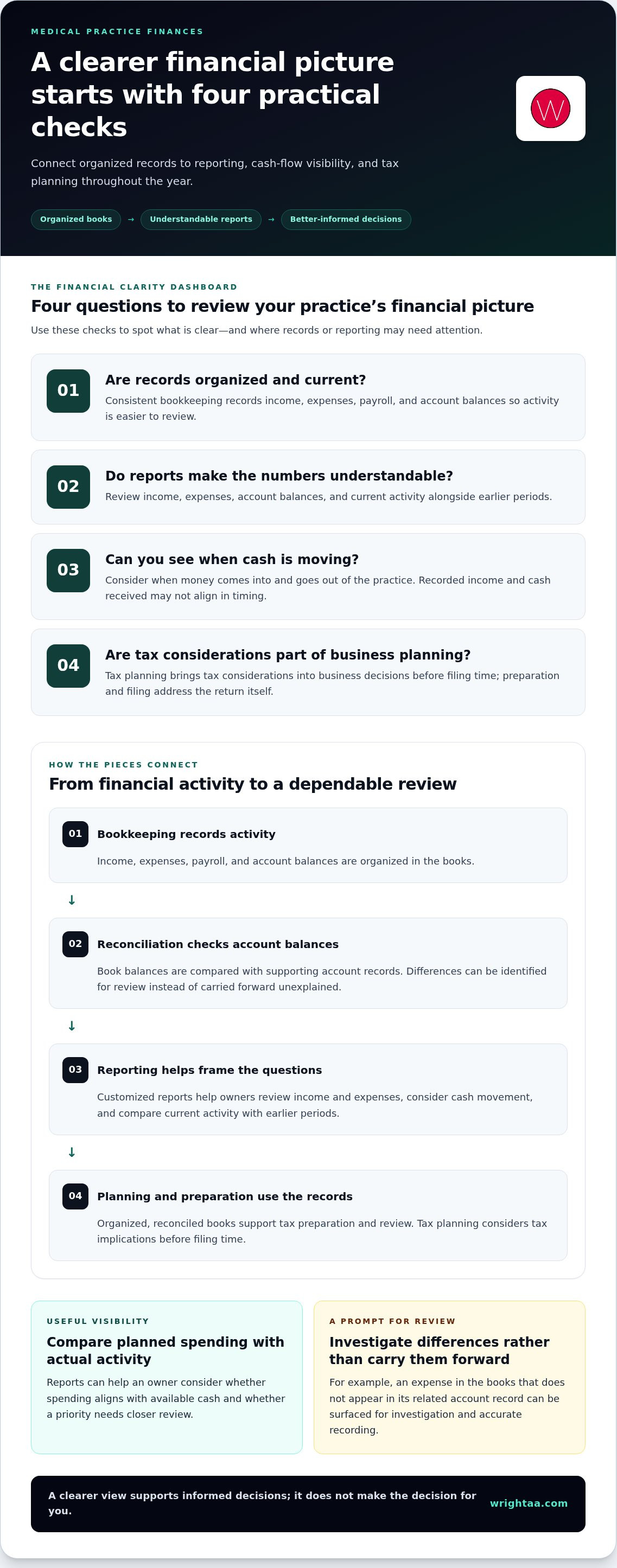
A practical first review can focus on a few questions:
- Are financial records organized and current enough to review?
- Do reports make income, expenses, and account balances understandable?
- Can you see when money is coming into and going out of the practice?
- Are tax considerations part of business planning, rather than only filing-time discussions?
The answers can show where your financial picture is clear and where it needs attention. A steady review also distinguishes ongoing oversight from a once-a-year look at the books. Tax preparation remains important, but it focuses on filing. Regular bookkeeping, reporting, and cash-flow review provide context throughout the year, so questions about budgeting and priorities can be considered before the next return is due.
Clarity starts with organized records, understandable reports, and planning that looks beyond the last reporting period. These foundations help practice owners make financial decisions with a fuller view, while keeping the distinct work of managing the business in perspective alongside clinical priorities.
Build a Reliable Accounting Foundation with Books, Payroll, and Reporting
Clear financial decisions depend on records that hold together. For a Syracuse practice, consistent bookkeeping creates an organized history of activity, making it easier to review transactions, prepare tax records, and understand what the numbers represent. Accounting for medical practices Syracuse owners rely on should connect recordkeeping to reporting and payroll support, rather than treating each task as separate.
How do clean books support a medical practice?
Bookkeeping organizes activity such as income, expenses, payroll, and account balances. Reconciliation adds an important check: the balances in the books are compared with supporting account records, and differences are identified for review. Full reconciliation of balance-sheet accounts helps keep financial records consistent and brings unexplained amounts to attention instead of carrying them forward from one period to the next.
That work supports financial reviews and tax preparation. If an expense appears in the books but not in the related account record, for example, reconciliation can surface the discrepancy for investigation and accurate recording. It doesn’t replace the owner’s judgment; it gives that judgment a more dependable starting point.
Which financial reports help owners see what is happening?
Reports are most useful when they answer the questions a business needs to address. Customized financial reporting can organize practice information so owners can review income and expenses, consider cash movement, and compare the current period with earlier activity. A report is more than a summary. It can focus discussion on an emerging pattern or a figure that needs explanation.
The Medical Group Management Association offers resources on medical practice financial management, a subject that shows why financial reporting matters beyond the ledger itself. Practice owners can use reports to consider whether planned spending aligns with available cash and whether a shift in priorities needs closer review. The goal is a clearer view, not a promised outcome.
Tax-ready books are organized, reconciled records that support tax preparation and review. Tax planning builds on those records by bringing tax considerations into conversations about business choices before filing time. Preparation and filing address the return itself.
Payroll is another part of an accounting foundation. Payroll solutions include preparation and filing of Form 1099s, keeping related records connected to the practice’s broader financial information. To strengthen your foundation, review whether transactions are recorded consistently, account balances are reconciled, reports answer practical questions, and payroll records are organized. Wright CPAs provides bookkeeping and financial reporting support to help bring these elements into a coherent financial picture.
Compare Accounting Support by What Your Syracuse Practice Actually Needs
Accounting support is most useful when it addresses the questions your practice needs answered. A practice with organized records but limited cash-flow insight has different needs from one still building consistent bookkeeping habits. If you’re considering accounting for medical practices Syracuse firms provide, start by identifying which financial tasks feel unclear or difficult to keep current.
| Current need | Relevant support | What it helps address |
|---|---|---|
| Transactions and account records are difficult to keep organized | Bookkeeping | Consistent financial records and reconciled accounts |
| Filing time brings unanswered tax questions | Tax preparation | Preparation and filing based on organized records |
| Business choices may affect future tax responsibilities | Tax planning | Forward-looking conversations about tax considerations |
| Payroll records and related forms need attention | Payroll services | Payroll support, including preparation and filing of Form 1099s |
| Owners need a clearer view of performance or cash movement | Financial reporting and cash-flow management | Information to support review and business decisions |
Explore Wright CPAs’ accounting and advisory approach to see how bookkeeping, reporting, payroll, cash-flow management, and tax services work together to address a practice’s financial needs.
When is tax preparation alone not enough?
Tax preparation may suit a practice with organized records and a primary need for filing. Broader, ongoing support is useful when records are hard to interpret, cash-flow questions arise between filing periods, or you want to discuss tax implications before making business decisions. Preparation addresses the return; planning considers what lies ahead. The right combination depends on the practice’s circumstances, not a standard package.
How should owners assess an accounting relationship?
Consider whether the financial work connects: are the books maintained, reports understandable, cash flow reviewed, payroll needs addressed, and tax planning considered alongside preparation? Wright CPAs serves physicians and other professional service providers with bookkeeping, customized financial reporting, payroll solutions, cash-flow management, tax planning and preparation, and CFO-level guidance. The physician practice financial tools from the American College of Physicians can help frame questions about financial indicators. For broader guidance on performance tracking, consider which financial KPIs are most relevant to your practice.
For a Syracuse practice, ongoing review can help address financial questions as they arise throughout the year, rather than only at filing time. Regular attention connects current reports with decisions about spending, priorities, and tax planning. Start by identifying what is already clear, what remains difficult to see, and which financial tasks need consistent attention.
Create a Practical Year-Round Financial Review for Your Medical Practice
A useful financial review is a repeatable process, not a last-minute scramble before filing. For a Syracuse practice, choose a review interval that fits how the business operates, then use the same sequence to move from records to decisions. The rhythm can be tailored to the practice. The key is returning to the numbers regularly enough to notice questions and bring them forward for discussion.
- Organize the records. Gather current bookkeeping information and make sure transactions and account balances are ready to review. Note incomplete or unusual items so they can be clarified rather than overlooked.
- Review the reports. Look at the financial reports for the period and compare them with earlier reports or the practice’s plans. Ask what changed, what needs explanation, and whether the information is detailed enough to support a decision.
- Assess cash flow. Consider when money is coming in and going out, along with upcoming business commitments. Reports show activity over a period; a cash-flow review helps you consider whether timing could affect the choices under discussion.
- Discuss tax planning. Bring forward business decisions that may have tax implications. Planning can help owners consider income and deductions in context, while current IRS and New York guidance should be used to verify applicable rules.
What should owners bring into a financial review?
Useful materials include current bookkeeping records, financial reports, payroll information, and a short list of cash-flow questions. For example, an owner might ask why a category changed from the previous period or how a planned purchase fits the practice’s current cash picture. Organized business information makes financial reviews and tax-planning conversations more focused. Patient records aren’t needed for this financial review.
Let the reports shape the agenda. If a balance, expense, or trend is unclear, mark it for discussion rather than assuming what caused it. This keeps the review grounded in the practice’s actual financial information and helps distinguish a recordkeeping question from a broader business decision. A consistent process also makes it easier to carry unresolved questions into the next review.
How can tax planning stay connected to business decisions?
Tax planning is more useful when it accompanies decisions, rather than being considered only after the year has closed. Owners can discuss how income, potential deductions, cash needs, and estimated-tax planning fit together as circumstances change. Specific requirements and timing can vary, so tax questions should be checked against current IRS and New York guidance rather than an outdated assumption.
For a broader New York business perspective, Wright CPAs discusses strategic business tax planning. The same discipline can help a Syracuse practice connect current records with forward-looking questions. Accounting for medical practices Syracuse owners need is most useful when a review creates a clear path from information to informed discussion, without assuming every practice follows the same plan.
Wright CPAs provides bookkeeping, financial reporting, cash-flow management, and tax planning and preparation for professional service providers, including physicians. Explore financial support for your practice and bring your questions into a more structured review.
Work with Wright CPAs for Medical-Practice Accounting in Syracuse
A medical practice needs financial support that keeps records in order and makes the information easier to use. Wright CPAs, LLC is headquartered in Rochester and serves businesses in Syracuse, Buffalo, and Rochester, including physicians and other professional service providers. For owners exploring accounting for medical practices Syracuse businesses can access, the firm brings bookkeeping, financial reporting, cash-flow management, payroll solutions, and tax planning together around the practice’s financial needs.
How Wright CPAs supports clearer practice finances
Accurate bookkeeping establishes an organized record of business activity. Reconciliation helps keep account balances aligned with supporting records, while customized reports give owners a relevant view of financial information. Together, these services make it easier to see what needs attention and prepare for a thoughtful review. Tom Wright, CPA, MST, founded the firm.
That foundation also supports proactive tax strategy. Rather than treating tax work only as a filing task, owners can bring financial information into conversations about business decisions and tax considerations. Tax planning and preparation are connected but serve distinct purposes: planning looks ahead, while preparation addresses filing. No particular tax result is assured; the value is having clearer information for the discussion.
What to expect from an ongoing financial relationship
For practices seeking continuity, Wright CPAs offers fixed-fee monthly accounting and advisory retainers. Ongoing support includes bookkeeping, financial reporting, and proactive tax strategy, creating a structure for reviewing financial information throughout the year. The scope can reflect the practice’s needs rather than assuming every physician’s business requires the same arrangement.
A continuing relationship gives owners a place to bring questions about a report, cash flow, payroll, or a decision with tax implications. Regular review connects details in the books with the broader view of the practice, keeping the focus on understandable, actionable financial information. The aim is a clearer process for reviewing the numbers, not a promise of a specific outcome.
Wright CPAs’ approach centers on clean, tax-ready books and reporting tailored to the business. Financial information can support more than filing: it can help owners understand what they’re seeing and prepare for informed conversations about what comes next. By bringing bookkeeping, reconciliations, reporting, cash-flow management, payroll, and tax planning into a connected picture, practice owners can work from a more coherent financial foundation.
For Syracuse practices looking for accounting and advisory support, explore tax, accounting, and CFO services from Wright CPAs.
Give Your Practice a Clearer Next Step
A useful next step is to identify the financial question that most often competes for your attention. Is it whether the numbers are current, how a decision may affect cash flow, or which tax considerations belong in the conversation? Naming that question gives your next financial review a clear starting point and keeps the discussion focused on what matters to your practice.
For owners considering accounting for medical practices Syracuse, the aim isn’t to add complexity. It’s to make financial information easier to work with, so business decisions can be considered with a clearer view of their context. Wright CPAs’ bookkeeping, customized financial reporting, and cash-flow management support that focus. The firm serves Syracuse, Buffalo, and Rochester from its Rochester, New York headquarters.
When you’re ready to take a more considered approach to your practice’s finances, explore Wright CPAs’ tax, accounting, and CFO services. A thoughtful conversation can help you define the questions that deserve attention and move forward with greater clarity.
Frequently Asked Questions
What accounting services does a medical practice need?
A medical practice may need bookkeeping, financial reporting, payroll support, tax preparation, and tax planning, depending on which financial tasks the owner handles internally. Start by identifying where work tends to stall: organizing transactions, understanding reports, managing payroll information, or preparing for tax discussions. The right mix can change as the practice’s structure and priorities change, so support should reflect its actual responsibilities.
Can an accountant help a medical practice with tax planning throughout the year?
Yes. Tax planning can be an ongoing conversation, not just a task near filing time. If a practice is considering a major business purchase or its income picture changes, an accountant can help review potential tax considerations and cash-flow implications. Estimated-tax planning may also be part of that discussion. Applicable rules can change, so current IRS and New York guidance should inform tax decisions.
How often should a medical practice review its financial reports?
A practice should review reports at intervals that fit its activity and decision-making needs, rather than follow a universal schedule. An owner might review them before setting a budget, considering a new expense, or discussing a change in business priorities. If reports raise unresolved questions, a more regular review rhythm can help keep them visible. Adjust the interval as the practice’s needs evolve.
What is the difference between bookkeeping and tax preparation for a medical practice?
Bookkeeping maintains the ongoing record of financial activity; tax preparation uses relevant records to prepare and file tax returns. Bookkeeping captures and organizes business transactions as they occur, while tax preparation draws on those records when it’s time to address a return. Keeping the two connected helps owners avoid treating filing as a substitute for maintaining usable records throughout the year.
Does Wright CPAs serve medical practices in Syracuse?
Yes. Wright CPAs serves physicians and other professional service providers in Syracuse, Buffalo, and Rochester. Its support includes bookkeeping, financial reporting, payroll solutions, cash-flow management, and tax planning and preparation. A practice can identify which areas would best address its current financial questions, from organizing records to bringing more context to a business decision.
What records should a medical practice organize for an accounting review?
Gather current bookkeeping records, financial reports, bank and account statements, payroll information, and relevant tax documents. It can also help to note unclear transactions and questions about upcoming business expenses or cash needs. Organize business financial materials for the review, rather than patient records. A clear set of records makes it easier to focus on the practice’s finances and identify information that needs follow-up.
Can accounting support help a medical practice understand its cash flow?
Yes. Cash-flow management helps owners examine the timing of money entering and leaving the practice, using available financial information to clarify near-term needs and commitments. For instance, a practice may compare expected expenses with the timing of receipts before deciding when to take on a planned cost. This view supports discussion and planning; it doesn’t guarantee that cash will arrive on a particular date or determine which choice is best.


