

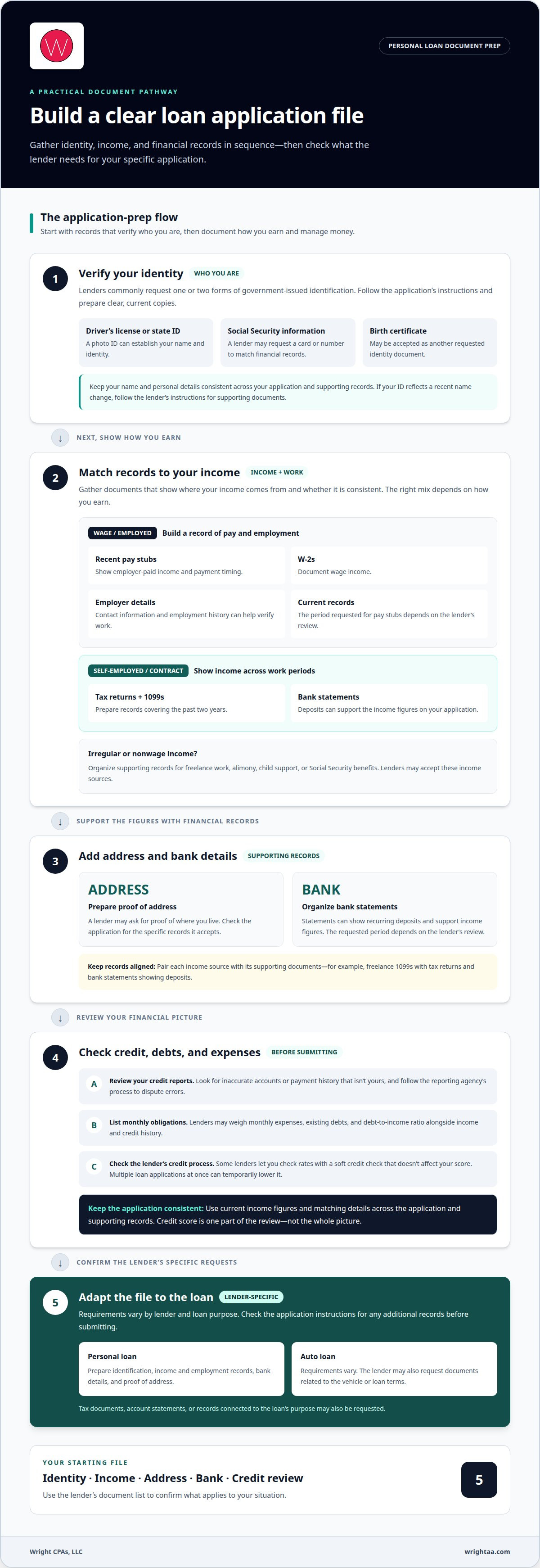
If you’re asking, “what financial documents do I need for a loan?” start with government-issued identification, proof of income and employment, proof of address, and bank details. A lender may also request tax documents, account statements, or records related to the loan’s purpose.
It’s reasonable to want a clear checklist before applying. The exact documents depend on how you earn income and the lender’s process. Knowing what financial documents you need for a loan can help you prepare a useful starting file and identify records that may need extra attention.
Whether you’re employed or self-employed, organize records that show who you are and how you manage your finances. The sections below cover identity, income, employment, and lender-specific requests, so you can prepare and adapt your documents to the application.
Key Takeaways
- Prepare government-issued identification and proof of address so the lender can confirm who you are and where you live.
- Gather income and employment records that reflect how you earn, including documents suited to self-employment or nonwage income.
- Understand how credit history, monthly expenses, debt-to-income ratio, and loan purpose may shape a personal loan decision.
- Review lender-specific requests in advance, especially if you’re consolidating debt or applying for a loan secured by collateral.
What Do I Need to Apply for a Personal Loan?
For a personal loan, prepare identification, income and employment records, bank details, and proof of address. Auto-loan requirements vary by lender, but these records are a useful starting point. The lender may also request documents related to the vehicle or loan terms.
Lenders assess credit scores alongside monthly expenses, existing debts, and the loan’s purpose. A personal loan application focuses on your personal credit profile. Business credit is more relevant when borrowing for a business, so don’t assume a business score replaces a personal credit review. For example, regular debt payments affect the monthly obligations a lender compares with income.
Review your credit reports before applying. Look for errors, such as an account or payment history that isn’t yours, and follow the reporting agency’s process to dispute inaccurate information. Accurate details matter because lenders use credit information to assess applications and make approval decisions. Reviewing your reports also gives you a clearer picture of existing debts before you submit paperwork.
Your credit score reflects information in your credit history, including how you’ve handled borrowing over time. A report review can reveal factors that may be weighing on the score, while steady repayment habits can support improvement before an application. Some lenders let you check rates using a soft credit check that doesn’t affect your score. Applying for multiple loans at once can temporarily lower it, so avoid sending applications without first reviewing the lender’s process.
Keep your records consistent. Use current income figures when reviewing monthly expenses and debt payments. Lenders may verify your employment and income, so accurate details across your application and supporting documents help them assess your finances. A credit score is only one part of the picture: a lender may also weigh expenses, debt-to-income ratio, and loan purpose when deciding whether to approve an application and what rate to offer.
Prepare identification, income and employment records, bank details, and proof of address. The lender may also request documents related to the vehicle or loan terms.
Identity documents
Personal loan lenders commonly request one or two forms of government-issued identification. These documents help verify your identity before the lender reviews financial information or processes an application. Requirements vary, so identify the documents requested in the lender’s application and prepare clear, current copies.
Common identity documents include a state-issued driver’s license or identification card, a Social Security card, or a birth certificate. A driver’s license or state ID can establish your name and identity. A Social Security card may provide the number needed to match your application with financial records. A birth certificate may also be accepted, but follow the lender’s instructions about which documents it requires.
- Prepare a government-issued photo ID. Use a current state driver’s license or ID if the lender asks for one.
- Have Social Security information available. A lender may request a Social Security card or number to verify identity.
- Keep a second document accessible. A birth certificate or another requested ID can help meet a request for multiple forms.
Use the same name and personal details across your application and supporting records. If your ID shows a recent name change, follow the lender’s instructions about supporting documents so your application can be matched accurately. Don’t substitute bank statements or payment records for identity documents unless the lender specifically accepts them for that purpose. Statements generally show financial activity, not government-issued identification.
Identity checks are separate from the lender’s review of income, credit, repayment ability, and requested loan amount. Keep sensitive documents private, and submit them through the lender’s designated process rather than sending them through an unrequested channel. For borrowing connected to a new venture, keep personal identification distinct from business setup records and explore support for forming a new business.
Income and employment verification
Gather records that show where your income comes from and whether it is consistent. Personal loan lenders may request pay stubs, tax returns, W-2s, 1099s, bank statements, employer contact information, or employment history. These records help verify income and assess eligibility alongside your application and credit report.
For a personal loan, the period covered by requested pay stubs and bank statements depends on the lender’s review and how regularly your income appears. Current records can show recurring deposits, while your employment history provides context if your income has recently changed.
Self-employed applicants may need more than a pay stub. Prepare tax returns and 1099s covering the past two years, which can help show income across changing work periods. Applicants with irregular or nonwage income can organize records for freelance work, alimony, child support, or Social Security benefits, since lenders may accept these income sources.
- Collect recent pay stubs. They show employer-paid income and the timing of payments.
- Gather tax forms. W-2s and 1099s document wage and contract income.
- Organize bank statements. Deposits can support the income figures on your application.
- Record employer details. Contact information and employment history can help a lender verify work.
For variable earnings, match each income source to its supporting document. For example, pair freelance 1099s with tax returns and bank statements showing deposits. This creates a clearer record than relying on a single recent payment or an estimate.
Income also informs the debt-to-income ratio, which compares monthly debt payments with income. A lender considers this alongside your existing obligations when assessing whether you may qualify and what loan amount fits your application. Keep reported income, monthly debt figures, and supporting records aligned so the lender can review a consistent financial picture.
Lender-specific application documents
For a personal loan, lenders commonly request proof of identity, income, address, and bank-account details. A utility bill, lease, mortgage statement, insurance proof, property tax receipt, or bank statement can document your address. For debt consolidation, have your bank routing and account numbers ready. Direct creditor payments may also require balances and account numbers.
Mortgage applications call for a broader file. Gather signed federal tax returns and W-2 forms for the last two years, pay stubs covering the last 30 days, and your two most recent bank statements. For down payment funds, provide investment or savings statements showing at least two months of ownership history. VA home loan applicants also need a certificate of eligibility.
Fannie Mae Form 1003 can serve as a starting point for collecting information commonly required by mortgage lenders. Lenders may request more records based on your finances, loan purpose, or the property. A secured personal loan may need documents about the collateral. If the lender verifies a bank account through a secure system, read-only access can let it view account information without making transactions.
- Match each item to the request. Label statements and tax forms by account or tax year.
- Submit complete, legible records. Missing pages or unclear account details can slow review.
- Keep updated copies ready. Mortgage applicants will likely need to update their application packet at least once during the process.
Common mortgage delays can arise when documents are missing, outdated, or don’t align with details in the application. For example, a changed account balance may prompt a request for a newer statement. Review the lender’s document list before submitting, then respond to follow-up requests with the specific records requested. For business borrowing, organize business financial records before submitting an application.
Wright CPAs, LLC
Wright CPAs, LLC helps business owners organize financial records when preparing for borrowing. Bookkeeping and Payroll Services support clear records of business activity and income, while Tax Planning and Preparation helps keep tax information in order. CFO Services can provide broader guidance on cash flow and business finances.
These services can be useful if you’re self-employed or applying for a loan connected to your business. Organized records can help you understand the figures behind an application, though lenders set their own document requirements and make their own lending decisions.
Contact Wright CPAs, LLC to discuss how its accounting and financial services may fit your needs.
Build a Clearer Path to Your Next Step
Knowing what financial documents you need for a loan is a practical starting point, but your application also depends on how clearly your records reflect your circumstances. Before submitting, make sure figures align across your records and that you can explain changes in income or business activity. This clarity can help you approach the process with a more grounded view of your finances.
For business owners, consistent bookkeeping and payroll records can provide a clearer financial picture. Wright CPAs, LLC offers Bookkeeping, Payroll Services, and Tax Planning and Preparation to help keep those records organized. These services support financial recordkeeping, while the lender determines its application requirements and lending decision.
If you’d like help bringing your business financial records into order, contact Wright CPAs, LLC for help. A careful next step can make the work ahead feel more manageable.
Frequently Asked Questions
How can I improve my chances of loan approval?
Review your credit reports for errors and dispute inaccurate information before applying. Then compare monthly expenses and debt payments with income so the amount you request reflects your budget. Avoid submitting multiple applications at once, since that can temporarily lower your credit score. If a lender offers a rate check using a soft credit inquiry, use it to review potential terms before deciding whether to apply.
Why do lenders ask for bank statements?
Lenders use bank statements to verify account ownership and review deposits or other financial activity relevant to an application. A statement, for example, can help show whether reported income appears in the account and provide details for loan-fund deposits. If the lender uses secure account verification, its system may allow read-only access, meaning it can view account information without making transactions.
What financial documents are needed to apply for a personal loan in the United States?
A personal loan application commonly involves verifying identity, income, employment, bank-account details, and address. The supporting records depend on your circumstances: an employee’s file may differ from a self-employed applicant’s, and debt consolidation may require creditor details. Use the lender’s application checklist as your final guide, since requested items depend on the loan purpose and verification process.
What proof of income can employees provide when applying for a loan?
Employees can provide recent pay stubs, W-2 forms, bank statements, and employer contact information when a lender requests income or employment verification. For example, pay stubs show current earnings, while a W-2 documents wages for a tax year. If income includes commissions or changes between pay periods, relevant statements and records can help explain how earnings vary over time.
What income and financial documents do self-employed borrowers need for a loan?
Self-employed borrowers may need tax returns and 1099 forms covering the past two years. Bank statements can help connect reported earnings with deposits, while organized income and expense records make business activity easier to interpret. If income varies by season or project, records from different periods can show that pattern more clearly than a single recent deposit.
Do lenders require bank statements, tax returns, or proof of assets for a loan?
Requirements depend on the loan type and the lender’s verification needs. Personal loan lenders commonly request bank statements, while mortgage applications may involve tax returns and account statements documenting funds for a down payment. A lender may also request additional records for secured borrowing or a specific loan purpose. Use the lender’s document list to distinguish required items from records that may not apply.


