

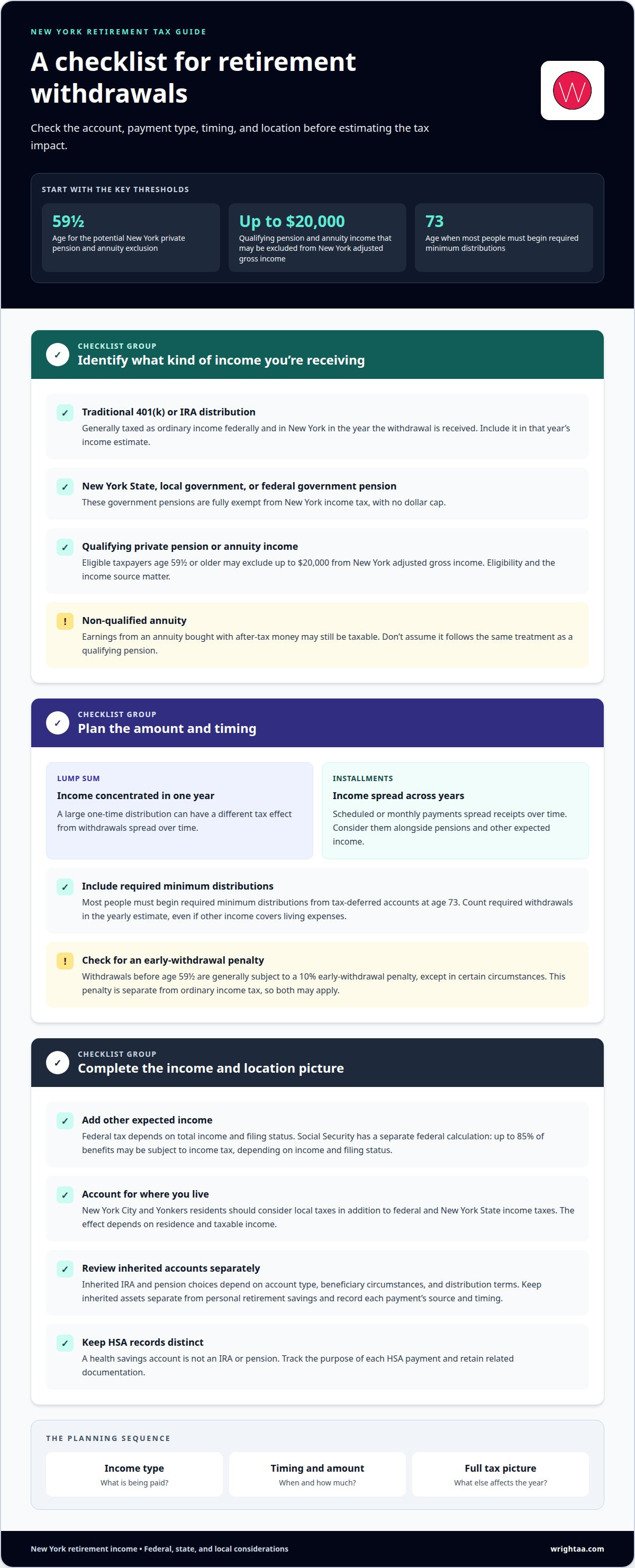
Retirement income isn’t automatically tax-free. Traditional 401(k) and IRA withdrawals are generally taxed as ordinary income federally and in New York, though eligible New Yorkers age 59½ or older may exclude up to $20,000 of qualifying pension and annuity income from state income. Tax planning for retirement accounts in NY means looking at both rules, not just the federal tax bill.
It’s reasonable to expect tax treatment to depend on the account, but the timing and size of a withdrawal can also affect what you owe. This guide explains how traditional contributions and withdrawals are treated, how New York’s retirement income exclusion works, and what additional standard deductions may be available to older adults.
You’ll also see why a large distribution can have a different tax effect from withdrawals spread over time. The goal is to clarify the choices to consider before taking money from a retirement account.
Key Takeaways
- Traditional 401(k) and IRA withdrawals are generally taxed as ordinary income, while eligible New Yorkers may qualify for a state pension and annuity income exclusion.
- According to the Internal Revenue Service, required minimum distributions from tax-deferred accounts generally begin at age 73; early withdrawals may also trigger a penalty.
- Social Security benefits can affect your federal tax picture: according to the Internal Revenue Service, up to 85% may be subject to income tax, depending on income and filing status.
- Older adults may qualify for additional standard deductions, including an age-based deduction and a temporary senior deduction subject to income limits.
Taxation of traditional retirement account distributions
Traditional retirement accounts generally defer tax until money is withdrawn. A distribution may add ordinary income to the tax return for the year it is received, so the account balance alone doesn’t show its full tax impact. Include pension income and other expected income when estimating how a withdrawal fits into your finances for the year.
Timing also matters. According to the Internal Revenue Service, most people must begin required minimum distributions from tax-deferred retirement accounts at age 73. Include those required withdrawals in a yearly income estimate before planning additional distributions. A withdrawal schedule that ignores required amounts can leave the year’s income picture incomplete.
A retirement plan distribution may be taken as a lump sum or as installments over time. Monthly payments can spread income across tax years, while a large one-time IRA distribution concentrates it in one year. Before choosing, consider how each option fits alongside pension income and other expected receipts. The amount and timing can affect your overall tax calculation.
Inherited IRA and pension distributions need separate review. The account type, beneficiary’s circumstances, and distribution terms shape the available choices and tax reporting. Keep inherited assets separate from personal retirement savings, and record the source and timing of each payment. Health savings account distributions also need distinct records. Track each payment’s purpose and retain related documentation, since an HSA is not the same account type as an IRA or pension.
New York planning also involves creditor exposure and estate value. Retirement savings may receive protection from bankruptcy creditors, but the protection depends on the account and circumstances. For deaths in 2026, New York’s estate tax basic exclusion amount is $7,350,000; estates more than about 5% above the threshold can lose the exclusion under the cliff rule. Include retirement assets when reviewing the estate’s overall value.
New York taxation of traditional 401(k) and IRA withdrawals
Traditional 401(k) and IRA withdrawals are generally taxable as ordinary income federally and in New York. Eligible residents may qualify for a state pension and annuity income exclusion, making the payment type and personal circumstances important to the state calculation.
Withdrawal Strategies and Tax Brackets
A withdrawal strategy shapes how distributions contribute to taxable income over time. A large distribution concentrates income in one year, while installments spread it across years. Federal tax depends on total income and filing status; New York applies its own tax rules. For tax planning for retirement accounts NY residents should consider how withdrawal timing, alongside pension payments, may affect annual taxable income.
Choosing Withdrawal Methods
Choosing a withdrawal method means weighing timing, payment structure, and account tax treatment. A lump sum provides the full distribution at once; scheduled payments spread receipts over time. Traditional 401(k) and IRA withdrawals are generally taxable in the year taken. Eligible taxpayers age 59½ or older may exclude up to $20,000 of qualifying pension and annuity income from New York adjusted gross income. Earnings from non-qualified annuities bought with after-tax money may also be taxable. Tax planning for retirement accounts NY residents undertake can account for these distinct income sources.
Early-Withdrawal Penalties
An early withdrawal is a distribution taken before the account holder reaches the applicable age threshold. According to the Internal Revenue Service, withdrawals from retirement accounts before age 59½ are generally subject to a 10% early-withdrawal penalty, except in certain circumstances. This penalty is separate from ordinary income tax, so a distribution may trigger both. Qualified annuities purchased with pretax money can also face a penalty before age 59½. Account type and circumstances determine whether an exception applies.
Required Minimum Distributions and Penalties
A required minimum distribution is an amount that must be withdrawn from certain tax-deferred accounts. According to the Internal Revenue Service, most people must begin required minimum distributions at age 73. Include these distributions when estimating annual taxable income, even when other sources cover living expenses. Taking less than required can bring tax consequences, so the amount due belongs in the yearly tax calculation.
New York City and Yonkers residents should account for local taxes in addition to state and federal income taxes. The effect depends on residence and taxable income.
Tax treatment of retirement contributions and withdrawals
Tax treatment depends on how contributions entered an account and how distributions are taken. Pension income, Social Security, and Roth withdrawals can each affect taxable retirement income differently.
Government and Private Pension Taxation
Government and private pensions follow different New York rules, which can change the state-tax portion of retirement income. New York State, local government, and federal government pensions are fully exempt from New York income tax, with no dollar cap. Eligible taxpayers age 59½ or older may exclude up to $20,000 of qualifying private pension and annuity income. Filing status and the income source help determine which treatment applies.
Social Security has a separate federal calculation. According to the Internal Revenue Service, up to 85% of benefits may be subject to federal income tax, depending on income and filing status.
Roth Account Tax Treatment
Roth contributions are taxed upfront, so qualified withdrawals can be tax-free in retirement. This differs from pre-tax contributions, which are generally subject to income tax when withdrawn. A qualified Roth withdrawal requires the account to have been held for at least five years and the owner to be age 59½ or older. Keeping Roth and traditional account records distinct helps clarify the tax treatment of each payment.
Contribution and Catch-Up Limits
Contribution limits set how much may be added to a retirement account, while catch-up limits allow additional contributions for eligible older savers. For 2026, IRA and 401(k) limits vary by plan type, income, and age; there isn’t one shared limit for both accounts. Catch-up eligibility and permitted amounts likewise depend on the account and age. These distinctions matter when setting contributions through payroll or direct deposits.
Taxes on Roth Conversions
A Roth conversion moves assets from a traditional IRA into a Roth IRA, and the converted amount is generally taxable federally in the year of conversion. New York residents can manage the potential tax impact by considering a partial conversion instead of converting the full balance at once. They can also assess timing alongside other income and planned withdrawals, since these amounts contribute to taxable income for the year. A conversion plan should account for both federal and New York tax calculations.
Additional standard deductions for older adults
For older taxpayers, federal deductions can reduce income subject to tax. The age-based additional standard deduction is separate from the temporary senior deduction, so filing status and eligibility affect the calculation.
Older taxpayers may be eligible for an additional standard deduction depending on their filing status. A married couple filing jointly may add $3,100 if both spouses are at least 65. A deduction can lower income subject to tax, but its effect on a tax bill depends on the taxpayer’s circumstances. A person deciding whether to itemize should compare eligible deductions with the standard deduction available for their filing situation.
A separate federal senior deduction of $6,000 is available for tax years 2025 through 2028, subject to income limits. Eligible spouses filing jointly can claim a $12,000 senior bonus deduction if both are at least 65, starting in 2025. This bonus deduction is scheduled to expire after 2028 unless Congress extends it. The age-based additional standard deduction and senior bonus deduction are distinct provisions; review their eligibility and interaction before preparing a return.
Retirement income still needs to be reported and assessed according to its own rules. Social Security benefits, pension payments, annuities, and Roth IRA distributions may each receive different tax treatment. A deduction can reduce taxable income, but it doesn’t change how each source is classified. List income sources separately before determining which deductions apply to the return.
New York residents should also distinguish federal deductions from state tax calculations. A federal deduction doesn’t automatically determine New York’s treatment of pension income or other distributions. Consider filing status, age, income, and income sources together when reviewing both returns. Estate planning is another consideration: an income tax deduction affects a current return, while estate tax planning concerns assets transferred at death.
For a coordinated review of retirement income and deductions, plan your tax filing with these factors in view.
Wright CPAs
Wright CPAs helps individuals consider retirement account decisions as part of their broader tax picture. Its tax planning and preparation can bring federal and New York income, pension payments, account withdrawals, and available deductions into one review. This can be useful before a Roth conversion, a large distribution, or a change in regular retirement income.
For people balancing retirement income with business or household cash flow, CFO-level financial guidance can help clarify how those pieces interact. The goal is a considered view of current tax obligations and future choices, grounded in your financial circumstances.
To discuss your retirement tax planning, contact Wright CPAs.
Give Your Retirement Decisions a Clear Next Step
Retirement income changes over time, and the choices around it may change too. Treat each major decision as part of a wider financial picture, rather than an isolated transaction. This perspective can bring greater clarity to tax planning for retirement accounts in NY as your priorities evolve.
Wright CPAs connects tax planning and preparation with the records that support informed decisions. Bookkeeping and payroll services can also help households managing business income alongside retirement income keep financial details organized. A review can be useful when you’re considering a change in how you draw income or preparing for a new tax year.
Contact Wright CPAs about retirement tax planning to discuss the decisions ahead. A considered plan can make the next step feel more grounded.
Frequently Asked Questions
Is retirement income taxable?
Some retirement income is taxable, but treatment depends on its source and the account rules. Traditional account withdrawals and pension payments may be taxable, while qualified Roth withdrawals can be tax-free. Social Security benefits may also be taxable federally: according to the Internal Revenue Service, up to 85% may be subject to income tax, depending on income and filing status. Reviewing each income source separately helps you prepare an accurate return.
Does New York tax 401(k) and IRA withdrawals?
Generally, yes. New York includes traditional 401(k) and IRA withdrawals in taxable income, although eligible taxpayers may use the state’s pension and annuity income exclusion for qualifying income. To understand how it applies, distinguish account withdrawals from other pension payments and consider age eligibility. Keeping distribution records separate by account and payment type can make the state tax calculation clearer.
How does tax diversification help retirement planning?
Tax diversification means holding savings across taxable, tax-deferred, and tax-advantaged accounts. This mix can offer flexibility because withdrawals from different account types may receive different tax treatment. For example, a retiree with traditional and Roth savings may have more than one source to consider as income needs change. The value is having options, not assuming one account type will always be preferable.
What does tax planning include?
Tax planning considers how financial choices affect tax liability under current law. It can include estimating income and cash needs, coordinating distributions, reviewing asset sales, considering tax-advantaged strategies, and accounting for estate-related tax implications. For example, someone planning a large asset sale and retirement withdrawal in the same year can review both together. This broader view connects individual decisions with the overall tax picture.
What’s the difference between tax-free and tax-deferred?
Tax-free means qualifying income or a distribution isn’t subject to income tax under applicable rules. Tax-deferred means tax is postponed, not eliminated, until a later event such as a withdrawal. Traditional retirement savings generally defer tax on contributions until distribution, while qualified Roth withdrawals can be tax-free. The distinction matters when estimating future taxable income and deciding which account to draw from.
How are traditional IRA and 401(k) withdrawals taxed in New York State?
Traditional IRA and 401(k) distributions are generally included in New York taxable income, as well as in the federal calculation. Eligible taxpayers may exclude qualifying pension and annuity income under New York rules, so the type of payment and the taxpayer’s age matter. A useful return-preparation step is to reconcile distribution statements with pension records, then review how each amount is reported for state purposes.


