

What if exercising stock options creates a tax bill before you sell the shares? The answer depends on the option type and timing: nonqualified options generally create wage income at exercise, while incentive stock options may trigger alternative minimum tax. A later sale can create capital gains or losses, and the holding period affects how the gain is treated. Thoughtful tax planning for stock options brings these events into view before they shape your tax bill.
It’s natural to focus on the exercise price and the shares’ potential value. But the cash needed to exercise, taxes due before a sale, and the sale’s timing can all affect your decision.
This guide explains how NSO and ISO exercises are taxed, what changes when you sell shares, and how gains, losses, and tax projections fit into planning. You’ll learn which details matter and why the right timing depends on your broader tax picture.
Key Takeaways
- Identify whether your awards are incentive or nonqualified options, since the option type shapes when tax consequences arise.
- Map exercise and sale dates together to understand how share-holding periods can affect the tax character of a gain.
- Include possible alternative minimum tax exposure in your ISO exercise decision, not just the cash needed to buy shares.
- Use income projections and planned sale timing to assess how exercising options may fit into your broader tax picture.
How are stock options taxed?
Tax depends on the option type and when you exercise or sell the shares. The distinction matters because exercising can create taxable income or alternative minimum tax before a sale.
Taxation at Grant, Exercise, and Sale
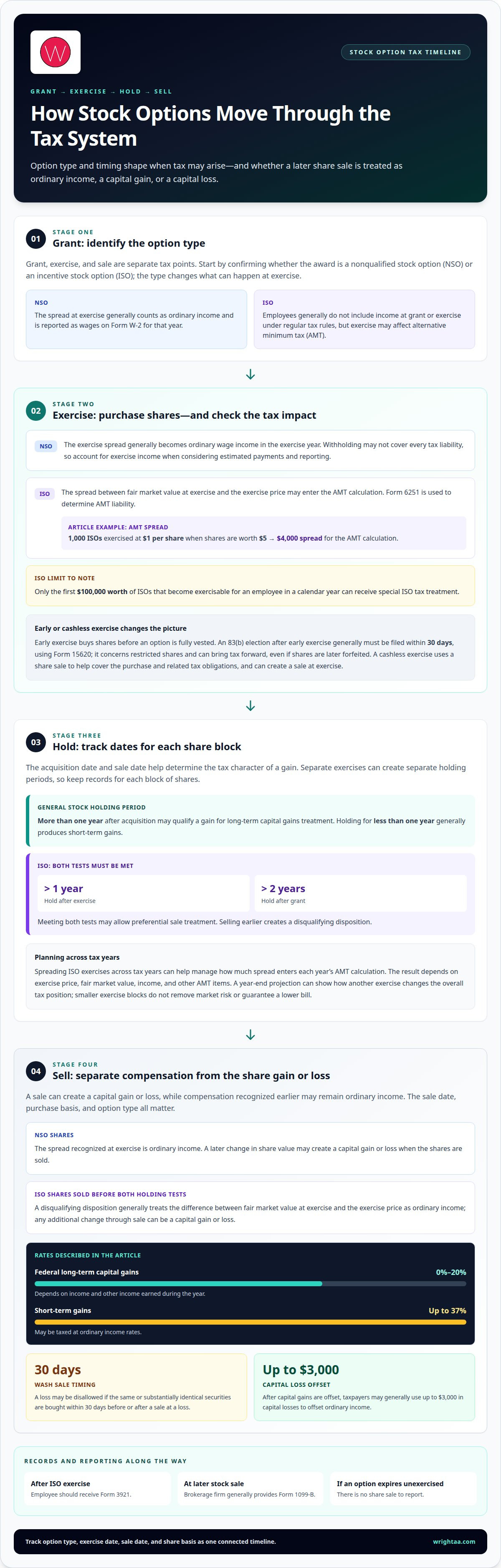
Grant, exercise, and sale are separate tax points, and each can affect the amount and character of taxable income. For a nonqualified option, the spread at exercise generally counts as ordinary income and is reported as wages on Form W-2 for that year. Employees generally don’t include income when they receive or exercise a statutory option under regular tax rules, though an ISO exercise may affect minimum tax.
If an option expires unexercised, there’s no share sale to report. After exercising an ISO, the employee should receive Form 3921; a brokerage firm generally provides Form 1099-B for a later stock sale. Withholding may not cover every tax liability, so estimated payments and reporting should account for exercise income and potential AMT.
Early and Cashless Exercise Strategies
Early exercise means buying shares before an option is fully vested, while a cashless exercise uses a share sale to help cover the purchase and related tax obligations. These choices affect when you need cash and how long you may hold shares after exercise. They also determine which records matter when calculating basis and reporting a later sale.
An 83(b) election after an early exercise generally must be filed within 30 days, using Form 15620. That election concerns restricted shares and can bring tax forward, even if shares are later forfeited. A cashless transaction can create a sale at exercise, so the sale’s tax treatment may differ from holding the shares.
ISO Exercise Limits and Alternative Minimum Tax
ISOs can receive special tax treatment, but the annual exercisable amount is limited. According to the Internal Revenue Service, only the first $100,000 worth of incentive stock options that become exercisable for an employee in a calendar year can receive special ISO tax treatment.
For AMT calculations, the employee may need to include the difference between the shares’ fair market value at exercise and the exercise price. For example, exercising 1,000 ISOs at $1 per share when shares are worth $5 creates a $4,000 spread for the AMT calculation. IRS Form 6251 is used to determine AMT liability.
Exercise Timing Across Tax Years
Spreading ISO exercises across tax years can help manage how much of the spread enters each year’s AMT calculation. The result depends on the exercise price, fair market value, income, and other AMT items. A year-end projection can show how an additional exercise changes your overall tax position before the calendar year closes.
Exercise timing also affects the holding period and potential tax treatment of a sale. Exercising in smaller blocks may spread tax exposure across years, but it does not remove market risk or guarantee a lower bill. Tax planning for stock options weighs timing alongside available cash, expected income, and plans for the shares.
Capital gains and losses on stock sales
A share sale can produce a capital gain or loss, while compensation recognized earlier may remain ordinary income. The sale date, purchase basis, and option type all affect how the transaction is reported.
Ordinary Income and Capital Gains Rates
Ordinary income and capital gains are taxed under different rate structures, so the source of each amount matters. Federal long-term capital gains rates range from 0% to 20%, depending on income and other income earned during the year. Short-term gains may be taxed at ordinary income rates, which can reach 37%.
For NSO shares, the spread recognized at exercise is ordinary income; a later change in value may create a capital gain or loss when you sell. Keep those amounts distinct when calculating the sale result. The distinction also matters for ISO shares sold before their required holding periods, when part of the transaction may be treated as ordinary income.
Capital Gains Holding Periods
For most stock, the holding period helps determine whether a gain is short-term or long-term. Shares held for more than one year after acquisition may qualify for long-term capital gains treatment; shares held for less than one year generally produce short-term gains.
Track the acquisition date and sale date for each block of vested shares, since separate exercises can create separate holding periods. A sale at a loss has its own timing concern: according to the Internal Revenue Service, the wash sale rule can disallow a tax loss when an investor buys the same or substantially identical securities within 30 days before or after selling at a loss. After capital gains are offset, taxpayers may generally use up to $3,000 in capital losses to offset ordinary income, according to the Internal Revenue Service.
ISO Holding Periods and Capital Gains
ISOs receive preferential sale treatment only when both holding-period tests are met: the shares must be held more than one year after exercise and more than two years after grant, according to the Internal Revenue Service. The Internal Revenue Service describes a holding period of more than one year after exercise and more than two years after grant for long-term capital gains treatment.
Selling earlier creates a disqualifying disposition. The difference between fair market value at exercise and the exercise price generally becomes ordinary income; any additional change through sale can be capital gain or loss. Compare the tax result with the risk of holding a concentrated position. A CFO-level cash-flow perspective can help connect sale timing with liquidity needs.
Incentive stock option (ISO) taxation
For an employee, ISO taxation involves both regular income tax and the alternative minimum tax (AMT). Grant and exercise generally create no regular-tax income, but exercise can create an AMT adjustment; later sale treatment depends on the holding period.
ISO Alternative Minimum Tax
AMT is a parallel federal calculation that can make exercising an ISO taxable before you sell the shares. The spread matters even if you keep the shares and receive no sale proceeds.
Calculate the spread by subtracting the exercise price from the stock’s fair market value at exercise. For example, exercising 1,000 ISOs at $1 per share when shares are worth $5 creates $4,000 for the AMT calculation. IRS Form 6251 is used to determine whether a taxpayer is subject to federal AMT and to calculate the associated taxes, according to the Internal Revenue Service.
For 2026, the federal AMT exemption is $90,100 for single filers and $140,200 for married couples filing jointly. Federal AMT rates are 26% or 28% on AMT income above the exemption, so other income and deductions can affect the result.
Tax Differences Among ISOs, NSOs, and RSUs
ISOs, nonqualified stock options (NSOs), and restricted stock units (RSUs) differ in when income is recognized and how exercise or vesting affects taxes. Understanding those differences helps you estimate cash needs and identify which records belong to each equity award.
An NSO generally creates ordinary income at exercise, based on the difference between the share value and exercise price. RSUs generally create wage income when shares vest. An ISO generally creates no regular income tax at grant or exercise, although its exercise spread may affect AMT.
For an ISO sale to receive the described long-term capital gains treatment, the Internal Revenue Service requires a holding period of more than one year after exercise and more than two years after grant. Selling before meeting both periods can create a disqualifying disposition, with ordinary income generally arising on the spread at exercise. A tax projection can compare the exercise spread, AMT exemption, and other income before you decide how many options to exercise.
Tax planning for stock options
A useful plan connects award terms, exercise timing, cash needs, and a possible sale. Treat each decision as part of one timeline, because exercising can create taxes before shares produce cash.
Start by listing each award’s option type, grant date, vesting status, exercise price, expiration terms, and available shares. Add the current fair market value used for planning, expected income, and any planned sale. This overview helps distinguish compensation at exercise from later changes in share value.
Next, compare potential exercise amounts across tax years. For ISOs, model the spread between fair market value and exercise price alongside other income and the AMT calculation. A year-end projection can show how another exercise affects your tax picture. Exercising smaller blocks across multiple years may help manage AMT exposure while preserving the possibility of meeting ISO holding periods.
Cash planning matters too. Estimate the exercise payment and potential tax separately from the shares’ paper value. A private-company share may be difficult to sell promptly, so a plan should account for liquidity rather than treating the quoted value as cash. If employment ends, review option expiration terms promptly; ISOs generally have a 90-day post-termination exercise window before unexercised options may convert to NSOs.
Keep reporting aligned with the plan. Match W-2 compensation, Form 3921 information, and Form 1099-B sale proceeds to the correct award and share lots. Reconcile the reported sale proceeds with the shares’ tax basis so a prior exercise adjustment does not distort the gain or loss.
Other equity awards may need separate treatment. An eligible employee may use an 83(i) election to defer tax on qualifying NSO exercises or RSU settlement for up to 5 years. A qualified employee stock purchase plan is generally a Section 423 plan, with its own holding-period considerations.
For a coordinated projection of exercise choices, sale timing, and tax reporting, discuss your stock option tax plan.
Wright CPAs, LLC
Wright CPAs, LLC helps individuals bring option exercises, share sales, and tax reporting into a clearer financial plan. Its Tax Planning and Preparation services can help assess how award timing and other income affect your tax position, while bookkeeping helps keep transaction records organized. When exercise costs or a potential tax bill affect broader cash decisions, CFO Services and Cash Flow Management can help you consider those choices alongside other financial commitments.
Consider working with Wright CPAs, LLC before exercising options, near year-end when reviewing projected income, or after selling shares as you prepare tax records. The goal is to connect tax treatment with the timing and cash flow of your decisions. Contact Wright CPAs, LLC to discuss your stock option tax questions.
Give your next equity decision a clear financial frame
Your option plan should stay connected to the rest of your financial life. A change in compensation, a planned share sale, or a shift in cash needs can affect which choice is workable. Revisit your plan’s assumptions when circumstances change, so decisions about equity remain grounded in your broader financial picture.
Thoughtful tax planning for stock options is an ongoing process, not a single calculation on the exercise date. Wright CPAs, LLC can help clarify tax considerations and financial records, including how payroll withholding relates to compensation income. That clarity can help you consider your next move without treating potential share value as cash you already have.
For guidance shaped around your circumstances, contact Wright CPAs, LLC about your stock option tax questions. A considered next step can help you move forward with greater confidence.
Frequently Asked Questions
What are the tax implications of ISOs?
ISOs can affect both regular income tax and alternative minimum tax, with the later sale shaping the final treatment. Keep grant, exercise, and sale records together so you can trace each share lot and its basis. If you sell shares before meeting the required ISO holding periods, the sale may be a disqualifying disposition, changing how part of the gain is taxed.
What are the tax implications of NSOs?
For an NSO, the difference between a share’s value at exercise and the exercise price is generally treated as ordinary compensation income. That income can affect withholding and the amount due when you file. A later sale creates a separate gain or loss based on the sale price and tax basis, so keep both the exercise details and brokerage statement.
What is AMT?
Alternative minimum tax is a separate federal tax calculation that can change the tax due beyond the regular income tax calculation. For an ISO exercise, the spread between fair market value and the amount paid may enter the AMT calculation, even without a share sale. Form 6251 helps determine whether AMT applies, so preserve the exercise information used to calculate the spread.
What is stock-based compensation?
Stock-based compensation is pay connected to an employer’s shares or their value. It can include stock options, restricted stock units, and employee stock purchase plan shares. The award type determines when compensation is recognized and what happens at sale. For example, an RSU recipient should track the vesting date and shares received, then keep those records for a future sale.
What is the $100,000 rule for ISO?
The $100,000 rule limits how much of an employee’s incentive stock options can receive special ISO tax treatment based on the options that first become exercisable in a calendar year. According to the Internal Revenue Service, only the first $100,000 worth can qualify. Options above that threshold may be treated as nonqualified options, so review exercisability by grant and year.
What taxes could you pay at exercise?
At exercise, an NSO can create ordinary compensation income on the spread between share value and exercise price. An ISO generally creates no regular income tax at exercise, but its spread may trigger AMT. The tax outcome depends on the award type and exercise details. For example, if you exercise both ISO and NSO grants, calculate each grant separately rather than combining them.


