

A profitable business can still face cash pressure when customer payments, payroll, purchases, and growth plans follow different schedules. Outsourced CFO solutions in Syracuse can bring these moving parts into a clearer financial plan through cash flow management, financial reporting, and strategic guidance.
Financial statements alone may not show what the numbers mean for your next decision, whether you’re managing a seasonal dip, preparing to expand, or navigating a change in ownership. CFO support connects current performance with the choices ahead.
This article explains when outsourced CFO support may be useful, how forecasting and cash flow planning work, and which industries may benefit, including real estate, retail, medical practices, and technology. It also considers what to expect from the service and how professional financial guidance can support a business through change.
Key Takeaways
- Consider outsourced CFO support when financial reporting needs to inform budgets, board discussions, or major business decisions.
- Assess how industry-specific patterns in real estate, retail, medical practices, and technology shape cash flow and forecasting needs.
- Use temporary CFO support to bring financial structure to transitions and complex projects.
- Connect cash flow forecasts with upcoming obligations and business plans to make financial decisions with greater clarity.
When Should you use Fractional Financial Management and Outsourced CFO Services?
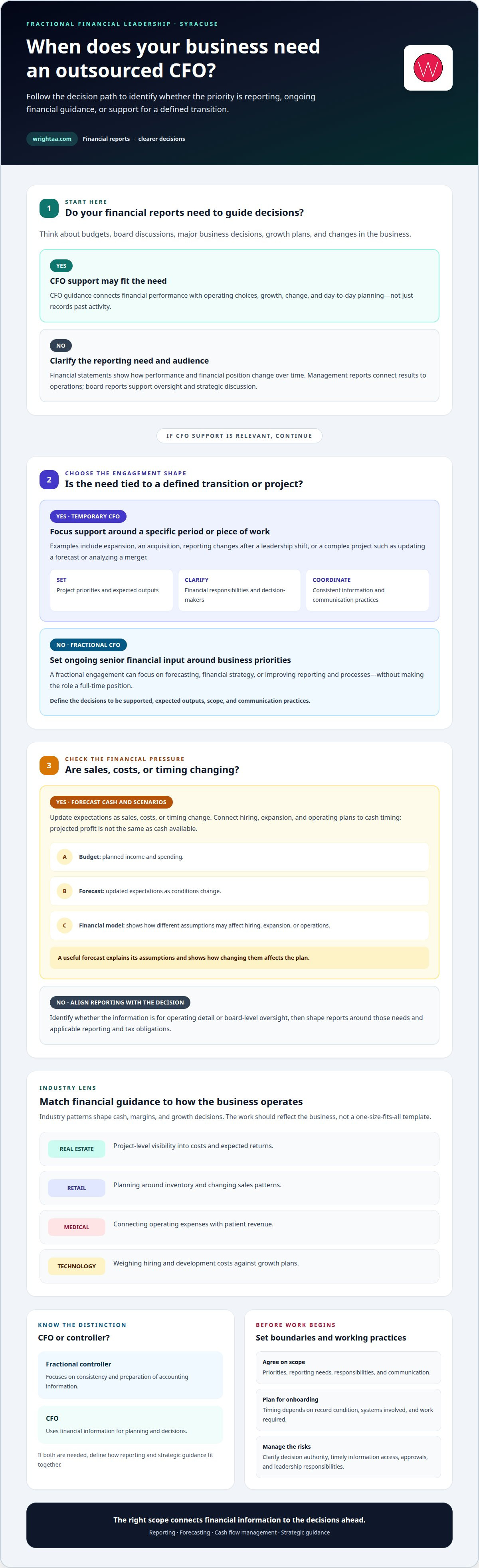
Consider fractional CFO support when you need financial reports to guide decisions, not just record past activity. The right support connects financial leadership with growth, change, and day-to-day planning.
Financial Statements and Management Reports
Financial statements prepared monthly, quarterly, or annually show how performance and financial position change over time. Management reports connect those changes to operating decisions, while board reports support oversight and strategic discussion. The emphasis differs: managers need detail tied to operations, while board members need a clear view of results, risks, and plans.
For businesses in Syracuse, reporting should reflect applicable reporting and tax obligations. The work should be shaped by the business’s needs, not by a separate city-specific CFO rule.
Budgeting, Forecasting, and Financial Modeling
Budgeting sets planned income and spending; forecasting updates expectations as sales, costs, or timing change. Financial modeling shows how different assumptions may affect hiring, expansion, or operations. A useful forecast links those decisions to cash timing, since projected profit is not the same as cash available.
Accounting systems and financial technology can support a growing business. A CFO can assess whether existing systems provide consistent information and help establish reporting practices that can scale with activity. Look for forecasts that explain their assumptions and show how changing them affects the plan.
Choosing a Syracuse CFO
Look for financial leadership that fits your business’s size, industry, and decisions. A good fit translates reports into practical guidance and explains how forecasts connect to operations. Wright CPAs, LLC provides CFO Services, financial reporting, and cash flow management for business owners in Syracuse, Buffalo, and Rochester.
Engagement typically begins by defining scope, priorities, reporting needs, and access to financial records. Onboarding time depends on the condition of those records, the systems involved, and the work required. Agree on responsibilities and communication practices before work begins.
Consider risks such as unclear decision authority, limited access to timely information, and reliance on an outside advisor. Set clear boundaries for approvals, data access, and leadership responsibilities so CFO guidance supports, rather than replaces, internal decisions.
Industry applications of outsourced CFO services
Outsourced CFO services are most useful when financial decisions depend on an industry’s operating patterns. A tailored, fractional engagement can focus on the pressures shaping cash, margins, and growth for a business in Syracuse or the surrounding region.
Different business models bring different financial needs. Real estate businesses may need project-level visibility into costs and expected returns. Retailers often plan around inventory and changing sales patterns, while medical practices connect operating expenses with patient revenue. Technology businesses may weigh hiring and development costs against growth plans. Financial guidance is most useful when it reflects the business, rather than following a one-size-fits-all template.
New York leads the United States in RevenueBase records for outsourced CFO services. For businesses in Syracuse, Buffalo, and Rochester, that wider market context is less important than finding a partner whose work aligns with the company’s needs. A metro ranking alone doesn’t show whether a provider’s experience fits a particular industry or financial function.
Choose support by matching the provider’s capabilities to the financial work you need. For example, if you need help with forecasting, look for relevant financial guidance and clear communication with leadership. Wright CPAs, LLC offers CFO Services, Cash Flow Management, and Financial Reporting & Insights to help business owners connect financial information with decisions.
Fractional CFO support can focus on priorities such as forecasting, financial strategy, or improving reporting and processes. It provides access to senior financial perspective without making the role a full-time position. Define the scope around the decisions to be supported, expected outputs, and communication practices.
Fractional controller services focus on the consistency and preparation of accounting information, while CFO work uses that information for planning and decisions. Businesses needing both can define how reporting and strategic guidance fit together. For support with financial leadership, explore CFO services.
Temporary CFO support for transitions and complex projects
A temporary CFO can support financial decision-making during a defined transition, such as expansion, an acquisition, or changes to reporting after a leadership shift. The practical work is to set priorities, clarify financial responsibilities, and ensure decision-makers have consistent information.
For startups, financial planning can inform hiring, spending, and the timing of new business activity. As a company expands, CFO guidance can help owners assess whether projected revenue supports new commitments. During a transition, it can clarify responsibilities, review reporting flows, and identify which processes need attention first. This helps leadership connect immediate decisions with longer-term plans.
Part-time support can suit a business that needs senior financial input for a particular project rather than a permanent executive role. A fractional CFO might update a forecast, support an expansion plan, or provide financial analysis for a merger. Define the project, expected outputs, decision-makers, and communication practices so the role stays focused as needs change.
Bank covenant reporting is another situation where organized financial information matters. A CFO can review the reporting requirements in the company’s loan agreement, coordinate relevant records, and prepare information for lender discussions. If results differ from expectations, timely analysis helps leadership understand the variance and consider its implications. The work depends on the agreement and the company’s reporting processes.
Support can adjust as the work changes. A company might begin with a defined transition project, then revise the CFO’s involvement as reporting and leadership needs evolve. Clear handoffs help preserve continuity when the assignment ends. Documenting recurring reports and responsibilities, for example, gives internal teams a process to follow afterward.
For useful results, define the decision the temporary CFO will support, such as expansion readiness or transition planning. Then align reporting, responsibilities, and project scope with that priority.
Cash flow management and forecasting
Cash flow planning tracks when money enters and leaves a business, not just whether it reports a profit. A growing company can have strong sales while customer payments arrive after payroll, rent, or supplier bills are due. A forecast makes those timing gaps visible so leadership can consider its options.
Start with current cash balances, expected customer receipts, and scheduled obligations. Compare them with operating plans, then update the forecast as payment dates or spending assumptions change. For example, delayed customer payments can shift the expected cash position even when sales remain steady. This helps distinguish a timing issue from a deeper profitability concern.
Forecasting supports decisions before commitments become difficult to change. A business considering additional staff can model payroll alongside expected revenue and other costs. If projected receipts fall short, leadership can examine timing, spending, or the scale of the plan. Make assumptions visible so decision-makers can see what changes the result.
Cash flow needs vary by organization. A retailer may plan around inventory purchases and seasonal sales, while a nonprofit may track grant receipts against program spending. In each case, reporting should connect expected inflows and outflows to the organization’s operating cycle. Regular financial guidance can help interpret changes and ground decisions in current information.
Cash flow management is most useful when forecasts inform action. Comparing projected and actual results helps identify recurring gaps, late receipts, or costs that differ from plan. Use those findings to update forecasts rather than treating each report as a standalone snapshot. This connects daily operations and available cash with longer-term profitability.
For support aligning forecasts with operating decisions, explore cash flow management.
Wright CPAs, LLC
Wright CPAs, LLC helps business owners connect financial information with decisions about cash, growth, and change. CFO Services and Cash Flow Management support planning, while Bookkeeping helps maintain the records those decisions rely on. Tax Planning and Preparation can add context when tax considerations affect business choices.
This support may help when financial information feels disconnected from operating plans or a transition calls for clearer reporting and direction. Wright CPAs, LLC can shape its accounting, cash flow, and CFO services around your business’s needs. Contact the firm to discuss your financial planning.
Make the Next Financial Decision With Clarity
Connect financial guidance to a decision your business is preparing to make. For leaders considering outsourced CFO solutions in Syracuse, that could mean clarifying the cash flow questions behind an expansion, transition, or change in operations. A focused conversation with Wright CPAs, LLC can help define priorities and identify the support that fits.
Wright CPAs, LLC brings financial guidance together with Tax Planning and Preparation, Bookkeeping, and Payroll Services. These services support the information and planning behind business decisions. The aim is to give owners a clearer view of their financial position and the choices ahead, grounded in their circumstances.
If you’re ready to discuss your business’s financial priorities, contact Wright CPAs, LLC. A deliberate next step can make the path forward easier to see.
Frequently Asked Questions
What Are CFO Services, and Why Do They Matter?
CFO services provide financial leadership to help a business make informed decisions. Alongside accounting information, a CFO can help owners assess the financial implications of expansion, changing operations, or new commitments. This perspective matters when a decision affects several parts of the business, connecting financial information with the direction leaders want to take.
What outsourced CFO services are available in Syracuse, NY?
Businesses in Syracuse can use outsourced CFO support for financial guidance and cash flow planning. Related needs may include bookkeeping, payroll, and tax planning and preparation. For example, a business considering a staffing change may need financial information that brings payroll and operating plans together. The right scope depends on the decisions the business needs to support.
Which Syracuse firms offer outsourced, fractional, or virtual CFO services?
Wright CPAs, LLC provides CFO Services to businesses in Syracuse, Buffalo, and Rochester. For businesses considering outsourced CFO support in Syracuse, the relevant question is whether the firm’s guidance fits their needs and decision-making. Wright CPAs, LLC also offers related accounting and planning services, allowing business owners to consider CFO support alongside the financial information that informs their plans.
How much do outsourced CFO services cost in Syracuse, NY?
The cost depends on the engagement’s scope, reporting needs, and financial work involved. Wright CPAs, LLC offers recurring monthly accounting and advisory retainers, as well as project-based consulting fees. A quote request should describe the work needed, such as ongoing guidance or analysis for a specific business decision.
How do outsourced CFO services compare with hiring a full-time CFO?
Outsourced CFO support brings financial leadership into a business without adding a full-time CFO position. It can suit companies that need guidance for specific decisions or ongoing planning, but not a dedicated executive role. A full-time CFO may fit an organization that needs continuous, in-house financial leadership. The right structure depends on the level of support the business needs.
Which Syracuse industries commonly use outsourced CFO services?
Real estate, retail, medical practices, and technology businesses may benefit from outsourced CFO support. Each has distinct financial needs: real estate may involve project decisions, retail may involve inventory planning, and technology businesses may weigh development and growth costs. Medical practices also benefit from financial insight connected to their operations. Useful support reflects the business model and current priorities.


