

The most enduring structures are rarely built in haste. In the realm of fiscal management, rushing a return to meet a spring deadline often introduces structural weaknesses that compromise your long-term stability. Securing a business tax filing extension NY is not a retreat or a failure of process. It is a strategic pause; a deliberate moment to breathe and ensure every detail of your financial narrative is recorded with absolute precision.
We understand the quiet weight of the looming calendar. The pressure to file can lead to a frantic search for documents and the persistent fear of IRS or NYS penalties. This guide will show you how to navigate the extension process with confidence, transforming a period of stress into an opportunity for financial clarity. We will examine the specific mechanics of Form CT-5 and Form 7004, providing a clear roadmap to ensure your 2026 filings are as intentional as the business you've built.
Key Takeaways
- View the filing extension as a strategic intervention that prioritizes long-term financial health over the immediate pressure of a deadline.
- Identify the precise documentation required for a business tax filing extension NY to ensure seamless compliance across both state and federal jurisdictions.
- Assess the cost of urgency against the value of accuracy to protect your firm from the structural risks inherent in rushed reporting.
- Utilize the six-month window as a deliberate space for deeper financial analysis and more robust cash flow management.
- Move beyond reactive compliance toward a proactive strategy that integrates tax planning into the permanent structure of your business.
The Strategic Value of Time: Understanding Business Tax Extensions in New York
Time is a raw material. In the context of tax return filing requirements in the United States, time allows for the careful curation of financial data. A business tax filing extension NY is not a sign of disarray. It is a formal, proactive request for additional time to submit a completed return. It is a choice made by those who value substance over speed. This extension represents a duality of purpose. It offers a six month window of clarity while maintaining absolute compliance with the law.
Sophisticated business owners across Buffalo, Rochester, and Syracuse recognize that complexity requires space. They use this period to refine their financial narrative. There is a common fear that requesting more time invites scrutiny from the authorities. In reality, a precise, well-documented return filed on extension often carries less risk than a rushed, error-prone submission. Clarity is the ultimate defense against audit. By taking this strategic pause, you ensure that your firm's reporting is both visionary and grounded.
Filing vs. Paying: The Essential Distinction
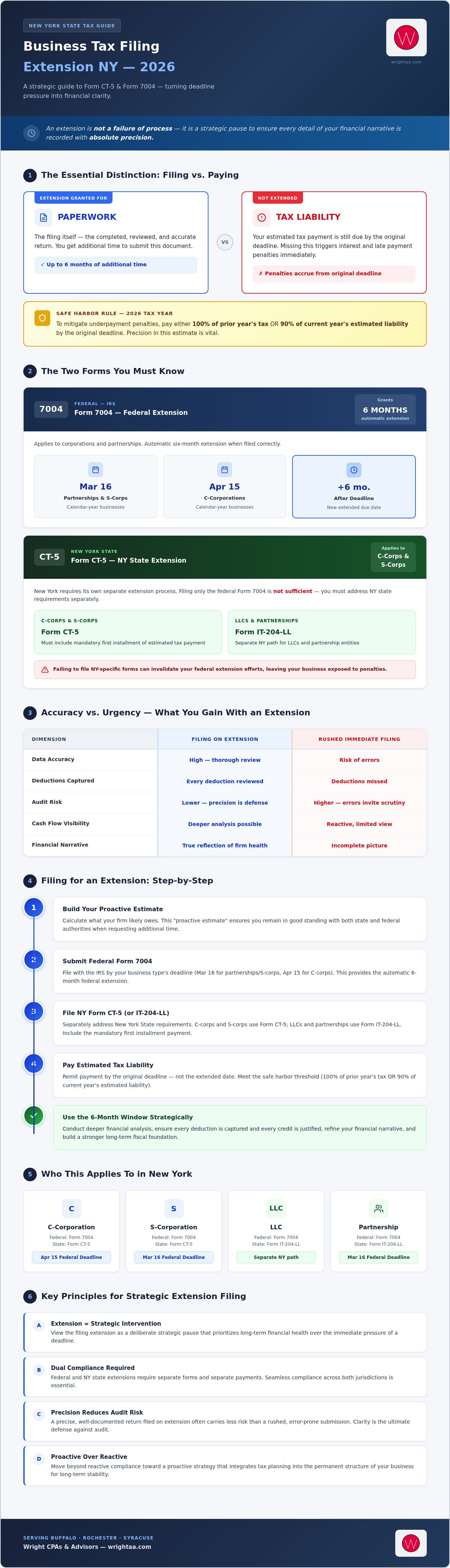
An extension applies strictly to the paperwork. It does not pause your tax liability. The state expects your estimated payment by the original deadline. If this payment is missed, interest and late payment penalties begin to accrue, regardless of whether the extension was granted. For the 2026 tax year, the safe harbor rule generally requires paying 100% of the prior year's tax or 90% of the current year's estimated liability to mitigate underpayment penalties. Precision in this estimate is vital to maintaining financial serenity.
The Architecture of a Deadline
Consider your business as the site and the tax code as the structure built upon it. To ensure the two align perfectly, you need a period of observation. The extension provides the breathing room necessary for thoughtful reporting. It allows you to move beyond reactive compliance and toward true financial intentionality. This intentionality ensures that every deduction is captured and every credit is justified. By choosing to wait, you're choosing to build a stronger financial foundation. It's a method of ensuring that the final filing is a true reflection of your firm's health and purpose.
Navigating the Process: How to File for a NY Business Tax Extension
Filing for a business tax filing extension NY requires a sequence of precise, intentional steps. It's not enough to simply ask for time. You must first construct a "proactive estimate." This calculation determines what your firm likely owes, ensuring that when you request a pause, you remain in good standing with both state and federal authorities. Modern technology facilitates this process, offering secure portals that make these submissions both verifiable and immediate. This digital transparency acts as a clear record, protecting your business from the ambiguity of lost paperwork.
Federal Form 7004: The Foundation
Federal compliance begins with Form 7004. This document serves corporations and partnerships, providing an automatic six-month extension if filed correctly. It's a declaration of order. For calendar-year businesses, the 2026 deadline falls on March 16 for partnerships and S-corps, while C-corps face an April 15 deadline. Submitting this form signals to the IRS that while the final structure is being refined, the foundation is secure. It's a necessary step to avoid the heavy weight of late-filing penalties.
New York Form CT-5: The State Intervention
New York requires its own specific interventions. C-corporations and S-corporations must utilize Form CT-5 to secure additional time. This process is deeply rooted in New York State business corporation tax guidance, which mandates the payment of a "mandatory first installment" of the estimated tax. For LLCs and partnerships, the path differs, requiring the submission of Form IT-204-LL. These state-level requirements are precise. They demand a dual focus on both the paperwork and the underlying fiscal obligations. Failing to address the state's specific forms can invalidate your federal efforts, leaving your business exposed.
Navigating these disparate forms can feel like managing two distinct architectural plans for the same site. It's a balance of federal expectations and specific New York mandates. Integrating these requirements into a cohesive tax strategy ensures that your business tax filing extension NY serves as a tool for growth rather than a source of confusion. By aligning your state and federal filings, you create a unified approach to your firm's financial health.
Accuracy Over Urgency: Comparing Extension Filing to Immediate Submission
A deadline is a boundary, but it shouldn't be a cage. Choosing to file a business tax filing extension NY is an act of prioritizing accuracy over the frantic energy of a spring deadline. When you rush a return, you risk building your financial house on unstable ground. The extra six months provided by an extension act as a period of curing, allowing your financial data to settle and reveal its true form. This deliberate pace aligns with IRS business tax filing and extension requirements, ensuring your submission is a finished work rather than a rough draft.
The Pros of Extending Your Filing
The value of an extension is often found in the details that arrive late. For businesses with external investments, waiting for Schedule K-1s is a common necessity. An extension provides the space for these documents to be integrated without the need for future corrections. It also allows for the maximization of retirement plan contributions, such as a SEP-IRA, which can be funded up until the extended deadline. By filing once and filing correctly, you reduce the need for amended returns. These corrections are like retrofitting a building's foundation; they are complex, costly, and often draw unwanted attention from regulators.
The Cons of a Rushed Return
Haste is the enemy of precision. In the rush to meet an April or March deadline, many firms suffer from "rushed reporting." This leads to overlooked deductions for law firms and small businesses that could significantly lower tax liability. Beyond the direct financial cost, the internal strain on bookkeeping teams can be immense. Crunch periods often result in the misclassification of expenses, which distorts your long-term KPIs and masks the true health of your operation.
A planned extension replaces this chaos with a sense of serenity. It creates the opportunity for a deep strategic tax planning session with your CPA. Instead of a reactive scramble, you engage in a thoughtful dialogue about your firm's trajectory. You move from simply filing a form to designing a fiscal future. This transition from urgency to accuracy is the hallmark of a sophisticated business owner who understands that quality cannot be forced.
Beyond the Form: Managing Your Financial Obligations During the Extension Period
The six-month window following a business tax filing extension NY is a period of deliberate observation. It's a walkthrough of your firm's structural health. This time shouldn't be spent in silence. Instead, use it to refine the rhythm of your bookkeeping. A business tax filing extension NY is a tool for management, not a reason to ignore the books. It's an opportunity to look closer at the materials that compose your fiscal life. A pause in filing is never a pause in responsibility.
Cash Flow and Tax Liability
Managing the duality of tax years requires precision. You're often finalizing the prior year's details while simultaneously funding current-year estimates. This overlap can strain a business if not handled with intentionality. Effective cash flow management ensures that tax reserves are set aside. If your initial estimate was low, use this time to build those reserves steadily. This prevents a sudden, disruptive impact on your liquid capital when the final return is submitted.
- Monitor financial KPIs to detect shifts in profitability during the extension period.
- Review your accounts receivable to ensure cash is available for the final payment.
- Balance the requirements of 2026 estimated payments against 2025 liabilities.
The Role of Outsourced CFO Guidance
The transition from data to insight is where the true value of an extension lies. Engaging outsourced CFO services allows you to step back and view the relationship between your business structure and its environment. This oversight ensures that the finalized return isn't just a compliance document. It becomes a reflection of your visionary goals. A CFO helps you interpret the sensory details of your balance sheet, turning tactical numbers into strategic direction.
Waiting until the final day of the extension to file is a risk. It invites the same urgency the extension was meant to avoid. Use the middle months to finalize your records. This unhurried approach creates a sense of trust and order. If you're ready to move from deadline anxiety to financial clarity, explore our tax strategy and CFO services to secure your firm's future.
Designing a Proactive Tax Strategy: How Wright CPAs, LLC Elevates Your Filing Process
Wright CPAs, LLC serves as the architect of your financial clarity. We provide the structural oversight necessary for businesses in Buffalo, Rochester, and Syracuse to maintain their equilibrium in a shifting regulatory landscape. Our fixed-fee advisory model is designed to remove the noise and unpredictability of traditional billing; it creates a space for year-round oversight that typical reactive firms cannot offer. This constant attention ensures that a business tax filing extension NY becomes a deliberate tool for precision rather than a frantic reaction to a looming date. We focus our expertise on law firms and closely held businesses in Western New York, providing a level of care that transforms compliance into a curated experience.
The Wright Way: A Disciplined Approach
Our approach is rooted in a commitment to deep listening. We analyze the specific environment of your practice-the cultural context of your firm and the geographic nuances of your market-before we implement any strategy. This contextual awareness allows us to blend modern technology with the rigorous, traditional building methods of the CPA profession. We don't view accounting as a mere technical exercise. It is a poetic intervention that improves the business owner's daily life by replacing chaos with order. When you utilize a business tax filing extension NY under the guidance of Wright CPAs, LLC, it is part of a larger, disciplined framework. By establishing a firm financial foundation, we allow you to focus on the visionary work that defines your legacy.
Next Steps Toward Financial Serenity
The path toward financial serenity begins with a single, intentional step. We invite you to move from these broad concepts to the specific material details of your firm's tax plan. A strategic consult at our Buffalo office offers the opportunity to walkthrough your financial structure with an expert eye. This is not a standard meeting; it is a collaborative design session. We examine the duality of your current cash flow and your long-term goals, ensuring the site and the structure are in perfect alignment. It is an invitation to transition from reactive filing to proactive design. Your business deserves a fiscal framework that is as thoughtfully constructed as the professional services you provide to your own clients in the Rochester and Syracuse regions.
Design your financial future with Wright CPAs, LLC.
Building a Foundation of Financial Serenity
A business tax filing extension NY is more than an administrative delay; it is the final verification of the structural integrity of your financial reporting. By choosing accuracy over urgency, you ensure that your firm’s narrative is captured with absolute precision. This strategic pause allows for the implementation of robust cash flow strategies that serve your long-term vision, moving beyond the noise of compliance toward a state of permanent clarity. It's the difference between a rushed response and a thoughtfully executed plan that respects the complexity of your practice.
Since 2012, Wright CPAs, LLC has provided CFO-level guidance and specialized accounting for high-stakes law practices across Buffalo, Rochester, and Syracuse. We believe that financial order is the cornerstone of a successful business. Our team is here to help you move beyond the anxiety of deadlines toward a serene, curated accounting experience. We invite you to Secure Your Strategic Tax Consult with Wright CPAs, LLC and begin the process of intentional planning. Your business deserves a foundation built on expertise and quiet confidence.
Frequently Asked Questions
Does filing an extension for my NY business tax return increase my chance of an audit?
Filing an extension does not increase your risk of an audit. Authorities recognize that complex business structures require time for precise reporting. A return that is filed with intentionality and accuracy is often more stable than one submitted in haste. Taking this strategic pause allows you to refine your data, ensuring that your final submission is a truthful reflection of your firm's health. Precision is the ultimate defense against regulatory scrutiny during any tax season.
How much extra time does a New York business tax extension provide in 2026?
A business tax filing extension NY typically provides six additional months to submit your final return. For calendar-year corporations in 2026, the original April 15 deadline shifts to October 15. For partnerships and S-corps, the March 16 deadline moves to September 15. This window offers the breathing room necessary to gather late-arriving documents and consult with your advisor to ensure every deduction is properly captured within the structure of your return.
Can I get an extension on the time I have to pay my NY business taxes?
No, an extension only applies to the paperwork, not the financial obligation. New York State requires that all estimated taxes be paid by the original filing deadline. If you fail to pay the tax due by this date, interest and late-payment penalties will accrue on the balance. It's vital to calculate your liability with precision before requesting more time, as the extension doesn't pause the accumulation of interest on unpaid amounts during the gap.
What happens if I miss the extension filing deadline for my Buffalo-based LLC?
Missing the deadline for a business tax filing extension NY results in immediate late-filing penalties. For an LLC in Buffalo, these costs can accumulate quickly, adding unnecessary weight to your firm's fiscal load. Beyond the financial cost, failing to file can impact your business's compliance status with the state. It's better to file a proactive estimate even if your data is still settling, as this preserves your right to the extended window and protects your standing.
What specific forms do I need for a New York S-Corp tax extension?
New York S-Corps must file Form CT-5 to request a six-month extension. This form is the specific state intervention required for corporate entities to gain additional time. Along with the form, you must pay the mandatory first installment of the estimated tax for the following year. Aligning this state-level requirement with your federal Form 7004 ensures that your practice remains compliant across both jurisdictions, providing a unified approach to your firm's overarching tax strategy.
Is there a fee to file a business tax extension with New York State?
New York State does not charge a processing fee to file an extension form. However, the state mandates that you pay any tax liability you expect to owe, along with any required installments for the next tax year. While the form itself is free to submit, the financial cost of underestimating your payment can be significant. Ensuring your payment is accurate prevents interest charges from eroding your cash flow during the six-month extension period.
How do I calculate my estimated tax payment for a NY extension?
You calculate your payment by projecting your total tax liability for the year and subtracting any credits or prior payments. Many businesses use the safe harbor method, paying 100% of the previous year's tax to avoid underpayment penalties. This calculation requires a walkthrough of your current books to ensure your estimate is grounded in reality. It's a moment of financial intentionality that protects your firm from the structural risk of unexpected and costly tax bills.
Can I file my federal and NY state extensions at the same time?
You can and should file your federal and state extensions concurrently. While the IRS and New York State use different forms, Form 7004 for federal and Form CT-5 for state, they follow a similar rhythm. Coordinating these filings ensures that your entire financial structure is paused at the same time. This synchronicity allows your bookkeeping team to work within a single, unified timeline, reducing the complexity of managing two disparate sets of deadlines for your business.


