

The first hire you make is more than a simple addition to your team; it's the primary structural pillar in the architecture of your firm's future. Structure precedes scale. This transition from solopreneur to employer is a moment of profound expansion that requires a new set of blueprints. It's natural to feel a sense of weight when confronting hiring first employee NY tax requirements, particularly as you balance the 2026 minimum wage increases with the state's intricate withholding schedules.
You likely recognize that a single missed deadline or a misunderstood insurance mandate can disrupt the quiet order you've worked so hard to establish. We'll show you how to navigate this complex regulatory environment with a sense of purpose and intentionality. By the end of this guide, you'll have a sophisticated framework for New York State tax compliance that protects your business and honors your new professional relationships. We'll explore the essential registrations, from Form NYS-100 to the 4.1% unemployment insurance contribution rate, ensuring your payroll setup is as resilient as the foundation of your business itself.
Key Takeaways
- Understand how your first hire acts as a permanent structural intervention, shifting your role from managing tasks to overseeing a complex financial ecosystem.
- Identify the specific registrations needed for hiring first employee NY tax requirements, from securing your EIN to filing the NYS-100.
- Learn to navigate mandatory insurance obligations, including Workers’ Compensation and Disability, which serve as the protective envelope for your firm.
- Adopt a disciplined onboarding checklist that ensures compliance with 2026 wage mandates and New York’s strict new hire reporting deadlines.
- Discover how integrating payroll into a broader tax strategy transforms a regulatory necessity into a tool for visionary business growth.
The Architectural Shift: Transitioning from Solopreneur to Employer
The first employee you bring into your firm is a permanent structural intervention. It changes the geometry of your business forever. This transition is not merely a technical exercise but a poetic one, marking the moment your vision requires more than two hands to sustain it. You are no longer just managing a series of tasks; you are now stewarding a financial ecosystem. Understanding the hiring first employee NY tax requirements is the first step in this design process. It ensures the foundation you build today can support the weight of tomorrow's growth.
Reactive hiring in Western New York often leads to tax inefficiencies that erode profitability before the new hire even settles in. When you hire in response to a crisis of capacity, you lose the opportunity to integrate that position into a larger tax strategy. This lack of intentionality can result in missed credits or poorly timed Payroll taxes that disrupt your cash flow. In 2026, New York State defines an employer as any individual or entity that pays $300 or more in gross wages in a calendar quarter.
Intentional Growth in the WNY Market
Buffalo businesses must account for a labor cost structure that differs from the national average. With the minimum wage set at $16.00 per hour in Western New York for 2026, the threshold for entry is high. This requires a serene approach to cash flow management. You must assess your readiness through a lens of clarity, ensuring your revenue can absorb the added layers of state and federal obligations. Linking your hiring decisions to your long-term business tax planning Buffalo NY allows you to see the hire as an investment in your business’s structural integrity rather than a simple expense.
The 1099 vs. W-2 Dilemma
The choice between an independent contractor and a W-2 employee is a fundamental design decision. In 2026, the IRS and New York State utilize strict criteria to determine worker classification, focusing on the degree of control you exercise over the individual’s work. Misclassification carries a high price, often resulting in steep penalties and significant back taxes that can compromise your firm’s stability. While a contractor might seem flexible, a W-2 structure provides a more grounded foundation for scaling. It allows for a disciplined approach to hiring first employee NY tax requirements, fostering a culture of professional intentionality and long-term commitment that contractors rarely match.
The Regulatory Framework: Federal and NYS Tax Registrations
Every structure requires a definitive foundation. The Federal Employer Identification Number (EIN) is that first cornerstone. It anchors your business within the federal tax system, providing the identity necessary for all subsequent filings. Once this federal anchor is in place, you must turn your gaze toward the state level. Successfully managing the hiring first employee NY tax requirements involves a deliberate registration process that connects federal mandates with New York’s specific regulatory climate.
Federal Essentials: Form W-4 and I-9
The relationship between employer and employee is codified through Form W-4 and Form I-9. The 2026 updates to withholding allowances demand a high degree of precision in data collection. It's no longer enough to simply collect paper; you must establish a secure, digital-first system for document retention. This ensures that sensitive information is both protected and accessible for future audits. These federal filings are the essential first steps for anyone starting a business in Buffalo NY. For a comprehensive view of federal obligations, the IRS Employer's Tax Guide remains the definitive resource for understanding withholding and FUTA taxes.
New York Specifics: Form NYS-100 and IT-2104
New York requires its own set of blueprints. Form NYS-100 is the primary vehicle for registering with both the Department of Labor and the Department of Taxation and Finance. This filing results in the issuance of your Employer Account Number. This number is the primary identifier for your state tax filings and unemployment insurance contributions. For the employee, Form IT-2104 is mandatory. It determines the correct amount of New York State tax to withhold from their wages. Western New York businesses must ensure geographic accuracy in these filings, as local tax jurisdictions can impact the final calculations. Within 20 days of the hire date, you must also report the new employee to the New York State New Hire Reporting Program.
Compliance follows a rhythmic cycle. Most employers will engage with Form NYS-45 on a quarterly basis to report wages, withholding, and unemployment insurance. This steady cadence prevents the accumulation of tax liabilities and maintains the financial integrity of your firm. If this regulatory walkthrough feels complex, engaging with professional payroll services can provide the clarity needed to focus on your core vision.
Beyond the Paycheck: Mandatory NY Insurances and Withholding
If registration represents the blueprint of your firm, then mandatory insurances are the protective envelope. They shield both the human element of your architecture and the financial stability of the structure itself. Fulfilling hiring first employee NY tax requirements means looking beyond the base salary to the statutory obligations that accompany every New York payroll. These costs are not merely line items; they are the essential materials required to build a compliant and resilient workplace.
Workers’ Compensation and Disability Benefits Law (DBL) coverage are mandatory from day one. In 2026, the DBL employee contribution remains capped at 0.5% of wages, with a maximum of $0.60 per week. For employers in the downstate region, the Metropolitan Commuter Transportation Mobility Tax (MCTMT) adds another layer of complexity. As of August 2026, rates in Zone 1 range from 0.055% to 0.895%, while Zone 2 reaches up to 0.635%. Calculating the true cost of a hire requires accounting for these variables, alongside the employer’s share of Social Security and Medicare, which currently sits at 6.2% and 1.45% respectively. The gross wage is only the facade; the total cost of employment includes these structural necessities.
The SALT Cap and Payroll Strategy
A sophisticated payroll strategy integrates seamlessly with your broader tax planning. For many closely held businesses, hiring impacts the Pass-Through Entity Tax (PTET) strategy, allowing for entity-level deductions that can mitigate the impact of the federal SALT cap. This alignment turns a standard payroll expense into a strategic tax tool. Specialized practices often require a CPA for law firms Buffalo NY to navigate these dualities, ensuring that payroll tax management supports the overall financial health of the partnership. It's about finding the intersection between internal operations and external tax environments.
New York’s Paid Family Leave (PFL) Evolution
New York’s Paid Family Leave (PFL) program continues to evolve as a cornerstone of the state’s labor environment. For 2026, the employee contribution rate is set at 0.432% of gross wages, with a maximum annual contribution of $411.91. While this is an employee-funded benefit, the administrative burden of tracking and remittance falls upon the employer. Automating this process through professional payroll solutions reduces the risk of error and allows you to frame PFL as a tool for retention. It signals to your team that their personal well-being is a valued component of the business’s long-term stability. This approach transforms a regulatory requirement into a poetic intervention in the lives of your staff.
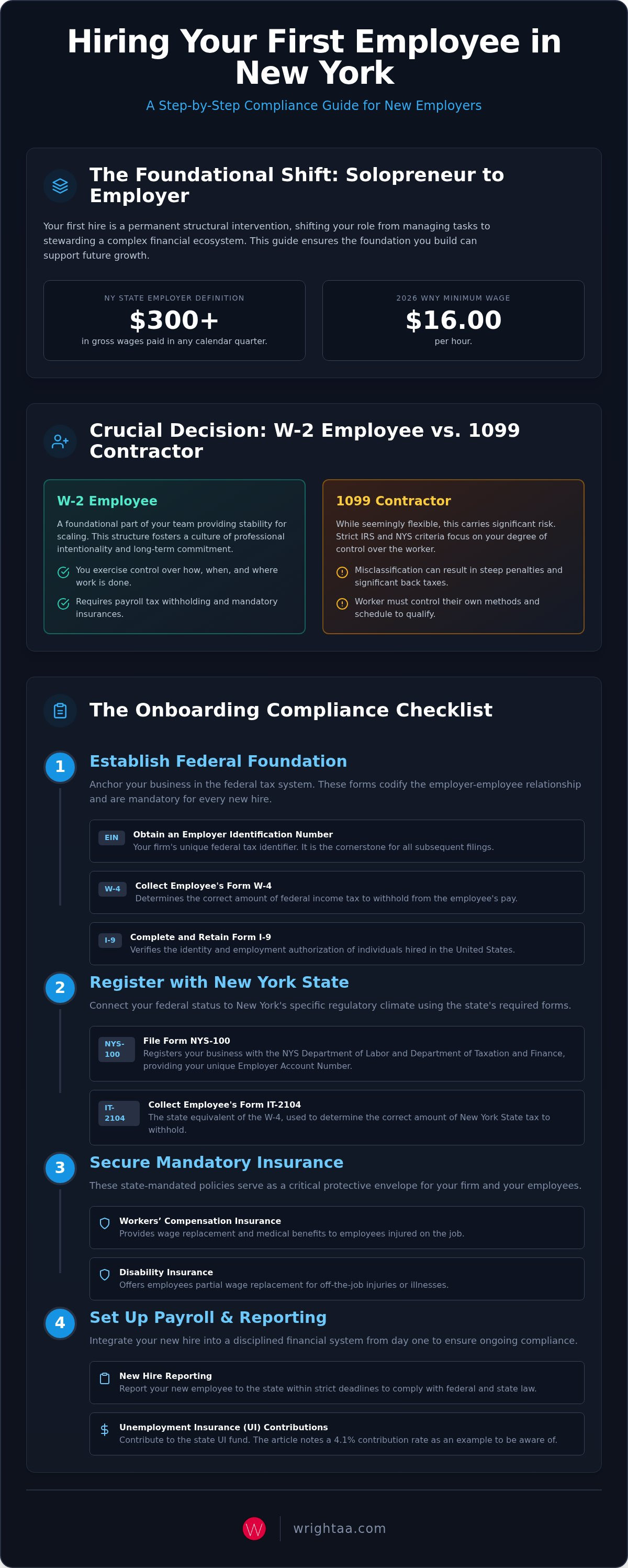
The Intentional Onboarding Checklist: A Step-by-Step Guide
Onboarding is a process of curation. It represents the final assembly of the components we have discussed, bringing the human element into the financial structure you have designed. To navigate the hiring first employee NY tax requirements with precision, you must follow a sequence that prioritizes both legal compliance and operational clarity. This checklist serves as your technical manual for a successful launch.
- Step 1: Verify Account Status. Confirm that your EIN is active and your NYS Employer Account is fully registered through the New York Business Express portal.
- Step 2: Secure Insurance Binders. Obtain formal binders for Workers’ Compensation and Disability insurance. These must be in place before the employee’s first hour of work.
- Step 3: Execute Documentation. Collect Federal Form W-4, New York Form IT-2104, and the I-9 Employment Eligibility Verification. Precision here prevents future withholding errors.
- Step 4: Report the Hire. Submit the required data to the New York State New Hire Reporting Center. This must occur within 20 calendar days of the hire date.
- Step 5: System Integration. Map your payroll data to your small business accounting Buffalo NY system to ensure every dollar is tracked with intentionality.
The 20-Day Reporting Rule
The New York State New Hire Reporting Center is a non-negotiable checkpoint in your onboarding workflow. This requirement facilitates the administration of child support and programs designed to detect fraud. Failing to report a new hire within the 20-day window can result in financial penalties. More importantly, it disrupts the rhythmic order of your compliance schedule. Integrating this step into your monthly workflow ensures that the hiring first employee NY tax requirements are met without the stress of last-minute filings. It’s a small intervention that yields significant peace of mind.
Setting Up Your Payroll Rhythm
Choosing a pay cycle is a decision that affects both your liquidity and your employee’s daily life. In New York, most manual workers must be paid weekly, while clerical and professional staff often follow bi-weekly or semi-monthly cadences. For S-Corp owners, this first hire often coincides with the need to establish a "Reasonable Salary" for themselves to satisfy IRS scrutiny. Automating the tax impounding process is essential. It ensures that funds for withholding and employer taxes are set aside immediately, preserving your cash flow for growth. If you are ready to design a more resilient financial foundation, consider our Business Consulting services to guide your transition.
Strategic Growth: Integrating Payroll into Your Business Architecture
Compliance is the floor, not the ceiling. Moving beyond the immediate demands of hiring first employee NY tax requirements allows you to view your team as a dynamic investment rather than a static cost. This is where basic bookkeeping transforms into visionary financial oversight. A fractional CFO Buffalo NY doesn't just record wages; they analyze the return on investment for each position added to your firm. They look at how a new hire impacts your capacity, your tax liability, and your long-term growth trajectory.
The value of fixed-fee advisory lies in its predictability. It creates a serene environment where you can ask questions without the friction of hourly billing. This model prevents payroll tax surprises by ensuring that every regulatory change is anticipated and integrated into your strategy before it becomes a crisis. You're designing a legacy. Every compliant hiring practice you implement today is a stone laid in a structure meant to endure. It's about building with intentionality from the very first hire.
The Wright CPAs, LLC Partnership
Our approach to payroll and tax strategy is rooted in proactive intentionality. We understand the specific economic landscape of Western New York, from the professional corridors of Buffalo to the growing businesses in Rochester. Law firms and closely held businesses trust our disciplined methods because we prioritize substance over spectacle. We eliminate the "hourly anxiety" often associated with payroll questions. By utilizing a fixed-fee model, we provide a consistent, professional presence that allows you to focus on your craft while we manage the intricate details of your financial architecture.
Your Next Steps Toward Expansion
The transition to becoming an employer is a significant milestone. It's the moment your business truly begins to scale. Scheduling a consultation to review your 2026 hiring plan is the first step toward a more resilient future. We help you harmonize your entity choice with your new employer obligations, ensuring that your corporate structure supports your expanding team. Whether you're navigating the complexities of hiring first employee NY tax requirements or refining your existing payroll rhythm, we provide the clarity you need. A building is only as strong as its supports. Your team is your greatest support. Let's ensure the foundation is worthy of the vision you've built.
Constructing Your Future with Intentionality
Expanding your firm is a profound act of creation. It requires a transition from the solitary work of a founder to the collective strength of a team. We've explored how hiring first employee NY tax requirements serves as the blueprint for this new phase, from the rhythmic filing of Form NYS-45 to the strategic integration of mandatory insurances. These structural elements ensure that your business remains resilient and compliant as it scales into the 2026 regulatory environment.
Professional oversight allows you to focus on your craft while we maintain the integrity of your financial ecosystem. Our specialized payroll strategy for WNY law firms and proactive tax planning provide the clarity needed to navigate complex state mandates. Through a fixed-fee advisory model, we eliminate the uncertainty of the transition, allowing for a serene and disciplined expansion. It's about moving beyond mere compliance toward a state of visionary financial oversight.
Design your team’s financial foundation with Wright CPAs.
The journey from solopreneur to employer is a significant milestone. With the right supports in place, your business will grow with the same purpose and stability that defined its beginning. Your vision deserves a foundation as strong as the work you do every day.
Frequently Asked Questions
What tax forms do I need to file for a new employee in New York?
To fulfill hiring first employee NY tax requirements, you must collect Federal Form W-4 and I-9 along with New York Form IT-2104. Additionally, you must register your business using Form NYS-100 to obtain your Employer Account Number from the Department of Labor. This foundation ensures that withholding is accurate for your team in Buffalo or Rochester. Establishing these digital records early creates a serene transition from solopreneur to employer.
How much is the NYS Unemployment Insurance rate for new employers in 2026?
For 2026, the total contribution rate for new employers in New York is 4.1%. This rate is applied to the first $17,600 of each employee's wages. It includes a 3.4% normal rate, a 0.625% subsidiary rate, and a 0.075% Re-employment Service Fund rate. Understanding these fixed costs allows Syracuse business owners to design a more resilient cash flow model before the first hire arrives at the firm.
Do I need Workers’ Compensation insurance if I only have one part-time employee?
Yes, New York law requires virtually all employers to carry workers’ compensation insurance, even for a single part-time employee. There is no minimum payroll floor or waiting period for this mandate. This insurance acts as a protective envelope for your firm's human element. It shields you from the high cost of workplace injuries and ensures your business architecture remains structurally sound and legally compliant from the first day of work.
What is the NYS New Hire Reporting requirement and what is the deadline?
You must report every new hire or rehire to the New York State Department of Taxation and Finance within 20 calendar days of their start date. This reporting is a non-negotiable deadline that helps the state manage child support and detect benefit fraud. Integrating this step into your rhythmic onboarding workflow prevents unnecessary penalties and maintains the professional intentionality of your firm’s growth in the Western New York market.
How does hiring an employee affect my S-Corp tax strategy in Buffalo?
Hiring your first employee often necessitates a shift in your S-Corp tax strategy to ensure you are paying yourself a "reasonable salary" as required by the IRS. This transition also opens opportunities for advanced tax strategy, such as utilizing the Pass-Through Entity Tax (PTET) to mitigate the federal SALT cap. For S-Corp owners in Buffalo, this hire is the catalyst for a more sophisticated financial foundation and visionary oversight.
Are there specific payroll taxes for businesses in Rochester or Syracuse?
While the Metropolitan Commuter Transportation Mobility Tax (MCTMT) applies only to employers in the downstate region, businesses in Rochester and Syracuse must still navigate standard state withholding and unemployment taxes. There are no specific local payroll taxes in these cities comparable to the MCTMT. You must ensure that your state filings accurately reflect your geographic context to maintain a clean and compliant payroll setup without triggering unnecessary audits.
What is the difference between NYS Disability and Paid Family Leave (PFL)?
NYS Disability (DBL) provides benefits for an employee’s own off-the-job illness or injury, while Paid Family Leave (PFL) is designed for bonding with a new child or caring for a family member. For 2026, the PFL employee contribution rate is 0.432% of gross wages. These programs represent two different supports in your firm’s architecture, providing essential security for the people who sustain your vision while fulfilling hiring first employee NY tax requirements.
How can Wright CPAs help with my first hire payroll setup?
Wright CPAs provides a serene and disciplined approach to your first payroll setup through our fixed-fee advisory models. We move beyond basic compliance to integrate your payroll into a proactive tax strategy. Our team handles the intricate details of registration and withholding, allowing you to focus on your vision. We specialize in providing financial clarity for law firms and closely held businesses throughout Buffalo, Rochester, and Syracuse through intentional guidance.


