

What if your retirement plan was less about a distant departure and more about the structural integrity of your business today? For many owners, exploring small business retirement plan tax benefits NY feels like a defensive maneuver against a high tax burden rather than a creative act of growth. You've likely felt the pressure of shifting mandates and the complexity of federal credits, wondering if your current path is truly optimized for the unique landscape of New York.
We understand that you value substance over spectacle. It's clear that managing the intersection of the SECURE Act 2.0 and state-level requirements requires more than just compliance; it requires a vision. This article provides a clear, intentional path toward financial clarity by aligning your business goals with the specific incentives available to you. You'll learn how to transform these obligations into a deliberate tax strategy that provides both immediate relief and long-term stability.
We'll examine a refined checklist for year-end planning that maximizes your tax position while helping you attract the talent your firm deserves. You'll discover how to treat retirement planning as a sophisticated tool for business preservation and a reflection of your commitment to excellence.
Key Takeaways
- View your retirement strategy as a foundational element that reduces your tax burden while building long-term equity.
- Identify specific federal credits, including the $5,000 startup credit, that significantly lower the cost of implementing a new plan.
- Navigate the small business retirement plan tax benefits NY offers by understanding why private plans often outperform the state-run mandate.
- Distinguish between SEP and SIMPLE IRA structures to select the framework that best supports your firm's specific growth and headcount.
- Master a year-end checklist that aligns your current profitability with proactive tax planning and CFO-level insights.
The Architecture of Retirement: Aligning Plan Selection with Tax Strategy
Retirement planning isn't a passive exercise. It's a deliberate structural intervention. Many owners view small business retirement plan tax benefits NY through a lens of simple compliance, but we choose to see them as a tool for financial clarity. A well-designed plan functions like the foundation of a building; it provides stability and allows for vertical growth. By shifting taxable income into a retirement vehicle, you reduce your current tax liability while building personal wealth. This dual benefit creates a rhythm of efficiency within your business lifecycle.
Intentionality is the difference between a generic solution and a curated strategy. As your business matures, its needs evolve. A startup requires flexibility, while an established law firm may prioritize aggressive tax sheltering. Proactive tax planning allows you to match your plan's complexity to your current stage of growth. This foresight prevents the friction of year-end tax surprises, ensuring your financial environment remains serene and predictable.
Defining Your Financial Intentions
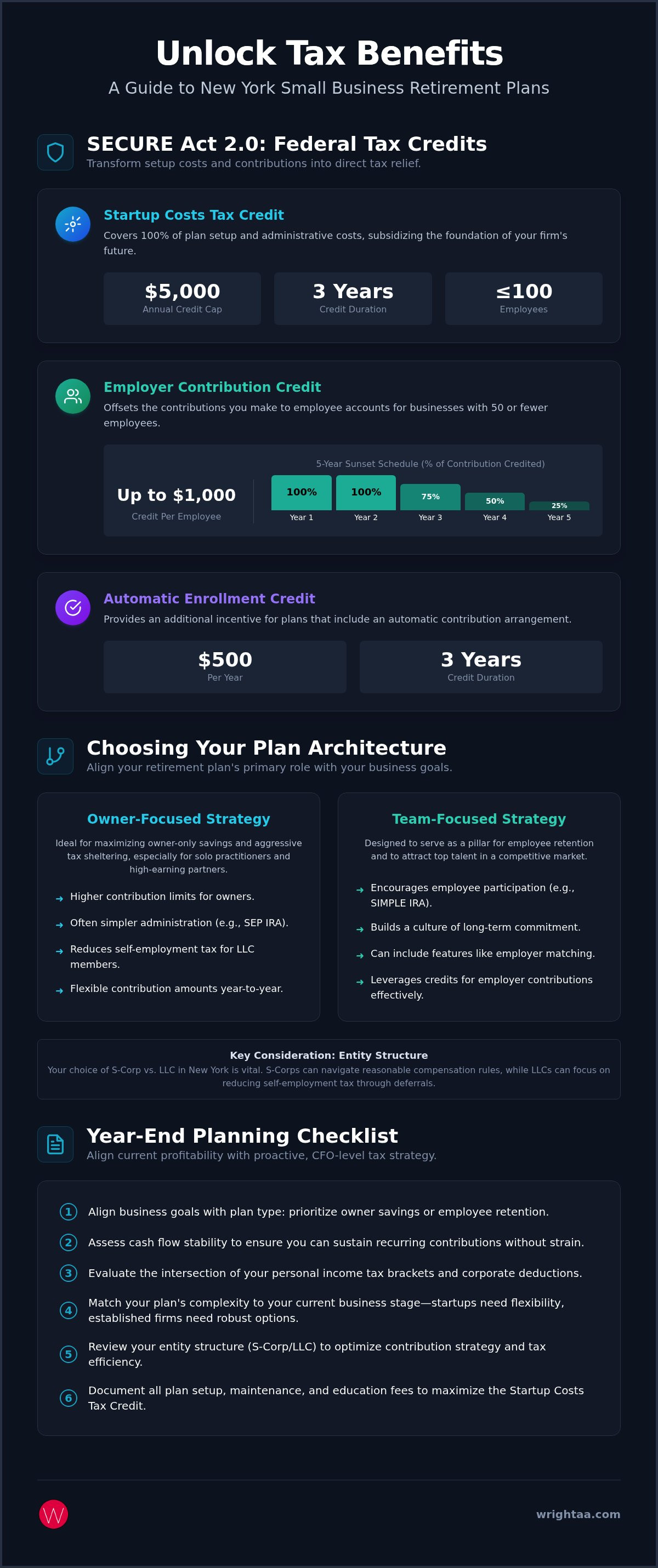
Clarity begins with purpose. You must decide if your plan's primary role is to maximize owner-only savings or to serve as a pillar for employee retention. High-earning solo practitioners often require different frameworks than firms with expanding teams. We assess your cash flow stability to ensure you can sustain recurring commitments without strain. We also evaluate the intersection of your personal income tax brackets and corporate deductions. When these elements align, the retirement plan becomes a poetic expression of your firm's success.
The Relationship Between Entity Structure and Retirement
Your choice of entity dictates the texture of your contribution strategy. In New York, the distinction between an S-Corp and an LLC is vital for tax efficiency. S-Corp owners might use retirement allocations to navigate the nuances of reasonable compensation and distributions. LLC members often focus on reducing self-employment tax through strategic deferrals. Whether you're operating a practice in Buffalo or a consultancy in Rochester, your plan should mirror your specific geographic and cultural context. We help you select the right architecture, ensuring your retirement strategy is as permanent and thoughtful as the business you've built.
The SECURE Act 2.0 is a rare moment where federal policy mirrors the intentionality of a well-crafted business. It removes the friction of entry. For owners exploring small business retirement plan tax benefits NY, these credits serve as a structural bridge. They transform the initial investment in a retirement framework from a sunk cost into a strategic intervention.
The most immediate impact comes from the $5,000 Startup Cost Tax Credit. It targets the administrative weight of establishing a new plan. This isn't a mere deduction; it's a direct offset of your tax liability. By covering 100% of setup and maintenance costs for the first three years, the government effectively subsidizes the foundation of your firm's future.
The Startup Costs Tax Credit Checklist
To secure this credit, your business must meet specific structural criteria. You must employ 100 or fewer individuals who earned at least $5,000 in the preceding year. The credit applies to 100% of qualified startup costs for the first three years, with an annual cap of $5,000. When you document these expenses for your tax preparer in Buffalo, NY, ensure you include every fee associated with plan design and employee education. This precision ensures no value is left on the table.
Employer Contribution Credits for Small Teams
A second, equally vital credit offsets the actual contributions you make to employee accounts. For firms with 50 or fewer employees, the government provides a credit for 100% of employer contributions, up to $1,000 per employee. This credit follows a deliberate five year sunset: it remains at 100% for the first two years before descending to 75%, 50%, and 25%. It's a sensory experience of financial relief. Additionally, an automatic enrollment credit offers a further $500 per year for three years, incentivizing participation through direct tax relief.
2026 marks a critical threshold for these incentives. As the landscape shifts, the window to maximize these small business retirement plan tax benefits NY remains open for those who act with purpose. Integrating these credits into a holistic tax strategy provides the clarity needed to grow a firm that is both financially sound and human-centric. By leveraging these federal tools, you ensure your retirement plan is a permanent, thoughtful intervention in your business's success.
Plan Comparison: Choosing the Right Structure for Your Firm
The choice of a retirement structure is a tactile decision. It defines how your capital flows and how your tax obligations are shaped. While federal credits provide the initial momentum, the specific plan architecture determines the long-term efficiency of your small business retirement plan tax benefits NY. For the self-employed entrepreneur, the Solo 401(k) offers a powerful dual-contribution structure. It allows for both employee and employer allocations that can significantly reduce taxable income in a single year.
By selecting the right structure, you anchor your small business retirement plan tax benefits NY in a strategy that respects your firm's specific lifecycle. This intentionality ensures that your plan is not merely a technical exercise but a poetic reflection of your business goals.
SEP IRA vs. SIMPLE IRA for NY Professionals
The SEP IRA represents a minimalist approach. It's favored by high-earning solo practitioners and law firms because it allows for significant contributions without the administrative weight of a traditional 401(k). You can contribute up to 25% of compensation, making it an ideal tool for partners seeking aggressive tax sheltering. Conversely, the SIMPLE IRA provides a balanced structure for small teams in Western New York. It requires less maintenance but has lower contribution limits. To count for the 2026 tax year, SEP IRAs offer the flexibility of being established up until your tax filing deadline, including extensions. SIMPLE IRAs generally require a more deliberate setup by October 1st of the year the plan begins.
The Safe Harbor 401(k) Advantage
For business owners with employees, compliance testing can feel like a structural flaw. The Safe Harbor 401(k) bypasses these annual tests by requiring a specific employer contribution. This design ensures that owners can maximize their own contributions regardless of how much their staff chooses to save. It creates a serene compliance environment. By committing to a 3% non-elective contribution or a matching schedule, you transform a potential headache into a predictable, tax-deductible expense.
In Buffalo and Rochester, where firm culture is built on trust, these matches serve a dual purpose. They are both a financial deduction and a clear signal of your commitment to your team's stability. When you align these structures with your firm's profitability, you achieve a level of financial clarity that standard payroll-focused plans cannot offer. Your choice of plan should be a permanent, thoughtful intervention in your wealth strategy.
The New York State Context: Secure Choice and Local Incentives
New York is a landscape of high stakes and specific requirements. While federal credits provide a broad foundation, the local regulatory environment adds a layer of complexity that requires intentionality. The New York State Secure Choice Savings Program represents a significant shift in the relationship between employers and the state. It's a mandate that demands a response. For many, it's the catalyst to finally explore how small business retirement plan tax benefits NY can be utilized to create a more resilient firm structure. This isn't just about avoiding a penalty; it's about claiming your place in a competitive market.
The state program is a floor, not a ceiling. It provides a basic Roth IRA for employees, but it offers little in the way of structural tax relief for the business owner. A private plan, by contrast, allows for employer deductions and higher contribution limits. This duality is essential for owners who value financial clarity. By choosing a private architecture, you satisfy the state's requirements while retaining the ability to lower your effective tax rate. It's a more sophisticated intervention that respects the unique needs of your practice.
NY Secure Choice Compliance Checklist
Compliance is the baseline. By 2026, New York businesses meeting specific employee thresholds must either enroll in the state-run program or offer a qualified private plan. Non-compliance isn't just a technical oversight; it carries financial penalties that disrupt your firm's serenity. You should verify if your headcount consistently exceeds ten employees, as this triggers the mandate. However, the state-run IRA has limitations. It doesn't allow for employer contributions or the significant tax deductions found in private structures. Choosing a private 401(k) or SIMPLE IRA allows you to satisfy the mandate while maximizing your small business retirement plan tax benefits NY.
Local Considerations for WNY Business Owners
In Buffalo and Rochester, the talent pool values substance. A superior benefit design is a signal of quality. When you integrate a retirement plan into your small business accounting Buffalo NY, you're not just moving numbers. You're building a culture of stability. Private plans offer a synergy with other state incentives, such as healthcare credits, creating a holistic financial environment. This integration ensures your payroll tax requirements are met with precision while you retain the flexibility to reward your team through profit-sharing or matching. If you're ready to move beyond basic compliance, we can help you design a tax strategy that aligns your state obligations with your long-term growth goals.
This localized approach ensures your firm remains grounded in its community while reaching for visionary financial goals. The intersection of state mandates and private strategy is where true financial clarity is found. By moving logically from broad compliance to specific material details, you guide your business through a narrative of growth and protection. It's a patient, methodical process that yields a more permanent and thoughtful result for your firm's future.
Implementation: Your Year-End Retirement Tax Checklist
Implementation is the final phase of construction. It's where the theoretical alignment of your strategy meets the physical reality of your balance sheet. To fully capture small business retirement plan tax benefits NY, your year-end approach must be as precise as a blueprint. This process begins with a quiet, thorough examination of your current year-to-date profitability. By projecting your final tax position now, you create the spatial breathing room necessary to make informed, unhurried decisions before the calendar year closes.
Establishing your plan structure before the 2026 thresholds requires more than just a signature. It involves a rhythmic coordination between your internal operations and external advisors. Once the architecture is in place, communicating these benefits to your team becomes a powerful tool for retention. You aren't just offering a savings account; you're providing a curated path toward stability that reflects the value you place on your firm's human element.
Step 1: The Strategic Financial Review
Clarity starts with data. You should analyze specific financial kpis for small business to determine your exact contribution capacity. This review ensures that your retirement allocations don't compromise your operational cash flow. We recommend coordinating directly with your payroll services to ensure that every contribution is tracked with sensory precision from the first deposit. For owners over age 50, this is also the moment to identify catch-up contribution opportunities. These additional deferrals act as a final structural reinforcement for your personal wealth strategy.
Step 2: Designing the Plan Architecture
The right plan should feel like a natural extension of your business. We work with you to model the specific tax impact of different frameworks, ensuring your small business retirement plan tax benefits NY are maximized for your entity type. This choice should align with your starting a business in Buffalo NY long-term vision, whether you're in the early stages of growth or preparing for a future transition. Once the design is finalized, you must formalize the plan documents and notify your employees according to ERISA requirements. This transparency builds trust and ensures your firm remains a serene, compliant environment for everyone involved.
Consulting with a business tax planning Buffalo NY expert allows you to navigate these final steps with confidence. It's a methodical walkthrough that transforms a complex tax obligation into a deliberate act of business preservation. By following this checklist, you ensure that your retirement strategy is both grounded in technical excellence and visionary in its pursuit of financial clarity.
Building Your Financial Legacy with Precision
The journey toward retirement is not a retreat; it's a deliberate construction of your firm's future. By aligning your plan selection with the specific small business retirement plan tax benefits NY offers, you create a structure that is both efficient and resilient. You've seen how federal credits from the SECURE Act 2.0 can offset startup costs, and how private plans provide a more sophisticated alternative to state mandates. These aren't just technical choices; they're expressions of your commitment to financial clarity.
True stability requires a partner who understands the intersection of professional practice and fiscal strategy. We specialize in accounting for Buffalo law firms, offering a fixed-fee monthly advisory model that ensures your path remains clear. Our proactive tax planning looks beyond the annual return to help you build a permanent, thoughtful intervention in your wealth management.
Design your proactive tax strategy with Wright CPAs, LLC and transform your retirement obligations into a visionary act of growth. Your future deserves the same rigor you apply to your daily work.
Frequently Asked Questions
What is the New York State Secure Choice mandate for 2026?
The mandate requires New York businesses with ten or more employees to provide a retirement savings vehicle by 2026. If you don't offer a private plan like a 401(k) or SIMPLE IRA, you must enroll staff in the state-run Secure Choice program. While this ensures compliance, private plans often provide superior small business retirement plan tax benefits NY owners prefer, such as higher contribution limits and significant employer deductions that the state-run Roth IRA lacks.
Can I still get tax credits if I already have a retirement plan?
Startup tax credits are primarily reserved for new plans established within the last three years. If your firm in Rochester or Syracuse already has an established plan, you likely won't qualify for the $5,000 startup cost credit. However, you may still access credits for adding specific features like automatic enrollment if they weren't previously active. We review your current plan architecture to identify any remaining incentives that align with your proactive tax strategy.
How much can a small business owner contribute to a SEP IRA in 2026?
Small business owners can contribute up to 25% of their net earnings or a specific dollar cap set by the IRS, which adjusts annually for inflation. For high-earning law firm partners in Buffalo, this minimalist structure allows for significant tax-deferred growth. It's a precise tool for reducing your taxable income while building personal wealth. We help you calculate the exact contribution amount to ensure your strategy remains intentional, compliant, and optimized for your specific income bracket.
Are administrative fees for a 401(k) tax deductible in New York?
Administrative fees for a 401(k) are generally fully deductible as a business expense on both federal and New York State tax returns. These costs represent a necessary investment in your firm's infrastructure. Beyond the deduction, the SECURE Act 2.0 provides a direct tax credit that can cover 100% of these fees for the first three years for qualifying small businesses. This combination of deductions and credits creates a serene financial environment for small teams in Western New York.
What is the deadline for setting up a SIMPLE IRA for the current tax year?
The deadline to establish a new SIMPLE IRA for the current tax year is typically October 1st. This date is a critical threshold for firms in Rochester or Syracuse looking to provide benefits before the calendar year closes. If you miss this window, you may have to wait until the following year to begin contributions. Early planning ensures your retirement architecture is finalized with the unhurried precision your business requires for maximum financial clarity and year-end impact.
How do SECURE Act 2.0 credits work for businesses with under 50 employees?
Businesses with fewer than 50 employees receive the most robust incentives under the SECURE Act 2.0. You can claim a 100% credit for plan startup costs and a direct credit for employer contributions made to employee accounts. This contribution credit is capped at $1,000 per employee and phases out over five years. It's a powerful mechanism for maximizing small business retirement plan tax benefits NY firms use to attract talent while lowering their effective tax rate.
Does Wright CPAs help with retirement plan selection or just the tax filing?
Wright CPAs provides strategic guidance on plan selection through our CFO services and proactive tax planning. We help you model the tax impact of different retirement architectures to ensure they align with your business lifecycle. While we don't offer investment management or audit services, we act as a fractional CFO to provide financial clarity. Our fixed-fee monthly advisory ensures your retirement strategy is a permanent, thoughtful intervention in your firm's long-term success and stability.


