

What if your firm’s escrow account was viewed not as a source of anxiety, but as a deliberate expression of your commitment to precision? For many practitioners, law firm trust accounting Rochester remains a source of persistent friction, often defined by the quiet fear of a New York State Bar audit or the weight of manual reconciliation. You've likely felt the frustration of losing hours to repetitive paperwork while searching for clarity between your earned fees and the funds held in trust for those you serve. It's a common struggle to balance the demands of a busy practice with the rigorous standards of Rule 1.15.
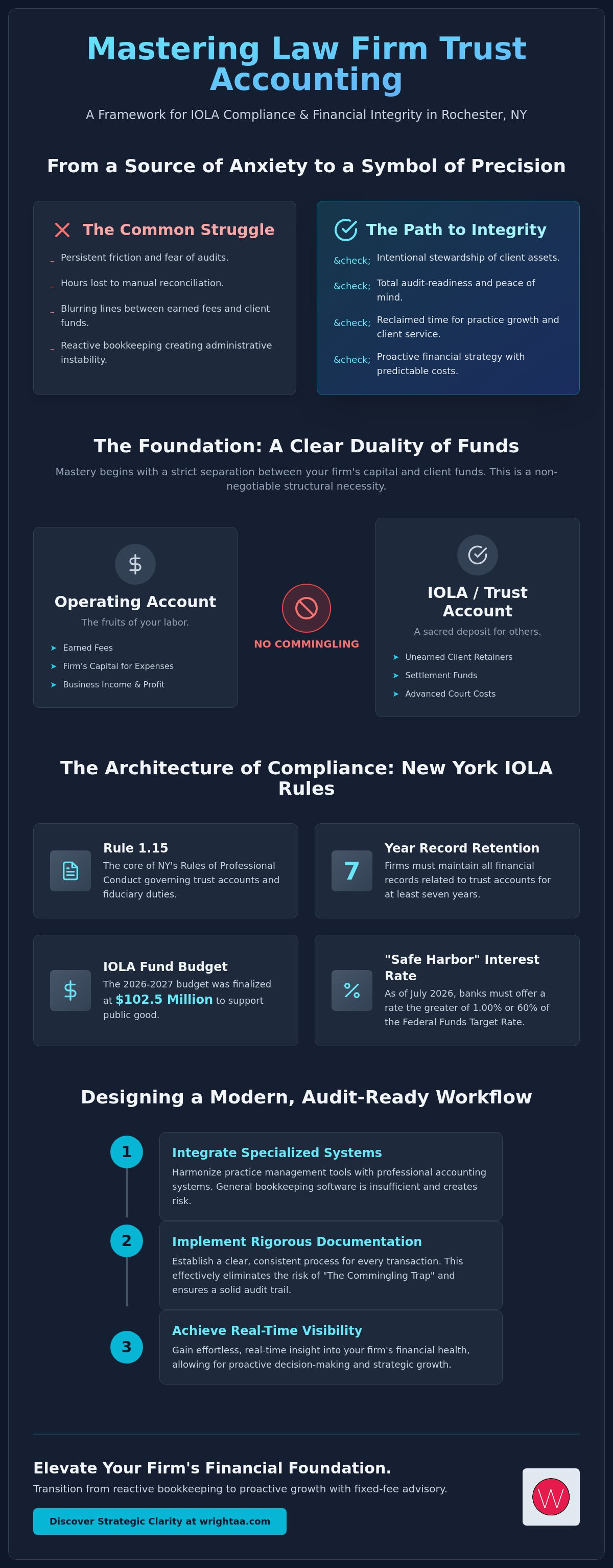
We believe that financial integrity is the quiet foundation of a lasting legal legacy. This guide provides a sophisticated framework for mastering IOLA compliance and reclaiming your time through financial intentionality. You'll gain a clear understanding of the 2026-2027 IOLA fund landscape, which recently finalized a budget of $102.5 million, and discover how to transition toward total audit readiness. We'll outline a path toward predictable, fixed-fee accounting costs and the strategic clarity necessary to support your firm's growth in an evolving regulatory environment.
Key Takeaways
- View trust accounting as the intentional stewardship of client assets, maintaining a clear duality between operating capital and unearned retainers.
- Navigate the specific requirements of the New York IOLA program to build a financial foundation that meets the highest ethical standards.
- Strengthen your firm’s resilience by implementing rigorous documentation processes for law firm trust accounting Rochester, effectively eliminating the risk of commingling.
- Design a modern workflow that harmonizes practice management tools with professional accounting systems for effortless, real-time visibility.
- Transition from reactive bookkeeping to proactive growth with fixed-fee monthly advisory retainers that offer predictable costs and strategic financial clarity.
The Intersection of Ethics and Architecture: Understanding Trust Accounting
A building stands because its internal logic is sound. In the legal profession, the trust account serves as that internal logic. It's the structural framework that supports every other aspect of a practice. We define trust accounting not merely as a ledger of transactions, but as the intentional stewardship of assets entrusted to the firm by those it serves. For law firm trust accounting Rochester, this stewardship requires a deep understanding of the duality between the firm’s operating capital and unearned client retainers. One represents the fruits of labor; the other is a sacred deposit waiting for the work to begin.
The Purpose of the Trust Account
The fiduciary duty inherent in holding client funds is a heavy mantle. In Rochester, attorneys act as temporary custodians for various forms of capital. This includes retainers for future services, settlement checks awaiting distribution, and advanced court costs. Each category requires precise placement and constant vigilance. Many of these funds are held within the Interest on Lawyers' Trust Accounts (IOLTA) program, where the interest generated serves the public good. Trust accounting is the foundational bedrock of legal financial ethics.
Why General Bookkeeping Fails Law Firms
Standard small business bookkeeping is designed to track income and expenses. It's a linear process focused on the bottom line. Legal accounting, however, is multidimensional. It requires a rigorous audit trail that most general systems aren't built to maintain. The danger of "The Commingling Trap" is real. Even a small error in transferring funds can lead to professional licensure issues in a New York practice. Standard software often lacks the safeguards to prevent these overlaps, leaving the firm vulnerable to structural collapse during an audit.
Relying on generalist tools creates gaps in your firm's integrity. To bridge these gaps, many practitioners seek specialized law firm accounting Buffalo NY expertise to ensure their systems are as robust as their legal arguments. When your financial structure is sound, you gain the freedom to build a practice that lasts. It's about creating a space where ethics and efficiency coexist in perfect balance.
The Architecture of Compliance: IOLTA Requirements in New York State
Compliance isn't a static state. It's a continuous alignment between your firm’s daily operations and the rigid standards defined by the New York State Bar Association ethics rules. In our region, the architecture of this compliance centers on the Interest on Lawyer Account (IOLA) program. While many practitioners use the universal term IOLTA, New York’s specific framework requires a nuanced approach to law firm trust accounting Rochester. It demands that you act as a precise filter, determining which funds are "qualified" for the pooled IOLA account based on their size and the duration they'll be held.
The technical requirements for IOLA accounts are specific. Banks in Western New York must elect a "Safe Harbor" interest rate option to remain eligible. As of July 2026, this rate must be the greater of 1.00% or 60% of the upper bound of the Federal Funds Target Rate. Beyond the banking relationship, the state mandates a rigorous record-keeping timeline. Under Rule 1.15(d) of the New York Rules of Professional Conduct, you must maintain all financial records related to trust accounts for at least seven years. This long-term storage is the structural memory of your firm’s integrity.
The Mechanics of IOLA
Interest generated from these pooled accounts doesn't benefit the firm or the client. Instead, it supports civil legal services across the state. The determination of "qualified funds" rests on your professional judgment. Generally, if funds aren't expected to generate at least $150 in interest, they're considered nominal or short-term. Selecting a participating "Safe Harbor" bank ensures that your practice contributes to the $102.5 million IOLA fund budget while remaining beyond reproach during an audit. Achieving this level of precision often requires a dedicated partner. Exploring law firm accounting services can transform this monthly obligation into a moment of strategic clarity.
3-Way Reconciliation: The Triple Check of Integrity
A standard two-way reconciliation only compares your bank statement to your check register. For a law firm, this is an incomplete structure. True integrity requires a three-way reconciliation. This process compares three distinct values:
- The Bank Balance: The actual cash held at the financial institution.
- The Book Balance: Your firm’s internal record of the total trust account balance.
- Individual Client Ledgers: The sum of every individual client’s funds held in trust.
If these three numbers don't match to the penny, the structure has a crack. A monthly cadence for this triple check is essential. It prevents small errors from becoming systemic failures. This discipline provides more than just audit readiness. It offers a sense of financial serenity that allows you to lead your firm with confidence.
Common Structural Failures in Rochester Law Firm Accounting
Structural failures are rarely the result of overt malice. They are the quiet accumulation of small, unobserved cracks. In the context of law firm trust accounting Rochester, these failures often stem from a lack of intentional systems rather than a lack of ethics. One of the most persistent issues is the "Bank Service Charge" nuance. Attorneys often forget that IOLA accounts cannot have bank fees deducted from client funds. If a bank pulls a monthly maintenance fee from the trust account, it creates an immediate shortfall. This technicality represents a breach of the fiduciary boundary, regardless of the dollar amount involved.
Inadequate documentation of disbursements further weakens the firm’s integrity. An audit trail must be clear and unbroken. When funds leave the trust account, the "why" and the "where" must be as visible as the amount itself. High-growth firms often fall into the trap of "DIY" accounting, viewing trust management as an administrative task to be handled in the margins. This approach carries a hidden cost. It diverts the intellectual energy of partners away from high-value legal work and toward the tedious mechanics of ledger balancing. It's a choice that prioritizes temporary convenience over permanent stability.
The Commingling Misconception
Accidental transfers are the most common trigger for NYSBA red flags. A partner might mistakenly use a trust check for a minor operating expense, intending to rectify the error immediately. This creates a "Commingling Trap" that is difficult to escape once the pattern begins. Beyond the regulatory risk, there's a significant psychological toll. Living with unorganized trust records creates a persistent background noise of anxiety that erodes professional focus. An audit-ready state is a permanent firm posture. It requires a commitment to keeping client funds and firm capital in entirely separate environments, both physically and mentally.
The Burden of Manual Processes
Manual ledger entry is subject to a relentless law of time-decay. As a Rochester practice grows, the sheer volume of transactions makes manual tracking nearly impossible to sustain with total accuracy. These manual errors eventually lead to "zombie balances"—small amounts of money that remain on the books long after a case is closed because the documentation trail has gone cold. Identifying these failures early requires a sophisticated level of oversight. Utilizing outsourced CFO services Buffalo NY provides the expert perspective needed to spot these systemic gaps. It's an investment in the structural health of the practice, ensuring that the firm's growth is supported by a foundation of absolute clarity.
Designing a Modern Trust Accounting Workflow
A well-designed space functions because every element serves a specific purpose. Your financial workflow is no different. For law firm trust accounting Rochester, the objective is to build a system where compliance is an inherent result of the process, not an afterthought. This requires selecting a "Taxonomy of Tools" that harmonizes with your firm's unique rhythm. It's about creating a bridge between your legal practice management and your professional accounting system. When these two environments communicate with precision, the risk of structural failure diminishes.
The implementation phase is where the CPA acts as a visionary guide. It isn't enough to simply install software. You must design the pathways through which information flows. A rhythmic month-end close process ensures that every transaction is accounted for before the next cycle begins. This steady cadence transforms a chaotic administrative burden into a predictable, manageable routine. It provides the clarity needed to make informed decisions about the firm’s future.
Technology as a Tool, Not a Master
Software is a material, not a blueprint. We often evaluate the synergy between Clio, QuickBooks Online, and the oversight provided by Wright CPAs. While Clio excels at managing the daily nuances of a legal case, QuickBooks Online serves as the repository for the firm's overall financial health. However, software alone cannot guarantee IOLA compliance. Expert oversight is the bond that holds these elements together. This is especially critical during a new business formation or a migration. Clean data migration for a new practice in Buffalo or Rochester is the foundation. If the initial data is flawed, the entire financial structure will remain unstable regardless of the tools used.
The Workflow of Intentionality
Intentionality in accounting means recording every movement of capital with absolute specificity. A modern workflow follows a deliberate sequence:
- Immediate Recording: Client deposits must be logged the moment they arrive, with clear attribution to the specific matter.
- Digital Check-and-Balance: All trust disbursements require a secondary review to ensure they align with the available client balance.
- Strategic Review: A monthly CFO-level analysis of financial kpis for small business ensures the trust account remains healthy and reconciled.
This sequence creates a closed loop of accountability. It moves the firm away from reactive bookkeeping and toward a model of financial mastery. If you're ready to elevate your practice with a system designed for growth, explore our specialized law firm accounting solutions today. We help you build a foundation that is as enduring as the law itself.
Wright CPAs: Elevating Law Firm Accounting in Rochester
Every enduring structure requires a master builder who understands the unique constraints of the site. At Wright CPAs, we provide that specialized oversight for law firm trust accounting Rochester. We don't view accounting as a back-office chore to be managed in the margins. We view it as a strategic pillar of your firm’s integrity. Our CFO-level guidance transforms compliance from a source of persistent friction into a distinct competitive advantage. It allows you to lead your practice from a position of absolute certainty, knowing the foundation is sound.
The transition from reactive bookkeeping to proactive financial stewardship requires a shift in perspective. We move beyond the simple recording of transactions to offer deep, contextual insights into your firm's health. This partnership ensures that your internal financial environment is as disciplined and refined as the legal strategies you craft for your clients. For dedicated practitioners such as Taylor & Associates Law, P.C. in Brooklyn, this level of organizational rigor is the bedrock of a successful immigration law practice. By establishing a permanent posture of audit readiness, we clear the path for sustainable growth and professional peace of mind.
The Predictability of Fixed-Fee Retainers
There is a quiet irony in law firms feeling the weight of the "billable hour" when managing their own internal finances. Our Fixed-Fee Monthly Accounting and Advisory Retainers eliminate this specific anxiety. This model provides a steady, rhythmic cost structure that brings transparency to your firm's overhead. Our comprehensive approach includes:
- Ongoing Bookkeeping: Maintaining a clean, continuous record of all operating and trust transactions.
- Tax Strategy and Planning: Aligning your firm’s success with proactive measures that minimize liability.
- Trust Oversight: Providing the expert "triple check" necessary to ensure IOLA compliance.
- CFO Services: Offering high-level financial clarity to guide your firm’s long-term evolution.
This model aligns our success with yours. By integrating Tax Planning and Cash Flow Management into a single, predictable retainer, we ensure your firm’s financial structure remains resilient across every season of the year.
A Partnership Rooted in Clarity
The Wright CPA approach is defined by deep listening and a commitment to the specific needs of the legal industry. We serve the legal communities of Rochester, Buffalo, and Syracuse with a focus on quality over spectacle. We understand the nuances of the New York State Bar requirements and the cultural context of practicing law in Western New York. Our goal is to design a financial structure that reflects your firm’s excellence and improves your daily professional life.
We invite you to begin a contemplative, unhurried conversation about your firm’s financial future. Together, we can build a foundation that is as permanent and thoughtful as the law itself. Reach out to us today to explore how our specialized Law Firm Accounting can elevate your practice.
The Blueprint for a Resilient Practice
A firm's financial health is the quiet scaffolding that allows its legal expertise to shine. We've explored how viewing trust accounting as intentional stewardship transforms a technical chore into a structural asset. By mastering the 3-way reconciliation and integrating a modern workflow, your practice achieves more than just audit readiness. It gains a foundation for sustainable growth and professional peace of mind. This clarity is the prerequisite for a legacy built on excellence and absolute transparency.
Mastering law firm trust accounting Rochester requires a commitment to precision and a partner who understands the unique nuances of New York's IOLA requirements. We provide specialized Law Firm Accounting expertise through Fixed-Fee Monthly Retainers that offer predictable costs and proactive Tax Strategy. Our CFO-level guidance ensures your financial environment is as disciplined as your legal counsel. This partnership allows you to focus on the law while we maintain the integrity of your financial architecture.
It's time to transition from reactive bookkeeping to visionary financial leadership. Design your firm’s financial future with Wright CPAs. We help you build a practice that is both grounded in ethics and inspired by purpose. Your firm deserves a foundation that is as enduring as the principles you defend every day.
Frequently Asked Questions
What is the most common trust accounting mistake for New York lawyers?
The most frequent error is the accidental commingling of funds, often occurring when bank service charges are deducted directly from a trust account. This creates a shortfall that violates the fiduciary boundary. It’s a structural flaw that can be avoided by ensuring the bank pulls all fees from the firm’s operating account instead of the client’s assets.
How often should a Rochester law firm perform a 3-way reconciliation?
A monthly cadence is the standard for law firm trust accounting Rochester. Performing a 3-way reconciliation every 30 days ensures that small discrepancies don't evolve into systemic failures. This rhythmic check maintains the alignment between your bank statement, internal book balance, and individual client ledgers, providing a clear view of your firm’s financial integrity.
Can I use a regular business checking account for client funds in New York?
No, you cannot use a standard business account for client funds. New York law requires these assets to be held in a specific attorney trust or IOLA account at an approved financial institution. These accounts are designed with unique protections and reporting structures that a general checking account lacks, ensuring client funds remain separate and protected.
What happens if I accidentally commingle funds in my Rochester IOLTA?
Accidental commingling must be corrected and documented immediately to preserve the firm’s integrity. While a single error doesn't always lead to disbarment, it can trigger a rigorous NYSBA audit if left unaddressed. It’s essential to have a clear trail of the corrective action to demonstrate your commitment to ethical stewardship and the proper handling of client capital.
Is it better to use a fixed-fee CPA or an hourly bookkeeper for my law firm?
A fixed-fee CPA offers a level of predictability and strategic depth that an hourly bookkeeper cannot match. Hourly models often discourage the deep, contemplative communication needed for effective tax planning. Our fixed-fee approach aligns our goals with yours, providing steady CFO-level guidance and law firm trust accounting Rochester oversight without the anxiety of the billable hour.
What records am I required to keep for a NYSBA trust account audit?
Rule 1.15(d) mandates that you maintain financial records for at least seven years. This includes checkbooks and stubs, bank statements, canceled checks, and detailed client ledgers showing every deposit and withdrawal. These documents form the permanent structural record of your practice, providing the necessary evidence of compliance during any regulatory review or audit.
Does Wright CPAs provide CFO services for small law firms in Rochester?
Yes, Wright CPAs provides specialized CFO services tailored to the needs of small and mid-sized law firms. We move beyond simple bookkeeping to offer strategic insights into cash flow and long-term growth. This high-level oversight ensures that your firm’s financial architecture remains as robust as your legal arguments, supporting both daily operations and future expansion.
How does IOLTA interest work in New York State?
Interest earned on pooled client funds in an IOLA account is automatically remitted to the New York State IOLA Fund. These funds support civil legal services for those in need across the state. It’s a system where the quiet growth of idle capital serves a broader humanitarian purpose, reflecting the intersection of legal ethics and social responsibility.


