

More revenue doesn’t always mean a more profitable business. Profitability is what remains after expenses are deducted from revenue, while cash flow tracks money moving into and out of the business. Understanding how to increase business revenue and profitability starts with seeing how these measures work together, rather than treating sales growth as the only sign of progress.
When growth is the goal, it’s natural to look for more clients and larger sales. But if the cost of delivering that growth rises just as quickly, the business may get busier without becoming more profitable. Reviewing margins, overhead, and cash timing helps show whether growth is strengthening the business or adding strain.
This article explains profitability and how to weigh it against revenue growth. It covers client expansion, upselling, overhead, and cash flow, so you can see how each decision affects the business’s overall financial picture.
Key Takeaways
- Use gross, operating, and net profit margins to see where revenue is being absorbed and where stronger performance can take shape.
- Assess whether new clients and upsells add profitable work, not simply more sales activity.
- Review recurring overhead and consider whether some costs can flex with demand instead of remaining fixed.
- Read the income statement alongside the cash flow statement to distinguish reported profit from available cash.
Revenue Growth and Profitability: Which Should Be Your Priority?
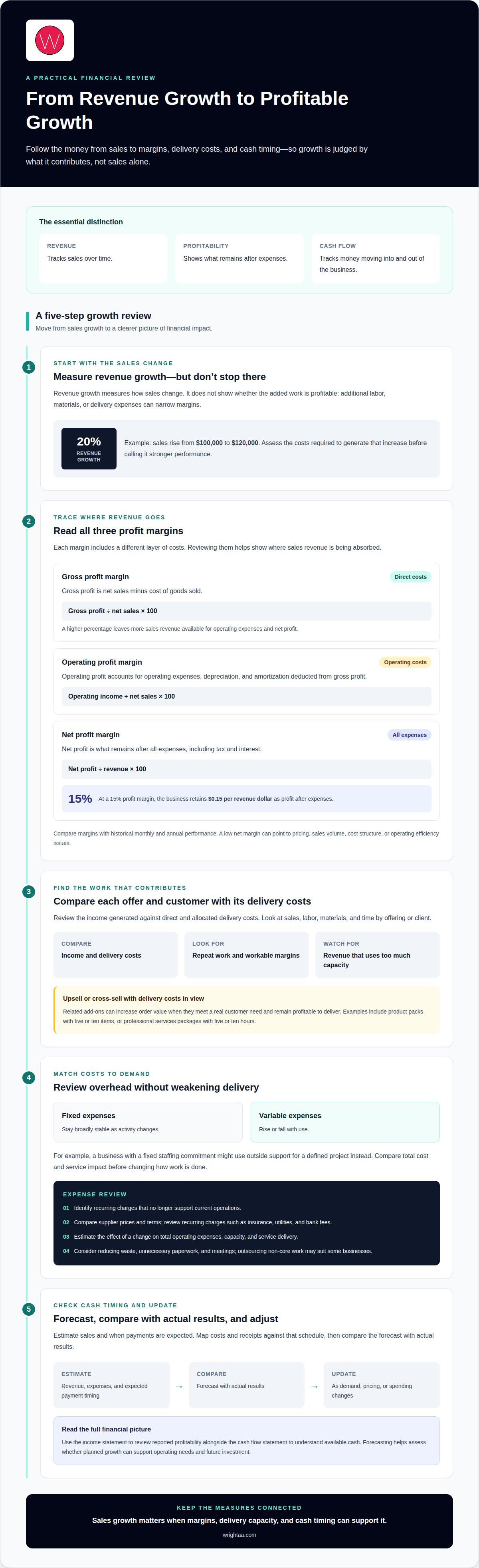
Revenue growth measures how sales change; profitability shows what remains after costs. A business that grows sales from $100,000 to $120,000 has revenue growth of 20%. That increase matters only alongside the costs required to generate it. A client may bring in more work, yet the additional labor, materials, or delivery expenses can narrow profit margins. Growth and profitability are connected, but they answer different financial questions.
Gross profit is revenue minus cost of goods sold. Gross profit margin expresses that amount as a percentage of net sales: subtract cost of goods sold from net sales, divide gross profit by net sales, then multiply by 100. A higher percentage leaves more sales revenue available for operating expenses and net profit.
To increase gross profit percentage, review pricing, direct costs, and the mix of products or services sold. Raising a price can increase gross profit if costs and sales volume stay steady. Reducing the cost of goods sold can have a similar effect. Compare offerings to identify which generate stronger gross profit and whether a high-volume item uses resources without contributing enough. These choices affect margins before general operating costs are included.
Operating profit accounts for operating expenses, depreciation, and amortization deducted from gross profit. Operating profit margin equals operating income divided by net sales, multiplied by 100. Net profit is what remains after all expenses, including tax and interest; net profit margin divides profit by revenue and multiplies by 100. At a 15% profit margin, a business retains $0.15 per revenue dollar as profit after expenses. Compare margins with historical monthly and annual performance. A low net margin can point to pricing, sales volume, cost structure, or operating efficiency issues.
Increasing revenue through client growth and upselling
Revenue growth increases sales, while profitable growth accounts for the resources needed to serve each new client. For owners considering how to increase business revenue and profitability, the key is to weigh demand against delivery capacity, costs, and expected income.
Balancing Growth With Profit Margins
Balancing growth with profit margins means pursuing additional sales without letting service costs consume the resulting income. Profitability can fund staffing, operations, and new opportunities. Before expanding, strengthen current markets and address weak sales, performance, or marketability. This helps build a sustainable base and protect the ability to deliver as demand changes.
Forecast revenue, expenses, and cash flow by estimating sales and when payments are expected, then mapping costs and receipts against that schedule. Compare the forecast with actual results and update it as demand, pricing, or spending changes. This helps owners assess whether planned growth can support operating needs and future investment.
Identifying Profitable Products and Customers
Identify profitable products, services, and customer segments by comparing the income they generate with the direct and allocated costs of delivery. Review sales, labor, materials, and time by offering or client. Then consider which segments generate repeat work and workable margins. This analysis can reveal revenue sources that use too much capacity and opportunities that contribute more consistently.
Upselling or cross-selling related add-ons can increase order value when they meet a real customer need and remain profitable to deliver. For example, a business might offer a product pack with five or ten items, or a professional services package with five or ten hours. Price each option with delivery costs in view. A measured approach to how to increase business revenue and profitability keeps customer value and business capacity in the same frame.
Rapid growth can strain staffing, service quality, and operating cash. Manage the risk by addressing weak areas, consolidating current markets, and forecasting expansion costs and timing before committing resources. CFO-level financial guidance can help connect growth plans with revenue, expenses, and cash-flow forecasts.
Converting fixed overhead expenses to variable expenses
A business can improve profit margins by cutting avoidable expenses, negotiating supplier terms, and matching some costs to actual demand. The goal isn’t simply to spend less. It’s to preserve operating capacity while improving efficiency and keeping costs aligned with revenue.
Fixed expenses stay broadly stable as activity changes, while variable expenses rise or fall with use. For example, a business with a fixed staffing commitment might use outside support for a defined project instead. That shifts some spending toward periods of demand, but compare the total cost and effect on service before changing how work is done.
Review suppliers and recurring expenses separately to identify potential savings. Compare supplier prices and terms periodically, then review recurring charges such as insurance, utilities, and bank fees. Calculate the effect of a proposed change on total operating expenses, not just its apparent monthly saving. A lower supplier price may offer little value if it creates additional costs elsewhere.
- Identify recurring charges that no longer support current operations.
- Compare supplier terms and seek better pricing where appropriate.
- Estimate how a cost change affects both capacity and service delivery.
Expense control can also reduce administrative effort. Cut unnecessary paperwork and meetings, and consider outsourcing non-core functions such as marketing or bookkeeping when that structure suits the business. These steps can make some costs more responsive to workload while freeing staff time for essential operations.
Reducing waste is another practical step. A retailer can remove obsolete inventory, a food business can reduce discarded ingredients, and an office can limit excess paper or plastic. Ask employees where work creates avoidable effort, then weigh any savings against changes in materials, processes, or service. Review the result alongside operating performance so cost reductions improve efficiency without weakening the work customers value.
Distinguishing profitability from cash flow
Profitability and cash flow describe different parts of a business’s financial health. An income statement shows revenue, costs, and expenses for a period; a cash flow statement tracks liquidity. A business can record a sale and recognize income before collecting payment. The sale may contribute to reported profit, while the delay leaves less cash available for payroll, suppliers, or other obligations.
That timing difference makes both statements important. An income statement measures whether operations generated profit over a period, commonly a year. A cash flow statement shows whether cash arrived in time to meet payments. Use the income statement to assess operating results, then compare cash receipts and payments to understand whether funds are available for upcoming obligations.
Accounting treatment can also change when income and expenses appear. In farm cash accounting, income and expenses are reported when products are sold or inputs are paid for. Accrual accounting reports farm income when products are produced and expenses when inputs are used. A tractor example illustrates the distinction: a $70,000 tractor depreciated over seven years records $10,000 per year as depreciation, rather than treating the full purchase as one year’s expense.
Loan principal creates another gap between profit and available cash. Principal payments are cash outflows, but they aren’t expenses; they transfer cash between the business and its lender. A business can therefore show a profit while making substantial loan payments. Track debt payments alongside expected receipts so cash needs don’t disappear from view in a profitable income statement.
A sound growth strategy reviews profitability and liquidity together. Compare actual cash movement with expected receipts, operating expenses, and planned investments for the same period. If profits are low, cash flow may weaken; if both deteriorate, the business can face a downward spiral. For a clearer view of how tax decisions affect the financial picture, discuss your tax strategy.
Wright CPAs
Wright CPAs, LLC helps business owners connect growth decisions with the financial details behind them. Bookkeeping provides a clearer view of revenue and expenses, while CFO Services can support planning for profitability, capacity, and cash flow. Tax Planning and Preparation and Payroll Services help integrate important financial obligations into the broader picture.
Consider working with Wright CPAs, LLC when rising sales, changing costs, or expansion plans make it harder to understand what growth is producing. A clearer financial view can help you weigh opportunities against operating needs and make informed decisions. Contact Wright CPAs, LLC to discuss the questions shaping your next stage of growth.
Shape Your Next Growth Decision
Make growth a deliberate financial choice. Before adding an offer, entering another market, or changing how work is delivered, connect the decision to the business’s capacity and priorities. A clear view of expected income, spending, and cash needs can help you choose a pace the business can support.
That’s the practical foundation for deciding how to increase business revenue and profitability: understand what each opportunity asks of the business, then weigh its contribution against the resources it requires. The right decision may be to expand, refine, or pause and strengthen the current model. What matters is choosing with financial clarity rather than pursuing sales growth alone.
Wright CPAs, LLC can help bring that clarity to planning and financial decisions through services including Tax Planning and Preparation, Bookkeeping, and Payroll Services. Contact Wright CPAs, LLC today to discuss the questions shaping your business’s next stage. A thoughtful decision now can give future growth a steadier foundation.
Frequently Asked Questions
What is profitability?
Profitability is a business’s ability to generate profit from its revenue and resources. It can be measured as an amount, such as net profit, or as a margin showing profit relative to revenue. A useful assessment looks beyond a single result: compare performance across periods and consider whether the business can sustain operations while funding its priorities.
Can a company grow without making a profit?
Yes. A company can increase sales, customers, or operations and still record a loss. Financing can help a business continue operating, but it does not itself make the business profitable. Owners should understand what is driving losses and whether planned growth can improve the underlying economics. Growth without a credible path to profitability can put financial stability at risk.
What are the most effective ways to increase business revenue?
Businesses can seek new customers, encourage repeat purchases, raise prices, or offer relevant additions to existing sales. They can also identify which sales channels perform better and direct effort toward those opportunities. The best approach depends on customer demand, delivery capacity, and the costs of serving each sale. Measure the effect on both revenue and profit, not sales alone.
How can pricing strategies increase revenue and profitability?
Pricing can support revenue and profit when it reflects customer value, direct costs, and allocated overhead. A business can use bottom-up pricing by adding its desired profit to those costs, then assess whether the resulting offer fits its market. Review how price changes affect sales volume and margins. A higher price may increase revenue per sale, but the overall effect also depends on customer response and delivery costs.
What are effective strategies for customer acquisition, retention, and upselling?
Attract customers whose needs fit the business’s offerings and service capacity. Before extending credit, assess a prospective customer’s creditworthiness and verify their identity and business legitimacy. Retention depends on delivering consistent value and responding to customer needs. Upselling works best when an additional product or service genuinely suits the customer and remains worthwhile after delivery costs.
Which financial metrics should businesses track to measure profitability?
Track gross, operating, and net profit margins to understand performance at different stages of expenses. Pair them with revenue growth and compare results with the business’s own monthly and annual history. Industry benchmarks can offer another point of comparison, but business models vary. Use the income statement to assess profitability, and review cash flow separately to understand liquidity and ability to meet payments.


