

The simpler accounting method may be the right starting point. For most landscaping companies with less than $5M in sales, cash-basis accounting is recommended, but the choice depends on how you need to understand work in progress, bills, and cash flow. Choosing accounting for landscapers in Rochester means weighing a clear view of cash movement against a fuller picture of income and expenses as they’re earned or incurred.
It makes sense to want books that are straightforward, especially when seasonal work and day-to-day operating costs pull your attention in different directions. This comparison explains how cash and accrual accounting differ, when each may fit a landscaping business, and how monthly bookkeeping, job costing, and financial reporting can shape the decision. You’ll also find a practical guide to matching the level of support to your company’s size and operating needs.
Key Takeaways
- Compare cash- and accrual-basis accounting to see which gives your landscaping business the clearest view of seasonal cash flow and outstanding work.
- Match monthly bookkeeping and job-cost tracking to your services so you can see where revenue and expenses accumulate.
- Understand how equipment depreciation and first-year deduction options may shape tax planning for vehicles, tools, fuel, and supplies.
- Plan payroll around seasonal staffing, worker classification, and required contractor reporting to keep administrative obligations in view.
Why should landscaping companies outsource monthly accounting?
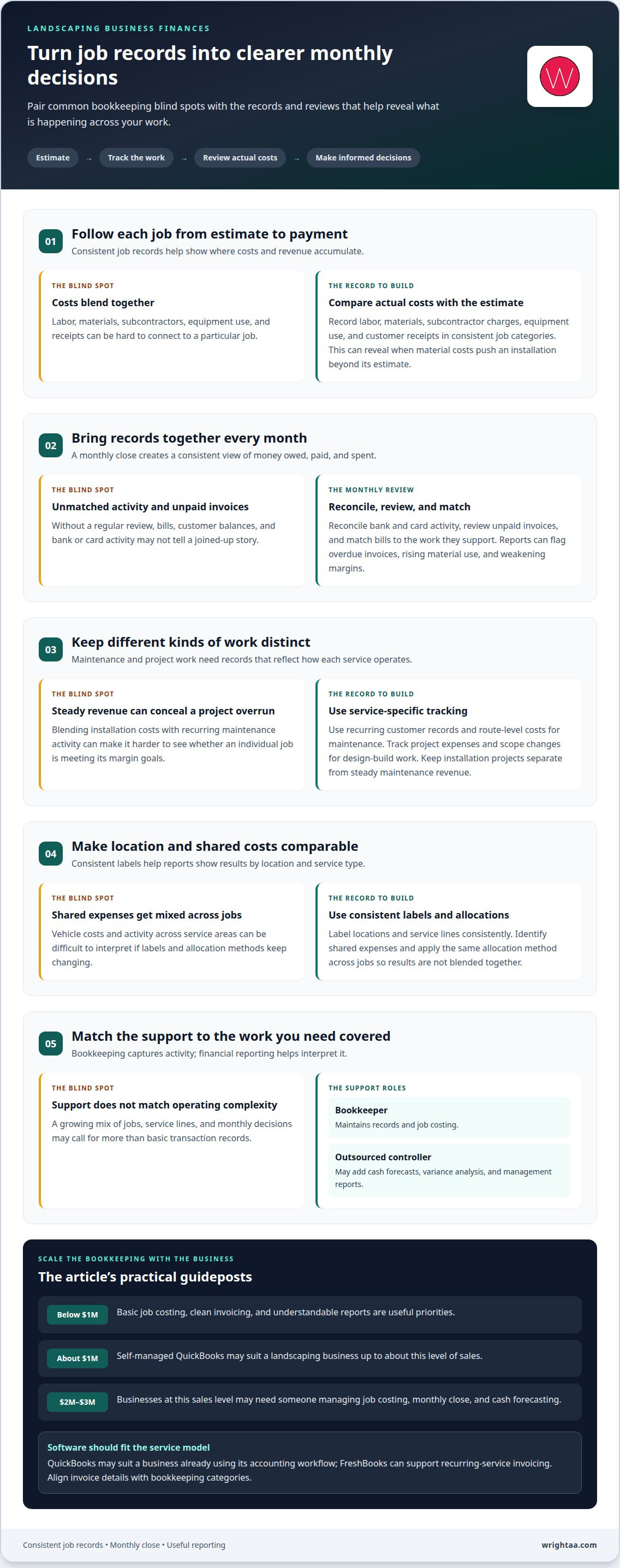
Landscaping businesses handle recurring maintenance, installations, and hardscape projects, each with different labor, equipment, and material costs. Specialized bookkeeping can track revenue and expenses by job, showing which services contribute most to profitability. For example, project records can reveal when material costs push an installation beyond its estimate.
Accounting firms can also organize bookkeeping, payroll records, and financial reports into a consistent monthly process. Clear reports help owners compare actual results with estimates, spot cash-flow pressure, and plan equipment decisions. For landscaping businesses below $1 million in revenue, basic job costing, clean invoicing, and understandable reports are useful priorities. Businesses with $2M to $3M in sales may need someone managing job costing, monthly close, and cash forecasting.
For a sole proprietor in New York, records typically focus on business income and expenses. LLCs and corporations benefit from keeping business transactions separate from owner activity. Corporations may also need more structured reporting for payroll and company decisions. Tax treatment depends on how the entity is set up.
Software can support that work, but integration matters. Self-managed QuickBooks may suit a landscaping business up to about $1M in sales. As operations expand, accounting support can connect job costs, payroll information, invoices, and reports into a useful monthly view. Missing required 1099 forms can also have consequences: according to the Internal Revenue Service, penalties start at $60 per form and climb to $310.
| Option | Best fit | Useful focus |
|---|---|---|
| Self-managed software | Simpler operations | Invoices and expense records |
| Bookkeeping support | More jobs or service lines | Monthly records and job costing |
| Outsourced controller | Growing operations | Close, forecasts, and decisions |
Match your accounting support to the records you need, the complexity of your jobs, and the work performed each month.
Bookkeeping and accounting services for landscapers
Useful bookkeeping follows each job from estimate through final payment. Record labor, materials, subcontractor charges, equipment use, and customer receipts in consistent categories, then compare actual costs with the estimate. For a Rochester landscaping business, this makes it easier to see whether a maintenance contract or installation project is meeting its margin goals.
A monthly close brings your records together. Reconcile bank and card activity, review unpaid invoices, and match bills to the work they support. A bookkeeper maintains the records, while an outsourced controller may add cash forecasts, variance analysis, and management reports. Bookkeeping captures activity; financial reporting helps you interpret it for business decisions.
Choose accounting software that fits your service model. Maintenance businesses may benefit from recurring customer records and route-level costs, while design-build work calls for project expense tracking and clear records of scope changes. QuickBooks may suit a business already using its accounting workflow, while FreshBooks can support recurring-service invoicing. Whichever system you use, align invoice details with your bookkeeping categories.
For recurring customers, use consistent service descriptions and billing schedules. Compare each invoice with the completed work before sending it, making missed charges and unpaid invoices easier to spot. Track installation projects separately so steady maintenance revenue does not conceal overruns on an individual job.
If your crews work across Rochester and nearby service areas, use consistent labels for locations and service lines. Identify shared expenses, such as vehicle costs, and apply the same allocation method across jobs. Reports can then show results by location and service type without blending them together, helping you review crew assignments, pricing, and expansion decisions.
Monthly reports can bring attention to overdue invoices, rising material use, or work with weakening margins. Structured monthly financial records can connect field activity with business decisions.
What tax deductions can Rochester landscapers claim for equipment, vehicles, fuel, and supplies?
Start an asset register for each mower, truck, trailer, and major tool. Record its purchase date, cost, business purpose, and date placed in service. Most landscaping equipment falls under five-year or seven-year depreciation schedules under IRS rules, depending on the asset classification. Keep purchase invoices with the register so each item has a clear record for tax preparation.
Section 179 and bonus depreciation may allow a landscaping business to deduct the full cost of equipment in year one. These options can change the timing of deductions, so compare the immediate tax effect with future-year depreciation. A new commercial mower, for example, should be reviewed alongside the company’s taxable income and cash needs before choosing a treatment.
For vehicles, keep records that connect each expense to business use. Track fuel, repairs, insurance, and registration by vehicle, and retain supporting receipts. If a truck is used for both business and personal purposes, keep records showing how it was used. This makes the expense trail clearer and helps distinguish business activity from personal use during tax preparation.
Track fuel purchases by vehicle or crew instead of combining them in one uncategorized account. For example, assign fuel receipts to the truck or equipment used on a job. Record seed, soil, mulch, and replacement parts under consistent categories. Clear descriptions help distinguish materials used on customer projects from equipment purchases recorded as assets.
Fuel tax rebates and incentives for sustainable practices may also be relevant to industry-specific tax planning. Keep fuel records and documentation of eligible practices together for review during tax planning. A practical year-end sequence is to reconcile asset purchases, match vehicle expenses to supporting records, categorize supplies, and identify potential incentives. Consistent documentation supports tax decisions, while separating recurring operating expenses from long-term equipment purchases makes reports easier to understand.
What payroll taxes and workers’ compensation requirements apply to landscaping businesses in Rochester?
Seasonal crews add complexity to payroll, scheduling, and tax administration. A landscaping business may have year-round employees, seasonal workers, and subcontractors. Keep each worker’s status and pay records distinct. Since classification affects how payments are recorded and handled, consistent documentation is important before payroll is processed.
For each pay period, organize hours, pay rates, overtime records, and work assignments. If a crew member works on maintenance and installation jobs, connect their time to the correct work. This supports accurate labor reporting by service line. Payroll services can also help coordinate federal, state, and local tax filing and compliance.
Subcontractor records need their own process. Collect a completed W-9 before the first payment, then retain payment details with the vendor file. Keep employee payroll separate from subcontractor expenses. This distinction supports tax reporting and makes year-end review more orderly. Avoid treating a worker’s label alone as the full classification decision; review the actual working arrangement.
Workers’ compensation administration also relies on clear workforce records. Maintain current employee details, job duties, payroll totals, and updates to seasonal staffing. For example, adding a crew for fall cleanup changes the payroll picture and should be reflected in your internal records. Keep related policy documents with payroll files so the information used for administration stays organized.
A practical monthly routine can reduce scattered records:
- Reconcile hours, rates, and overtime against payroll reports.
- Update employee and seasonal-worker details as crews change.
- File subcontractor W-9s and payment records separately.
- Review payroll totals alongside job and service-line reports.
Wright CPAs’ Payroll Services can help landscaping businesses organize payroll processing and reporting around changing crews. Explore payroll support when seasonal staffing makes records harder to manage consistently.
Wright CPAs: Law Firm Accounting
Wright CPAs helps landscaping business owners bring bookkeeping, payroll, and tax planning into a clearer financial routine. Monthly records can connect crew costs, customer payments, equipment expenses, and seasonal cash needs, giving you a more grounded view of your operations.
Consider this support when invoices, payroll records, and job expenses are difficult to reconcile, or when tax planning needs to account for equipment purchases and changing revenue. Bookkeeping maintains the underlying records; Tax Planning and Preparation supports tax decisions, while Payroll Services helps manage pay administration. Together, these services can support your business as its work and staffing evolve.
Law Firm Accounting serves a different industry. For a landscaping business, the relevant next step is to discuss bookkeeping, payroll, or tax planning. Contact Wright CPAs to talk about which area best fits your business.
Set a steadier course for the next season
Choose a monthly accounting routine that fits how your landscaping business operates. Decide which records need regular attention, who will maintain them, and what information you need to make operating decisions. A consistent process can leave you with more time to focus on the work taking shape outdoors.
Wright CPAs provides Bookkeeping, Payroll Services, and Tax Planning and Preparation to support different parts of your financial routine. For accounting for landscapers in Rochester, start with the area creating the most friction, whether that is keeping records current, managing payroll, or planning for taxes. Then align support with the financial questions your business needs to answer.
Start a conversation with Wright CPAs about your accounting and take a thoughtful next step toward clearer financial oversight.
Frequently Asked Questions
Why do I have to manage my cash flow during my off season?
Off-season cash flow matters because expenses may continue as customer income falls. Landscaping sales typically peak from April through October, then drop sharply in November. Map expected receipts and recurring obligations across the year, using prior sales history as a guide. This can help you schedule equipment purchases and discretionary spending around quieter months.
What accounting services do landscaping businesses in Rochester need?
Most landscaping businesses need bookkeeping that organizes income and expenses and makes job performance visible. Payroll support can help manage changing crews, while tax planning and preparation connect business records with tax decisions. The right combination depends on the work: a maintenance-focused company may prioritize recurring customer records, while a design-build firm may need clearer tracking of project phases and changes.
How should landscapers track job costs, materials, labor, and equipment?
Give each project a consistent identifier and use it across estimates, supplier receipts, crew time, and equipment records. When a crew moves between sites, record its hours against the work completed at each location. Allocate shared truck or equipment expenses consistently rather than leaving them unassigned. At project close, compare actual figures with the estimate and note approved scope changes.
What financial reports and bookkeeping practices help manage seasonal landscaping cash flow?
A rolling cash forecast, income statement, and accounts-receivable aging report offer complementary views. The forecast maps expected receipts against upcoming obligations, the income statement shows operating performance, and receivables highlight outstanding customer balances. Update assumptions as booked work and payment timing change. Comparing forecast results with actual bank activity can help you spot a shortfall early enough to adjust planned spending.
How can I find and compare accountants for landscapers in Rochester, NY?
When choosing accounting support, compare the work covered: routine bookkeeping, payroll, tax planning, and reporting that separates maintenance from installation activity. For Rochester businesses, also consider whether the firm understands seasonal operations and can explain reports in terms of business decisions. Wright CPAs serves businesses in Rochester, Buffalo, and Syracuse, offering Bookkeeping, Payroll Services, and Tax Planning and Preparation.


