

Why does a firm with record-breaking revenue often feel as though its foundation is thinning when tax season arrives? For many partners, the answer isn't found in the courtroom but in the quiet, often overlooked architecture of their financial strategy. Effective tax planning for law firms Buffalo requires more than reactive filing. It demands a deliberate design that anticipates the unique rhythms of contingency fees and the precision required for IOLTA compliance. It's frustrating to see strong revenue diminished by high liabilities and unpredictable cash flow.
This article explores how proactive tax strategies and structural financial clarity can transform your practice from a reactive entity into a high-performance firm. You'll discover how to leverage New York State PTET benefits and find the stability offered by predictable, fixed-fee accounting models. We'll examine the shift from year-end damage control to intentional, year-round planning, ensuring your firm's financial health is as permanent and thoughtful as the counsel you provide. We will guide you through the essential components of a modern tax framework tailored specifically for the Western New York legal community.
Key Takeaways
- Understand the vital distinction between looking back at historical data and the forward-looking intentionality of tax planning for law firms Buffalo.
- Identify how structural choices like entity selection and QBI optimization act as the architectural framework for your firm's financial efficiency.
- Gain clarity on New York State specific opportunities, including the PTET, to ensure your practice remains both compliant and highly performant.
- Replace the anxiety of the annual tax rush with a steady, unhurried monthly advisory rhythm and the predictability of fixed-fee accounting.
- Learn how a disciplined onboarding process can transform messy financial records into a clear, curated landscape that supports your firm's growth.
Beyond Compliance: The Necessity of Specialized Tax Planning for Law Firms
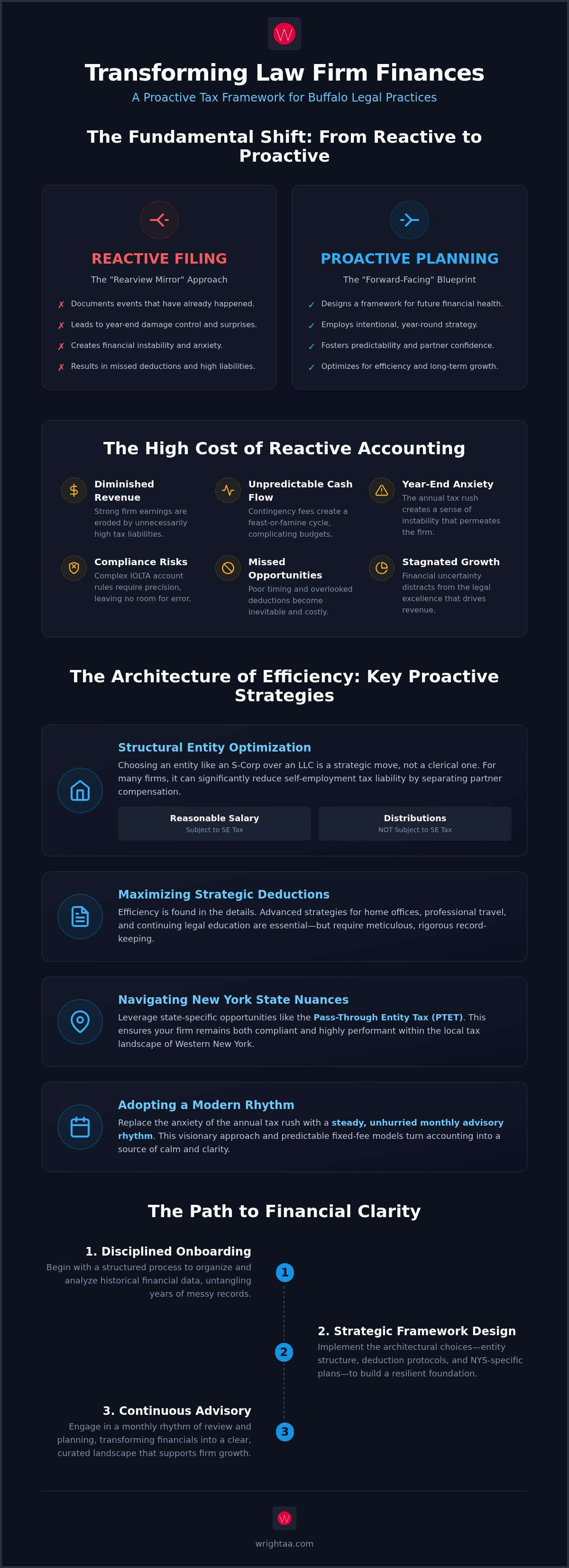
Financial intentionality is the cornerstone of a resilient practice. Most firm partners view the tax season as a recurring storm to be weathered rather than a landscape to be designed. There is a profound distinction between tax preparation and tax planning. Preparation is a rearview mirror; it simply records what has already transpired. Effective tax planning for law firms Buffalo is a forward-facing exercise. It's the difference between documenting a collapse and ensuring structural integrity before the first stone is laid.
Law firms face unique pressures that other professional services rarely encounter. The erratic pulse of contingency fees can create a feast-or-famine cycle that complicates traditional budgeting. Managing IOLTA accounts requires a level of precision that leaves no room for error. When these complexities are met with silence or generic advice, the emotional weight of financial uncertainty begins to settle. This burden often distracts from the very legal excellence that drives firm revenue.
The High Cost of Reactive Accounting
A reactive stance is expensive. When accounting is merely an annual event, missed deductions and poor timing become inevitable. These aren't just line items; they are the erosion of partner distributions. Tax surprises at the end of the fiscal year create a sense of instability that permeates the entire firm. The books should provide a sense of calm. Without a proactive strategy, the firm remains in a perpetual state of defense. True financial clarity allows a partner to lead with confidence, knowing the foundation is secure. It's about reclaiming the mental space needed to solve complex legal problems.
A Visionary Approach to Firm Finances
A strategic partner does more than fill out forms. While a basic U.S. Tax System Overview provides a foundation for any business, law firms operate within a more complex environment. Generic tax advice fails because it doesn't account for the specific cash flow cycles of a litigation practice or the nuances of New York State regulations. This is where the role of a CPA for law firms Buffalo NY shifts from record-keeper to strategic architect.
We believe in a deliberate, unhurried advisory rhythm. By integrating tax planning for law firms Buffalo into your monthly operations, the annual rush is replaced by steady progress. This visionary approach ensures that every financial decision aligns with the firm's long-term goals. It's not just about the current fiscal year. It's about building a legacy of financial health that supports the firm's growth for decades to come.
The Architecture of Efficiency: Key Tax Strategies for Buffalo Legal Practices
A firm's financial health depends on its underlying framework. Just as a building requires a foundation suited to its site, tax planning for law firms Buffalo requires a structure tailored to the local legal landscape. We don't settle for default configurations. We look for the intentional placement of every financial element to ensure the practice remains both resilient and efficient.
Structural Entity Optimization
The choice between an S-Corp and an LLC is more than a clerical decision. It's a strategic maneuver that dictates your relationship with the New York State Tax Guide for Businesses. For many Buffalo firms, transitioning to an S-Corp can significantly reduce self-employment tax liability by separating partner compensation into salary and distributions. This distinction is vital. You can explore a deeper analysis of these choices in our guide on S-Corp vs. LLC: Tax Implications in New York State. Every entity has its own silhouette; the goal is to find the one that minimizes friction with state and federal requirements.
Maximizing Deductions for the Modern Practice
Efficiency is found in the details. Advanced strategies for home offices, professional travel, and continuing legal education aren't just perks. They're essential components of a proactive tax strategy. However, these deductions require a rigorous record-keeping process. Meticulous law firm bookkeeping services Buffalo ensure that no reimbursable expense is lost to the passage of time. Utilizing modern technology allows for the seamless capture of costs that might otherwise erode your bottom line.
Timing is equally critical. In years where contingency fees create a surge in revenue, accelerating necessary expenses or shifting income can balance the scales. Integration of retirement plans serves as a powerful vehicle for tax reduction. For 2026, employee contribution limits for 401(k) plans have reached $24,500, with catch-up contributions for those over 50 adding another $8,000. Additionally, Qualified Business Income (QBI) optimization allows partners to potentially deduct up to 20% of their business income, provided the firm's structure is designed to meet specific IRS thresholds. If you're ready to refine your firm's financial design, you might consider how tax planning for law firms Buffalo can clarify your path forward through professional tax strategy.
Proactive Strategy vs. Reactive Filing: A Framework for Firm Partners
The transition from a reactive posture to a proactive strategy is a shift in a firm's fundamental rhythm. Many partners are accustomed to the annual tax rush, a period of high friction where documents are gathered in haste and decisions are made under pressure. This approach is inherently flawed. It treats the tax return as a final, unchangeable verdict rather than a manageable outcome. By contrast, a monthly advisory cadence allows for a steady, unhurried walkthrough of the firm's financial landscape. This year-round oversight is particularly vital for maintaining the rigorous standards of IOLTA compliance, ensuring that trust accounting errors are caught and corrected long before they become systemic failures.
The Fixed-Fee Advantage
Traditional accounting models often mirror the legal industry's own billable hour, creating a natural friction between the CPA and the attorney. When every question carries a price tag, communication suffers. We prefer a fixed-fee monthly retainer model. This structure eliminates the hesitation to seek guidance and ensures that your financials are tax-ready every single month. It's an essential component of small business accounting Buffalo NY, providing the overhead predictability that partners need to make informed decisions. Ongoing bookkeeping becomes the steady pulse of the firm, allowing tax planning for law firms Buffalo to happen in real-time rather than in retrospect.
CFO-Level Financial Guidance
True financial intentionality requires looking beyond the tax line. By integrating outsourced CFO services Buffalo NY into your planning, you gain access to a deeper level of analysis. We examine firm-specific KPIs, such as realization rates and average case values, to drive strategic tax decisions. This intersection of cash flow management and tax liability is where firm growth is designed. Instead of asking "What do I owe?" at the end of the year, partners begin to ask "How can we grow?" This shift in perspective transforms the accounting function from a necessary expense into a strategic asset. It allows for the deliberate allocation of resources toward expansion, hiring, or improved partner distributions, all within a framework of total financial clarity.
This disciplined approach ensures that tax planning for law firms Buffalo is not a seasonal event but a permanent structural feature of the practice. By removing the billable hour barrier, we foster a relationship built on deep listening and contextual awareness. The result is a firm that moves with purpose, guided by data and protected by a robust, proactive financial design.
Navigating New York State Nuances: Local Tax Considerations for WNY Firms
The landscape of New York taxation is a complex topography, shaped by both state legislation and the specific climate of Western New York. For a practice to thrive, its financial strategy must be rooted in its geographic context. General advice often ignores the subtle shifts in the terrain that occur when moving between jurisdictions. Effective tax planning for law firms Buffalo requires a deep understanding of these local variables, ensuring that the firm's structure is resilient enough to withstand the weight of state-level requirements while capturing every available incentive.
The PTET Opportunity for WNY Partners
The New York State Pass-Through Entity Tax (PTET) represents a significant architectural shift in how law firm partners manage their tax liability. This optional tax serves as a deliberate workaround for the federal $10,000 cap on state and local tax (SALT) deductions. By electing to pay tax at the entity level, partners can effectively deduct their state taxes on their federal returns, a maneuver that reclaims value that would otherwise be lost. The PTET is a strategic tool that allows Buffalo law partners to optimize their personal tax profiles through the firm's collective structure.
For the 2026 tax year, firms must be mindful of the rigorous election deadlines and the rhythm of estimated payments. S-corporations and partnerships generally must make this election by March 15. Maintaining this pace requires foresight. Quarterly estimated tax payments for 2026 are due on or before April 15, June 15, and September 15, with the final payment due by January 15, 2027. Missing these markers can disrupt the firm's cash flow and lead to unnecessary friction with the state.
Western New York Economic Context
Buffalo's business environment has its own specific requirements. The combined sales and use tax rate in the city stands at 8.75%, a figure that includes both the 4% state rate and the 4.75% Erie County rate. Additionally, non-homestead properties in Buffalo face a combined city and school tax rate of $14.442589 per $1,000 of assessed valuation for the 2026-2027 period. These local costs are not merely line items; they are the environmental conditions under which your firm operates.
Compliance becomes even more nuanced for multi-office firms with footprints in Rochester or Syracuse. Each location brings its own set of local considerations and residency impacts for partners. A partner's primary residence can significantly alter their tax obligations, making it vital to have a unified strategy that accounts for these individual differences. Staying ahead of evolving New York State tax legislation requires a partner who understands the intersection of traditional accounting and modern legal practice. To ensure your firm is positioned for long-term health, you can explore our tax planning services designed specifically for the Western New York legal community.
Cultivating Clarity: How Wright CPAs Partners with Buffalo Law Firms
The transition from financial clutter to architectural clarity requires a steady hand. At Wright CPAs, LLC, we view the bookkeeping and tax structure of a practice not as a chore, but as a thoughtfully designed environment. Effective tax planning for law firms Buffalo begins with a period of deep listening. We don't rush the process. Instead, we move logically from broad goals to specific material details, ensuring your firm's foundation is built to support long-term growth. Messy books are a common point of entry, but they don't have to be your firm's permanent state.
The Wright CPAs, LLC Methodology
Our methodology is rooted in the monthly retainer model, which fosters a continuous, unhurried dialogue. We design a custom tax roadmap that reflects the specific geographic and cultural context of your Buffalo practice. This is not about loud marketing or empty spectacle. It's about the substance of your distributions and the resilience of your cash flow. We prioritize quality over quantity, providing the visionary guidance needed to move beyond reactive filing into a state of financial intentionality. By integrating with your existing legal and administrative teams, we provide holistic support that feels both professional and evocative.
Starting the Conversation
The first steps toward a more intentional future begin with a quiet, focused conversation. During our initial financial strategy consultation, we conduct a narrative walkthrough of your current books and tax history. We look for the dualities between your internal operations and the external regulatory environment. You'll gain a sense of trust as we identify the structural interventions needed to improve your daily life as a partner. Preparing for this shift requires only a commitment to transparency and a desire for excellence. We are here to help you move from a state of anxiety to one of calm, purposeful leadership. When you are ready to refine the architecture of your practice, we invite you to book your consult for law firm accounting Buffalo NY.
Designing a Permanent Foundation for Growth
A firm's financial health is rarely a product of chance. It is the result of a deliberate, architectural approach to every distribution and deduction. We've explored how moving from reactive filing to proactive tax planning for law firms Buffalo allows partners to reclaim their mental space and focus on legal excellence. By utilizing a specialized law firm financial architecture and the predictability of fixed-fee monthly retainers, you can eliminate the friction of the billable hour and replace it with steady, visionary guidance.
Navigating the nuances of the local landscape, from Erie County sales tax to a proactive NYS tax strategy like the PTET, ensures your practice remains both compliant and highly performant. This intentionality is what separates a firm that merely survives from one that leaves a lasting legacy in the Western New York community. It's time to move beyond the anxiety of the fiscal year-end and step into a curated financial future.
Design your firm’s financial future with Wright CPAs. We look forward to helping you build a practice that is as resilient and thoughtful as the counsel you provide.
Frequently Asked Questions
How does the NYS Pass-Through Entity Tax (PTET) benefit Buffalo law firm partners?
The NYS PTET allows Buffalo partners to bypass the federal $10,000 SALT deduction cap. By electing to pay taxes at the entity level, the firm creates a federal deduction for state taxes paid. This structural maneuver reclaims value that would otherwise be lost to the federal government. It's a deliberate tool for enhancing partner distributions while maintaining compliance with New York's rigorous tax landscape.
What is the difference between tax preparation and tax planning for a law practice?
Tax preparation is a retrospective exercise that records what has already happened. In contrast, tax planning is a forward-facing design process. It involves making intentional decisions throughout the fiscal year to shape your final liability. Effective tax planning for law firms Buffalo transforms the tax return from an unpredictable verdict into a manageable, planned outcome. It's the difference between documenting a structure's collapse and ensuring its integrity from the start.
Can proactive tax planning help with law firm cash flow management?
Proactive planning is essential for stabilizing the feast-or-famine cycles common in litigation practices. By anticipating tax liabilities well in advance, partners can manage their cash reserves with greater precision. This foresight prevents the sudden drain on liquidity that often occurs when reactive firms face unexpected tax bills. It creates a serene financial environment where cash flow is a predictable resource rather than a source of constant anxiety.
What are the most common tax deductions for law firms in Western New York?
Law firms in Western New York often overlook deductions for home office use, professional travel, and continuing legal education. Partners can also leverage retirement plan contributions and QBI deductions to lower taxable income. For 2026, the 401(k) employee contribution limit is $24,500. Capturing these costs requires meticulous record-keeping, ensuring that every firm expense is intentionally placed to minimize the overall tax burden on the practice.
How often should a law firm meet with their CPA for tax planning?
A law firm should meet with their CPA on a monthly basis to maintain financial intentionality. This steady, unhurried advisory rhythm allows for real-time adjustments as case loads and revenues shift. Waiting until the end of the year results in missed opportunities and high-pressure decision-making. Monthly check-ins ensure that the firm's financial architecture remains sound and that the partners are always prepared for upcoming obligations.
Is a fixed-fee accounting model better for law firms than hourly billing?
A fixed-fee model is typically better because it eliminates the billable hour friction that often hinders communication. Partners can ask questions and seek guidance without the fear of an unpredictable invoice. This model provides structural clarity for the firm's overhead and fosters a deeper, more collaborative relationship between the attorney and the CPA. It aligns the interests of both parties toward the long-term health of the practice.
How does Wright CPAs ensure IOLTA compliance through tax planning?
We ensure IOLTA compliance by integrating trust account oversight into our monthly bookkeeping and tax planning for law firms Buffalo. By performing regular three-way reconciliations, we catch and correct discrepancies before they become systemic issues. This disciplined approach to trust accounting is a permanent structural feature of our service. It provides partners with the peace of mind that their professional standing is protected through rigorous financial design.
What documents do I need to begin a tax planning engagement for my firm?
To start, you'll need your firm's prior-year tax returns, current year-to-date profit and loss statements, and your most recent balance sheet. We also review payroll records and entity formation documents to understand your current financial framework. This initial collection of materials allows us to conduct a thorough narrative walkthrough of your firm's history. It's the first step in designing a more intentional and resilient financial future for your practice.


